
相关资源
探索丰富的全球公民教育资源,深化理解,促进研究、倡导、教学与学习。
共找到3,182条结果
 Enforcing the right to education of refugees: a policy perspective 出版年份: 2019 机构作者: UNESCO This paper, aimed at education policymakers, provides analysis and insights on how the right to education for refugees could be ensured from a policy perspective. It does so by reviewing the current status of access to education of refugees, using the scant data that is available in this area. It also outlines some of the extensive barriers to education that refugees face, with recognition of the multifaceted, interlinked and complex nature of exclusion. It provides an overview of the international normative frameworks and global agendas on education that can be applied to refugees to ensure their right to education and achieve SDG 4. Additionally, this document presents practical examples, good practices, and promising measures taken by countries in order to ensure the inclusion of refugees in their national systems and better guarantee the fulfilment of their right to education. As a result of this research, collaboration and the invaluable contributions from the participants in a dedicated Expert Meeting in Barcelona (2018), a set of policy recommendations are provided in the last chapter which aims to guide policymakers to ensure equal access to good quality education for refugees.
 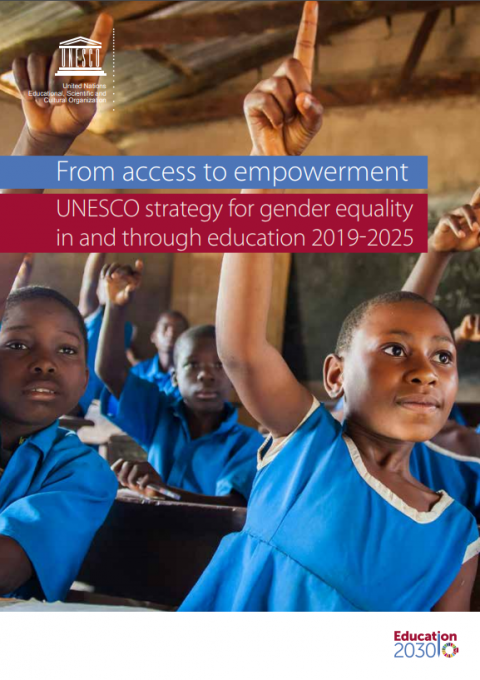 From access to empowerment: UNESCO strategy for gender equality in and through education 2019-2025 出版年份: 2019 机构作者: UNESCO Gender bias still permeate the entire education system in some settings and is often perpetuated rather than questionned. This includes the absence of women as leaders in textbooks, to differential expectations of boys and girls by teachers, to school policies that put pregnant girls at the door rather than respecting, protecting and fulfilling their right to education. This Strategy focuses on system-wide transformation to benefit all learners and targeted interventions to support girls’ and women’s empowerment. It offers three clear lines of action: better data to inform action for gender equality in and through education, better legal, policy and planning frameworks to advance rights, and better teaching and learning practices to empower. De l’accès à l’autonomisation: stratégie de l’UNESCO pour l’égalité des genres dans et par l’éducation 2019-2025 出版年份: 2019 机构作者: Organisation des Nations Unies pour l'éducation, la science et la culture (UNESCO) Les préjugés de genres continuent d’imprégner l’ensemble du système éducatif et sont souvent perpétués au lieu d’être contestés. Ces derniers vont de l’absence de leaders féminins dans les manuels scolaires, aux attentes différentes des enseignants concernant les filles et les garçons, en passant par les politiques scolaires qui excluent les filles enceintes au lieu de les respecter, de les protéger et de garantir leur droit à l’éducation. Cette stratégie met l’accent sur la transformation à l’échelle du système au profit de tous les apprenants, et sur des interventions ciblées pour soutenir l’autonomisation des filles et des femmes. Elle propose trois thématiques prioritaires distincts : meilleures données pour éclairer l’action ; meilleurs cadres juridiques, politiques et de planification pour faire progresser les droits ; et meilleures pratiques d’enseignement et d’apprentissage pour autonomiser.
 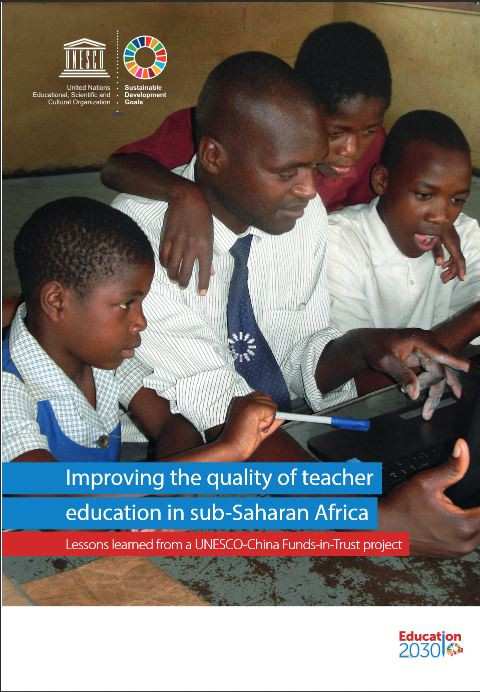 Improving the quality of teacher education in Sub-Saharan Africa: lessons learned from a UNESCO-China Funds-in-Trust project 出版年份: 2018 机构作者: UNESCO The booklet describes how the project started, the choice of beneficiary countries, the implementation strategies and its achievements. The different sections numbered one to four describe particular aspects of the project, using country cases to illustrate how the success of the project was due to strong country ownership and leadership. UNESCO, in partnership with the Government of the People’s Republic of China, initiated the project to enhance the institutional capacity and the professional development of teacher educators through ICT-supported learning, teaching and research. This technology aided the transformation of capacity teacher training through digitalization of instructional materials.
 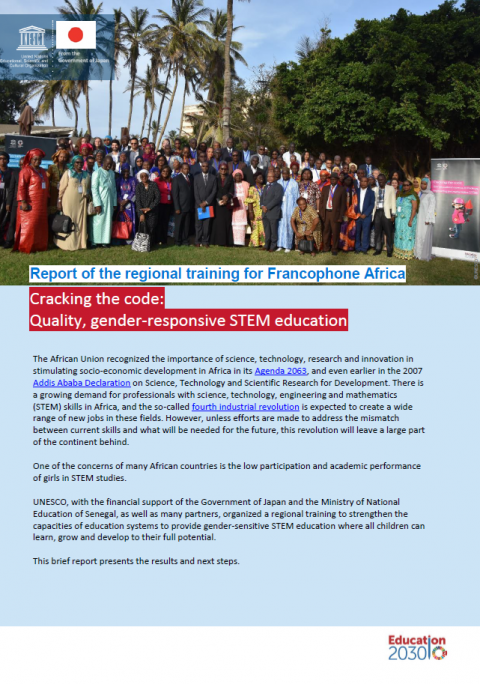 Report of the regional training for Francophone Africa, cracking the code: quality, gender-responsive STEM education 出版年份: 2019 机构作者: UNESCO The African Union recognized the importance of science, technology, research and innovation in stimulating socio-economic development in Africa in its Agenda 2063, and even earlier in the 2007 Addis Ababa Declaration on Science, Technology and Scientific Research for Development.There is a growing demand for professionals with science, technology, engineering and mathematics (STEM) skills in Africa, and the so-called fourth industrial revolution is expected to create a wide range of new jobs in these fields. However, unless efforts are made to address the mismatch between current skills and what will be needed for the future, this revolution will leave a large part of the continent behind.One of the concerns of many African countries is the low participation and academic performance of girls in STEM studies. UNESCO, with the financial support of the Government of Japan and the Ministry of National Education of Senegal, as well as many partners, organized a regional training to strengthen the capacities of education systems to provide gender-sensitive STEM education where all children can learn, grow and develop to their full potential. This brief report presents the results and next steps.
 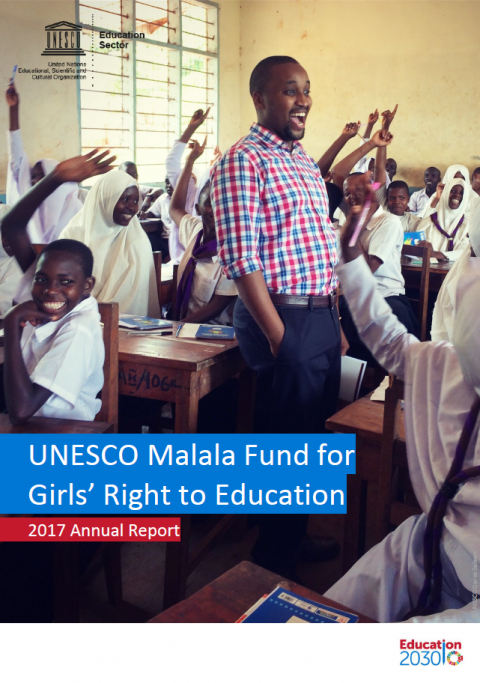 UNESCO Malala Fund for Girls' Right to Education: 2017 annual report 出版年份: 2018 机构作者: UNESCO The brutal assassination attempt made against Pakistani teenager and activist for girls’ education Malala Yousafzai gave birth to the UNESCO Malala Fund for Girls’ Right to Education. Part of the “Better Life, Better Future” Global Partnership for Girls’ and Women’s Education, the fund was established in 2012 to expand girls’ access to quality and gender-responsive education and ensure safe learning environments, especially in countries affected by conflict and disaster. The Islamic Republic of Pakistan initially committed 10 million USD to the Fund, and since 2014 the CJ Group is another major contributor to the Fund, along with other supporters.Fund objectivesThe Fund supports the implementation of holistic programmes which aim to: Expand access to education for girls and women, especially those hardest to reach and affected by conflict and disaster Improve the quality and relevance of education, ensuring that content, teaching practices, learning processes and environments are gender-sensitive Strengthen policy and capacity to ensure safe learning environments
 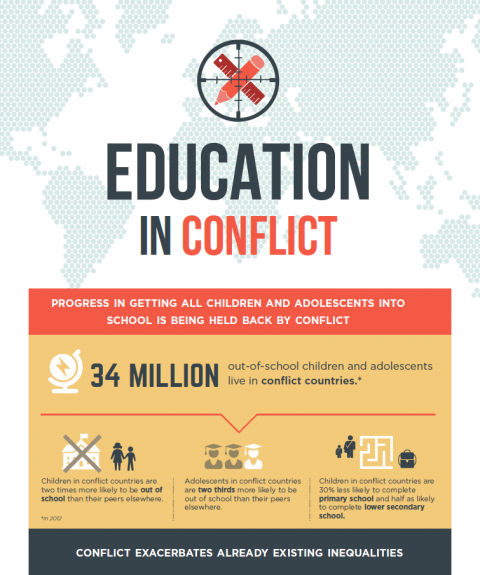 EDUCATION IN CONFLICT 机构作者: EFA Global Monitoring Report Team | UNESCO PROGRESS IN GETTING ALL CHILDREN AND ADOLESCENTS INTO SCHOOL IS BEING HELD BACK BY CONFLICT - 34 million out-of-school children and adolescents live in conflict countries. - Children in conflict countries are two times more likely to be out of school than their peers elsewhere.- Adolescents in conflict countries are two thirds more likely to be out of school than their peers elsewhere.- Children in conflict countries are 30% less likely to complete primary school and half as likely to complete lower secondary school.- Girls are almost two and a half times more likely to be out of school if they live in a conflict country than those elsewhere.- Adolescent girls are almost 90% more likely to be out of secondary school than young women elsewhere.- The poorest children in conflict countries are twice as likely to be out of school as the poorest elsewhere.
  Education for Sustainable Development: Partners in Action; Global Action Programme (GAP) Key Partners' Report (2015-2018) 出版年份: 2019 机构作者: UNESCO The Global Action Programme (GAP) on Education for Sustainable Development (ESD) was launched by UNESCO as a follow up to the United Nations Decade of ESD in order to accelerate progress on sustainable development and scale up action in all areas of education and learning. Its duration is from 2015 to 2019.To that end, UNESCO works with a network of 97 GAP Key Partners from government, civil society, the private sector and academia active in five Priority Action Areas: advancing policy, transforming learning environments, building the capacity of educators, empowering youth, and accelerating sustainable solutions at the local level. Each GAP Key Partner committed to meet specific targets by 2019. To measure progress in meeting the targets set by the GAP Key Partners, 10 indicators were identified, two in each Priority Action Area. Through surveys sent to them by UNESCO, GAP Key Partners report against these 10 indicators and toward the targets set for each indicator. In the surveys, GAP Key Partners are also invited to rate the benefits of participation in the GAP for their work and provide qualitative data concerning their implementation progress. Three progress reports are scheduled to be produced: The first report, covering progress between 2015 and 2016, was released by UNESCO in 2017 This second report, covering 2015-2018, is to be published in 2019 The third and final report, covering the entire period of the GAP, 2015-2019, will be published in 2020 This second report presents the results of the GAP Key Partners survey carried out at the end of 2018, with a response rate of 78%. The report presents the analysis of the quantitative responses of GAP Key Partners to each of the 10 indicators. Based on the qualitative responses provided by the GAP Key Partners, a short comment on each of the progress status is also provided. Éducation en vue du développement durable: Partenaires dans l’action; Rapport des partenaires clés du Programme d’action global (2015-2019) 出版年份: 2019 机构作者: Organisation des Nations Unies pour l'éducation, la science et la culture (UNESCO) Le Programme d’action global pour l’éducation en vue du développement durable (EDD) a été lancé par l’UNESCO dans le cadre du suivi de la Décennie des Nations Unies pour l’éducation au service du développement durable afin de donner un coup d’accélérateur à la réalisation des objectifs de développement durable et d’intensifier l’action en faveur de l’EDD dans tous les domaines de l’éducation et de l’apprentissage. Le Programme a été mis en œuvre entre 2015 et 2019. L’UNESCO a travaillé avec un réseau constitué des 97 partenaires clés du Programme d’action global. Issus des gouvernements, de la société civile, du secteur privé et de l’université, ces partenaires interviennent dans cinq domaines d’action prioritaires : promouvoir des politiques, transformer les environnements d’apprentissage, renforcer les capacités des éducateurs, autonomiser les jeunes et accélérer la recherche de solutions durables à l’échelle locale. Les partenaires clés du Programme d’action global se sont engagés à atteindre des objectifs précis en 2019. Dix indicateurs, soit deux par domaine d’action prioritaire, ont été définis.Les partenaires clés du Programme d’action global ont rendu compte des progrès accomplis au regard de ces indicateurs à l’aide des trois enquêtes que l’UNESCO leur a envoyées au cours de la mise en œuvre du Programme.Les partenaires clés ont par ailleurs été invités à évaluer en quoi leur participation au Programme d’action global avait été bénéfique à leurs activités et à fournir des données qualitatives sur le déroulement de la mise en œuvre. Trois rapports d’étape ont ainsi été produits : le premier rapport, relatif aux progrès accomplis en 2015 et 2016, a été publié par l’UNESCO en 2017 ; le second, qui concerne la période de 2015 à 2018, est paru en 2019 ; le troisième et dernier rapport (le présent document) couvre l’ensemble de la période de mise en œuvre du Programme d’action global, de 2015 à 2019. Le présent rapport livre une analyse des données quantitatives fournies par les partenaires clés du Programme d’action global pour chacun des dix indicateurs. En s’appuyant sur ces données quantitatives, il indique brièvement quels ont été les progrès réalisés par rapport aux indicateurs. On trouvera en conclusion de ce bref rapport quelques-uns des enseignements tirés du Programme d’action global qui pourront utilement guider la mise en œuvre du nouveau cadre global établi pour la période 2020-2030, L’éducation en vue du développement durable : vers la réalisation des ODD (L’EDD pour 2030).
  Global Citizenship Education for the Rule of Law: Doing the Right Thing 出版年份: 2018 机构作者: UNESCO | UN. Office on Drugs and Crime (UNODC) UNESCO and UNODC have established a partnership to promote the rule of law and a culture of lawfulness through education. Combining their resources and expertise, they are seeking to build the capacities of educators, teachers and policy-makers to plan and undertake educational activities that empower learners to take constructive and ethically responsible decisions in their daily lives that support justice, human rights and strong institutions to defend them.