
相关资源
探索丰富的全球公民教育资源,深化理解,促进研究、倡导、教学与学习。
共找到3,559条结果
 Цели образования в интересах устойчивого развития: Задачи обучения 出版年份: 2017 机构作者: Организация Объединенных Наций по вопросам образования, науки и культуры (UNESCO) ЮНЕСКО занимается поощрением образования в интересах устойчивого развития (ОУР) с 1992 г. Организация сыграла ведущую роль в проведении Десятилетия образования в интересах устойчивого развития Организации Объединенных Наций (2005- 2014 гг.), а сегодня возглавляет усилия, связанные с последующей деятельностью по итогам ДОУР и осуществлением Глобальной программы действий (ГПД) по образованию в интересах устойчивого развития. Потребность в ОУР еще никогда не была настолько актуальной. Глобальные проблемы, такие как изменение климата, диктуют необходимость безотлагательной трансформации нашего образа жизни, нашего менталитета и наших привычек. Для того, чтобы эти изменения стали реальностью, нам нужны новые практические навыки, ценностные ориентиры и поведенческие установки, которые обеспечат построение более устойчивых обществ. Системы образования должны реагировать на эту насущную потребность посредством формулирования соответствующих задач и содержания обучения, применения методик, расширяющих возможности учащихся, активного поощрения своих учреждений к внедрению принципов устойчивого развития в структурах управления образовательных учреждений. Такое понимание значимости адекватного реагирования со стороны систем образования получило наглядное отражение в новой Повестке дня в области устойчивого развития на период до 2030 г. В этом документе образование представлено в виде отдельной цели в области устойчивого развития (ЦУР 4). Целый ряд других целей в области устойчивого развития (ЦУР) также включает задачи и целевые показатели, связанные с образованием. Образование – это одновременно самостоятельная цель и средство для достижения всех остальных ЦУР. Оно является не только неотъемлемой частью, но и ключевым фактором устойчивого развития. В связи с этим оно представляет собой важнейшую область с точки зрения реализации ЦУР. Настоящая публикация призвана стать руководством для специалистов в области образования по вопросам применения принципов ОУР в обучении в интересах достижения целей в области устойчивого развития. Таким образом, она призвана содействовать достижению ЦУР. В этом руководстве сформулированы типовые задачи обучения и предложены темы и практические учебные задания по каждой ЦУР. В нем также представлены методы реализации этих задач на различных этапах - от разработки учебных курсов до формулирования национальных стратегий. Руководство не носит директивного характера, а является методологической основой и предлагает решения, которые могут быть использованы специалистами в области образования и адаптированы ими для конкретных условий обучения.
  Climate change in the classroom: UNESCO course for secondary teachers on climate change education for sustainable development 出版年份: 2013 作者: David Selby | Fumiyo Kagawa 机构作者: UNESCO This course has been created with the goal of bringing climate change education outside the science classroom into the many other subject areas upon which climate change now has an impact, or will impact in the future, such as ethics, social studies, economics, political science, among others. The course materials are organized into four parts: 1. Course Framework and Overview, 2. Teachers’ Education Course daily materials, 3. Regional Resource Packs, 4. Daily Classroom Materials for teachers. These materials are all described in more detail and can be accessed from the Start Menu found on the following pages. This course is designed to enable teachers at the secondary level from diverse subject areas to introduce climate change education for sustainable development (CCESD) across the curriculum. UNESCO has identified the professional development of teachers in education for sustainable development as the top priority in recognition of the transformative role that teachers and teacher educators need to play in re-orienting education to help realize a sustainable future (UNESCO, 2005, p. 19). But good intentions for the professional development of teachers have fallen short in practice. Although taken up by enthusiasts, teacher education for sustainable development has rarely been mainstreamed, and, where there are courses, is often approached within a disciplinary as opposed to an interdisciplinary frame (Wals, A., 2009). If professional development in education for sustainable development is at an adolescent stage, teacher education in climate change education for sustainable development is in its infancy. For instance, according to a 2009 international comparative study on climate change education and sustainable development in ten countries, climate change education has peripheral status in educational research and practice, and when it is addressed it is only within science education (Læssøe,J. Schnack, K., Breiting, S. & Rolls, S., 2009). There is a clear and present need to respond to climate change challenges through systematic teacher education programmes that are not restricted to a single subject area. This teacher education course is an attempt to fill the current gap and is in line with one of UNESCO’s key objectives for climate change education for sustainable development, that is, to support teacher training on climate change for sustainable development (UNESCO, 2010, p. 9). The programme has four distinctive features: 1. It helps teachers to understand the causes, dynamics and impacts of climate change through a holistic approach. 2. Teachers are exposed to, and experience, a range of pedagogical approaches and techniques, that they can use in their own school environment. This includes engagement of themselves and their students in whole school and school-in-community approaches. 3. Teachers will develop their capacities to facilitate students’ community based learning. 4. Teachers will develop future-oriented and transformative capacities in facilitating climate change mitigation, adaptation, and disaster risk reduction learning. Les changements climatiques dans la salle de classe: Cours de l'UNESCO pour les enseignants du secondaire sur le changement climatique éducation au développement durable 出版年份: 2013 作者: David Selby | Fumiyo Kagawa 机构作者: Organisation des Nations Unies pour l'éducation, la science et la culture (UNESCO) Ce cours a été créé avec l'objectif d'amener le changement climatique l'éducation en dehors de la salle de classe de la science dans les nombreux autres domaines sur lesquels le changement climatique a maintenant un impact, ou aura un impact à l'avenir, comme l'éthique, les études sociales, l'économie, la science politique , parmi d'autres. Les supports de cours sont organisés en quatre parties: 1. Structure du cours et aperçu, cours d'éducation matières quotidiennes 2. Enseignants, Packs 3. Ressources régionales, 4. Quotidiennes Matériel didactique pour les enseignants. Ces matériaux sont décrits plus en détail et sont accessibles à partir du menu démarrer trouvé dans les pages suivantes. Ce cours est conçu pour permettre aux enseignants au niveau secondaire de domaines divers pour introduire l'éducation sur le changement climatique pour le développement durable (ECCDD) à travers le curriculum. L'UNESCO a identifié le développement professionnel des enseignants dans l'éducation pour le développement durable comme priorité absolue dans la reconnaissance du rôle transformateur que les enseignants et les formateurs d'enseignants doivent jouer dans l'éducation de réorientation pour aider à réaliser un avenir durable (UNESCO, 2005, p. 19 ). Mais les bonnes intentions pour le développement professionnel des enseignants sont tombés à court dans la pratique. Bien pris par les amateurs, la formation des enseignants pour le développement durable a rarement été intégré, et où il y a des cours, est souvent abordé dans une discipline, par opposition à un cadre interdisciplinaire (Wals, A., 2009). Si le développement professionnel en éducation pour le développement durable est à un stade adolescent, la formation des enseignants en éducation au changement climatique pour le développement durable est à ses débuts. Par exemple, selon une étude comparative internationale 2009 sur le changement climatique l'éducation et le développement durable dans dix pays, éducation au changement climatique a un statut périphérique dans la recherche et la pratique éducative, et quand elle est adressée, il est seulement dans l'enseignement des sciences (Laessoe, J. Schnack , K., Breiting, S. & Rolls, S., 2009). Il y a un besoin clair et présent pour répondre aux défis du changement climatique par le biais de programmes de formation des enseignants systématiques qui ne se limitent pas à une seule matière. Ce cours de formation des enseignants est une tentative de combler le vide actuel et est en ligne avec l'un des principaux objectifs de l'UNESCO pour le changement climatique éducation pour le développement durable, qui est, pour soutenir la formation des enseignants sur le changement climatique pour le développement durable (UNESCO, 2010, p. 9). Le programme comporte quatre traits distinctifs: 1.Il aide les enseignants à comprendre les causes, la dynamique et les impacts du changement climatique à travers une approche holistique. 2.Les enseignants sont exposés, et de l'expérience, une gamme d'approches et de techniques pédagogiques, qu'ils peuvent utiliser dans leur propre milieu scolaire. Cela comprend l'engagement d'eux-mêmes et de leurs élèves à l'école ensemble et approches écoles en communauté. 3.Les enseignants développeront leurs capacités pour faciliter base communautaire d'apprentissage des élèves. 4. Les enseignants développeront les capacités de tournées vers l'avenir et de transformation pour faciliter l'atténuation des changements climatiques, l'adaptation et l'apprentissage de la réduction des risques de catastrophe.
  Молодежь и насильственный экстремизм в социальных медиа: Сопоставление исследований 出版年份: 2017 作者: Séraphin Alava | Divina Frau-Meigs | Ghayda Hassan 机构作者: Организация Объединенных Наций по вопросам образования, науки и культуры (UNESCO) Приводят ли социальные сети уязвимых людей к насилию? Многие люди верят, что это так. И они отвечают на такую возможность введением цензуры, слежкой и контрпропагандой. Но что мы действительно знаем об Интернете как о причине и что мы знаем о влиянии этих реакций? Во всем мире правительства и интернет-компании принимают решения на основе предположений о причинах и средствах защиты от насильственных нападений. Задача состоит в том, чтобы обеспечить надежные обоснования для проводимого анализа и принимаемых ответных мер. Необходима политика, которая строится на основе фактов и доказательств, а не основывается на догадках - или движимая паникой и страхом. Именно в этом контексте ЮНЕСКО заказала исследование под названием «Молодежь и насильственный экстремизм в социальных сетях». В данной работе представлено глобальное сопоставление исследований (проведенных в основном в период 2012-2016 гг.), посвященных изучению предполагаемой роли, которую играют социальные сети в процессах насильственной радикализации, особенно когда они затрагивают молодежь и женщин.
  Global Education Monitoring Report, 2016: Planet: Education for Environmental Sustainability and Green Growth 出版年份: 2016 机构作者: UNESCO PLANET: Education for environmental sustainability and green growth, a publication taken from the full 2016 Global Education Monitoring Report, explores the knowledge and skills needed for sustainable and inclusive economic growth that does not damage our planet.This publication demonstrates how education can help people understand and respond to environmental issues and climate change. Environmental education can increase green knowledge and build sustainability practices. The publication warns that while education contributes to economic growth, education systems must be careful not to encourage unsustainable lifestyles and all learners must acquire the knowledge and skills needed to promote sustainable development.It also argues that we must continue to learn throughout our lives in order to make production and consumption sustainable, and to provide green skills for green industries. Creating green industries relies on high-skill workers with specific training, yet by 2020 there could be 40 million too few workers with tertiary education relative to demand. Higher education and research should also be oriented towards green innovation and growth; innovation depends on cooperation in higher education and investment in research and development to transform production in vast swaths of the economy.It also recognises that education must change in order to keep up with the changing face of work. Green and transferable skills should be taught in both school and the workplace. The greening of industries requires not only the production of more high-skill workers, but the continued training and education for low and medium skill workers, often on the job. “To ensure the Sustainable Development Goals are implemented, everyone involved needs to think, to work, to organise, to communicate and to report in ways that are completely different from what has been done up till now. Education truly is key to a wide appreciation not just of the SDGs but the new ways of thinking and working that are going to be necessary to fulfil them. So the challenge to all of us is to re-learn, and that does not just apply to educators, but it applies to all of us.”
  Better Life, Better Future: UNESCO Global Partnership for Girl's and Women's Education 出版年份: 2015 机构作者: UNESCO Since its inception, UNESCO has been a strong advocate, promoter and defender of the right to quality education for all, especially for girls and women. Gender equality and education are fundamental human rights, which stand at the core of UNESCO’s mandate. UNESCO launched the Global Partnership for Girls’ and Women’s Education in 2011, guided by the conviction that by educating girls and women, we can break persistent cycles of poverty and in turn foster greater social justice. The Partnership aims to increase learning opportunities for adolescent girls and women and to find solutions to some of the biggest challenges and obstacles to their education. The partnership addresses two weakest links which are secondery education and literacy. Une Vie meilleure, un avenir meilleur: partenariat mondial de l'UNESCO pour l'éducation des filles et des femmes 出版年份: 2015 机构作者: Organisation des Nations Unies pour l'éducation, la science et la culture (UNESCO) Since its inception, UNESCO has been a strong advocate, promoter and defender of the right to quality education for all, especially for girls and women. Gender equality and education are fundamental human rights, which stand at the core of UNESCO’s mandate. UNESCO launched the Global Partnership for Girls’ and Women’s Education in 2011, guided by the conviction that by educating girls and women, we can break persistent cycles of poverty and in turn foster greater social justice. The Partnership aims to increase learning opportunities for adolescent girls and women and to find solutions to some of the biggest challenges and obstacles to their education. The partnership addresses two weakest links which are secondery education and literacy.
 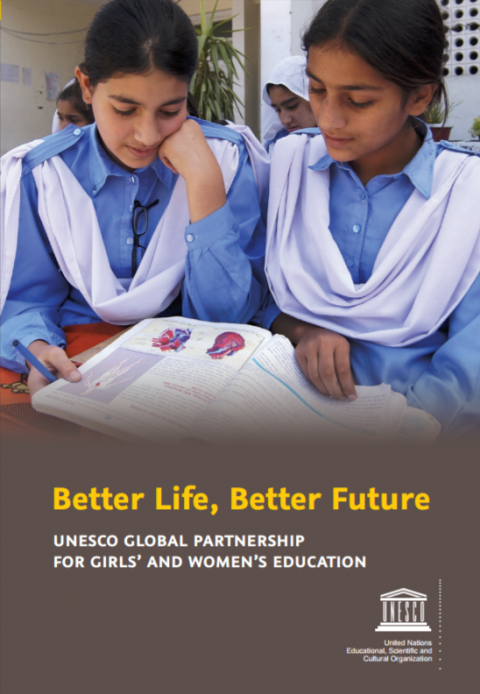 Better Life, Better Future: UNESCO Global Partnership for Girls' and Women's Education 出版年份: 2014 机构作者: UNESCO Since its creation, UNESCO has been advocating for, promoting and defending the right to quality education for all, especially for girls and women. As fundamental human rights, gender equality and education stand at the core of UNESCO’s mandate. UNESCO launched the Global Partnership for Girls’ and Women’s Education in 2011 guided by the conviction that educating girls and women can break the cycle of poverty and foster greater social justice. The Partnership seeks to increase learning opportunities for adolescent girls and women and to find solutions to some of the biggest challenges and obstacles to their education. The Partnership addresses two main areas which require increased attention: secondary education and literacy.
  [Summary] Investing in Cultural Diversity and Intercultural Dialogue: UNESCO World Report; Executive Summary 出版年份: 2009 机构作者: UNESCO Cultural diversity has emerged as a key concern at the turn of a new century. Yet the meanings attached to this catch-all term are as varied as they are shifting. Some see cultural diversity as inherently positive, insofar as it points to a sharing of the wealth embodied in each of the world’s cultures and, accordingly, to the links uniting us all in processes of exchange and dialogue. For others, cultural differences are what cause us to lose sight of our common humanity and are therefore at the root of numerous conflicts.This second diagnosis is today all the more plausible since globalization has increased the points of interaction and friction between cultures, giving rise to identity-linked tensions, withdrawals and claims, particularly of a religious nature, which can become potential sources of dispute. The essential challenge, therefore, would be to propose a coherent vision of cultural diversity and thereby to clarify how, far from being a threat, it can become beneficial to the action of the international community. This is the essential purpose of the present report.
  Interculturalism at the Crossroads: Comparative Perspectives on Concepts, Policies and Practices 出版年份: 2017 作者: Fethi Mansouri 机构作者: UNESCO Today most societies across the world are witnessing rising levels of social and cultural diversity brought about by globalisation and in particular increased human mobility and significant advances in information and communications technologies. The dilemma, therefore, has been how best to manage the resultant diversity and what optimal social policy paradigms to adopt towards this end.Assimilation, multiculturalism and presently interculturalism have all been proposed as possible policy conduits for managing socio-cultural diversity.This book, in focusing on the latter concept, and in particular in its intercultural dialogue manifestation, offers at once theoretical examinations, policy discussion and practical explorations of its uptake across the world. The core argument connecting the book’s three distinct sections is that whilst assimilation in its racist manifestation is no longer a viable option in today’s world, intercultural dialogue within existing multicultural settings has much to offer.