
相关资源
探索丰富的全球公民教育资源,深化理解,促进研究、倡导、教学与学习。
共找到3,530条结果
 Transforming 'MEN'talities: Gender Equality and Masculinities in India; Roadmap and Scoping Report 出版年份: 2021 作者: Christopher Coley | Christie M. Gressel | Rao R. Bhavani 机构作者: UNESCO This Transforming ‘Men’talities Report is consolidated into a few key messages and crucial responsible parties who can potentially take up these key messages. These recommendations reflect broad areas of theoretical and social science research, policy and governance, and multi- stakeholder engagement. In essence, this report sought to lay a roadmap for how India might best engage men and boys in GEWE (Gender equality and women’s empowerment). Multiple arguments were made in terms of the efficacy of this approach for achieving SDG5; however, these arguments are based largely in theory, in small pilot findings, or in limited sectors. Until now, efforts to engage men and boys in GEWE have been sporadic and limited, given relatively low priority in terms of funding and national and international support, and generally far removed from public consciousness. A more unified and collaborative effort is required to properly understand how to make design effective strategies for engaging men and boys in GEWE.
  Learn, Protect, Respect, Empower: The Status of Comprehensive Sexuality Education in Asia and the Pacific; A Summary Review 2020 出版年份: 2021 机构作者: United Nations Population Fund (UNFPA) | UNESCO | International Planned Parenthood Federation (IPPF) More than half of the world’s 1.8 billion young people aged 10–24 live in the Asia and Pacific region1 and a majority of them live in low and middle-income countries. In spite of their diverse socio-economic contexts, young people across this vast region commonly face limited access to sexual and reproductive health and rights (SRHR) information and services, including age-appropriate comprehensive sexuality education. Of the 13 million adolescent girls globally with an unmet need for contraception, approximately half live in Asia-Pacific, leading to an estimated 3.7 million births to adolescent girls in the region annually. In addition, around 82,000 young people are infected with HIV each year in the region. As adolescents transition through to adulthood, it is crucial that they are equipped with the necessary knowledge, attitudes and skills to support their health and wellbeing, regardless of age, sex, marital status, socioeconomic status, ethnicity, sexual orientation or gender identity. School-based and age-appropriate comprehensive sexuality education (CSE) is an effective means of reaching a large population of children and young people, particularly where rates of school participation are high. This overview of the status of in-school CSE in Asia and the Pacific provides a strong evidence base on the reach and impact of this across the region. Importantly, post COVID-19 we need to build back CSE programmes that are better and stronger to meet the social and emotional needs of our young people.
  From Rights to Country-Level Action: Results of the Tenth Consultation of Member States on the 1960 Convention and Recommendation 出版年份: 2022 作者: Rolla Moumné | Sharlene Bianchi 机构作者: UNESCO The year 2020 marked a turning point for education worldwide. The impact of the COVID-19 pandemic not only amplified the difficulties and revealed existing weaknesses, but also brought the unpreparedness and lack of resilience of national education systems to the fore.The tenth consultation on the 1960 Convention against Discrimination in Education was conducted in precisely this context.Providing a valuable opportunity for States to take stock of the progress made in implementing Convention and sharing interesting national practices, the Consultation revealed continuous and new challenges the education sector faces. The unique timing of the consultation also created an opportunity to report on actions taken to faceadverse effects of the pandemic. This report analyzes and presents the Consultation findings, draws trends, and provides guidance for action. It shows how, by implementing the provisions of the Consultation, States can accelerate progress towards achieving Sustainable Development Goal 4, while invites a reflection on possibly reviewing the framework of the right to education to further respond to new challenges and put an end to increased inequalities worldwide.
  K-12 AI Curricula: A Mapping of Government-Endorsed AI Curricula 出版年份: 2022 机构作者: UNESCO Regulations on their own are insufficient to ensure AI as a common good for education and for humanity. All citizens need to be equipped with some level of AI literacy covering the values, knowledge and skills relating to AI. This report features key findings and recommendations of UNESCO’s global survey on AI curricula for K-12. It reveals that only 11 countries have developed and endorsed K-12 AI curricula and another four countries have AI curricula in development. This is a strong call for Member States to develop AI curricula for K-12 students, and to build stronger mechanisms to validate non-governmental AI curricula offered to balance the private-driven approach. The report also reveals that the learning outcomes of AI curricula need to be more focused on fostering creativity in crafting AI technologies and on contextual ethics. Teacher training is key to ensure the implementation of AI curricula, and teachers need to be trained on designing and facilitating project-based learning which is the most commonly used pedagogical methodology in existing AI curricula. The report also advises an ‘agnostic approach’ towards AI brands and products when introducing domain-specific AI technologies.
  Policy Review Report: Early Childhood Care and Education in Kazakhstan 出版年份: 2005 机构作者: UNESCO UNESCO launched a joint UNESCO/OECD Early Childhood Policy Review Project as a component of the 2004-2005 plan. The purpose is to provide selected countries with an opportunity to review their early childhood policies and identify concrete options and strategies for improvement. Four countries were chosen based on their expressed interest - Brazil, Indonesia, Kazakhstan and Kenya. This review was conducted as part of Kazakhstan's participation in the project, which is being implemented in collaboration with the OECD. Отчет по обзору политики: дошкольное воспитание и обучение в Казахстане 出版年份: 2005 机构作者: Организация Объединенных Наций по вопросам образования, науки и культуры (UNESCO) ЮНЕСКО, в качестве составного компонента плана на 2004-2005 годы, запустило совместный Проект ЮНЕСКО/ОЭСР по обзору политики в области дошкольного воспитания и обучения. Целью является предоставить выбранным странам возможность провести обзор своей политики в области дошкольного воспитания и обучения и определить конкретные варианты и стратегии по его совершенствованию. Четыре страны были выбраны на основе выраженного ими интереса – Бразилия, Индонезия, Казахстан и Кения. Настоящий обзор был проведен в рамках участия Казахстана в проекте, который реализуется в сотрудничестве с ОЭСР.
  ПЕРЕОСМЫСЛИМ НАШЕ БУДУЩЕЕ 出版年份: 2021 机构作者: International Commission on the Futures of Education | UNESCO Наше человечество, наша планета находятся в опасности, пандемия лишь подтвердила нашу хрупкость и взаимозависимость, чтобы изменить ход вещей и переосмыслить наше будущее, необходимы неотложные совместные действия; в этом докладе Международной комиссии по перспективам образования подтверждается способность образования к осуществлению коренных изменений. Перед нами стоит двойная задача – выполнить невыполненное обещание обеспечить право на качественное образование для каждого ребёнка, молодого человека и взрослого и полностью реализовать преобразующий потенциал образования, способного проложить путь к устойчивому коллективному будущему. Для этого нам нужен новый общественный договор в области образования, который сможет устранять проявления несправедливости, преобразуя будущее.Этот новый общественный договор должен основываться на принципах прав человека, недопущения дискриминации, социальной справедливости, уважения жизни, человеческого достоинства и культурного разнообразия. Он должен включать в себя этику заботы о людях, взаимности и солидарности. Он должен укреплять позиции образования как общественного дела и общего блага.Этот доклад, который готовился два года на основе глобального процесса консультаций с участием миллиона человек, предлагает правительствам, учреждениям, организациям и гражданам всего мира разработать новый общественный договор в области образования, который поможет нам построить мирное, справедливое и устойчивое будущее, отвечающее всеобщим интересам.Представленные здесь концепции, принципы и предложения являются лишь отправной точкой. Их воплощение в практику в конкретных условиях – это коллективная работа. Уже есть много положительных моментов, и в настоящем докладе предпринята попытка их отразить и развить. Это не инструкция и не план, а начало жизненно важного разговора.
  لتوصية الخاصة بأخلاقيات الذكاء الاصطناعي 出版年份: 2022 机构作者: منظمة الأمم المتحدة للتربية والعلم والثقافة (UNESCO) تتناول هذه التوصية ما يندرج في نطاق مهمة اليونسكو من القضايا األخالقية المتعلقة بمجال الذكاء االصطناعي. ً ً معياريا وتبحث التوصية أخالقيات الذكاء االصطناعي بحثا ً يقوم على إطار كلي شامل ومتعدد الثقافات ومتغير منهجيا ِلقيم ومبادئ وإجراءات مترابطة يمكن أن ترشد المجتمعات فيما يخص التصدي بطريقة مسؤولة للعواقب المعروفة وغير المعروفة لوسائل تكنولوجيا الذكاء االصطناعي على البشر والمجتمعات البشرية، وكذلك على البيئة والنُظم اإليكولوجية؛ وترسي التوصية بالتالي األسس الالزمة التي يستطيع البشر االستناد إليها للحكم على وسائل تكنولوجيا الذكاء االصطناعي وقبولها أو رفضها. وتعتبر ً مرنة للتقييم المعياري والتوجيه ُسسا التوصية األخالقيات أ المعياري لوسائل تكنولوجيا الذكاء االصطناعي، وتستند إلى وجوب صون كرامة اإلنسان ووجوب ضمان السالمة والرفاهية ووجوب درء الضرر باعتبارها البوصلة التي يجب االسترشاد بها، وباعتبارها مبادئ راسخة في أخالقيات العلوم والتكنولوجيا.
  [Résumé] Résumé du rapport mondial de suivi sur l’éducation 2023 : les technologies dans l’éducation; qui est aux commandes? 出版年份: 2023 机构作者: Organisation des Nations Unies pour l'éducation, la science et la culture (UNESCO) | Global Education Monitoring Report Team Le rôle de la technologie dans l’éducation suscite depuis longtemps un débat intense. Est-ce qu’elle démocratise le savoir ou menace la démocratie en permettant à quelques-uns de contrôler l’information? Offre-t-elle des opportunités sans limite ou mène-t-elle vers un avenir dépendant de la technologie sans retour en arrière possible ? Est-ce qu’elle égalise les chances ou aggrave les inégalités? Devrait-elle être utilisée pour enseigner aux jeunes enfants ou présente-t-elle des risques pour leur développement? Ce débat a été alimenté par les fermetures d’écoles dues à la COVID-19 et l’émergence de l’intelligence artificielle générative. Mais comme les développeurs sont souvent en avance sur les décideurs, la recherche sur la technologie éducative est complexe. Les preuves solides et impartiales sont rares. Les sociétés posent-elles même les bonnes questions sur l’éducation avant de se tourner vers la technologie comme solution? Reconnaissent-elles ses risques tout en cherchant ses avantages? Les technologies de l’information et de la communication ont le potentiel de favoriser l’équité et l’inclusion en permettant d’atteindre les apprenants défavorisés et de diffuser plus de connaissances dans des formats attrayants et abordables. Dans certains contextes et pour certains types d’apprentissage, elles peuvent améliorer la qualité de l’enseignement et l’apprentissage des compétences de base. De toute évidence, les compétences numériques font désormais partie des compétences de base. La technologie numérique peut également soutenir la gestion et accroître l’efficacité en aidant à traiter de plus grands volumes de données éducatives. Mais la technologie peut également exclure, être inappropriée et pesante, voire carrément nuisible. Les gouvernements doivent veiller à créer les bonnes conditions pour assurer un accès équitable à l’éducation pour tous, réguler l’utilisation de la technologie afin de protéger les apprenants de ses influences négatives, et former les enseignants. Ce rapport recommande que la technologie soit introduite dans l’éducation sur la base de preuves montrant qu’elle serait appropriée, équitable, évolutive et durable. En d’autres termes, son utilisation devrait être dans l’intérêt des apprenants et compléter l’interaction en face-à-face avec les enseignants. Elle devrait être considérée comme un outil à utiliser dans ces conditions. À mi-parcours de l’échéance, le Rapport mondial de suivi sur l'éducation 2023 évalue la distance qu’il reste à parcourir pour atteindre les objectifs éducatifs de 2030. L’éducation est la clé pour débloquer la réalisation d’autres objectifs de développement, notamment le progrès technologique.
 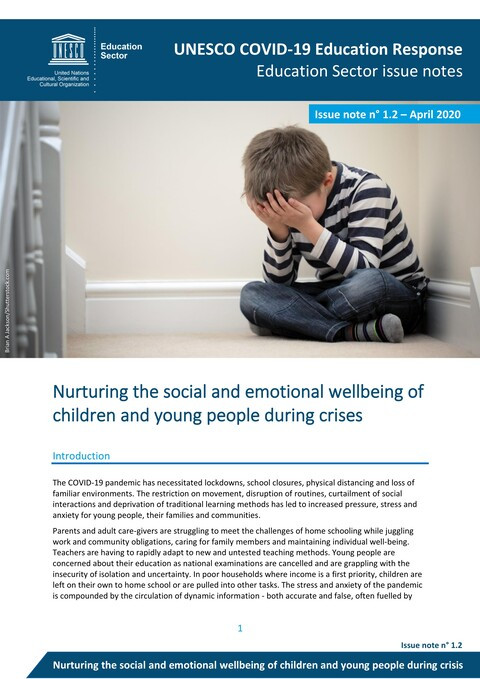 Nurturing the Social and Emotional Wellbeing of Children and Young People During Crises (UNESCO COVID-19 Education Response: Education Sector issue notes; No.1.2, 2020) 出版年份: 2020 机构作者: UNESCO The COVID-19 pandemic has necessitated lockdowns, school closures, physical distancing and loss of familiar environments. The restriction on movement, disruption of routines, curtailment of social interactions and deprivation of traditional learning methods has led to increased pressure, stress and anxiety for young people, their families and communities. Parents and adult care-givers are struggling to meet the challenges of home schooling while juggling work and community obligations, caring for family members and maintaining individual well-being. Teachers are having to rapidly adapt to new and untested teaching methods. Young people are concerned about their education as national examinations are cancelled and are grappling with the insecurity of isolation and uncertainty. In poor households where income is a first priority, children are left on their own to home school or are pulled into other tasks. The stress and anxiety of the pandemic is compounded by the circulation of dynamic information - both accurate and false, often fuelled by sensationalist media reporting. This not only increases insecurity but also acts as fertile ground for the spread of intolerance, racism, xenophobia and hate crimes. To address and counter the social anxiety, emotional upheaval and fearful insecurity unleashed by COVID-19, it is urgent and necessary that families and communities build vital coping skills and emotional resilience. Social and emotional skills are well established, evidence-based practices, that can be adapted to help equip children, young people, parents and teachers with the knowledge, skills, attitudes and behaviours they need to stay healthy and positive, navigate emotions, practice mindful engagement, exhibit pro-social behaviour and cope with daily challenges.