
相关资源
探索丰富的全球公民教育资源,深化理解,促进研究、倡导、教学与学习。
共找到1,983条结果
 Gender and Recovery Toolkit: Advancing Gender Equality and Women’s Empowerment in Crisis and Recovery Settings; Updated 2024 出版年份: 2024 机构作者: United Nations Development Programme (UNDP) The Gender and Recovery toolkit is a practical resource in the hands of UNDP personnel to help government, civil society and other partners put gender equality at the core of immediate and long-term recovery processes. It shows how to incorporate gender perspectives and women’s participation throughout the recovery programme cycle – from assessment, strategic planning and framing of results to budgeting and implementation, and monitoring and evaluation.The toolkit emphasizes the need to address the root causes of gender inequality and fragility by transforming power dynamics. It advocates for approaches that go beyond increasing women’s representation, focusing on tackling masculinities and reshaping institutions, behaviors, and norms. It underscores the importance of holistic strategies to address the interconnected challenges of climate change, peacebuilding, and gender equality in crisis contexts, highlighting the role of technology and innovative programming in empowering women. The seven guidance notes and tip sheets incorporate recent updates to global policy frameworks with updated indicators and robust data sources. While primarily designed for UNDP practitioners, this resource is valuable for all partners in crisis and recovery settings.
 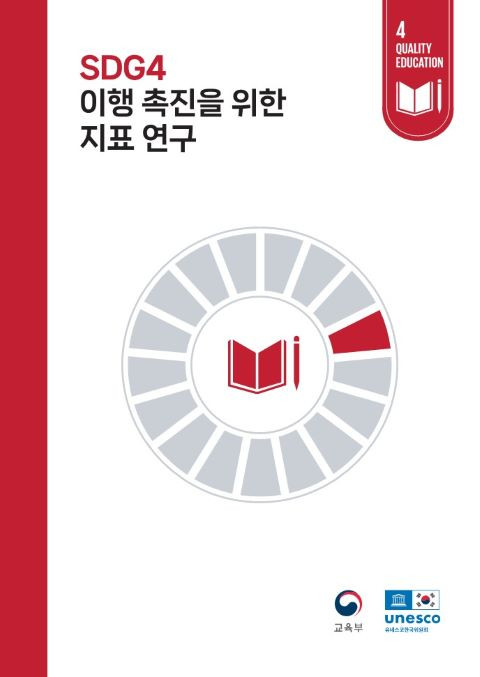 SDG4 이행 촉진을 위한 지표 연구 出版年份: 2025 作者: 박근영 | 주형미 | 문무경 | 오예진 | 류기락 | 조혜승 | 변종임 | Sunmi Ji | 이슬비 | 박기웅 | 안해정 | 서무계 机构作者: Korean National Commission for UNESCO 지속가능발전목표(SDGs) 이행의 전환점을 맞아 국내 교육의 현황과 과제를 SDG4 지표를 통해 진단하고 향후 방향을 탐색한 연구 보고서 <목차> 발간사 ‘SDG4 이행 촉진을 위한 지표 연구’ 보고서를 발간하며 서론 현 시점의 SDG4 이행 수준 점검과 개선 방향 탐색의 당위성 SDG 4.1 공평하고 양질의 초·중등 교육 이수 보장에 대한 한국 현황 및 향후 과제 SDG 4.2 영유아 교육과 보육 지표 검토와 향후 과제 SDG 4.3 고등교육의 수월성과 형평성 논의 및 향후 과제 SDG 4.4 고용을 위한 스킬: SDG 4.4의 이행 현황과 과제 SDG 4.5 교육 형평성 실현을 위한 SDG 4.5 지표 검토와 이행 현황 분석 SDG 4.6 한국의 SDG 4.6 이행 현행과 과제: 성인 문해력 SDG 4.7 더불어 살기 위한 학습을 향하여: 세계시민교육 및 지속가능발전교육 이행 현황과 모니터링 개선 방안 탐색 SDG 4.a SDG 4.a.1과 한국 디지털 교육 이행 현황: 접근성, 사용도, 스킬 SDG 4.b 공적개발원조(ODA) 장학금 확대 SDG 4.c 자격을 갖춘 교사의 공급 관련 이행 현황 및 개선 방안 결론 엄격한 현실 인식에 기반한 다음 목표로의 이행 준비
 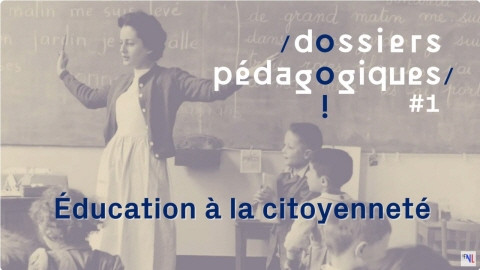 Educational Pack: Claire Ravez, research analyst focused on monitoring and analysis, IFE 出版年份: 2021 机构作者: French Institute of Netherlands As a professor of history and geography, Claire Ravez joined the Monitoring and Analysis team of the French Institute of Education within the École normale supérieure de Lyon in 2017.Pedagogical file #1 is dedicated to civic education, with contributions from Claire Ravez, Dominique Schnapper, FEi, and the National Library of France. Dossier pédagogique : Claire Ravez, chargée d'étude Veille et Analyses, IFE 出版年份: 2021 机构作者: French Institute of Netherlands Professeure d’histoire-géographie, Claire Ravez a rejoint l’équipe Veille et Analyses de l’Institut français de l’éducation au sein de l’École normale supérieure de Lyon en 2017.Dossier pédagogique #1 consacré à l’éducation à la citoyenneté, avec les contributions de Claire Ravez, Dominique Schnapper, FEi et la BnF.
 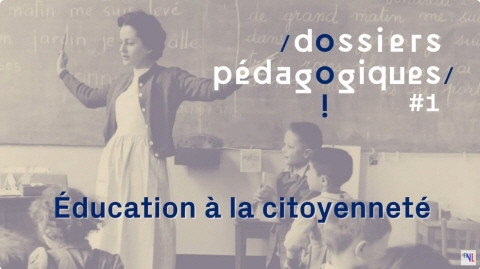 Education Pack: Dominique Schnapper, sociologue 出版年份: 2023 机构作者: French Institute of Netherlands Member of the Constitutional Council from 2001 to 2010, Dominique Schnapper is a French sociologist and political scientist. pedagogical file #1 is dedicated to civic education, with contributions from Claire Ravez, Dominique Schnapper, FEi and the BnF. Dossiers pédagogiques : Dominique Schnapper, sociologue 出版年份: 2023 机构作者: French Institute of Netherlands Membre du Conseil constitutionnel de 2001 à 2010, Dominique Schnapper est une sociologue et politologue française.Dossier pédagogique #1 consacré à l’éducation à la citoyenneté, avec les contributions de Claire Ravez, Dominique Schnapper, FEi et la BnF.
 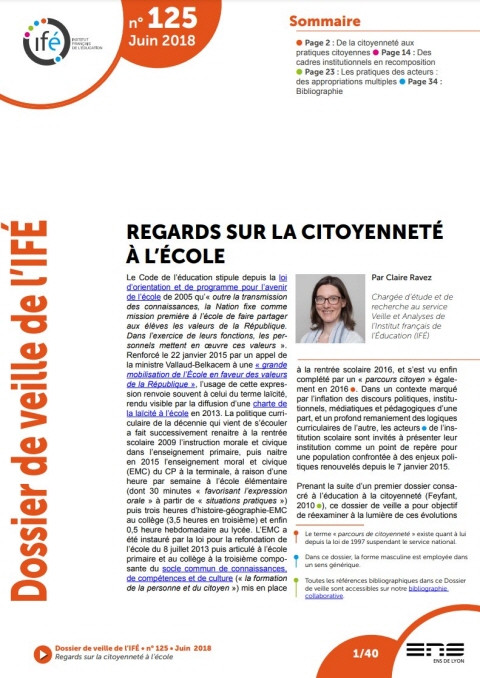 Perspectives on Citizenship in School (IFE Monitoring Report; (vol. 125, no.6) 出版年份: 2018 机构作者: École normale supérieure de Lyon.L’Institut français de l’Éducation Prenant la suite d’un premier dossier consacré à l’éducation à la citoyenneté (Feyfant, 2010 l), ce dossier de veille a pour objectifde réexaminer à la lumière de ces évolutions récentes la question des liens entre école et citoyenneté. Following up on an initial report dedicated to citizenship education (Feyfant, 2010 I), this monitoring report aims to re-examine the relationship between school and citizenship in light of recent developments. Regards sur la citoyenneté à l’école(Dossier de veille de l’IFÉ; (vol.125, n°6) 出版年份: 2018 机构作者: École normale supérieure de Lyon.L’Institut français de l’Éducation Prenant la suite d’un premier dossier consacré à l’éducation à la citoyenneté (Feyfant, 2010 l), ce dossier de veille a pour objectifde réexaminer à la lumière de ces évolutions récentes la question des liens entre école et citoyenneté. Following up on an initial report dedicated to citizenship education (Feyfant, 2010 I), this monitoring report aims to re-examine the relationship between school and citizenship in light of recent developments.
 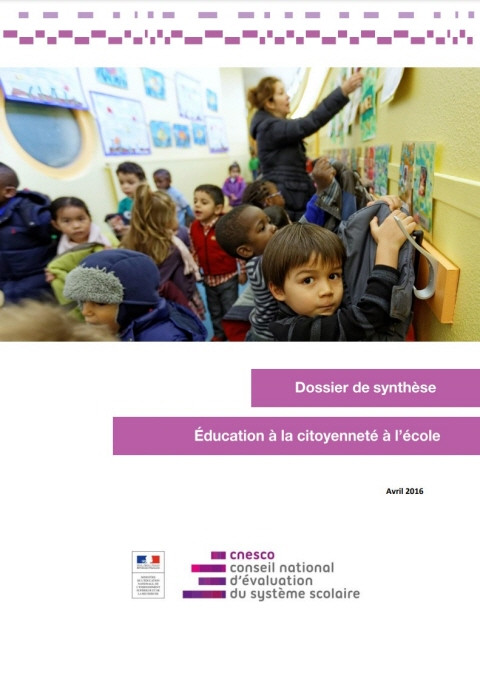 Citizenship Education in Schools: Summary Report 出版年份: 2016 机构作者: National Center for the Study of School Systems (CNESCO) This report explores the evolution of citizenship education in French schools in response to contemporary challenges. It highlights the key principles of this education and its impact on students, supported by recent research and surveys. The report also compares international practices and presents innovative examples, offering insights to enhance citizenship teaching in France. Éducation à la citoyenneté à l'école : Dossier de synthèse 出版年份: 2016 机构作者: National Center for the Study of School Systems (CNESCO) Ce dossier explore l'évolution de l'éducation à la citoyenneté dans les écoles françaises face aux défis contemporains. Il met en avant les principes clés de cette éducation et son impact sur les élèves, soutenu par des recherches et des sondages récents. Le rapport compare les pratiques internationales et présente des exemples innovants, offrant des perspectives pour améliorer l'enseignement de la citoyenneté en France.