
相关资源
探索丰富的全球公民教育资源,深化理解,促进研究、倡导、教学与学习。
共找到2,255条结果
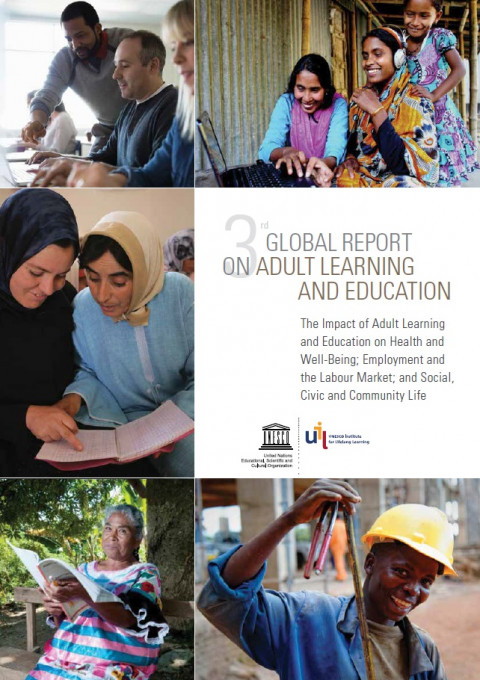 Третий Глобальный доклад по обучению и образованию взрослых (ООВ) ий Влияние образования взрослых на здоровье и благополучие, занятость и рынок труда, социальную, гражданскую и общественную жизнь 出版年份: 2016 机构作者: UNESCO Institute for Lifelong Learning (UIL) Данный доклад является результатом деятельности международного сообщества и связан с разработкой повестки дня в области устойчивого развития 2030 года, а также справочными и информационными документами, предоставляющими информацию для аналитиков и политиков, и напоминают государствам-членам об их обязательстве. Здесь политические деятели найдут веские доказательства в поддержку политики, стратегий и бюджетов. Заинтересованные стороны найдут убедительные аргументы того, как обучение и образование взрослых способствует устойчивому развитию, здоровому обществу, улучшению рабочих мест и более активной гражданской позиции. Исследователи найдут возможности и идеи для будущих исследований.
 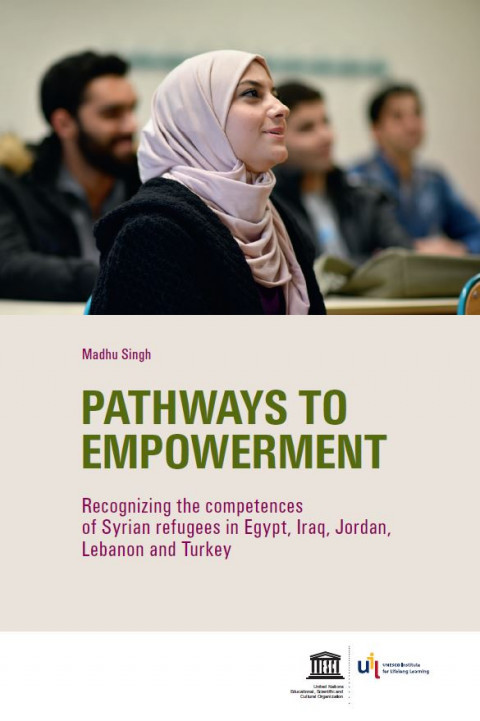 Pathways to Empowerment: Recognizing the Competences of Syrian Refugees in Egypt, Iraq, Jordan, Lebanon and Turkey 出版年份: 2018 作者: Madhu Singh 机构作者: UNESCO Institute for Lifelong Learning (UIL) For Syrian refugees living in Egypt, Iraq, Jordan, Lebanon and Turkey, recognition is a transformative mechanism that can help them enter or re-enter education, integrate into the world of work and participate fully in their host communities. However, while policy-makers in the region have prioritized the recognition, validation and accreditation of non-formal and informal learning, it remains a major challenge to develop systems that do this effectively. Pathways to Empowerment lays the essential groundwork for such a system, urging governments to develop comprehensive national strategies rather than ad hoc projects to recognize the competences of Syrian refugees. Its recommendations will contribute to dialogue between national authorities and social partners, and guide policy actions and RVA practices both in the region and in other parts of the world where recognition of refugees’ learning is a critical issue.
  Recognition, Validation and Accreditation of Youth and Adult Basic Education as a Foundation of Lifelong Learning 出版年份: 2018 机构作者: UNESCO Institute for Lifelong Learning (UIL) Since its 2005 General Conference, UNESCO has supported the recognition, validation and accreditation (RVA) of the outcomes of nonformal and informal learning for youth and adults and acknowledged the importance of RVA in the development of lifelong learning systems. More recently, the UNESCO Institute for Lifelong Learning, in partnership with UNESCO’s Section of Partnerships, Cooperation and Research, has undertaken a number of comprehensive analyses of policy and practice in this area. These studies have highlighted the need to focus on the RVA of non-formal basic education.Globally, the scale of need is enormous. There are significant challenges in integrating the recognition, validation and accreditation of the outcomes of non-formal and informal learning at the basic education level into existing RVA systems and in enabling young people and adults without basic education to complete such processes successfully.This report summarizes the research and policy dialogue of an international expert group invited by UNESCO to three meetings in 2016. It focuses on three themes – principles, policy and practice – and provides examples of how the issue is being approached across the world. It offers 12 conclusions, based on the evidence considered by the expert group, and proposes a number of key messages for stakeholders in Member States, including policy-makers and the research community.
 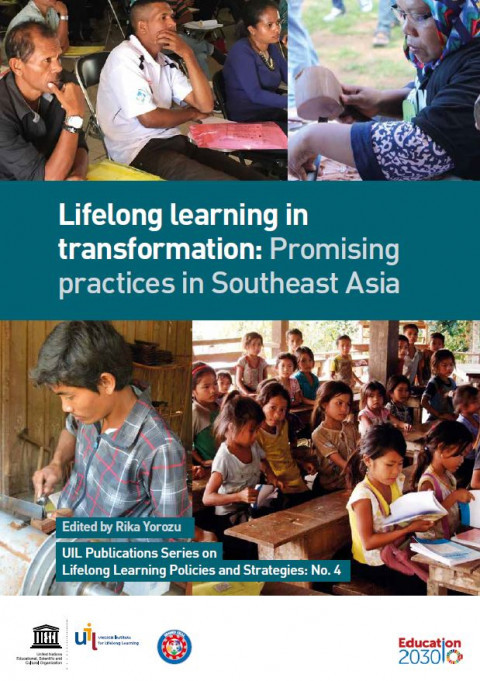 Lifelong Learning in Transformation: Promising Practices in Southeast Asia 出版年份: 2017 作者: Rika Yorozu 机构作者: UNESCO Institute for Lifelong Learning (UIL) This report is an outcome of a project on building a lifelong learning agenda in Southeast Asian countries, which aims to address the region’s remaining educational challenges in ensuring ‘inclusive and equitable quality education and promot[ing] lifelong learning opportunities for all’ (Goal 4 of the 2030 Agenda for Sustainable Development). By sharing promising policies and practices in implementing integrated lifelong learning from different perspectives, countries can learn from one another and move their visions for lifelong learning fully into practice. The publication documents a variety of promising practices from 11 countries, focusing particularly on the features critical to the promotion of lifelong learning for all; namely, inclusive and gender-responsive teaching and learning practices, recognition of learning outcomes from non-formal and informal learning, collaboration between social and economic development sectors and coherent national government policies and strategies. The report comprises three main sections: a reflection on lifelong learning in international and national documents, a collection of good practice drawn from their national reports, and a set of recommendations for policies and programmes promoting lifelong learning. It is hoped that these recommendations will stimulate discussion and new developments, in both policy and practice, in the region.
  ESD Implementation in Learning Cities 出版年份: 2021 机构作者: UNESCO Institute for Lifelong Learning (UIL) This publication aims to share the best practice cases from nine cities on ESD implementation (policy and practice) following a lifelong learning approach. These cases showcase innovative local initiatives that have embedded ESD into lifelong learning systems through policy/ strategy development or project implementation, focusing on the following priority areas of action and local activities laid down in the ESD for 2030 roadmap: Local policy/strategy development on ESD: The development of an action plan that determines how the community as a whole can become a learning laboratory for sustainable development. Capacity-building for educators and local authorities: Lifelong learning initiatives for systematic and comprehensive ESD capacity development for educators in the formal and non-formal education sectors, and for local government officials. Efforts to foster engagement with local communities, including: • formal education institutions’ engagement with local communities for the promotion of ESD; • non-formal education institutions (e.g. community learning centres) serving as a hub for lifelong learning on ESD in their communities. Empowerment and mobilization of youth: Lifelong learning initiatives for ESD that focus on young people. Innovative use of local spaces for ESD: Designated areas or spaces that inspire learning and host projects that promote sustainability. In addition to the five priority areas listed above, the case studies share one cross-cutting theme: • Multi-stakeholder approach: How people from different walks of life or professional sectors come together to contribute to local ESD initiatives at either the policy or the project level.
  Global Inventory of Regional and National Qualifications Frameworks 2017, Vol. I: Thematic Chapters 出版年份: 2017 机构作者: European Centre for the Development of Vocational Training (CEDEFOP) | European Training Foundation (ETF) | UNESCO | UNESCO Institute for Lifelong Learning (UIL) The global inventory 2017 further strengthens the knowledge base on developments in national and regional qualifications frameworks, as implemented by countries and regions, by end of 2016. It acts as an observatory of progress in establishing NQFs, as well as the challenges and success factors in implementation. The thematic chapters (Volume I) discuss key trends and policy issues emerging from qualifications frameworks and learning outcomes reforms and developments. Volume II consists of NQF case studies of 100 countries from all continents and seven regional qualifications frameworks (RQF). The case studies look at the educational, social, economic and political context in which an NQF is embedded, main policy objectives, implementation of learning outcomes, stakeholder involvement and institutional arrangements. They also show how NQFs open for and link to validation arrangements, support recognition and learning pathways. They conclude with important lessons and future plans.The global inventory draws on inventories from four agencies: the European Centre for the Development of Vocational Training (Cedefop), the European Training Foundation (ETF), the United Nations Educational, Scientific and Cultural Organisation (UNESCO) and the UNESCO Institute for Lifelong Learning (UIL), working and communicating with country officials and experts. It also draws on extensive international research in qualifications reforms, comparability of qualifications, and use of learning outcomes.
  Global Inventory of Regional and National Qualifications Frameworks 2017, Vol. II: National and Regional Cases 出版年份: 2017 机构作者: European Centre for the Development of Vocational Training (CEDEFOP) | European Training Foundation (ETF) | UNESCO | UNESCO Institute for Lifelong Learning (UIL) The global inventory 2017 further strengthens the knowledge base on developments in national and regional qualifications frameworks, as implemented by countries and regions, by end of 2016. It acts as an observatory of progress in establishing NQFs, as well as the challenges and success factors in implementation. The thematic chapters (Volume I) discuss key trends and policy issues emerging from qualifications frameworks and learning outcomes reforms and developments. Volume II consists of NQF case studies of 100 countries from all continents and seven regional qualifications frameworks (RQF). The case studies look at the educational, social, economic and political context in which an NQF is embedded, main policy objectives, implementation of learning outcomes, stakeholder involvement and institutional arrangements. They also show how NQFs open for and link to validation arrangements, support recognition and learning pathways. They conclude with important lessons and future plans.The global inventory draws on inventories from four agencies: the European Centre for the Development of Vocational Training (Cedefop), the European Training Foundation (ETF), the United Nations Educational, Scientific and Cultural Organisation (UNESCO) and the UNESCO Institute for Lifelong Learning (UIL), working and communicating with country officials and experts. It also draws on extensive international research in qualifications reforms, comparability of qualifications, and use of learning outcomes.
  Counting the Cost: Achieving Literacy in Countries of the Global Alliance for Literacy 出版年份: 2021 机构作者: UNESCO Institute for Lifelong Learning (UIL) This paper seeks to determine the cost of achieving Sustainable Development Goal 4 (SDG 4) Target 4.6: 'By 2030, ensure that all youth and a substantial proportion of adults, both men and women, achieve literacy and numeracy'. In an effort to answer this question, UNESCO ran simulations and identified the cost and funding gap for the 29 member countries of the Global Alliance for Literacy within the Framework of Lifelong Learning (GAL). This paper argues that 739 million youth and adults require additional literacy programmes of which 580 million are located in 9 of the 29 member countries (the E-9 countries). Based on the results of the simulation, an estimated US$ 190 billion is needed to achieve Target 4.6 by 2030 in the 29 GAL countries. The E-9 countries account for 80% of this cost as the large majority of the global population of youth and adults who lack basic literacy skills live in these territories. The estimation considers the impact of the COVID-19 crisis on GDP growth and presents several scenarios for consideration. If the 29 member countries allocate the recommended 3 per cent of their national education budget to youth and adult literacy, a funding gap of US$ 17 billion will still remain. However, this gap is greater in the 20 non-E9 countries, which account for US$ 12 billion of the funding gap. These 20 non-E9 countries already experience massive challenges for investing in their public education system due to low economic growth and low education development outcomes. A detailed description of the UNESCO GAL simulation model used to estimate the total cost and identify the financing gap for the 29 countries is presented to help interpret the results. The paper ends with a set of recommendations for governments and the international community to work together and ensure the availability of lifelong learning opportunities for all, especially those often left behind.
  How Can a Lifelong Learning Perspective Enhance the Relevance and Impact of the 1974 Recommendation?: Thematic Paper 出版年份: 2022 机构作者: UNESCO Institute for Lifelong Learning (UIL) Lifelong learning is rooted in the integration of learning with participation in society. It includes learning activities for people of all ages, in all life-wide contexts and spaces (family, school, community, workplace and more), and through a variety of modalities (formal, non-formal and informal).The purpose of this background paper is to propose ways in which the significance of lifelong learning can be reflected in the revision of the 1974 Recommendation concerning Education for International Understanding, Cooperation and Peace and Education relating to Human Rights and Fundamental Freedoms. It does this by recalling previous international contributions to the promotion of lifelong learning, including the landmark publications Learning to Be: The World of Education Today and Tomorrow (Faure et al., 1972) and Learning: The Treasure Within (Delors et al., 1996), which show the benefits of lifelong learning not only for employment but for the whole life of an individual and their participation in society. Third Global Report on Adult Learning and Education: The Impact of Adult Learning and Education on Health and Well-Being; Employment and the Labour Market; and Social, Civic and Community Life 出版年份: 2016 机构作者: UNESCO Institute for Lifelong Learning (UIL) This Report on Adult Learning and Education (GRALE III) comes out as the international community works towards the 2030 Agenda for Sustainable Development. It is also reference and advocacy documents, providing information for analysts and policymakers, and reminding Member States of their commitment. Here policymakers will find high-quality evidence to support policies, strategies and budgets. Stakeholders will find compelling arguments for how adult learning and education promotes sustainable development, healthier societies, better jobs and more active citizenship. Researchers will find entry points and ideas for future research.