
相关资源
探索丰富的全球公民教育资源,深化理解,促进研究、倡导、教学与学习。
共找到2,255条结果
 الأطفال غير المصحوبين بذويهم أو المنفصلين عنهم في منطقة الشرق الأوسط 出版年份: 2024 作者: Pierre Cazenave 机构作者: International Centre for Migration Policy Development (ICMPD) | European Union (EU) قد صمم هذا العمل لتسليط الضوء على الديناميات السابقة والحالية التي تؤثر على الهجرة الدولية (من المنطقة وداخلها)، وجمع وجهات النظر وتحليل سرد الأطفال غير المصحوبين بذويهم أو المنفصلين عنهم في محاولة لفهم الأسباب التي تدعم تنقل والأطفال غير المصحوبين بذويهم أو المنفصلين عنهم من المنطقة وداخلها، وذلك أي ًضا بهدف تقديم توصيات بشأن كيفية توفير احتياجاتهم المحددة على نحو أفضل في سياقات مختلفة. ركزت الدراسة بشكل خاص على ٣ بلدان مختارة في منطقة الشرق الأوسط وشمال إفريقيا (المغرب والأردن ولبنان) بينما تم استخدام المعلومات والبيانات القيمة التي تم جمعها في بلدين من بلدان الاتحاد الأوروبي (الاتحاد الأوروبي)، وهما اليونان وإسبانيا. Unaccompanied and Separated Children in the Mediterranean Region 出版年份: 2024 作者: Pierre Cazenave 机构作者: International Centre for Migration Policy Development (ICMPD) | European Union (EU) This work was designed to shed light on past and current dynamics that influence international migration (from and within the region), gather the perspectives and analyse the narratives of Unaccompanied and Separated Children (UASC) in an attempt to understand the reasons that underpin the mobility of unaccompanied and separated children from and within the region, also with a view to provide recommendations on how to better provide for their specific needs in different contexts. The study placed a special emphasis on 3 selected countries in the MENA region (Morocco, Jordan and Lebanon) while valuable information and data gathered in 2 European Union (EU) countries, Greece and Spain, were also used. Les enfants non accompagnés et séparés dans la région méditerranéenne 出版年份: 2024 作者: Pierre Cazenave 机构作者: International Centre for Migration Policy Development (ICMPD) | European Union (EU) La présente étude a été menée dans le cadre du programme EUROMED Migration V, qui est financé par l'Union européenne (UE) et mis en œuvre par le Centre international pour le développement des politiques migratoires (ICMDP). Il aide les Pays membres de l’Union européenne et les Pays partenaires du sud (PPS) à mettre en place un cadre de dialogue et de coopération global, constructif et opérationnel, portant en particulier sur le renforcement des instruments et des capacités pour développer et mettre en œuvre des politiques de migration fondées sur des données factuelles. EMM5 s’appuie sur les résultats de ses quatre premières phases (2004-2020) et développe ses activités autour de la facilitation d’un dialogue et d’une coopération régionale Sud-Nord et Sud-Sud efficaces dans les domaines thématiques identifiés dans le nouvel agenda pour la Méditerranée sur les migrations et la mobilité et le Nouveau pacte sur les migrations et l'asile. Il s'agit notamment de la gouvernance en matière de migration et d'asile, des opportunités socio-économiques pour les migrants et les communautés d'accueil, du retour et de la réintégration, de la migration légale et de la mobilité.
  Особенности обучения русскому языку студентов из Центральной Азии на современном этапе: вызовы и решения (Вестник ПНИПУ. Проблемы языкознания и педагогики; № 3. ) 出版年份: 2023 作者: Ильина Наталья Олеговна 机构作者: Вестник Пермского национального исследовательского политехнического университета (ПНИПУ) Рассматривается актуальная в настоящий момент проблема обучения русскому языку студентов из Центральной Азии, количество которых заметно увеличивается в университетах Российской Федерации. Более предметно в статье рассматриваются проблемы академической адаптации студентов из Туркменистана, обосновывается необходимость особого подхода к преподаванию русского языка для данного контингента учащихся.
  كـراسي اليونسكو في المغرب العربي 出版年份: 2023 机构作者: UNESCO Rabat في كانون ألاول/ديسمبر 2022، احتفل برنامج توأمة الجامعات/كرايس اليونسكو بالذكرى السنوية الثلاثين لتأسيسه. ولعل استمرار وتطورهذا البرنامج طيلة هذه المدة يؤشران على طابعه الاستراتيجي بالنسبة لليونسكو وللدول ا ألاعضاء على السواء. ويروم هذا البرنامج تعبئة الجامعات ومن خلالها جميع الجهات الفاعلة في مجال التنمية لدعم السياسات العمومي في مختلف مراحلها (من البلورة والتنفيذ إل التقييم) وعلى مختلف مستويات الحكامة (الدولية والوطنية والترابية) لتحقيق أهداف التنمية المستدامة. ويسعى البرنامج إلى جعل الجامعات الوطنية مراكز امتياز موضوعاتية قادرة على المساهمة في تحسين أداء العمل العمومي وتعزيز بعدهالاستشرفي، باعتبارها فضاء متكاملا للتكوين والبحث والتوعية.كما يستمد البرنامج أهميته من خصوصيات مقاربته المنهجية. حيث يستند، من ناحية، إلى تعزيزالتشبيك وتعدد التخصصات، ومن ناحية أخرى،إلى الاخذ بعين الاعتبار بطريقة جوهرية ومنهجية الهدف الاستراتيجي المتمثل في بناء القدرات الوطنية. ويهدف اليونسكو لمنطقة الغرب العربي إلى المواكبة الدولاألاعضاء التي يغطيها، في عملية تطوير هذا البرنامج والاستفادة من إمكاناته المختلفة، بالتعاون مع الدوائر الوطنية للتربية والعلومي والثقافة. ويعدإصدارهذه الطبعة ألاولى من كتيب كرايس اليونسكو الجامعية في المغرب العربي مبادرة فيبيأولى هذا الاتجاه. Chaires UNESCO au Maghreb 出版年份: 2023 机构作者: UNESCO Rabat En décembre 2022, le programme UNITWIN/Chaires UNESCO a fêté son trentième anniversaire. Sa longévité et sa dynamique de développement illustrent son caractère stratégique pour l’UNESCO et pour les Etats membres. Ce programme vise à mobiliser les universités et, à travers elles, l’ensemble des acteurs de développement, pour accompagner les politiques publiques pour atteindre les objectifs de développement durable (ODD). Le programme consiste à faire des universités nationales des centres d’excellence thématiques qui sont, en tant qu’espaces intégrés de formation, de recherche et de sensibilisation, en capacité de contribuer à améliorer la performance de l’action publique et à renforcer sa dimension prospective. Ce programme puise sa pertinence dans les spécificités de sa démarche. Cette dernière repose, d’une part, sur la promotion du réseautage et de la pluridisciplinarité et, d’autre part, sur la prise en compte de manière intrinsèque et systématique de l’objectif stratégique de renforcement de capacités nationales. Le Bureau de l’UNESCO pour le Maghreb ambitionne d’accompagner les Etats membres qu’il couvre à développer ce programme et à mettre à profit ses différentes potentialités, en collaboration avec les services concernés au Siège de l’UNESCO à Paris et les Commissions nationales pour l’éducation, les sciences et la culture. La production de cette première édition de la brochure des Chaires UNESCO au Maghreb constitue une première initiative dans ce sens.
  The Two Minutes of Citizenship 机构作者: Vie Publique "Les 2 minutes citoyennes" is a series of podcasts designed to provide a concise explanation of the concepts, notions and principles essential to understanding the workings of public life and French and European institutions. Produced by the editorial staff of vie-publique.fr, these educational capsules are aimed at all citizens. Les deux minutes citoyennes 机构作者: Vie Publique « Les 2 minutes citoyennes » est une série de podcasts visant à expliquer de façon synthétique les concepts, les notions ou les principes essentiels à la compréhension du fonctionnement de la vie publique et des institutions françaises et européennes. Produites par la rédaction du site vie-publique.fr, ces capsules pédagogiques s’adressent à tous les citoyens.
 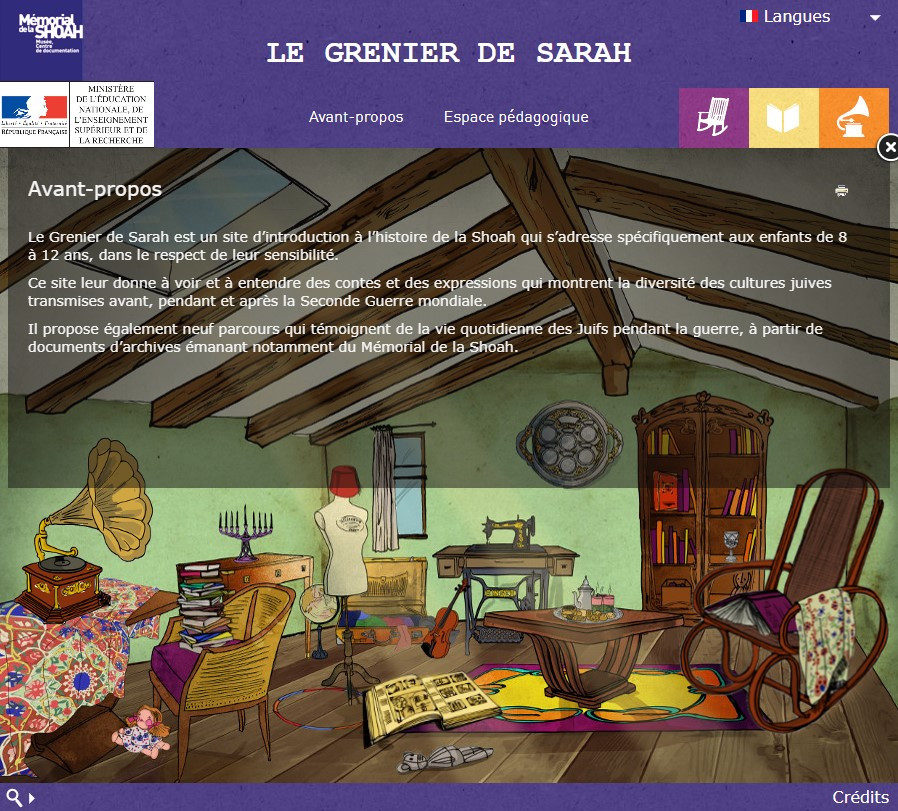 Le grenier de Sarah 作者: Jacques Fredj | Barbara Mellul | Adeline Salmon | Barbara Mellul | Adeline Salmon | Tralalère | Alliance concept | Judith Panijel | Alban Perrin | Iannis Roder Lior Lalieu-Smadja | Karen Taieb | Ariel Sion 机构作者: Memorial de la Shoah Le Grenier de Sarah est un site d’introduction à l’histoire de la Shoah, créé spécifiquement pour les enfants de 8 à 12 ans, dans le respect de la sensibilité des jeunes visiteurs. Les choix éditoriaux et iconographiques du site traduisent scrupuleusement cette volonté de ne pas les choquer. Le site a été conçu à partir du questionnement des enfants sur cette période.- Qui étaient ces personnes que les nazis ont voulu assassiner ?- Dans quels pays vivaient-elles ? Quelles langues parlaient-elles ?- Quels ont été les parcours propres à chacune d’entre-elles ?Le Grenier de Sarah permet aux enfants de naviguer sur le site de façon autonome. Toutefois, il est conseillé aux adultes de les accompagner lors de leur première visite afin d’instaurer un dialogue et de répondre à d’éventuelles questions.Pour y répondre, trois rubriques, « Il était une fois », « Des mots à l’oreille » et « En noir et blanc », donnent des clefs de compréhension.- Dans « Il était une fois », des contes donnent un aperçu de la diversité des cultures juives. - Dans « Des mots à l’oreille », des expressions en hébreu, yiddish, judéo-espagnol et judéo-arabe ouvrent une fenêtre sur la pluralité du judaïsme. - Dans « En noir en blanc », neuf parcours témoignent de la vie quotidienne des Juifs pendant la guerre. En cliquant sur l’album photo, l’enfant choisit d’entendre un des récits de vie proposés.Tout au long de chaque parcours, des définitions et des documents, sont à la disposition du jeune visiteur. Pour les enseignants, un espace pédagogique spécifique a été créé afin d’y trouver des ressources complémentaires et des pistes de travail. Sarah’s attic is a website introducing to the Shoah History. It was specifically created for children from age 8 to 12 and respects their sensibility as young visitors. The contents and iconography are carefully intended to suit their emotional and cognitive abilities.The website was designed and elaborated from questions asked by children in History classes teaching this time period - Who were these persons the Nazis wanted to murder?- In which countries did they live? Which languages did they speak?- What were their personal experiences? Sarah’s attic enables children to navigate through the website on their own. Nevertheless, we recommend that adults accompany them on their first visit in order to create a dialog and answer possible questions.As part of a school or extra-curricular framework, this program can be used in small groups with the guidance of an adult.In order to answer these questions, three sections “Once upon a time”, “Words to my ear” and “In black and white” give keys to understanding the event.- In “Once upon a time”, tales give a glimpse of the diversity of Jewish cultures. - In “Words to my ear”, expressions in Hebrew, Yiddish, Judeo-Spanish and Judeo-Arabic open a window on the pluralism of Judaism. - In “In Black and white”, nine personal itineraries bear witness of the daily life of Jews during the war. Along each personal story, definitions and documents are available to the young visitor.For teachers and educators, a specific educational section contains additional resources, guidelines and teaching materials.
 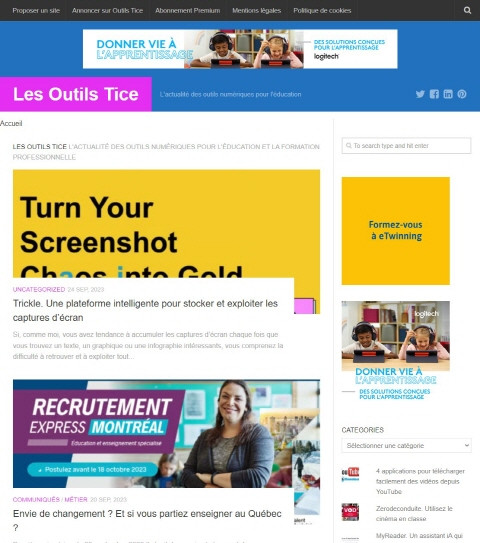 Les Outils TICE - L'actualité des outils numériques pour l'éducation 作者: Fidel Navamuel Les outils Tice est un site de références dans son domaine.Créé par un journaliste, il recense, chaque semaine l’actualité des sites et des outils utilisant les Technologies de l’Information et de la Communication dans l’Education (TICE). Chaque ressource est présentée et analysée. Les ressources sont classées par catégorie et une newsletter permet de recevoir chaque semaine les dernières nouveautés. Les outils Tice is a reference site in its field.Created by a journalist, it provides weekly news on sites and tools using Information and Communication Technologies in Education.(ICTE). Each resource is presented and analyzed. Resources are classified by category, and a weekly newsletter keeps you up to date with the latest news.