
相关资源
探索丰富的全球公民教育资源,深化理解,促进研究、倡导、教学与学习。
共找到2,193条结果
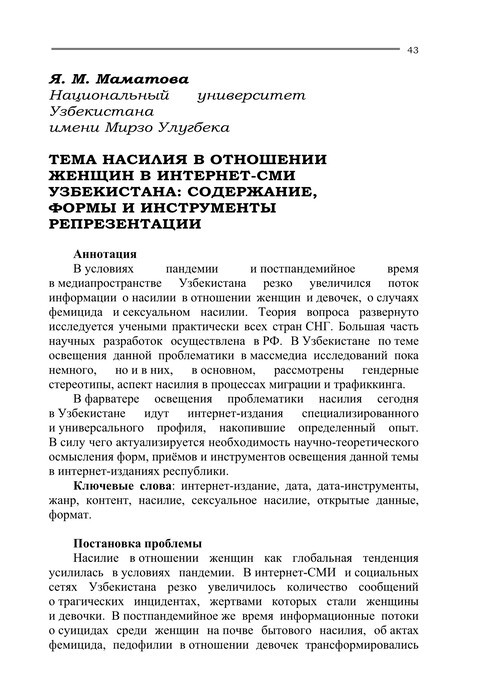 The Theme of Violence Against Women on the Internet Media of Uzbekistan: Content, Tools of Representation (PR and Advertising in a Changing World: Regional Aspect; No.28, 2023) 出版年份: 2023 作者: Я. М. Маматова In the context of the pandemic and post-pandemic in the media space of Uzbekistan, the flow of information about violence against women and girls, about cases of femicide and sexual violence has increased dramatically. In Uzbekistan, there are still few studies on the topic of coverage of this issue in the mass media, but they also mainly consider gender stereotypes, the aspect of violence in the processes of migration and trafficking. Тема насилия в отношении женщин в интеренет-СМИ Узбекистана: содержание, формы и инструменты репрезентации (PR и реклама в изменяющемся мире: региональный аспект; No.28, 2023) 出版年份: 2023 作者: Я. М. Маматова В условиях пандемии и постпандемийное время в медиапространстве Узбекистана резко увеличился поток информации о насилии в отношении женщин и девочек, о случаях фемицида и сексуальном насилии. В Узбекистане по теме освещения данной проблематики в массмедиа исследований пока немного, но и в них, в основном, рассмотрены гендерные стереотипы, аспект насилия в процессах миграции и трафиккинга.
  Introducing quality assurance of education for democratic citizenship in schools - comparative study of 10 countries 出版年份: 2009 机构作者: Council of Europe For over a decade the Council of Europe has been working on policies in the field of education for democratic citizenship (EDC). One result has been that the Committee of Ministers of the Council of Europe agreed on a recommendation stating that EDC is central to educational politics, and that it is a “factor for innovation in terms of organising and managing overall education systems, as well as curricula and teaching methods” (Recommendation Rec(2002)12). According to this recommendation, European governments acknowledged their responsibility for ensuring the cultural basis of democracy through education. However, politics is not so simple that supranational recommendations are immediately translated into policy in national states. This gap between agreed and realised policies has been termed a “compliance gap”. One of the most logical reasons for noncompliance comes from a lack of awareness or competences. Therefore the Council of Europe concentrated on producing materials that could help raise awareness and develop competences. Key products resulting from this effort have been collected as an “EDC/HRE Pack” since 2005.This collection covers the areas of policy making, democratic governance of educational institutions, teacher training and quality assurance. The “Tool for Quality Assurance of Education for Democratic Citizenship in Schools” (Bîrzea et al., 2005), which is one of these materials, forms the reference document for this study.This study analyses relevant conditions and possible activities with regard to implementing the tool in 10 national educational systems. As relevant conditions, the study considers the existing attempts to deliver educational quality within countries, together with the teacher training programmes that accompany these attempts. As possible activities, national adaptations of the tool, and various ways of working with different target groups, are also taken into account.The following sections provide background information concerning the project. This will help the reader understand why the tool needs to be adapted in different circumstances. Section 2 presents points of reference that open theoretical perspectives on the work presented. Section 3 provides a rationale for the selection of participating countries and gives and describes the methodology used when conducting this study. Finally, Section 4 provides an overview of the remaining contents of this book.
 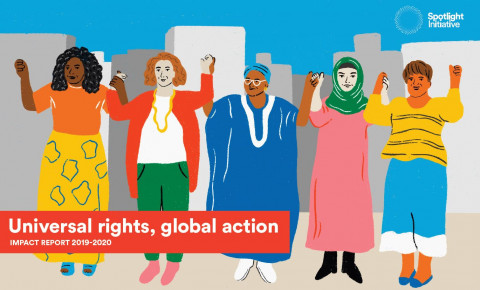 Universal Rights, Global Action: Impact Report 2019-2020 出版年份: 2020 机构作者: Spotlight Initiative Universal rights, global action is a shortened, visual adaptation of the 2019 Global Annual Narrative Progress Report. The Spotlight Initiative is a global, multi-year partnership between the European Union and the United Nations to eliminate all forms of violence against women and girls by 2030. This report outlines the Spotlight Initiative’s key signature results from 2019.The 32-page document highlights the ways the Spotlight Initiative country and regional programmes have meaningfully reached women and girls, including those facing multiple and intersecting forms of discrimination.
  Peace Education: A Pathway to a Culture of Peace; Third Edition 出版年份: 2019 作者: Loreta Navarro-Castro | Jasmin Nario-Galace 机构作者: Miriam College. Center for Peace Education This book is based on author's study and research as well as on experiences as teachers and trainers. By writing about what the authors have come to know and experienced. It is their hope that the ideas contained in this book will circulate widely and promote enthusiasm for both education and action for peace.This book is organized into three sections. Part I aims to develop a holistic understanding of peace and peace education; Part II discusses key peace education themes; Part III focuses on the peaceable learning environment. A "vision for the future" is presented in conclusion.
 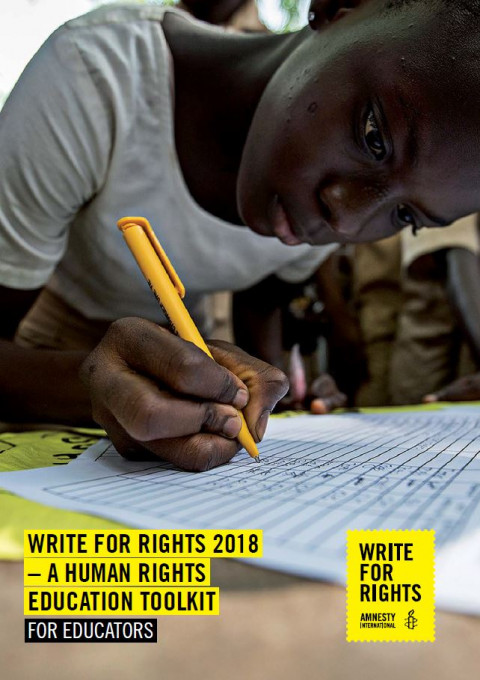 Write for Rights 2018: A Human Rights Education Toolkit for Educators 出版年份: 2018 机构作者: Amnesty International The annual Write for Rights (W4R) campaign is one of Amnesty International’s biggest human rights events. In 2018 the campaign focuses on women human rights defenders who have suffered human rights violations or are at great risk because of the positions they have taken on certain human rights issues.This Human Rights Education toolkit was created to support teachers’ participation with their students in the W4R campaign. It provides a broad perspective on human rights issues and offers the opportunity to open young people’s minds to global concerns. By learning about and writing persuasive letters to help end human rights violations and achieve justice, teachers and students contribute to the international human rights movement and see for themselves how words can make a difference in the world.This toolkit was created for students aged 13 and above and is primarily designed for use in a school setting: both inside the classroom as well as in clubs or school-wide events. Activities can also be adapted for use in other, non-formal education contexts such as youth groups and community settings. The toolkit contains general activities on human rights and highlights six women human rights defenders from the W4R campaign who have made extraordinary contributions to the advancement of human rights around the world. Écrire pour les droits 2018: Manuel d´éducation aux droits humains pou les éducateurs et éducatrices 出版年份: 2018 机构作者: Amnesty International La campagne annuelle Écrire pour les droits est l’une des plus importantes actions d’Amnesty International autour des droits humains. L’édition 2018 est axée sur les défenseures des droits humains qui sont victimes de violations de leurs droits fondamentaux ou en grand danger du fait de leur position sur certaines questions relatives aux droits humains.Le manuel Éducation aux droits humains vise à favoriser la participation des enseignant-e-s et de leurs élèves à la campagne Écrire pour les droits. Il offre une perspective large sur les questions relatives aux droits humains et la possibilité de sensibiliser les jeunes à des préoccupations mondiales. En en apprenant davantage et en rédigeant des lettres convaincantes pour aider à mettre fin aux violations des droits humains et à obtenir justice, les enseignant-e-s et leurs élèves contribuent au mouvement international des droits humains et voient par elles/eux-mêmes que les mots peuvent faire la différence.Ce manuel est destiné aux élèves de 13 ans et plus pour une utilisation en contexte scolaire, tant en classe que dans des clubs ou des manifestations organisées à l’école. Les activités peuvent cependant être adaptées à des contextes d’apprentissage plus informels comme des groupes de jeunes et des associations. Le manuel propose des activités générales sur les droits humains et met en avant six défenseures des droits humains choisies au titre de la campagne Écrire pour les droits qui ont apporté des contributions extraordinaires à la progression des droits fondamentaux dans le monde entier. Escribe por los derechos 2018: Carpeta de materiales de educación en derechos humanos para educadores/as 出版年份: 2018 机构作者: Amnesty International La campaña anual Escribe por los Derechos es uno de los mayores eventos de derechos humanos de Amnistía Internacional. En 2018, la campaña se centra en defensoras de los derechos humanos que han sufrido violaciones de derechos humanos o corren grave riesgo a causa de la postura que han adoptado respecto a ciertas cuestiones de derechos humanos.Esta carpeta de materiales de Educación en Derechos Humanos se creó para ayudar a profesores y profesoras a participar con sus estudiantes en la campaña Escribe por los Derechos. Ofrece una amplia perspectiva de cuestiones de derechos humanos y brinda la oportunidad de abrir la mente de los y las jóvenes a cuestiones de preocupación mundiales. Al aprender sobre estas cuestiones y escribir cartas convincentes para ayudar a poner fin a las violaciones de derechos humanos y lograr justicia, los profesores y profesoras y sus estudiantes contribuyen al movimiento internacional de derechos humanos y ven con sus propios ojos cómo las palabras pueden hacer cambiar las cosas en el mundo.Esta carpeta se creó para estudiantes de a partir de 13 años y está concebida principalmente para utilizarla en un entorno escolar: tanto dentro del aula como en clubes o eventos de toda la escuela. Las actividades también se pueden adaptar para utilizarlas en otros contextos de educación no formal, como grupos de jóvenes y entornos comunitarios. La carpeta contiene actividades generales sobre derechos humanos y destaca el caso de seis defensoras de los derechos humanos de la campaña Escribe por los Derechos que han hecho contribuciones extraordinarias al progreso de los derechos humanos en todo el mundo.
  Asia-Pacific Education 2030: SDG 4 Midterm Review 出版年份: 2024 机构作者: UNESCO Institute for Statistics (UIS) | UNESCO Bangkok This publication marks the conclusion of the collaborative national midterm reviews of SDG 4 achievement in the Asia-Pacific. More importantly, it represents the beginning of the final sprint to the 2030 finish line. It also serves as a comprehensive analytical and policymaking tool for all stakeholders in the region to reflect and be better prepared for the second half of the journey. At the midway point of implementing the Education 2030 Agenda, we are observing both challenges and progress in achieving Sustainable Development Goal 4 (SDG 4) in the Asia-Pacific. The region, overall, has made advances in reaching the globally and regionally most important targets under SDG 4, yet it is still far from delivering the common commitment of the Education 2030 Agenda, to ‘ensure inclusive and equitable quality education and promote lifelong learning opportunities for all’. Eight years into implementation, the Asia-Pacific has shown progress, especially in improving access to lower levels of basic education, as well as expanding early childhood education (ECE). Across most subregions of Asia and the Pacific, over 95% of primary school students complete primary education within the expected timeframe, while more than 80% of children one year before the official primary entry age are enrolled in organized early childhood education. However, participation in education is only one part of the puzzle, and the quality of learning, evidenced by limited data for the Asia-Pacific region on learning outcomes, remains concerning. More than half of students in Eastern and South-Eastern Asia do not reach the minimum proficiency level in mathematics at the end of lower secondary education. Overall and from a regional perspective, with priorities having accelerated in ECE, primary education reaching universal participation, and higher education being consistently regarded as prestigious to accomplish, secondary education is currently the weakest link apart from the chronically undervalued technical vocational education and training path. Fulfilling our commitment to the Education 2030 Agenda and leaving no one behind is not an easy endeavour and we need everyone on board in this unprecedented, yet necessary feat. This publication is meant to facilitate taking stock of the current situation and accelerate focused advances on the most relevant education topics for the Asia-Pacific region. To live together: shaping new attitudes to peace through education 出版年份: 1997 作者: Daniel S. Halpérin 机构作者: UNESCO International Bureau of Education (IBE) The ‘To live together’ initiative was born at a meeting in February 1996 with Professor Emeritus Antoine Cuendet, a pediatric surgeon, former Dean of the Faculty of Medicine at Geneva University, and chairman of the Geneva Foundation to Protect Health in War (hereafter the Geneva Foundation). His foundation was in a process of trying to better define its scope of action within the large theme of ‘health and war’, and to identify areas of research that would deserve priority support. We agreed that, at a time when politicians had entered an era of peacemaking in the Middle-East, the situation might be suitable for Palestinians and Israelis to venture into joint research projects. In particular, a potentially fruitful project could be to examine the effects of long term, protracted conflicts-such as the Israeli-Palestinian one-on the mental and social health of children. Little was known about how much of their anxiety, psychosomatic complaints, agressivity, behavioural disorders or school failures may be linked with direct or indirect consequences of the conflict. What were the interventions or instruments that may counterbalance, or even correct such problems? Was there any kind of an educational programme, for instance, that might be demonstrated to be efficacious in counteracting those putative effects of the conflict; and that might prove of value in actually accelerating the healing of the traumatisms, while simultaneously strengthening the construction of peace?