
相关资源
探索丰富的全球公民教育资源,深化理解,促进研究、倡导、教学与学习。
共找到2,199条结果
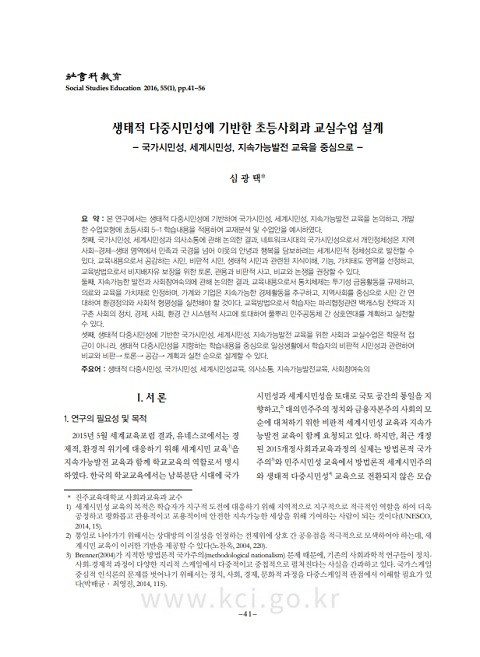 Instructional Design Based on Ecological Multiple Citizenship for Elementary Social Studies Classroom: Focusing on National Citizenship, Global Citizenship and Sustainable Development Education (Social studies education; Vol. 55, No. 1) 出版年份: 2016 作者: Kwangtaek Sim 机构作者: Korean Social Studies Association An instructional model for national citizenship, global citizenship, and sustainable development education was developed. Four lesson plans in the elementary 5thgrade social studies were suggested to show the practice of the instructional model. Three outcomes are reported. First, identity as a citizen of a nation, global citizenship, communications are interrelated. National citizenship and communications in the network society can result in a stronger vision of one’s global citizenship. This is especially the case when the wellbeing and happiness of people in neighboring countries who live across the national boundary are viewed within the domain of community- economy- ecology. Each prepares citizens through knowledge and skills that enable them to empathize, criticize constructively, and live together sustainably. The educational methods recommended to attain global citizenship perspectives are critical thinking, comparative studies, and teaching controversial issues. Those methods tend to result in a commitment to guarantee of non-domination freedom and tolerance of others. Second, discussions regarding sustainable development focused largely on deliberative engagement as a teaching method. Issues discussed were: speculative banking and its regulation; medical treatment and education as value goods; the steps necessary for households and businesses to attain sustainability; and environmental justice and social equity. The educational methods recommended to live together sustainably are planning and practice for grassroots democratic communities’ solidarity by applying back-casting strategy and systematic thinking. Thirdly, social studies classrooms intent on to enhance national citizenship, global citizenship, and sustainable development have a five step task. They, should emphasize comparison and critique→ discussion→ empathy→ planning and lastly the engagement of learners in content critical to ecological multiple citizenship. 생태적 다중시민성에 기반한 초등사회과 교실수업 설계: 국가시민성, 세계시민성, 지속가능발전 교육을 중심으로 (사회과교육; Vol. 55, No. 1) 出版年份: 2016 作者: 심광택 机构作者: 한국사회과교육연구학회 본 연구에서는 생태적 다중시민성에 기반하여 국가시민성, 세계시민성, 지속가능발전 교육을 논의하고, 개발한 수업모형에 초등사회 5-1 학습내용을 적용하여 교재분석 및 수업안을 예시하였다. 첫째, 국가시민성, 세계시민성과 의사소통에 관해 논의한 결과, 네트워크시대의 국가시민성으로서 개인정체성은 지역 사회-경제-생태 영역에서 민족과 국경을 넘어 이웃의 안녕과 행복을 담보하려는 세계시민적 정체성으로 발전할 수 있다. 교육내용으로서 공감하는 시민, 비판적 시민, 생태적 시민과 관련된 지식이해, 기능, 가치태도 영역을 선정하고, 교육방법으로서 비지배자유 보장을 위한 토론, 관용과 비판적 사고, 비교와 논쟁을 권장할 수 있다. 둘째, 지속가능한 발전과 사회참여숙의에 관해 논의한 결과, 교육내용으로서 통치체제는 투기성 금융활동을 규제하고, 의료와 교육을 가치재로 인정하며, 가계와 기업은 지속가능한 경제활동을 추구하고, 지역사회를 중심으로 시민 간 연대하여 환경정의와 사회적 형평성을 실천해야 할 것이다. 교육방법으로서 학습자는 파리협정관련 백캐스팅 전략과 지 구촌 사회의 정치, 경제, 사회, 환경 간 시스템적 사고에 토대하여 풀뿌리 민주공동체 간 상호연대를 계획하고 실천할 수 있다. 셋째, 생태적 다중시민성에 기반한 국가시민성, 세계시민성, 지속가능발전 교육을 위한 사회과 교실수업은 학문적 접근이 아니라, 생태적 다중시민성을 지향하는 학습내용을 중심으로 일상생활에서 학습자의 비판적 시민성과 관련하여 비교와 비판→ 토론→ 공감→ 계획과 실천 순으로 설계할 수 있다.
 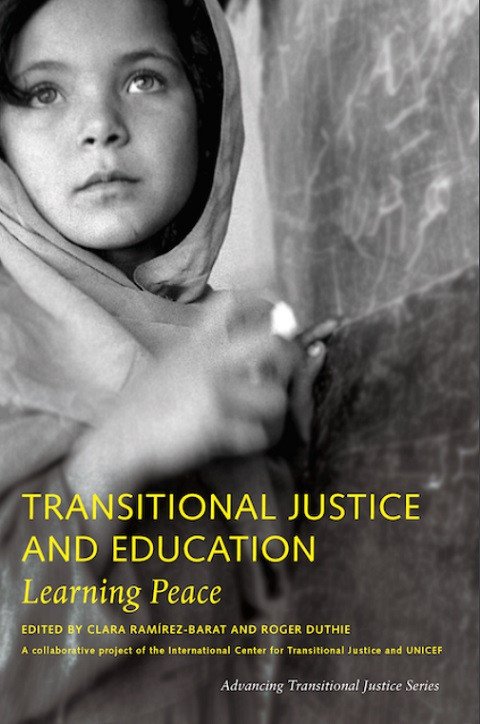 Transitional Justice and Education: Learning Peace (Advancing Transitional Justice Series) 出版年份: 2017 作者: Clara Ramírez-Barat | Roger Duthie 机构作者: Social Science Research Council (SSRC) | United Nations Children's Fund (UNICEF) After periods of conflict and authoritarianism, education institutions often need to be reformed or rebuilt. But in settings where education has been used to support repressive policies and human rights violations, or where conflict and abuses have resulted in lost educational opportunities, legacies of injustice may pose significant challenges to effective reform. Peacebuilding and development perspectives, which normally drive the reconstruction agenda, pay little attention to the violent past. Transitional Justice and Education: Learning Peace presents the findings of a collaborative research project of the International Center for Transitional Justice and UNICEF on the relationship between transitional justice and education in peacebuilding contexts. The book examines how transitional justice can shape the reform of education systems by ensuring programs are sensitive to the legacies of the past, how it can facilitate the reintegration of children and youth into society, and how education can engage younger generations in the work of transitional justice.
 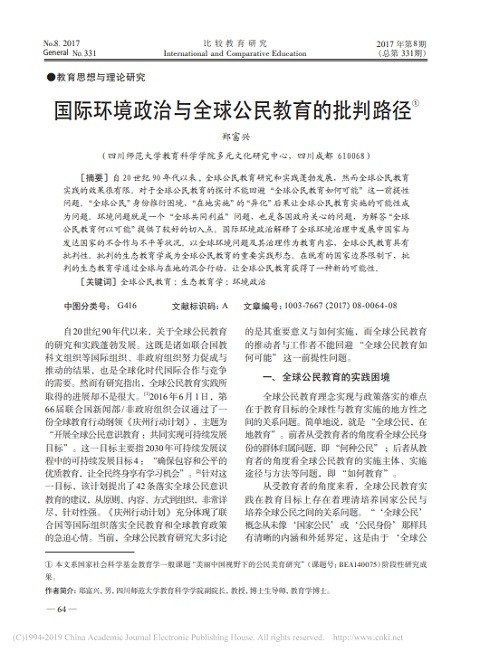 International Environmental Politics and Critical Approach to Global Citizenship Education (International and Comparative Education; No. 8) 出版年份: 2017 作者: Zheng Fuxing 机构作者: Beijing Normal University The research and practice of global citizenship education have thrived since 1990s, but the effectiveness of global citizenship education is limited. The researcher cannot avoid the problematic premise of the possibility of global citizenship education. The identity predicament of global citizen and alienation of local implementing make probability of the global citizenship education problematic. The practical predicament of the global citizenship education manifests that the nation state is the key factor of policy implementation. Environmental question, which is about global common good, attracts the attention from the government of most of nations, and becomes the good case for exploring the feasibility of global citizenship education. Environmental politics explain the inequality and injustice in the globally environmental governance which made the global citizenship education critical. The critical ecopedagogy becomes the new form of global citizenship. The practice of the global citizenship education becomes viable by hybrid activism generated by dialectical movement between local and global in the limit of nation-state. 国际环境政治与全球公民教育的批判路径 (比较教育研究; No. 8) 出版年份: 2017 作者: Zheng Fuxing 机构作者: Beijing Normal University 自 20 世纪 90 年代以来 , 全球公民教育研究和实践蓬勃发展,然而全球公民教育 实践的效果很有限。对于全球公民教育的探讨不能回避“全球公民教育如何可能”这一前提性 问题。“全球公民”身份推衍困境、“在地实施”的“异化”后果让全球公民教育实施的可能性成 为问题。环境问题既是一个“全球共同利益”问题,也是各国政府关心的问题,为解答“全球 公民教育何以可能”提供了较好的切入点。国际环境政治解释了全球环境治理中发展中国家与 发达国家的不合作与不平等状况。以全球环境问题及其治理作为教育内容,全球公民教育具有 批判性。批判的生态教育学成为全球公民教育的重要实践形态。在既有的国家边界限制下,批 判的生态教育学通过全球与在地的混合行动,让全球公民教育获得了一种新的可能性。
 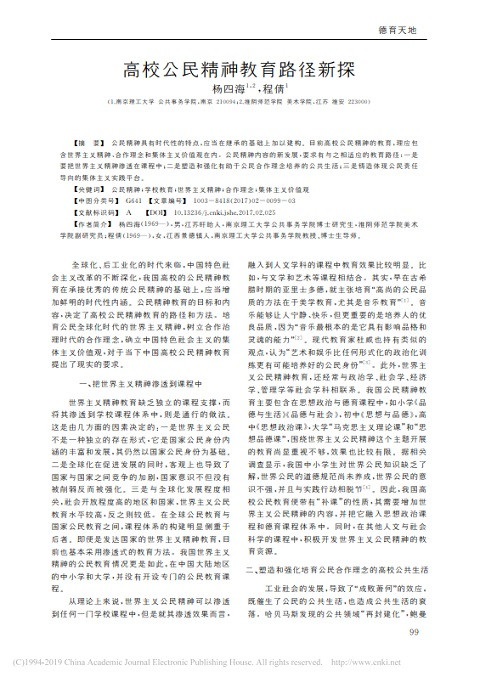 A New Approach to Civic Spirit Education in Universities (Jiangsu Higher Education; No. 2) 出版年份: 2017 作者: Yang Sihai | Cheng Qian 机构作者: Jiangsu Education Press The civic spirit has the characteristics of The Times and should be constructed on the basis of inheritance. At present, the education of civic spirit in universities should include the spirit of cosmopolitanism, the idea of cooperation and the value of collectivism. The new development of civic spirit requires the corresponding educational path: First, the spirit of cosmopolitanism should be infiltrated into the curriculum; Second, to shape and strengthen the public life conducive to the cultivation of the concept of citizen cooperation; Thirdly, casting the collectivism practice platform that embodies the orientation of civic responsibility. 高校公民精神教育路径新探 (江苏高教; No. 2) 出版年份: 2017 作者: Yang Sihai | Cheng Qian 机构作者: Jiangsu Education Press 公民精神具有时代性的特点,应当在继承的基础上加以建构。目前高校公民精神的教育,理 应 包 含世界主义精神、合作理念和集体主义价值观在内。公民精神内容的新发展,要求有与之相适应的教育路径:一是 要把世界主义精神渗透在课程中;二是塑造和强化有助于公民合作理念培养的公共生活;三是铸造体现公民责任 导向的集体主义实践平台。
 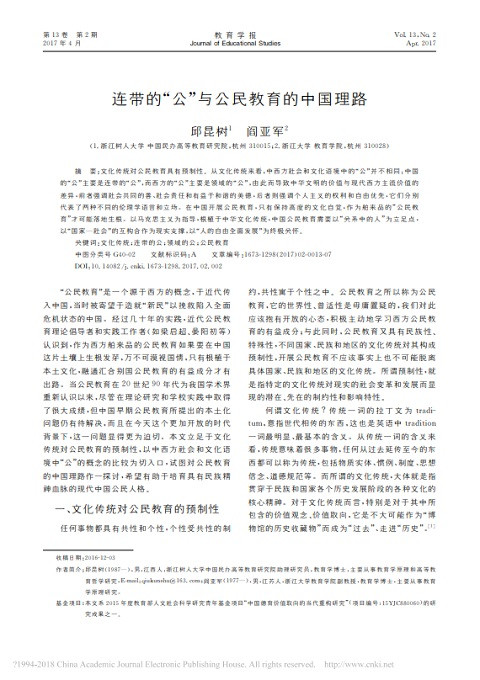 The Connective “Public” and the Chinese Logic of Citizenship Education (Journal of Educational Studies; Vol. 13, No. 2) 出版年份: 2017 作者: Qiu Kunshu | Yan Yajun 机构作者: Beijing Normal University Cultural tradition has pre-conditionality on citizenship education. From the point of view of cultural tradition, the “public” in citizenship education has different meaning in China and the West: Chinese “public” is mainly a kind of connective “public”, while the western “public” mainly means domanial “public”. This lead to the difference in Chinese and modern western main stream values. The former emphasizes the common goodness of the whole society, social responsibility and virtue which is favorable to harmony, while the later emphasizes individualist rights and priority of freedom. They represent two kinds of ethics language and position. It is essential to maintain high cultural awareness for the implementation of citizenship education in China and the localization of exotic “citizenship education”. Guided by Marxism and rooted in Chinese cultural tradition, Chinese citizenship education should be based on “people in relation”, use the actual support of “state-society” cooperation, and offer ultimate concern to “the free and comprehensive development of human”. 连带的“公”与公民教育的中国理路 (教育学报; Vol. 13, No. 2) 出版年份: 2017 作者: Qiu Kunshu | Yan Yajun 机构作者: Beijing Normal University 文化传统对公民教育具有预制性。从文化传统来看,中西方社会和文化语境中的“公”并不相同:中国 的“公”主要是连带的“公”,而西方的“公”主要是领域的“公”,由此而导致中华文明的价值与现代西方主流价值的 差异,前者强调社会共同的善、社会责任和有益于和谐的美德,后者则强调个人主义的权利和自由优先,它 们 分 别 代表了两种不同的伦理学语言和立场。在中国开展公民教育,只有保持高度的文化自觉,作 为 舶 来 品 的“公 民 教 育”才可能落地生根。以马克思主义为指导,根植于中 华 文 化 传 统,中国公民教育需要以“关 系 中 的 人”为 立 足 点, 以“国家—社会”的互构合作为现实支撑,以“人的自由全面发展”为终极关怀。
 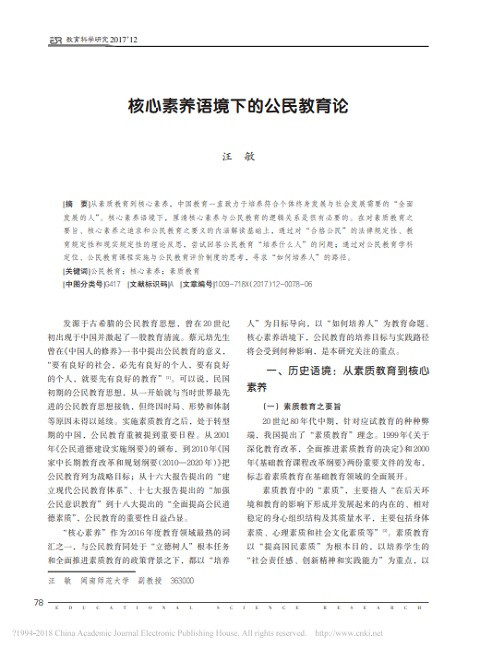 The Theory of Civic Education in the Context of Key Competence (Educational Science Research) 出版年份: 2017 作者: Wang Min 机构作者: Beijing Open University From quality-oriented education to key competence, Chinese education has always been committed to cultivating “well-rounded people” who meet the needs of individual lifelong development and social development. In the context of key competence, it is necessary to clarify the logical relationship between key competence and civic education. On the basis of understanding the essence of quality education, the pursuit of key competence and the connotation of civic education, this paper attempts to answer the question of “who to train” in civic education through theoretical reflection on the legal, educational and practical provisions of “qualified citizen”. Through thinking about the subject orientation, curriculum implementation and evaluation system of civic education, this paper seeks the way of “how to train people”.