
相关资源
探索丰富的全球公民教育资源,深化理解,促进研究、倡导、教学与学习。
共找到2,668条结果
 Expo et outils pédagogiques 出版年份: 2015 机构作者: La maison des solidarités locales et internationales Éduquer à la citoyenneté c’est changer les mentalités et les comportements de chacun dans le but de contribuer individuellement et collectivement à la construction, dès le plus jeune âge, d’un monde juste, solidaire et durable.Dans ce sens, le centre de ressources de la Maison propose à la location ou à la vente des outils pour donner les moyens, par l’information et la sensibilisation, de faire des choix plus responsables.
 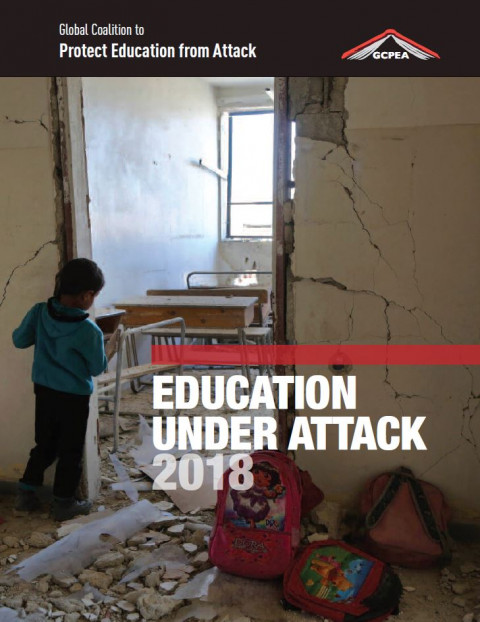 Education Under Attack 2018 出版年份: 2018 机构作者: Global Coalition to Protect Education from Attack (GCPEA) This report is the fourth edition of Education under Attack. It builds on the 2014 study published by the Global Coalition to Protect Education from Attack and the 2007 and 2010 publications by the United Nations Educational, Scientific and Cultural Organization (UNESCO). The present edition covers the five-year period from January 2013 to December 2017. The previous edition included profiles of 30 countries that had experienced at least five incidents of attacks on education in which students or education personnel were harmed, including at least one direct attack or one person killed, between 2009 and mid-2013. The current study includes profiles of 28 countries that experienced at least 20 attacks on education during the 2013-2017 reporting period, regardless of the severity of the incidents. Although significant data gaps remain and data quality varies, reporting of attacks on education has become more comprehensive and systematic over the last five years.Each country profile includes information on six categories of attacks on education, as relevant: Physical attacks or threats of attacks on schools Physical attacks or threats directed at students, teachers, and other education personnel Military use of schools and universities Child recruitment at, or en route to or from, school or university Sexual violence by armed parties at, or en route to or from, school or university Attacks on higher education
 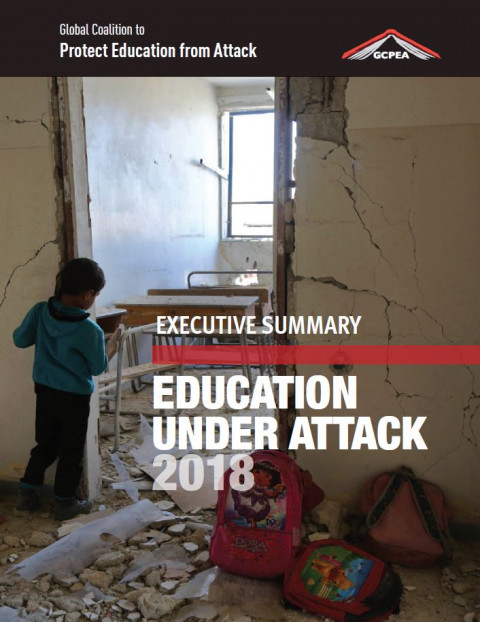 [Summary] Education Under Attack 2018; Executive Summary 出版年份: 2018 机构作者: Global Coalition to Protect Education from Attack (GCPEA) A global study of threats or use of force, either deliberate or indiscriminate, against students, teachers, academics, education support and transport staff or education officials, and against schools, universities and other education institutions carried out for political military, ideological, sectarian, ethnic or religious reasons from 2013 to 2017. [Resumen] Ataques a la Educación 2018; Resumen Ejecutivo 出版年份: 2018 机构作者: Global Coalition to Protect Education from Attack (GCPEA) Estudio global de las amenazas o instancias de uso deliberado o indiscriminado de la fuerza contra estudiantes, docentes, académicos, personal auxiliar educativo y de transporte o funcionarios de educación, y contra escuelas, universidades y otras instituciones educativas, perpetradas con fines políticos, militares, ideológicos, sectarios, étnicos o religiosos entre 2013 y 2017. [Résumé] L’education prise pour cible 2018; Un résumé de 出版年份: 2018 机构作者: Global Coalition to Protect Education from Attack (GCPEA) Une étude globale des menaces ou de l'usage de la force, délibérée ou non, contre les élèves, les enseignants, les universitaires, le personnel scolaire et des transports ou les agents de l'éducation; et contre les écoles, les universités et autres institutions éducatives, menées pour des raisons politiques, militaires, idéologiques, sectaires, ethniques ou religieuses de 2013 à 2017.
  [Video] Global Education Week 2018 Highlights 出版年份: 2019 机构作者: North-South Centre of the Council of Europe This video clip shows some highlights from the 2018 edition (The world is changing: What about us?) of the Global Education Week (GEW).#GlobalEducationWeek#GEW18
  Guide d’enseignement aux citoyens du monde 出版年份: 2016 机构作者: La Fondation Aga Khan Cette ressource est destinée aux corps enseignant des niveaux intermédiaire et secondaire et a pour but d’instruire les jeunes sur le développement international et les thèmes qui y sont liés, notamment la citoyenneté mondiale. Les activités qui y sont présentées visent à approfondir les connaissances des élèves sur l’interdépendance des pays, les facteurs qui exacerbent les inégalités à l’échelle mondiale et les solutions efficaces et durables pour réduire la pauvreté dans le monde. Nous espérons que le contenu incitera les élèves à agir de façon concrète pour améliorer la vie des gens dans le monde entier.
  Human rights education at Holocaust memorial sites across the European Union : An overview of practices 出版年份: 2011 机构作者: European Union Agency for Fundamental Rights Most European Union (EU) Member States have memorial sites and museums that both preserve the memory of the Holocaust and encourage visitors, in particular young people, to reflect on current human rights issues. In this handbook, the European Union Agency for Fundamental Rights (FRA) provides examples of the various ways in which memorial sites link the history of the Holocaust to human rights, ensuring that the past resonates in the present and its lessons are brought to bear on difficult contemporary issues against its backdrop. The report offers a sampling of educational programmes at selected historical sites and museums that either address human rights directly or approach, in a more general way, the dignity of human life and the equality of all human beings. (By the publisher)
  Gathering the voices: Disseminating the message of the Holocaust for the digital generation by applying an interdisciplinary approach The aim of the Gathering the Voices project is to gather testimonies from Holocaust survivors who have made their home in Scotland and to make these testimonies available on the World Wide Web. The project commenced in 2012, and a key outcome of the project is to educate current and future generations about the resilience of these survivors. Volunteers from the Jewish community are collaborating with staff and undergraduate students in Glasgow Caledonian University in developing innovative approaches to engage with school children. These multimedia approaches are essential, as future generations will be unable to interact in person with Holocaust survivors. By students being active participants in the project, they will learn more about the Holocaust and recognize the relevance of these testimonies in today’s society. Although some of the survivors have been interviewed about their journeys in fleeing from the Nazi atrocities, for all of the interviewees, this is the first time that they have been asked about their lives once they arrived in the United Kingdom. The interviews have also focused on citizenship and integration into society. The project is not yet completed, and an evaluation will be taking place to measure the effectiveness of the project in communicating its message to the public. (By the author) "Why are we learning this ?" : Does studying Holocaust Encourage better citizenship values ? 出版年份: 2008 作者: Henry Maitles The relationship between learning about the Holocaust and the development of positive values may seem common sense, but in reality there is a complex level of development and understanding. The research reported here, which was sponsored by the Scottish government, was designed to ascertain whether learning about the Holocaust has an impact on young people’s general citizenship values and attitudes; does learning about the Holocaust allow them to extrapolate from the events of the Holocaust to present-day issues, such as racism and discrimination? The study followed a cohort of approximately 100 pupils (aged 11–12) who had studied the Holocaust and compared their values one year later both to their earlier attitudes and to those of their peers who had not studied the Holocaust. As we might expect, the results were not always as predicted, particularly when it came to the pupils’ understanding of anti-Semitism or genocide; in general, however, the study’s core group maintained more positive values than they had before their lessons on the Holocaust and showed more positive values than their peers who had not studied the Holocaust. (By the author)