
相关资源
探索丰富的全球公民教育资源,深化理解,促进研究、倡导、教学与学习。
共找到1,477条结果
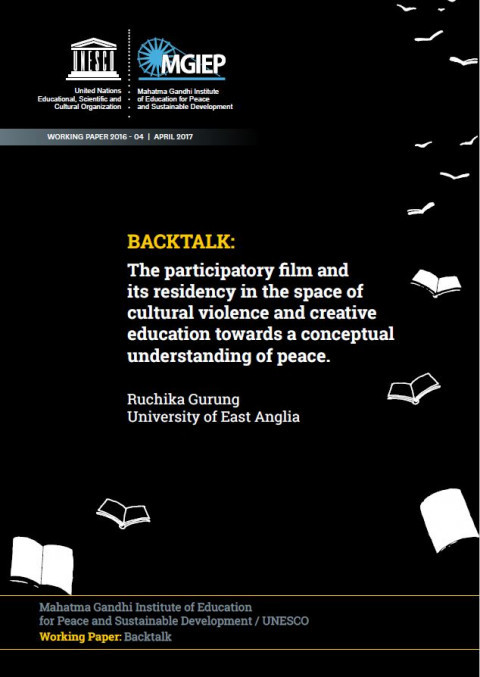 Backtalk: The Participatory Film and Its Residency in the Space of Cultural Violence and Creative Education towards a Conceptual Understanding of Peace 出版年份: 2017 作者: Ruchika Gurung 机构作者: Mahatma Gandhi Institute of Education for Peace and Sustainable Development (MGIEP) Cultural violence is defined as the beliefs, attitudes and values that justify structural and direct violence (Galtung 1990). It dulls us into seeing exploitation and repression as normal or in not actively witnessing it, and the media plays a vital role in its dissemination. Media and in particular film studies occupies a space through which notions of culture, ideology, peace and violence are negotiated.While the observational approach to film is well established in education, participatory filmmaking as an educational tool is what this paper addresses, with reference to concepts of cultural violence and peace education.This paper uses Brantmeier’s (2011) five stage model, that encourages social and cultural change towards a future that is nonviolent, sustainable and renewable, and Bery’s (2003) conceptualisation of empowerment to propose that participatory film functions as a transformative creative process and challenges notions of identity and culture while helping learners describe the world around them (Zembylas & Bekerman 2013).Through analysing existing cases in the field of participatory video (Schwab-Cartas & Mitchell 2014), the author argue that participatory film functions as a tool for creative education practices that promotes a more hands-on approach to raising awareness about cultural violence and engaging with identity formation, and as a creative tool for knowledge creation and dissemination.
 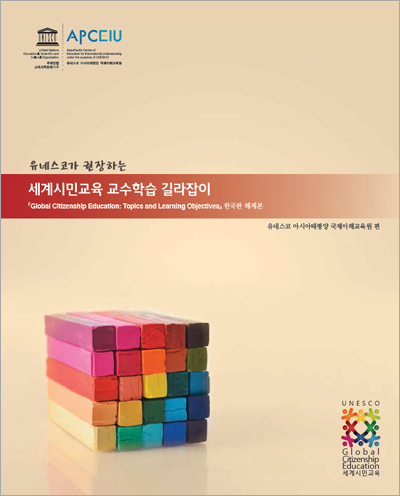 A Pedagogical Guide on Global Citizenship Education in Korean Context 出版年份: 2015 机构作者: APCEIU APCEIU has published a pedagogical guide on Global Citizenship Education (GCED) for Korean readers, which is the Korean adaptation of the UNESCO pedagogical guide, GCED: Topics and Learning Objectives (a.k.a. TLOs).Following the recently launched Korean translation of the TLOs, this Korean adaptation contextualizes the TLOs in Korean education, aligns its terminologies with Korean curriculum, and provides further explanations for Korean readers. This guide was developed by professors in the field of teacher education, primary and secondary school teachers, and curriculum developers with special expertise in GCED/EIU.It is hoped that this guide will help Korean educators and key stakeholders better understand GCED as a new pedagogy and also reflect on traditional teaching-learning experiences in various respects. Éducation Mondiale à la citoyenneté: Sujets et objectifs d'apprentissage 出版年份: 2015 机构作者: Centre Asie-Pacifique d'éducation pour la compréhension internationale (APCEIU) APCECI a publié un guide pédagogique sur l'éducation à la citoyenneté Mondiale (ECM) pour les lecteurs coréens, qui est l'adaptation coréenne du guide pédagogique de l'UNESCO, ECM: Sujets et objectifs d'apprentissage (TLO) alias.Après la traduction coréenne a récemment lancé le TLO, cette adaptation coréenne contextualise les TLO dans l'éducation coréenne, aligne ses terminologies avec curriculum coréen, et fournit d'autres explications pour les lecteurs coréens. Ce guide a été élaboré par des professeurs dans le domaine de la formation des enseignants, les enseignants des écoles primaires et secondaires, et les développeurs de programmes d'études avec une expertise particulière dans ECM / ECI.Il est à espérer que ce guide aidera les éducateurs coréens et les principaux intervenants de mieux comprendre ECM comme une nouvelle pédagogie et de réfléchir également sur les expériences d'enseignement et d'apprentissage traditionnelles à divers égards. 세계시민교육 교수학습 길라잡이: 「Global Citizenship Education: Topics and Learning Objectives」 한국판 해제본 出版年份: 2015 机构作者: 유네스코 아시아태평양 국제이해교육원 이 책은 유네스코가 2015년에 발간한 세계시민교육 교수·학습 지침서 『세계시민교육: 학습 주제 및 학습 목표 Global Citizenship Education: Topics and Learning Objectives(이하 유네스코 지침서)』를 한국 교육현장의 맥락과 독자의 이해를 고려하여 필요한 설명을 덧붙인 한국판 해제본이다. 주로 학교교육과 국가교육과정을 염두에 두고 구성된 이 해제본은 유네스코 지침서의 내용을 한국 교육과정 용어에 맞게 풀어쓰고 맥락화하였으며, 개발 과정에는 세계시민교육/국제이해교육 분야의 전문성을 갖춘 교대와 사범대학 교수, 초·중·고 전현직 교사, 교육과정 전문가 등이 참여하였다. 이 해제본을 바탕으로 교육정책 및 현장의 관계자들이 세계시민교육에 대한 이해를 넓히고 기존의 전통적인 교수·학습 경험을 다각적으로 성찰해보는 기회를 가질 수 있길 기대한다.
 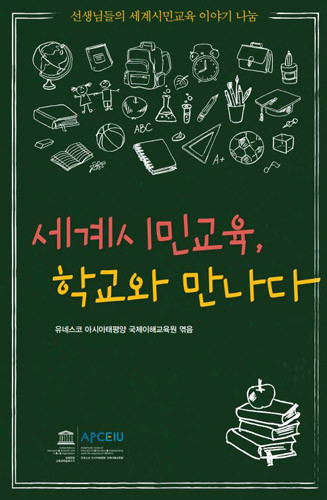 Encountering Global Citizenship Education in Schools: Stories of School Teachers on GCED 出版年份: 2016 机构作者: APCEIU Titled “Encountering Global Citizenship Education in Schools: Stories of School Teachers on GCED,” the book includes stories of 11 GCED Lead Teachers focusing on the practical implementation of GCED in real educational setting. Readers will be able to learn from the experiences of those teachers, who worked to implement GCED in the field of education. Moreover, this publication provides an opportunity for educators from small primary schools in rural areas to the high schools in big cities, to think about the implications associated with GCED and how GCED can be used for students from diverse backgrounds and various ages. The stories included in the book are as follows: • GCED Starts from the Horizontal Relationships • GCED Practices in Small Schools • Doing by Learning, Learning by Doing • To View Social Issues from the Children's Perspective • Living through Communication with the People of Earth • Meeting Global Citizens in Jeju • Beginning of GCED with Students and Teachers • Starting with a Slow Change : The Story of a Candle • GCED with the views of the Children • A Path to the Future, Walking with Teachers to GCED • GCED is to Search for Values in Daily Lives Rencontrant L'éducation à la Citoyenneté Mondiale (ECM) dans les Écoles: Histoires des enseignants sur ECM 出版年份: 2016 机构作者: Centre Asie-Pacifique d'éducation pour la compréhension internationale (APCEIU) Intitulée «Rencontrant L'éducation à la citoyenneté Mondiale (ECM) dans les écoles: Histoires des enseignants sur ECM », le livre comprend des histoires de 11 ECM enseignantes et enseignants leaders mettant l'accent sur la mise en œuvre pratique de l'ECM dans un cadre éducatif réel. Les lecteurs pourront apprendre des expériences de ces enseignants, qui ont travaillé à mettre en œuvre ECM dans le domaine de l'éducation. De plus, cette publication fournit une occasion pour les éducateurs de petites écoles primaires dans les zones rurales vers les écoles secondaires dans les grandes villes, à réfléchir sur les implications associées à ECM et comment ECM peut être utilisé pour les étudiants d'origines diverses et de divers âges. Les histoires inclus dans le livre sont les suivantes: • ECM commence à partir des relations horizontales • Pratiques ECM dans les petites écoles • Faire en apprentissage, apprentissage par la pratique • Pour afficher les questions sociales du point de vue des enfants • Vivre par la communication avec le peuple de la Terre • réunion des citoyens du monde à Jeju • Début de l'ECM avec les étudiants et les enseignants • a partir d'un changement lent: l'histoire d'une bougie • ECM avec les points de vue des enfants • un chemin vers l'avenir, Marcher avec les enseignants pour ECM • ECM est à la recherche pour les valeurs dans la vie quotidienne 세계시민교육, 학교와 만나다: 선생님들의 세계시민교육 이야기 나눔 出版年份: 2016 机构作者: 유네스코 아시아태평양 국제이해교육원 유네스코 아시아태평양 국제이해교육원은 “세계시민교육, 학교와 만나다”를 출간하였다. 이 책은 세계시민교육을 실천하고 있는 학교 선생님들의 현장 이야기를 담은 책으로, 세계시민교육 선도교사로 활동하고 있는 11명의 선생님들의 세계시민교육에 관한 진솔한 이야기를 만날 수 있다. 여는글수평적 관계 맺음으로 시작하는 세계시민교육 - 김동혁 (광주 문정여고)작은 학교에서 세계시민교육 실천하기 - 곽병남 (충북 영동초등학교)배움으로 행동하기, 행동으로 배우기 - 임영아 (울산 강남고등학교)아이들의 시선에서 사회적 문제 바라보기 - 이흥순 (인천 청일초등학교)지구인과 소통하며 살아가기 - 박범철 (서울 경문고등학교)제주에서 세계시민을 만나다 - 한상희 (제주 서귀중앙여자중학교)아이들과 함께, 선생님들과 함께 열어가는 세계시민교육 - 김민경 (인천 청량초등학교)스스로, 천천히, 하나의 변화로 시작하기: ‘촛불하나’ 이야기 - 최재화 (경기 신천고등학교)세계시민교육, 아이들과 눈맞춰 함께 가기 - 김양모 (안동 동부초등학교)미래로 가는 길, 선생님과 함께 걷는 세계시민교육 - 정애경 (서울 국제고등학교) 세계시민교육이란 일상에서 가치 찾기 - 조성준 (대전 복수고등학교)
  Final Report: 2nd Youth Leadership Workshop on Global Citizenship Education 出版年份: 2016 机构作者: APCEIU This report provides an overview of the activities carried out during the 2nd Youth Leadership Workshop on Global Citizenship Education (GCED) held in Busan, Republic of Korea, from 11 - 16 July 2016. As an APCEIU's 2nd youth workshop, this programme gathered 49 youth activists from 38 countries around the world to exchange their ideas and identify GCED leadership strategies in order to mobilize young people for GCED in local and national contexts and advance the agenda globally. This report also aims to convey the voice of the youth on GCED: their thoughts and reflections on GCED and its priority areas. The workshop was co-organized by APCEIU and UN Secretary General’s Global Education First Initiative (GEFI); it was sponsored by Busan University of Foreign Studies and the Geum-jeong District of Busan Metropolitan City. For more information, please contact APCEIU's Office of Education and Training at ent@unescoapceiu.org. 제2차 세계시민교육 청년리더십 워크숍 최종보고서 出版年份: 2016 机构作者: 유네스코 아시아태평양 국제이해교육원 본 보고서는 2016년 7월 11일부터 16일까지 부산에서 열린 ‘제2차 세계시민교육 청년리더십 워크숍(2nd Youth Leadership Workshop on GCED)’에서 이루어진 활동 개요를 제공한다. 이 워크숍은 유네스코 아태교육원과 유엔 사무총장의 글로벌교육우선구상(GEFI)가 공동주최하고 부산외국어대학교와 부산광역시 금정구가 후원하였다.이 프로그램에 전세계 38개국 49명의 청년활동가들이 참가하여 세계시민교육에 대한 아이디어를 교환하며, 세계시민교육을 전 세계적으로 확산하고 지역·국가적 차원의 청년활동을 증진하기 위한 리더십 전략을 논의하였다. 본 보고서는 6일간의 워크숍 활동들에 대한 기록과 더불어 세계시민교육의 주체로서 청년들의 세계시민교육의 의미와 우선 과제들에 대한 목소리를 담고자 했다. 문의: 유네스코 아태교육원 교육연수실(ent@unescoapceiu.org)
 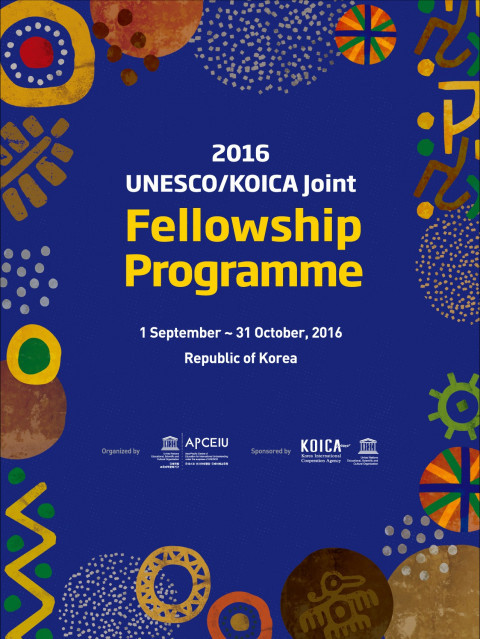 Final Report: 2016 UNESCO/KOICA Joint Fellowship Programme 出版年份: 2016 机构作者: APCEIU This report provides an overview of the activities carried out during the 2016 UNESCO/KOICA Joint Fellowship Programme held in Republic of Korea from 1 September - 31 October, 2016.In its 10th year of implementation, UNESCO/KOICA Joint Fellowship Programme 2016 invited 25 educators from 17 countries in Africa and the Asia-Pacific region for two months; from September 1st to October 31st. The overarching goal of the Programme was to enhance the capacities of participating educators under the themes of “Teacher Training for Basic Education,” “Use of ICT for Education (or e-Learning),” “Leadership in Global Education” and “Girls’ Education.” Composed of various segments such as lectures, workshops, hands-on activities, and seminars, which were closely interlinked with each module, the modules were designed to enable the participants to reorient their perspectives on educational development, to gain essential knowledge and skills, and furthermore to produce meaningful and relevant outputs that could be widely applied in their local contexts.For more information, please contact APCEIU's Office of Education and Training at ent@unescoapceiu.org.