
相关资源
探索丰富的全球公民教育资源,深化理解,促进研究、倡导、教学与学习。
共找到1,471条结果
 One World, One People, One Future: Imagine a World that Understands, Embraces & Practices Peace and Sustainable Development 出版年份: 2014 机构作者: Mahatma Gandhi Institute of Education for Peace and Sustainable Development (MGIEP) One World, One People, One Future: Imagine a World that Understands, Embraces & Practices Peace and Sustainable Development
  The Elusive and Exclusive Global Citizen 出版年份: 2015 作者: Jill Koyama 机构作者: Mahatma Gandhi Institute of Education for Peace and Sustainable Development (MGIEP) In this paper, the author interrogate the notion of global citizenship, both as an aspiration and an improbable practice, by situating it within contemporary understandings of citizenship and globalization.It is a conceptualization that suffers from the dangers inherent in the term “citizenship” and misconceptions of the terms “global,” and it is rooted in the West’s long engagement in normative undertakings in non-Western countries. The writer refute ideas of the autonomous and agentic global citizen. he encourage a rethinking of global citizenship and global citizenship education (GCE) and offer recommendations for redirecting attention to contemporary global stratifications and issues of human rights to address the issues of social justice and inequality that, due to the problematic definition of global citizenship, are currently inadequately covered in existing GCE curricula.
  Citizenship, Identity, and Education: Examining the Public Purposes of Schools in an Age of Globalization 出版年份: 2006 作者: Fernando Reimers 机构作者: UNESCO International Bureau of Education (IBE) One of the purposes of educational institutions is to develop citizenship. In the 21st century, citizenship includes global citizenship. Addressing the challenges of globalization will require making citizenship education and the development of global values an explicit objective of efforts to improve quality throughout the world, critically examining theories and evidence about the effectiveness of various approaches to developing citizenship and global citizenship and supporting activities aligned with this public purpose. In this article, the author does not argue for an exclusive effort to focus schools on civic education, but rather for a balanced effort to elevate educational quality making it more relevant to address global challenges and opportunities, of which civic education and global education are components, much neglected at present. The author also does not suggest making civic education the only purpose of the curriculum or making it a priority to the expense of science, math, arts or physical and health education, but he thinks that helping students develop a sense of purpose, situated within broader civic and global purposes, would also facilitate high level engagement with science, mathematical and artistic pursuits.
  The war in our minds: is global citizenship the answer? (Blue Dot issue 1) 出版年份: 2015 机构作者: Mahatma Gandhi Institute of Education for Peace and Sustainable Development (MGIEP) Feature Global Citizenship Education: A New Educational, Pedagogical and Political Narrative in the World System? (by Carlos A. Torres) In Pursuit of a Global Civics (by Hakan Altinay) Global Citizenship: Necessary and Possible (by Paul and Anne Ehrlich) Cover Story YOUth Speak for a better today and tomorrow (by Piyali Sarkar Debnath, UNESCO MGIEP) Essays Unlocking the Civic Sense of Young Minds (by Karthik Shankar) Shared Home, Shared Hopes and Shared Actions (by Trang T. Nguyen) Redesigning the Education System for Global Citizenship (by Ayodeji Ojo) Youth Voices Who is a global citizen? News What we have been up to UNESCO MGIEP Crossword Event Calendar
 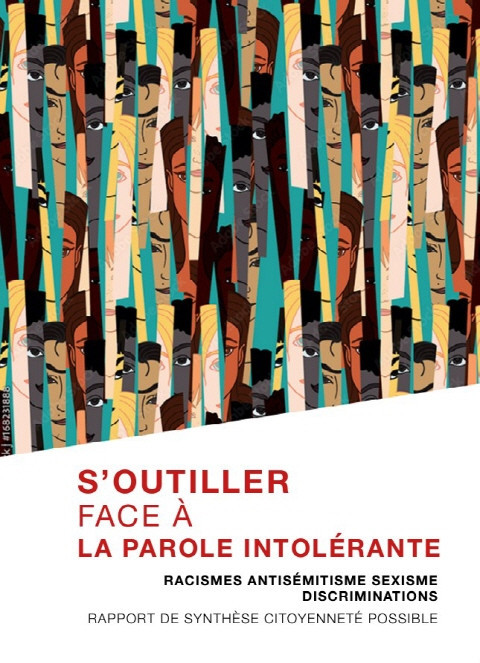 Equipping To Deal With Intolerant Speech: Racism, Antisemitism, Sexism, Discriminations 出版年份: 2023 机构作者: Citoyenneté Possible In this report, NGO Citoyenneté Possible shares 18 years' experience in the field of anti-discrimination and dialogue. It provides both hands-on experience, with testimonials and tools, and in-depth reflection, analysis and sharing of experiences, practices and visions. It's possible to dare to engage in constructive dialogue on divisive issues, provided you have the intention to do so, and above all, the skills to do so. This report offers very concrete and detailed recommendations for professionals working with young people (teachers, educators, associations, etc.). S'outiller face à la parole intolérante: Racisme, antisémitisme, sexisme, discriminations 出版年份: 2023 机构作者: Citoyenneté Possible L’association Citoyenneté Possible partage dans ce rapport 18 ans d’expérience de terrain dans la lutte contre les discriminations et pour le dialogue. Il livre à la fois une expérience de terrain, avec des témoignages, des outils, et une réflexion de fond, des analyses et points de partage d’expériences, de pratiques et de vision. Ne pas laisser passer, oser dialoguer sur des sujets clivants de manière constructive est possible, certes à condition d’en avoir l’intention, mais surtout d’en avoir acquis les compétences. Ce rapport propose des recommandations très concrètes et détaillées, pour les professionnels travaillant auprès d’un public jeune (enseignants, éducateurs, associations…)
  Peace education: framework for teacher education, 2005 出版年份: 2005 机构作者: UNESCO New Delhi UNESCO has taken a commendable initiative in promoting peace education. It has generated some important literature and educational material on peace education. ‘Learning the Way of Peace: A Teacher’s Guide to Peace Education’ is a pioneering work. It is because of UNESCO’s initiative that this material on peace education for teacher education has been developed. It would be useful to read this document in conjunction with “Learning the Way of Peace.” Éducation à la Paix: cadre pour la formation des enseignants 2005 出版年份: 2005 机构作者: UNESCO New Delhi L'UNESCO a pris une initiative louable dans la promotion de l'éducation de la paix. Il a généré une certaine littérature importante et du matériel éducatif sur l'éducation de la paix. «Apprendre la Voie de la Paix: Guide de l'Enseignant à l'Éducation de la Paix» est un travail de pionnier. Il est à cause de l'initiative de l'UNESCO que ce matériel sur l'éducation de la paix pour la formation des enseignants a été mis au point. Il serait utile de lire ce document en collaboration avec «Apprendre le Chemin de la Paix. »
 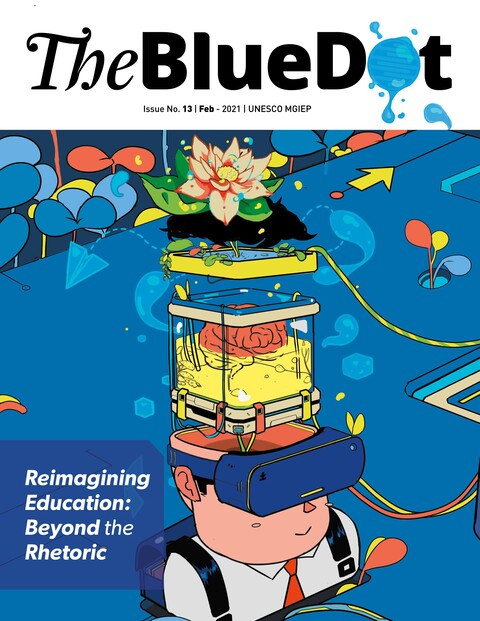 Reimagining Education: Beyond the Rhetoric (The Blue Dot; No.13, 2021) 出版年份: 2021 机构作者: Mahatma Gandhi Institute of Education for Peace and Sustainable Development (MGIEP) The events of the year 2020, driven predominantly by the COVID-19 pandemic, have forced governments, policymakers, educators and organisations to rethink the purpose, structure and modality of existing education systems. Even while the world is struggling with climate change, decreased empathy, violent extremism, xenophobia and an increase in mental health issues in children, with a recent report by WHO highlighting that 800,000 people between the ages of 15-29 are dying by suicide ever year, globally1 , the COVID-19 virus singlehandedly shut down access to face-to-face school education for roughly half of the world’s student population. These ongoing and unexpected challenges bring to light the urgent need for education systems to be more adaptable, responsive, and resilient to future shocks and disasters. We can work to transform education in many ways, such as by translating our understanding of how the brain learns from the research laboratory to the classroom and leveraging the power of technology to ensure that learning can reach every child who hungers to learn. It is time we reimagine education to ensure learning continues with minimal disruption but also empowers students as compassionate human beings, prepared for an unpredictable future, but also as global citizens seeking a peaceful and kinder world. The purpose of education needs to change from being instrumental (based on human capital) to one that is constitutive (human-flourishing), accessible to all and structured such that learning can happen anytime and anywhere and always.
  Education for conflict prevention and peacebuilding: meeting the global challenges of the 21st century 出版年份: 2012 作者: Phyllis Kotite 机构作者: UNESCO International Institute for Educational Planning (IIEP) The 21st century is witnessing global concern over the interrelated effects of climate change, the economic crisis, energy depletion, food and water shortages, natural disasters and conflicts all of which have devastating effects on humanity and the future of the planet. These events impact education systems and can impair the ability of governments to provide quality education for their citizens. However, when governments and ministries of education analyse and anticipate the risk of such events through careful planning, education can play an important role in preventing violent conflict, and in supporting peacebuilding efforts. An estimated 1.5 billion people live in countries affected by repeated cycles of political and other forms of violence, and the same population is often affected by hunger and poverty. Furthermore, such countries have difficulty meeting development goals. For example, no low-income fragile or conflict-affected country has yet achieved a single MDG (World Bank, 2011). In 2010 world military expenditures reached US$1.6 trillion as a result of fifteen ongoing conflicts (SIPRI, 2011). Yet, it is estimated that only US$16 billion is needed to fill the education gap to reach the EFA goals (UNESCO, 2011b: 11). This paper argues that we have the knowledge, legal instruments and mechanisms to prevent conflict and to transfer resources to sustainable development and education to meet the challenges of the 21st century. The paper describes a range of conflict prevention initiatives and examines the role of policy-makers, youth, women, and the media in maintaining and restoring peace as part of a holistic vision of education. International institutions, governments and civil society are increasingly developing conflict prevention mechanisms and utilizing political and economic incentives to avoid conflicts. They are also creating new technology for sustainable development, adaptation to climate change and renewable forms of energy. Educational planning must therefore go beyond traditional mechanisms. It must take into consideration the unpredictable nature of our times; be flexible and rapid in implementation and responsive to local needs. Training and research in sustainable development; and skills for peaceful inter-human relations, good governance, the prevention of conflict and peacebuilding are priorities elaborated in the paper. In addition, specific recommendations are highlighted such as: capacity development for conflict prevention within the education sector and other ministries, analysing the root causes of conflict and the role that education can play in mitigating tensions. This paper is an elaboration of Chapter 1.2 of the IIEP-UNESCO Guidebook for Planning Education in Emergencies and Reconstruction (IIEP-UNESCO, 2010). A brief treatment of additional global challenges (e.g. water scarcity, food insufficiency, energy depletion and economic instability), which are beyond the educational focus of this paper, may be found in Annex I.