
相关资源
探索丰富的全球公民教育资源,深化理解,促进研究、倡导、教学与学习。
共找到1,450条结果
 Mondiale l'éducation civique et la formation des enseignants dans un contexte mondial: le Canada, l'Inde et l'Afrique du Sud 出版年份: 2011 作者: George Cappelle | Gary Crippin | Ulla Lundgren 机构作者: Children's identity and Citizenship in Europe (CICE) Dans cette étude, nous changeons notre objectif d'un cadre européen pour une approche globale. Nous nous sommes intéressés de voir comment nos observations de la première étude serait reflétée dans un contexte plus global en mettant l'aCECnt sur les cas du Canada, l'Inde et l'Afrique du Sud qui cherchent à la fois les modèles pour l'éducation à la citoyenneté mondiale et l'influence des facteurs contextuels. Dans le choix de ces pays, nous étions intéressés à: ● Les pays sur différents continents ● pays à différents stades de développement national, social et économique ● Les pays dans lesquels il y avait une grande diversité dans les populations ● Les pays dans lesquels la citoyenneté et la citoyenneté mondiale l'éducation a été considérée comme une priorité ● importants pays, en raison des limitations des chercheurs, qui ont utilisé l'anglais comme langue principale. Outre la recherche de fond, nous avons demandé l'aide de professeurs dans le domaine de la formation des enseignants dans les trois pays pour nous fournir des informations sur des questions clés liées à l'éducation à la citoyenneté et à la formation des enseignants.
 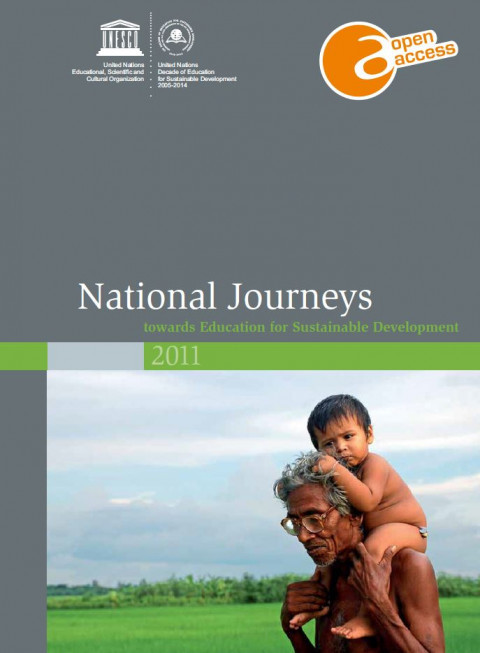 National journeys towards education for sustainable development, 2011: reviewing national experiences from Chile, Indonesia, Kenya, the Netherlands, Oman 出版年份: 2011 作者: I. Mulà | Daniella Tilbury 机构作者: UNESCO This publication has sourced information from a series of national reviews commissioned by UNESCO in 2010 and written by authoritative stakeholders in Chile, Indonesia, Kenya, the Netherlands and Oman. The selection of countries was based on: i) work showcased at the 2009 World Conference on Education for Sustainable Development held in Bonn, Germany; ii) submissions to the monitoring and evaluation process for the Decade of Education for Sustainable Development (DESD); as well as iii) through evaluation material submitted by UNESCO staff in regional bureaux of education.The countries showcased in this report are not necessarily the ‘best’ examples of the region, as many other countries are also progressing effectively towards implementing ESD. Rather, the countries selected illustrate the wide diversity of ESD approaches and initiatives taking place in different parts of the learnt world. The national studies were then edited and harmonized before common themes and lessons learned were identified to support other national efforts in moving towards the second half of the UN Decade of Education for Sustainable Development. Education, diversité et cohésion sociale en Méditerranée occidentale 出版年份: 2010 作者: Sobhi Tawil | Abdeljalil Akkari | Bouthaïna Azami 机构作者: UNESCO La diversité culturelle constitue une caractéristique essentielle des différentes sociétés de la région de la Méditerranée occidentale où une multitude de traditions religieuses et culturelles se sont côtoyées et réciproquement influencées, créant ainsi une mosaïque sociale particulièrement intéressante. Or, la diversité, source de créativité et d'enrichissement culturel, peut aussi amener à renforcer les tensions sociales et creuser les divisions, menaçant ainsi la cohésion sociale à l'intérieur des sociétés comme entre les pays de la région. En effet, des événements récents ont attiré l'attention sur des tensions sociales et politiques liées à l'identité et à la cohésion sociale dans un contexte de mondialisation, d’accroissement des disparités des niveaux de développement économique entre les deux rives de la Méditerranée occidentale et de diversification grandissante des flux migratoires, contexte trop souvent marqué, par ailleurs, par une exacerbation du phénomène de l’exclusion sociale, de la montée de la xénophobie et de l’extrémisme religieux. Conscients de l’importance de la contribution essentielle de l’éducation pour promouvoir un dialogue interculturel axé sur les principes d’équité, de justice, et de respect de la dignité et de la diversité culturelle, la Chaire UNESCO Droits de l’homme et éthique de la coopération internationale de l’Université de Bergame, le Bureau multipays de l’UNESCO à Rabat, et l’ISESCO ont conjointement lancé, en 2007, le projet Education, diversité et cohésion sociale en Méditerranée occidentale. Le projet s’inscrit dans une dynamique de recherche, de dialogue et d’action, renforçant ainsi les efforts de chacun des trois partenaires visant à promouvoir la culture de la justice et de la paix. Cette recherche propose de nouveaux éclairages sur le rôle des systèmes éducatifs nationaux dans la promotion du respect de la diversité et le renforcement de la cohésion sociale, et esquisse des pistes d’action et de coopération. Nous formons le vœu que cet ouvrage commun, fruit des travaux de recherche se rapportant au projet, puisse contribuer à la promotion du respect de la diversité et de la cohésion sociale en Méditerranée occidentale.
 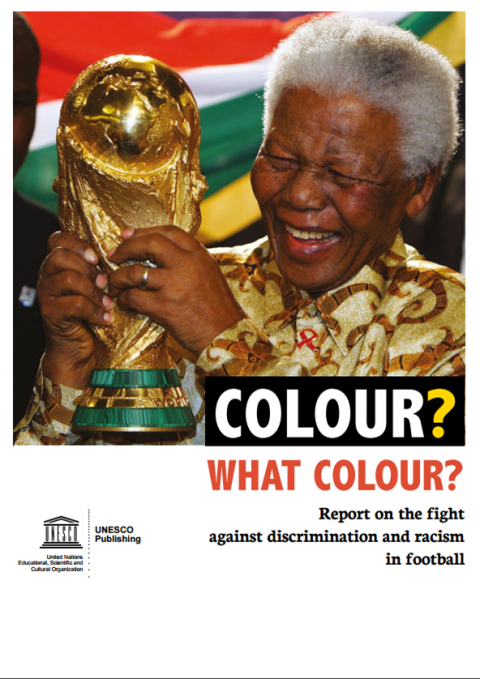 Colour? What colour? Report on the fight against discrimination and racism in football 出版年份: 2015 作者: Albrecht Sonntag | David Ranc 机构作者: UNESCO Football has been shown to be a mirror of society, it may also be viewed as providing a temporary suspension of reality for an interlude of high emotion and idealized hopes and dreams. Football’s public transcends differences of age, gender, culture, religion, and socioeconomic status to unite in support of their team. The broad diversity of backgrounds of football players represents tangible evidence of equal opportunity and meritocracy. The sport itself has team solidarity, fair play and mutual respect among members and for opponents ingrained within its rules and practices. Yet, the ‘beautiful game’ is one with an imbedded paradox. Football is also a game that may in many vaguely resemble war, where opponents face each other in a struggle to win over the other side, with the noisy and emphatic support of the spectators. An ‘us’ and ‘them’ mentality is an integral part of trying to help a team reach the objective, which is to win the game. This setting naturally produces a desire by supporters to intimidate the other side by encouraging their team and expressing both confidence and superiority through their words and actions. When the ‘us’ and ‘them’ mentality turns into symbolic exclusion of others, language of disparagement and insult based on racism or discrimination, or physical confrontation, the ‘beautiful game’ is debased. The existence of racism and discrimination in football is not a secret, but it is a shame on the game. Although much is already being done, both observers and experts feel too many problems persist and measures to tackle them have not been effective enough. This report was commissioned by UNESCO within the framework of UNESCO’s partnership with Juventus. It focuses on discrimination and racism in professional football and to some extent the amateur clubs that funnel into the leagues. It provides an overview of the historic and theoretical background. It reports on the state of affairs on the ground. It summarizes what has been done and is being done to mitigate racism and discrimination in domestic and international football, how the effects of these actions may be evaluated, and which new avenues for further, complementary action are promising. The report is based on a literature review, desk research, regional reports from the Unesco network and a field survey among a purposive sample of experts and actors in a number of countries. The report has a somewhat European focus, in its sources and examples. Europe has a unique position Executive Summary in the world of football, with its leading competitions, championships and clubs. It is the region where racism and discrimination in football has been most intensively researched. A number of civil society organisations from Europe have played a pioneering role in the fight against racism and discrimination in football. Moreover, the pressure that comes with the money invested in and generated by western European football, as well as its exposure in the media, has also made clubs, federations and UEFA particularly sensitive to the negative impact that discrimination can have on the game and its image, within Europe and worldwide. Europe must therefore occupy a central role in a study of the fight against discrimination in professional football and in determined policies to mitigate racism and discrimination related to football wherever they occur. The examples of incidents of discrimination and racism, as well as of existing measures to combat them have been selected to be as wide-ranging as possible. The authors do not, however, claim the report to be a comprehensive listing. Similarly, the examples of best practice have been collected through extensive reading and contacts, but must be looked at as an overview rather than as a directory. They are chosen by the authors to illustrate types of actions and institutions with the potential for greatest impact. The report also does not deal with the methods of allocation of resources to football, with issues of employment, or with womens’ football. While these are significant topics on which concerns can be expressed, the necessary focus of a report of this type means that they are alluded to without being treated in depth.
  Human rights education in the school systems of Europe, Central Asia and North America: a compendium of good practice 出版年份: 2009 机构作者: Council of Europe | UNESCO | UN. Office of the United Nations High Commissioner for Human Rights (UN. OHCHR) | OSCE. Office for Democratic Institutions and Human Rights (ODIHR) “Human Rights Education in the School Systems of Europe, Central Asia and North America: A Compendium of Good Practice” is a compilation of 101 examples of good practice in human rights education in primary schools, secondary schools and teacher training institutions in the Organization for Security and Co-operation in Europe (OSCE) area, which is also covered by the United Nations Educational, Scientific and Cultural Organization (UNESCO), the Office of the United Nations High Commissioner for Human Rights (OHCHR) and, partially, the geographical mandate of the Council of Europe (CoE).The term “human rights education” is often used in this resource in a broader sense, to also include educationfor democratic citizenship and education for mutual respect and understanding, which are all based on internationally agreed human rights standards. These three areas are seen as interconnected and essential within educational systems in order to prepare youth to be active, responsible and caring participants in their communities, as well as at the national and global levels.Human rights education has been defined as education, training and information aimed at building a universal culture of human rights. A comprehensive education in human rights not only provides knowledge about human rights and the mechanisms that protect them, but also imparts the skills needed to promote, defend and apply human rights in daily life. Education for democratic citizenship focuses on educational practices and activities designed to help young people and adults to play an active part in democratic life and exercise their rights and responsibilities in society. Education for mutual respect and understanding highlights self-respect, respect for others, and the improvement of relationships between people of differing cultural traditions.This book aims to support quality teaching in these areas and to inspire educational policymakers (those working in education ministries and local school boards) and administrators, teachers, teacher trainers, non-formal educators and all other interested actors, as well as to facilitate networking and the exchange of experience among education professionals. Inclusion from the start: guidelines on inclusive early childhood care and education for Roma children 出版年份: 2014 机构作者: UNESCO | Council of Europe Inclusion from the start: guidelines on inclusive early childhood care and education for Roma children (Guidelines hereafter) is a joint contribution by the Council of Europe and UNESCO to improving access to quality early childhood services for Roma children. They are a concrete follow-up to the recommendations arising from an expert meeting, organised by the two organisations in 2007.1 Recognising that quality early childhood experience is an important stepping stone toward inclusive participation in school and society, the Guidelines address the challenges specifc to Roma children in the early years and transition to primary education. They provide guidance on key themes, such as the conceptualisation of early childhood care and education (ECCE) services, agenda-setting, stakeholders’ responsibilities, curricular and pedagogical approaches, staf training and professional development, assessment and transition to primary education. The Guidelines primarily address formal ECCE services – such as kindergartens and preschools – which typically cater for children from ages 3-6 years. The reason for this focus is that providing care and education experience prior to primary school entry is crucial for supporting Roma children’s school readiness and for facilitating an equal start in their frst year. This being said, the Guidelines also acknowledge the critical importance of the years pre-natal to age 3, and consider health and nutrition interventions and non-formal ECCE programmes (e.g. community-based childcare, parenting education) as essential services in deprived neighbourhoods and settlements. Inclusion dès le début: les lignes directrices sur les soins de la petite enfance inclusive et éducation pour les enfants roms 出版年份: 2014 机构作者: Organisation des Nations Unies pour l'éducation, la science et la culture (UNESCO) | Conseil de l'Europe Inclusion dès le début: les lignes directrices sur les soins de la petite enfance inclusive et l'éducation des enfants roms (lignes directrices ci-après) est une contribution conjointe du Conseil de l'Europe et de l'UNESCO à l'amélioration de acesss aux services de la petite enfance de qualité pour les enfants roms. Ils sont un suivi concret aux recommandations découlant d'une réunion d'experts, organisée par les deux organisations en 2007.1. Reconnaissant que l'expérience de qualité de la petite enfance est une étape importante vers la participation inclusive à l'école et de la société, les lignes directrices abordent les défis spécifques aux enfants roms dans les premières années et la transition à l'enseignement primaire. Ils fournissent des conseils sur des thèmes clés, tels que la conceptualisation des soins de la petite enfance et les services d'éducation (EPPE), l'établissement de l'ordre du jour, les responsabilités des parties prenantes, des programmes et des approches pédagogiques, la formation des staf et le perfectionnement professionnel, l'évaluation et la transition à l'enseignement primaire. Les lignes directrices traitent principalement des services formels EPPE - tels que les jardins d'enfants et les écoles maternelles - qui répondent généralement pour les enfants âgés de 3-6 ans. La raison de cette mise au point est que la prestation de soins et de l'expérience de l'éducation avant l'entrée de l'école primaire est cruciale pour soutenir la maturité scolaire des enfants roms et pour faciliter un départ égal dans leur année frst. Ceci étant dit, les lignes directrices reconnaissent également l'importance critique des années pré-natal à 3 ans, et d'envisager des interventions de santé et de la nutrition et des programmes non formels EPPE (garde d'enfants, l'éducation parentale à base communautaire) comme des services essentiels dans les quartiers défavorisés et colonies.
  Informe de las Naciones Unidas sobre el desarrollo de los recursos hídricos en el mundo 2016: agua y empleo 出版年份: 2016 机构作者: UNESCO Three out of four jobs worldwide rely on water. As such, water shortages and lack of access may limit economic growth in the years to come, according to the World Water Development Report 2016. From its collection, through various uses, to its ultimate return to the natural environment, water is a key factor in the development of job opportunities either directly related to its management (supply, infrastructure, wastewater treatment, etc.) or in economic sectors that are heavily water-dependent such as agriculture, fishing, power, industry and health. In its analysis of the economic impact of access to water, the report cites numerous studies that show a positive correlation between investments in the water sector and economic growth. It also highlights the key role of water in the transition to a green economy.
  Study on challenges in the development of local equality indicators: a human-rights-centred model; Commitment 2 of the Ten-Point Plan of Action 出版年份: 2010 作者: Klaus Starl | Jennifer Pinno 机构作者: UNESCO | European Training and Research Centre for Human Rights and Democracy (Austria) The study aims at: Providing a theoretical fundament of ECCAR Indicators to measure racism or (in)equality1 and to evaluate municipal anti-discrimination policies (framework concept), and Discussing related legal and practical issues such as legality and reliability of available ‘ethnic’ data (legal and practical preconditions) in the context of ECCAR’s endeavours to set up an ECCAR-wide applicable system of monitoring racism, discrimination, equality and respective municipal policies. The study is structured in three parts. In the first part, preliminary questions concerning legality and practical feasibility of ‘ethnic’ data collection as a prerequisite for the development of and work with adequate indicators will be discussed. The second part deals with the conceptualization of human rights law as the constructing principle of ECCAR Indicators. It includes the discussion of the proposed model of the ECCAR-ADIX. The third part of the study describes practical examples of indicator use in selected ECCAR member cities. The section shows various approaches and gives evidence on different attempts by municipalities to set up fact-based anti-racism policies but also highlights the variety of methods, data, measurement topics, goals, etc.
 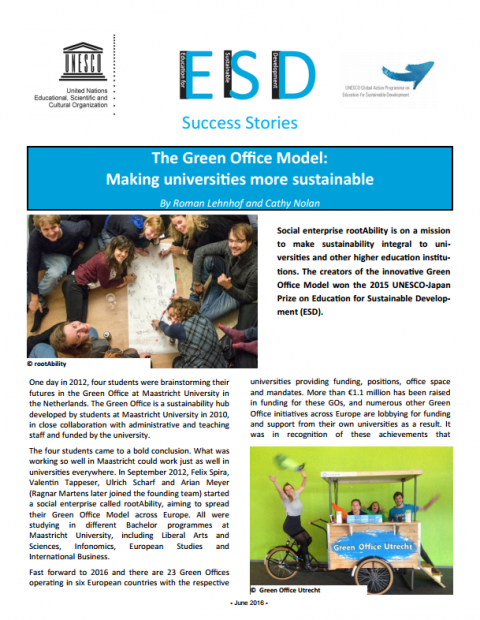 The Green office model: making universities more sustainable 出版年份: 2016 作者: Roman Lehnhof | Cathy Nolan 机构作者: UNESCO ESD Success Stories are showcasing compelling stories with a personal/human dimension from all five UNESCO regions (Africa, Arab States, Asia and Pacific, Europe & North America and Latin America & the Caribbean). The stories illustrate the wide diversity of ESD approaches and initiatives taking place in different parts of the world. They show how involvement with ESD has changed the lives of specific individual persons and how they have become more active in their community. Each story centers on one individual or a group of individuals.The rootAbility, a social enterprise, is planned by four students at Maastricht University, aiming to spread Green Office Model across Europe. The Green Office can effectively drive a dynamic sustainability process in universities and other institutions of higher education by collaboratively working with students and university staffs and integrating sustainability into university’s teaching and research.