
相关资源
探索丰富的全球公民教育资源,深化理解,促进研究、倡导、教学与学习。
共找到3,436条结果
 Le cœur de l'éducation: apprendre à vivre ensemble; articles sélectionnés présentés à la 16e Conférence internationale UNESCO-APEID 出版年份: 2014 机构作者: UNESCO Bangkok Pour aider à encadrer la réflexion actuelle sur l'éducation dans un monde en mutation, l'UNESCO à Bangkok, le Ministère de l'éducation en Thaïlande, le Réseau Asie-Pacifique pour l'éducation et les valeurs internationales (APNIEVE), Pearson Thaïlande et JP Morgan co-organisé le 16 UNESCO-APEID internationale Conférence, The Heart of Education: Apprendre à vivre ensemble en Novembre 2012 à Bangkok, Thaïlande. La conférence a fourni un forum pour les participants de partager leurs connaissances et expériences, soulèvent des questions critiques, fournir une rétroaction constructive et, surtout, expriment leur engagement à imprégner et de traduire l'essence de l'apprentissage à vivre ensemble dans leurs efforts éducatifs respectifs. Ce rapport contient des documents présentés à la conférence afin de refléter les liens entre l'apprentissage et le développement social, les approches de la vitrine et des outils, et d'identifier des politiques favorables et des instruments pour promouvoir l'apprentissage à vivre ensemble sélectionné. جهانی شدن و ضرورت آموزشهای شهروندی جهانی 出版年份: 2012 作者: Yousef Keshavarz 机构作者: Center for Strategic Studies of the Presidency Today, due to “Globalization”, the fate of all individuals, organizations and governments are more tied together and effects of this process in all areas of human activity is undeniable. By looking at the concept of “Global Citizenship” new expectations of education as a meaningful factor to people’s lives and a tool to develop human character and supplying the social needs, is formed. This paper aims to examine and discuss the characteristics and components of global citizenship, the role, importance and necessity of global citizenship education. If we accept that the current use of existing resources in the world is unfair and unacceptable and the gap between rich and poor (in all aspects) wide and widens, should ponder choice. Training and education of global citizens (especially children and young people) who wish the world as a place full of justice, equality, peace and sustainable development, respect and protection of racial diversity, religious etc… and also possess other characteristic features addressed in this paper seems to be a powerful tool and solution. In this frame work, poverty and identity crisis of Iranian youth and in the other hand being attracted to the Globalization culture of outsiders, are two points that reveal the necessity for paying more attention to the training of global citizens, to adopt a broad and enormous prospective to the global issues. Therefore, according to the valuable Islamic texts and outlined prominent place for human beings and human values, also with consideration to the rich Iranian culture and civilization in direction with an active role in global co-management, living such training in formal and informal education system and also establishment of a center as such in partnership and cooperation with other educational institutions in the country is suggested. جهانی شدن و ضرورت آموزشهای شهروندی جهانی 出版年份: 2012 作者: Yousef Keshavarz 机构作者: Center for Strategic Studies of the Presidency Aujourd'hui, en raison de «mondialisation», le sort de tous les individus, les organisations et les gouvernements sont plus attachés ensemble et les effets de ce processus dans tous les domaines de l'activité humaine est indéniable. En regardant le concept de "citoyenneté mondiale" nouvelles attentes de l'éducation comme facteur significatif pour la vie des gens et un outil pour développer le caractère humain et de fournir les besoins sociaux, est formé. Ce document vise à examiner et discuter des caractéristiques et des composantes de la citoyenneté mondiale, le rôle, l'importance et la nécessité de l'éducation à la citoyenneté mondiale.Si nous aCECptons que l'utilisation actuelle des ressources existantes dans le monde est injuste et inaCECptable, et l'écart entre les riches et les pauvres (dans tous les aspects) de large et élargit, devraient méditer choix. La formation et l'éducation des citoyens du monde (en particulier les enfants et les jeunes) qui souhaitent le monde comme un lieu plein de la justice, l'égalité, la paix et le développement durable, le respect et la protection de la diversité raciale, religieuse, etc ... et aussi possèdent d'autres caractéristiques abordées dans le présent papier semble être un outil et une solution puissante. Dans ce cadre de travail, la pauvreté et la crise de la jeunesse iranienne et dans l'autre main identité étant attirés par la culture de la mondialisation de l'extérieur, sont deux points qui révèlent la nécessité d'accorder plus d'attention à la formation des citoyens du monde, d'adopter une vaste et énorme prospective aux enjeux mondiaux. Par conséquent, selon les textes islamiques et une grande place de premier plan décrit pour les êtres humains et les valeurs humaines, également avec considération à la culture iranienne riche et la civilisation dans le sens d'un rôle actif dans la co-gestion globale, vivant une telle formation dans le système éducatif formel et informel et également la création d'un centre en tant que tel en partenariat et de coopération avec d'autres établissements d'enseignement dans le pays est suggéré. Guide Pratique sur l'éducation à la citoyenneté mondiale ses pratiques d'enseignement - Prendre l'étude des étudiants du Collège comme un exemple 出版年份: 2012 作者: Amy Shumin Chen 机构作者: National Taiwan Normal University. Center for Educational Research and Innovation La mondialisation a contribué une forte influence sur les mouvements sociaux, les risques et les crises et incorpore en outre des expériences de vie individuelles dans les événements mondiaux. En ce qui concerne les tendances actuelles, ce document examine la transformation des caractéristiques de la citoyenneté mondiale et analyse les dimensions de l'apprentissage de la citoyenneté mondiale. Cette étude porte sur les pratiques pédagogiques qui se réfèrent aux aspects liés à L'éducation à la citoyenneté Mondiale (ECM) et donne un exemple de premier cycle d'apprentissage. L'article examine ce qui suit: 1) Illustrant les milieux de la citoyenneté mondiale en tant que cadre d'actions individuelles dans le contexte de la mondialisation. 2) Construire les dimensions de l'apprentissage et des concepts connexes de la citoyenneté mondiale. 3) Discuter des fondements théoriques et le contenu des pratiques pédagogiques envers l'éducation à la citoyenneté mondiale. 4) Le document donne également des conclusions et des suggestions pour la recherche future. 論全球公民教育與其教學實踐-以大學生的學習為例 出版年份: 2012 机构作者: 國立臺灣師範大學教育研究與創新中心 Globalization has contributed a strong influence on social movements, risks and crisis and further embeds individual life experiences in global events. Regarding current trends, this paper investigates the features transformation of global citizenship and analyzes the learning dimensions of global citizenship.This study focuses on pedagogical practices which refer to the related aspects in global citizenship education and gives an example of undergraduates learning.The article examines the following:1)Illustrating the backgrounds of global citizenship as a framework of individual actions in the context of globalization.2) Constructing the learning dimensions and related concepts of global citizenship.3) Discussing the theoretical foundations and contents of pedagogical practices toward global citizenship education.4) The paper also gives conclusions and suggestions for future research Are we all global citizens now? Reflections on citizenship and citizenship education in a globalising world (with special reference to Singapore) 出版年份: 2012 作者: Saravanan Gopinathan 机构作者: Centre for Governance and Citizenship | Hong Kong Institute of Education Research into citizenship education has traditionally focused on citizenship curricula within the context of the nation-state. More recently, as a response to globalization trends, it has been suggested that citizenship research must embrace the concept of the 'global citizen.' Such perspectives draw principally on Anglo-Saxon perspectives on the evolution of the nation-state and citizen-state relations. This perspective is critiqued from the context of a post-colonial developing state, Singapore, and an argument made that a nation-centric perspective is still viable. Sommes-nous tous les citoyens du monde maintenant? Réflexions sur la citoyenneté et l'éducation à la citoyenneté dans un monde globalisé (avec référence spéciale à Singapour) 出版年份: 2012 作者: Saravanan Gopinathan 机构作者: Centre for Governance and Citizenship | Hong Kong Institute of Education La recherche sur l'éducation à la citoyenneté est traditionnellement concentrée sur les programmes de la citoyenneté dans le cadre de l'État-nation. Plus récemment, en réponse aux tendances de la mondialisation, il a été suggéré que la recherche sur la citoyenneté doit embrasser le concept de «citoyen du monde». Ces perspectives attirent principalement sur les perspectives anglo-saxons sur l'évolution des relations de l'État-nation et de l'Etat-citoyen. Cette perspective est critiquée dans le cadre d'un post-colonial en développement état, Singapour, et un argument fait que la perspective de la nation centrée est toujours viable.
 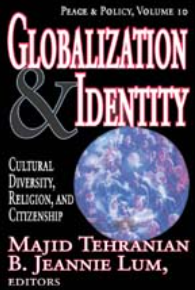 Globalization and Identity: Cultural Diversity, Religion and Citizenship 出版年份: 2006 作者: Majid Tehranian | B. Jeannie Lum 机构作者: Transaction Publishers In the first decade of the twenty-first century, globalization and identity have emerged as the most critical challenges to world peace. This volume of Peace & Policy addresses the overarching question, "What are the effects of globalization in the areas of culture, ethnic diversity, religion, and citizenship, and how does terrorism help groups attain a sense of global identity?"Part I, "Citizenship in a Globalizing World," reexamines globalization in light of the traditions from which human civilizations have evolved. Linda Groff focuses on Samuel R. Huntington's thesis that the Cold War would be followed by a clash of civilizations. Joseph A. Camilleri traces the history of the concept of citizenship and its transformation through the ages to modern times. Kamran Mofid argues that the marketplace is not just an economic sphere but one where economic and business interests must embrace the spiritual assets of the community. Majid Tehranian raises the problem of identity and advocates the assumption of global identity, responsibility, and citizenship. Part II, "Convergence in Global Cultures," explores the complex issues of diversity in religions. Christopher Leeds, Vladimir Korobov, and Bharapt Gupt show how the reconceptualization of the world both geographically and regionally can recreate new sensibilities needed to overcome differences. Part III, "Divergence in Global Conflicts," discusses the multiple dimensions of the globalizing effects of economic expansion and political strife experienced by different cultures at local and regional levels. Audrey Kitigawa and Ade Ogunrinade use Nigeria as an example of political manipulation of religious and ethnic groups to divert attention from the real problems of social and economic marginalization. Fred Riggs looks at how the Web has become a medium in the globalization of religious movements.The authors maintain that continuing efforts for dialogue across cultural and religious boundaries in today's interreligious and interfaith organizations can become a force for healing.
  Education for global citizenship 出版年份: 2004 作者: Audrey Osler Cosmopolitan Citizenship is described as a concept of Global learning based on international agreements of UNESCO and the Council of Europe. To live in a global world people would need – besides basic education – different social skills as competencies of political literacy.
  Translating globalization theories into educational research : thoughts on recent shifts in Holocaust education Much educational research on globalization aims to prepare students to be successful citizens in a global society. We propose a set of three concepts, drawing on systems theory (Nassehi, Stichweh) and theories of the subject (Butler, Foucault), to think the global which enables educational research to step back from hegemonic discourses and reflect on current practices. Globalization is understood in this approach as referring to: (1) a cognitive shift; (2) expanding relevancy spaces; and (3) new forms of subjectivation. The framework is illustrated with examples from educational policy and learning materials, with an extended look at how globalization is articulated in recent shifts in Holocaust education. (By the author)