
相关资源
探索丰富的全球公民教育资源,深化理解,促进研究、倡导、教学与学习。
共找到2,199条结果
 교사를 위한 안내서: 세계시민교육 出版年份: 2025 机构作者: 옥스팜 빠르게 변하는 ‘세계화’의 세상은 청소년들에게 엄청난 기회와 함께 그에 못지 않은 수많은 도전 과제를 주고 있습니다. 옥스팜은 세계 시민 교육을 통해 청소년들에게 교육분쟁, 기후변화, 불평등과 빈곤 등 전 세계에서 일어나고 있는 기회와 도전을 받아들이고, 나아가 자신이 살고 싶은 세상을 만들어 나갈 수 있도록 관련된 지식, 기술, 가치를 교육받을 권리를 실현시킬 수 있도록 지원합니다. 이슈 트리, 결과의 바퀴, 역할 놀이 등 옥스팜이 소개하는 구체적인 활동안을 활용해 학생들과 함께 유익한 세계 시민 교육을 진행해 보세요. 주요 내용 세계 시민의식 키우기 세계 시민의식에서 중요한 개념들 교실 수업에서 세계 시민의식 키우기 학습과 의사 결정에 참여하기 질문하기 연관성 찾기 관점과 가치 탐구하기 세계 시민으로서 적극적으로 행동하기 수업 평가하기
  SDG4 이행 촉진을 위한 지표 연구 出版年份: 2025 作者: 박근영 | 주형미 | 문무경 | 오예진 | 류기락 | 조혜승 | 변종임 | Sunmi Ji | 이슬비 | 박기웅 | 안해정 | 서무계 机构作者: Korean National Commission for UNESCO 지속가능발전목표(SDGs) 이행의 전환점을 맞아 국내 교육의 현황과 과제를 SDG4 지표를 통해 진단하고 향후 방향을 탐색한 연구 보고서 <목차> 발간사 ‘SDG4 이행 촉진을 위한 지표 연구’ 보고서를 발간하며 서론 현 시점의 SDG4 이행 수준 점검과 개선 방향 탐색의 당위성 SDG 4.1 공평하고 양질의 초·중등 교육 이수 보장에 대한 한국 현황 및 향후 과제 SDG 4.2 영유아 교육과 보육 지표 검토와 향후 과제 SDG 4.3 고등교육의 수월성과 형평성 논의 및 향후 과제 SDG 4.4 고용을 위한 스킬: SDG 4.4의 이행 현황과 과제 SDG 4.5 교육 형평성 실현을 위한 SDG 4.5 지표 검토와 이행 현황 분석 SDG 4.6 한국의 SDG 4.6 이행 현행과 과제: 성인 문해력 SDG 4.7 더불어 살기 위한 학습을 향하여: 세계시민교육 및 지속가능발전교육 이행 현황과 모니터링 개선 방안 탐색 SDG 4.a SDG 4.a.1과 한국 디지털 교육 이행 현황: 접근성, 사용도, 스킬 SDG 4.b 공적개발원조(ODA) 장학금 확대 SDG 4.c 자격을 갖춘 교사의 공급 관련 이행 현황 및 개선 방안 결론 엄격한 현실 인식에 기반한 다음 목표로의 이행 준비
  The Development of Asian Primary Students’ Global Citizenship Literacy Scales: An Exploratory Study of Taiwan Primary Student (Educational Journal ; Vol.45, No.1) 出版年份: 2017 作者: 吴时省 | 蔡清华 This study aimed to develop an instrument to measure the effect of Taiwan’s policy on global education. Four constructs were developed, namely rights and responsibilities of global citizenship, competencies of global citizenship, participation of global citizenship, and reflection of global citizenship. The instrument was tested with a sample of 1,112 elementary school students in Taiwan. Content validity was established. Exploratory factor analysis and confirmatory factor analysis confirmed construct validity. All the indexes were satisfied except the convergent validity. 亚洲小学生全球公民素养量表之发展:以台湾小学生为探索个案 (教育学报; Vol.45, No.1) 出版年份: 2017 作者: 吴时省 | 蔡清华 本研究主要目的在发展一份全球公民素养量表,作为台湾过去这些年来对于小学阶段全球教育努力成果的检视。透过文献分析,研究者归纳出全球公民素养四个构念,分别为「全球公民权利与义务」、「全球公民能力」、「全球公民参与」、「全球公民反思」,并根据这四个构念进行量表的编制和信效度的检核。研究样本为台湾各地小学生,总计1,112名。量表整体信度为.868,与各个效标工具的相关亦都至少达到.05显着水准;模式的考验方面,除了内在品质的聚敛效度稍嫌不理想外,其余结果都达到预期。
  2022 세계시민교육 보고서: 국제 수업 교류 사례 및 세계시민교육 교원학습공동체 연구 자료 出版年份: 2022 机构作者: 서울특별시교육청 2022 세계시민교육 보고서는 크게 두 파트로 나누어 Part.1에서는 국내 12개 초·중·고등학교의 국제 수업 교류 사례와 수업설계, 학습지도안 활동사진 등을 담고 있고 Part. 2에서는 수달스, 더불어 평화 등 5개 세계시민교육 교원학습공동체의 연구 자료를 수록하고 있다.
 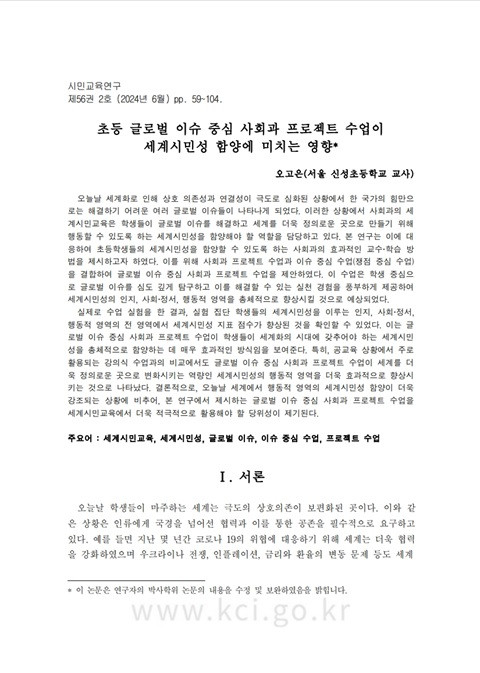 초등 글로벌 이슈 중심 사회과 프로젝트 수업이 세계시민성 함양에 미치는 영향 (시민교육연구; Vol. 56, No. 2) 出版年份: 2024 作者: 오고은 机构作者: 한국사회과교육학회 오늘날 세계화로 인해 상호 의존성과 연결성이 극도로 심화된 상황에서 한 국가의 힘만으로는 해결하기 어려운 여러 글로벌 이슈들이 나타나게 되었다. 이러한 상황에서 사회과의 세계시민교육은 학생들이 글로벌 이슈를 해결하고 세계를 더욱 정의로운 곳으로 만들기 위해 행동할 수 있도록 하는 세계시민성을 함양해야 할 역할을 담당하고 있다. 본 연구는 이에 대응하여 초등학생들의 세계시민성을 함양할 수 있도록 하는 사회과의 효과적인 교수-학습 방법을 제시하고자 하였다. 이를 위해 사회과 프로젝트 수업과 이슈 중심 수업(쟁점 중심 수업)을 결합하여 글로벌 이슈 중심 사회과 프로젝트 수업을 제안하였다. 이 수업은 학생 중심으로 글로벌 이슈를 심도 깊게 탐구하고 이를 해결할 수 있는 실천 경험을 풍부하게 제공하여 세계시민성의 인지, 사회-정서, 행동적 영역을 총체적으로 향상시킬 것으로 예상되었다. 실제로 수업 실험을 한 결과, 실험 집단 학생들의 세계시민성을 이루는 인지, 사회-정서, 행동적 영역의 전 영역에서 세계시민성 지표 점수가 향상된 것을 확인할 수 있었다. 이는 글로벌 이슈 중심 사회과 프로젝트 수업이 학생들이 세계화의 시대에 갖추어야 하는 세계시민성을 총체적으로 함양하는 데 매우 효과적인 방식임을 보여준다. 특히, 공교육 상황에서 주로 활용되는 강의식 수업과의 비교에서도 글로벌 이슈 중심 사회과 프로젝트 수업이 세계를 더욱 정의로운 곳으로 변화시키는 역량인 세계시민성의 행동적 영역을 더욱 효과적으로 향상시키는 것으로 나타났다. 결론적으로, 오늘날 세계에서 행동적 영역의 세계시민성 함양이 더욱 강조되는 상황에 비추어, 본 연구에서 제시하는 글로벌 이슈 중심 사회과 프로젝트 수업을 세계시민교육에서 더욱 적극적으로 활용해야 할 당위성이 제기된다.
 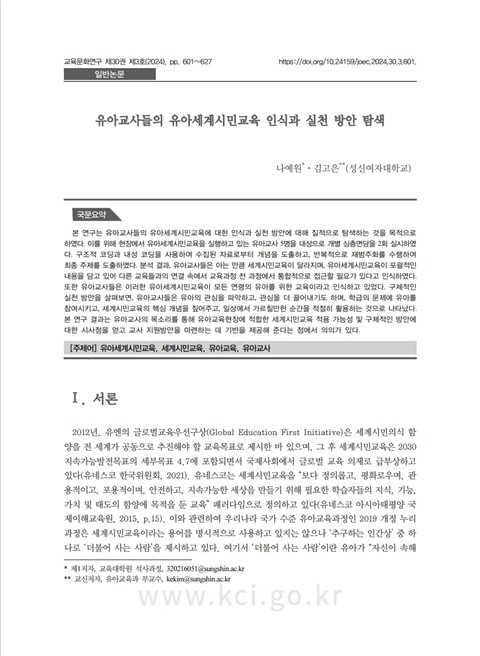 유아교사들의 유아세계시민교육 인식과 실천 방안 탐색 (교육문화연구; Vol. 30, No. 3) 出版年份: 2024 作者: 나예원 | 김고은 机构作者: 인하대학교 교육연구소 본 연구는 유아교사들의 유아세계시민교육에 대한 인식과 실천 방안에 대해 질적으로 탐색하는 것을 목적으로 하였다. 이를 위해 현장에서 유아세계시민교육을 실행하고 있는 유아교사 5명을 대상으로 개별 심층면담을 2회 실시하였다. 구조적 코딩과 내성 코딩을 사용하여 수집된 자료로부터 개념을 도출하고, 반복적으로 재범주화를 수행하여 최종 주제를 도출하였다. 분석 결과, 유아교사들은 아는 만큼 세계시민교육이 달라지며, 유아세계시민교육이 포괄적인 내용을 담고 있어 다른 교육들과의 연결 속에서 교육과정 전 과정에서 통합적으로 접근할 필요가 있다고 인식하였다. 또한 유아교사들은 이러한 유아세계시민교육이 모든 연령의 유아를 위한 교육이라고 인식하고 있었다. 구체적인 실천 방안을 살펴보면, 유아교사들은 유아의 관심을 파악하고, 관심을 더 끌어내기도 하며, 학급의 문제에 유아를 참여시키고, 세계시민교육의 핵심 개념을 짚어주고, 일상에서 가르칠만한 순간을 적절히 활용하는 것으로 나타났다. 본 연구 결과는 유아교사의 목소리를 통해 유아교육현장에 적합한 세계시민교육 적용 가능성 및 구체적인 방안에 대한 시사점을 얻고 교사 지원방안을 마련하는 데 기반을 제공해 준다는 점에서 의의가 있다.
 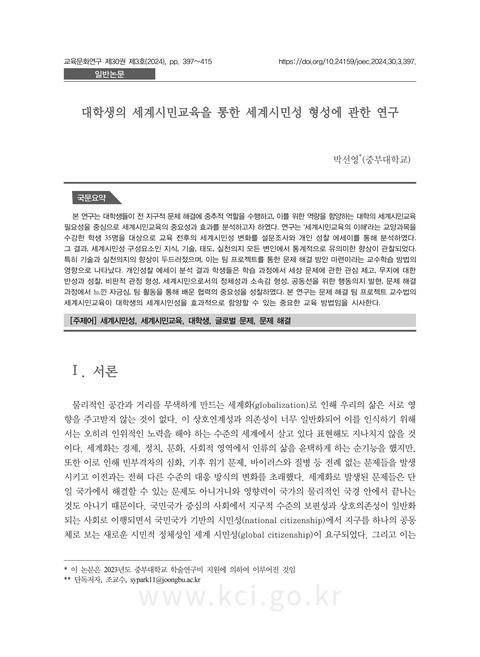 대학생의 세계시민교육을 통한 세계시민성 형성에 관한 연구 (교육문화연구; Vol. 30, No. 3) 出版年份: 2024 作者: 박선영 机构作者: 인하대학교 교육연구소 본 연구는 대학생들이 전 지구적 문제 해결에 중추적 역할을 수행하고, 이를 위한 역량을 함양하는 대학의 세계시민교육필요성을 중심으로 세계시민교육의 중요성과 효과를 분석하고자 하였다. 연구는 '세계시민교육의 이해'라는 교양과목을수강한 학생 35명을 대상으로 교육 전후의 세계시민성 변화를 설문조사와 개인 성찰 에세이를 통해 분석하였다. 그 결과, 세계시민성 구성요소인 지식, 기술, 태도, 실천의지 모든 변인에서 통계적으로 유의미한 향상이 관찰되었다. 특히 기술과 실천의지의 향상이 두드러졌으며, 이는 팀 프로젝트를 통한 문제 해결 방안 마련이라는 교수학습 방법의영향으로 나타났다. 개인성찰 에세이 분석 결과 학생들은 학습 과정에서 세상 문제에 관한 관심 제고, 무지에 대한반성과 성찰, 비판적 관점 형성, 세계시민으로서의 정체성과 소속감 형성, 공동선을 위한 행동의지 발현, 문제 해결과정에서 느낀 자긍심, 팀 활동을 통해 배운 협력의 중요성을 성찰하였다. 본 연구는 문제 해결 팀 프로젝트 교수법의세계시민교육이 대학생의 세계시민성을 효과적으로 함양할 수 있는 중요한 교육 방법임을 시사한다.
 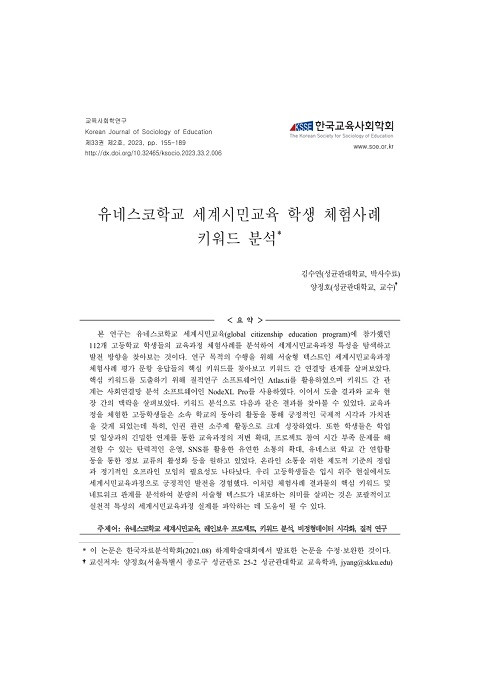 유네스코학교 세계시민교육 학생 체험사례 키워드 분석 (교육사회학연구; Vol. 33, No. 2) 出版年份: 2023 作者: 김수연 | 양정호 机构作者: 한국교육사회학회 본 연구는 유네스코학교 세계시민교육(global citizenship education program)에 참가했던 112개 고등학교 학생들의 교육과정 체험사례를 분석하여 세계시민교육과정 특성을 탐색하고 발전 방향을 찾아보는 것이다. 연구 목적의 수행을 위해 서술형 텍스트인 세계시민교육과정 체험사례 평가 문항 응답들의 핵심 키워드를 찾아보고 키워드 간 연결망 관계를 살펴보았다. 핵심 키워드를 도출하기 위해 질적연구 소프트웨어인 Atlas.ti를 활용하였으며 키워드 간 관계는 사회연결망 분석 소프트웨어인 NodeXL Pro를 사용하였다. 이어서 도출 결과와 교육 현장 간의 맥락을 살펴보았다. 키워드 분석으로 다음과 같은 결과를 찾아볼 수 있었다. 교육과정을 체험한 고등학생들은 소속 학교의 동아리 활동을 통해 긍정적인 국제적 시각과 가치관을 갖게 되었는데 특히, 인권 관련 소주제 활동으로 크게 성장하였다. 또한 학생들은 학업 및 일상과의 긴밀한 연계를 통한 교육과정의 저변 확대, 프로젝트 참여 시간 부족 문제를 해결할 수 있는 탄력적인 운영, SNS를 활용한 유연한 소통의 확대, 유네스코 학교 간 연합활동을 통한 정보 교류의 활성화 등을 원하고 있었다. 온라인 소통을 위한 제도적 기준의 정립과 정기적인 오프라인 모임의 필요성도 나타났다. 우리 고등학생들은 입시 위주 현실에서도 세계시민교육과정으로 긍정적인 발전을 경험했다. 이처럼 체험사례 결과물의 핵심 키워드 및 네트워크 관계를 분석하여 분량의 서술형 텍스트가 내포하는 의미를 살피는 것은 포괄적이고 실천적 특성의 세계시민교육과정 실제를 파악하는 데 도움이 될 수 있다.
  A Comparative Study on Global Citizenship Education between Korea and ASEAN 出版年份: 2015 机构作者: Korea Institute for Curriculum and Evaluation (KICE) This research is the second-year study for a three-year project (2013-2015) focused on the global citizenship education of ASEAN (Association of Southeast Asian Nations). In the first-year study (2013), the current global citizenship education presented in the social studies curriculum of each country was analyzed based on literature research, and the global citizenship of students from each country was examined through surveys. Based on the analysis of the current global citizenship education of Korea and ASEAN overall and the characteristics of global citizenship of students from each country, this study is designed to make an in-depth analysis of global citizenship education and to seek direction for the joint global citizenship education programs between Korea and ASEAN to be employed in the third-year research.The students from the two countries, Indonesia and Thailand, among the 10 ASEAN countries are selected as participants because these two countries also participated in the previous international comparison study. The purposes of this study are as follows; (1) comparing the current global citizenship education of the national-level curriculum of Korea, Indonesia, and Thailand, (2) finding the similarities and differences by analysing the characteristics of global citizenship education of Korean, Indonesian, and Thai students, and (3) proposing the direction and themes of global citizenship education which will be mutually applied in Korea and ASEAN countries based on the research results.To conduct this study, various methods including literature study, interviews through visits to local schools, conferences for specialists, and international seminars were used. First, the meaning and goals of global citizenship education were established by reviewing literature and the concepts of ‘Humanity’, ‘Global Identity’, and ‘Global Participation’, which are the three sub-indices for global citizenship extracted from the first-year study, were used. Based on this framework, interview protocols for students, teachers, and policy makers were composed.The research team visited Indonesia and Thailand, carried out semi-structured interviews with students, teachers, and policy makers of national-level curriculum and classroom observations, and collected data related to global citizenship education. In addition, by conducting an international seminar with policy makers of curriculum of each country’s Ministry of Education and UNESCO specialists, we aimed to seek direction for joint global citizenship education in Korea and ASEAN and to reinforce educational cooperation.The major findings of this research can be suggested according to the research purposes in the following way.First, in the analysis of the national-level curriculum made for the comparison of current global citizenship education of Korea, Indonesia, and Thailand, the curriculum of each country is found to include elements of global citizenship education. However, countries show discrepancies in their actualization of curriculum, and citizenship education is still centered on national citizenship rather than global citizenship. Therefore, a more systematic attempt is needed for the advancement of citizenship education from nation-centered to globally oriented.Second, the findings from the interviews with students of each country carried out to define the characteristics of global citizenship of Korean, Indonesian, and Thai students indicate that while students’ responses showed a number of similarities in general, differences were found in specific answers as well. High school students provided more logical answers with greater depth compared to middle school students, and their responses differed based on their cultural contexts and experiences rather than their gender or religion. Therefore, while taking an approach which considers the level of students’ cognitive development as well as the cultural distinctiveness of each country, a way to expand opportunities for specific activities and experiences rather than an abstract way of teaching should be considered.Third, based on the analysis results, the directions and themes for global citizenship education to be jointly applied in Korea and ASEAN countries are proposed as follows: (1) The curriculum for global citizenship education should be focused on reinforcing the competency of citizens to participate in communities rather than that of individuals to ensure international competitiveness. (2) It is necessary to educate students to confront various conflicts and solve them by themselves rather than teaching them the abstract answers to the conflicts. (3) Global citizenship education should move beyond knowledge-based education and aim to lead bring changes in students’ behavior thereby empowering them to settle global issues. (4) For the actual implementation of curriculum, the cultural distinctiveness of each country and the differences by groups should be considered. (5) It is important to help students spread their interest to diverse countries beyond Western countries or ‘developed countries’.With these points in consideration, the objective of global citizenship education to be jointly promoted in Korea and ASEAN is suggested as the following: “Citizens are cultivated to form their identity as Asians based on their interest and knowledge of Asia and to participate in settling global issues. Through this, their qualities to participate in issues concerning all humanity are eventually cultivated.” The specific themes may include understanding Asia and ASEAN, social justice and equality, diversity, globalization and interdependence, conflict and peace, as well as sustainable development and environment. To improve effectiveness of joint global citizenship education of Korea and ASEAN and to reinforce educational cooperation, we made the following three suggestions.First, the standardization of global citizenship education across the nation is required. Having defined global citizenship education as the cultivation of the qualities of citizens based on the perception of human rights (Humanity) and with the identity as a global citizen (Global Identity) who can participate in settling the issues of global society (Participation), global citizenship education will yield the greatest efficiency when carried out together by all beyond national boundaries. Therefore, it is suggested that research for developing and expanding the joint curriculum by regions be supported and close cooperation be formed between policy makers of national curriculum and officials of International Training and Cooperation.Second, the reinforcement of global citizenship education through teacher training is required. For the effective implementation of joint global citizenship education in each country through the standardization of global citizenship education, the cultural diversity and distinctiveness of each country should be reflected. For these reasons, various practical bottom-up strategies are needed. Teacher training is a mandatory prerequisite for global citizenship education that is appropriate for the situations and contexts of each country. Therefore, it is suggested that researchers find out how to reinforce global citizenship education in teacher training based on solid research.Third, global citizenship education should be expanded by the exchange of human resources. As confirmed in this study, the exchange itself can bring a positive influence on the cultivation of global citizenship, and the sharing of the strategies for global citizenship education in each country can contribute to the development of a model for better global citizenship education. Therefore, it is suggested that the research for the joint promotion of project-based global citizenship education and the opportunities for mutual exchange of students and teachers between Korea and ASEAN countries should be expanded.