
相关资源
探索丰富的全球公民教育资源,深化理解,促进研究、倡导、教学与学习。
共找到2,199条结果
 Une Étude Comparative sur L'éducation à la Citoyenneté Mondiale (ECM) entre le Coréen et l'ASEAN 出版年份: 2015 机构作者: Korea Institute for Curriculum and Evaluation (KICE) Pour réaliser cette étude, diverses méthodes, y compris l'étude de la littérature, des entrevues par des visites dans les écoles locales, des conférences pour les spécialistes et séminaires internationaux ont été utilisés. Premièrement, le sens et les objectifs de L'éducation à la citoyenneté Mondiale (ECM) ont été établies en examinant la littérature et les concepts de «l'humanité», «Global Identity» et «Participation globale», qui sont les trois sous-indices pour mondiale la citoyenneté extraite de l'étude de première année, ont été utilisés. Sur la base de ce cadre, les protocoles d'entrevue pour les étudiants, les enseignants et les responsables politiques ont été composées.L'équipe de recherche a visité l'Indonésie et de la Thaïlande, a mené des entretiens semi-structurés avec les étudiants, les enseignants et les décideurs des observations du curriculum et de la classe au niveau national, et a recueilli des données relatives à l'éducation à la citoyenneté mondiale. En outre, en procédant à un séminaire international avec les décideurs du curriculum du ministère de l'Éducation et de l'UNESCO spécialistes de chaque pays, nous avons cherché à obtenir des directives pour joint L'éducation à la citoyenneté Mondiale (ECM) en Corée et l'ASEAN et de renforcer la coopération éducative.Les principaux résultats de cette recherche peuvent être proposées en fonction des fins de recherche de la manière suivante.Tout d'abord, dans l'analyse du programme au niveau national fait pour la comparaison du courant L'éducation à la citoyenneté Mondiale (ECM) de la Corée, l'Indonésie et la Thaïlande, le programme d'études de chaque pays se trouve à inclure des éléments d'éducation à la citoyenneté mondiale. Toutefois, les pays montrent des divergences dans leur actualisation du programme, et de l'éducation à la citoyenneté est toujours centrée sur la citoyenneté nationale plutôt que la citoyenneté mondiale. Par conséquent, une tentative plus systématique est nécessaire pour l'avancement de l'éducation à la citoyenneté d'un pays centré à vocation mondiale.Deuxièmement, les résultats des entrevues avec les étudiants de chaque pays menées pour définir les caractéristiques de la citoyenneté mondiale de la Corée, l'Indonésie, et les étudiants thaïlandais indiquent que, bien que les réponses des élèves ont montré un certain nombre de similitudes en général, des différences ont été trouvées dans des réponses précises que bien. Les élèves du secondaire ont fourni des réponses plus logiques avec une plus grande profondeur par rapport aux élèves des écoles moyennes, et leurs réponses différaient en fonction de leurs contextes et des expériences culturelles plutôt que de leur sexe ou de religion. Par conséquent, tout en adoptant une approche qui tient compte du niveau de développement cognitif des élèves, ainsi que les particularités culturelles de chaque pays, un moyen d'accroître les possibilités pour les activités et les expériences spécifiques plutôt que d'une manière abstraite de l'enseignement devrait être considéré.Troisièmement, sur la base des résultats d'analyse, les orientations et les thèmes de L'éducation à la citoyenneté Mondiale(ECM) à appliquer conjointement en Corée et les pays de l'ASEAN sont proposées comme suit: (1) Le programme de L'éducation à la citoyenneté Mondiale (ECM) devrait se concentrer sur le renforcement de la compétence des citoyens à participer à des communautés plutôt que celle des individus pour assurer la compétitivité internationale. (2) Il est nécessaire d'éduquer les étudiants pour faire face à divers conflits et de les résoudre par eux-mêmes plutôt que de leur enseigner les réponses abstraites aux conflits. (3) L'éducation à la citoyenneté Mondiale (ECM) devrait aller au-delà de la connaissancel'éducation et visent à entraîner apporter des changements dans le comportement des élèves autonomisation qui leur permet de régler les problèmes mondiaux. (4) Pour la mise en œuvre effective du programme, la spécificité culturelle de chaque pays et les différences par groupes devraient être considérés. (5) Il est important d'aider les élèves propagent leur intérêt de divers pays au-delà de l'Ouestpays ou «pays développés».Avec ces points en considération, l'objectif de L'éducation à la citoyenneté Mondiale (ECM) pour être promu conjointement en Corée et l'ASEAN est proposé comme suit: «Les citoyens sont cultivées pour former leur identité en tant Asiatiques en fonction de leur intérêt et de connaissance de Asie et de participer dans le règlement des problèmes mondiaux. Grâce à cela, leurs qualités de participer à des questions concernant toute l'humanité sont finalement cultivées. "Les thèmes spécifiques peuvent inclure la compréhension de l'Asie et de l'ASEAN, la justice sociale et l'égalité, la diversité, la mondialisation et l'interdépendance, les conflits et la paix, ainsi que le développement durable et l'environnement. Pour améliorer l'efficacité de l'articulation L'éducation à la citoyenneté Mondiale (ECM) de Corée et l'ASEAN etde renforcer la coopération éducative, nous avons fait les trois suggestions suivantes. Premièrement, la normalisation de L'éducation à la citoyenneté Mondiale (ECM) à travers le pays est nécessaire. Après avoir défini L'éducation à la citoyenneté Mondiale (ECM) comme la culture des qualités de citoyens fondées sur la perception des droits de l'homme (l'humanité) et de l'identité en tant que citoyen du monde (GlobalIdentity) qui peut participer au règlement des problèmes de la société globale (Participation), L'éducation à la citoyenneté Mondiale (ECM) donnera la plus grande efficacité lorsqu'elle est effectuée conjointement par tous au-delà des frontières nationales. Par conséquent, il est suggéré que la recherche pour le développement et l'expansion du programme commun par les régions être soutenu et une coopération étroite se former entre les décideurs du curriculum national et les responsables de la formation et la coopération internationale.Deuxièmement, le renforcement de L'éducation à la citoyenneté Mondiale (ECM) à travers la formation des enseignants est nécessaire. Pour la mise en œuvre effective de l'articulation L'éducation à la citoyenneté Mondiale (ECM) dans chaque pays grâce à la normalisation de l'éducation à la citoyenneté mondiale, la diversité culturelle et la spécificité de chaque pays doivent être pris en compte. Pour ces raisons, diverses stratégies ascendantes pratiques sont nécessaires. La formation des enseignants est une condition préalable obligatoire pour L'éducation à la citoyenneté Mondiale (ECM) qui est approprié pour les situations et les contextes de chaque pays. Par conséquent, il est suggéré que les chercheurs découvrent comment renforcer L'éducation à la citoyenneté Mondiale (ECM) dans la formation des enseignants sur la base de recherche solide.Troisièmement, L'éducation à la citoyenneté Mondiale (ECM) devrait être élargi par l'échange des ressources humaines. Comme l'a confirmé dans cette étude, l'échange lui-même peut apporter une influence positive sur la culture de la citoyenneté mondiale, et le partage des stratégies pour L'éducation à la citoyenneté Mondiale (ECM) dans chaque pays peut contribuer au développement d'un modèle pour une meilleure éducation à la citoyenneté mondiale. Par conséquent, il est suggéré que la recherche pour la promotion conjointe de par projet L'éducation à la citoyenneté Mondiale (ECM) et les possibilités d'échange mutuel d'étudiants et d'enseignants entre les pays de l'ASEAN et la Corée devrait être élargi.
  The Global Civil Society and the Global Citizenship Education 出版年份: 2014 作者: Feng Jianjun The globalization era generates the global civil society, and the global civil society requires the global citizen. Global citizens not only live in the era of globalization, but also should have global awareness and human care, being willing to act positively for world peace, human development, global equity, justice and sustainable development of human and nature. Cultivating responsible global citizens is the mission given by the new era of globalization for education of civilization. The purpose of global civic education is training responsible civic education which has global awareness and takes positive action for global and human development. The global civic education includes human rights along with humanitarian education, global consciousness along with global responsibility education, environment along with sustainable development education, and international understanding education along with multicultural education. 全球公民社会与全球公民教育 出版年份: 2014 作者: Feng Jianjun 全球化时代产生全球公民社会,全球公民社会需要全球公民。全球公民不仅生活在全球化时代,更要具有全球意识和人类关怀,并愿意为世界的和平与人类的发展、全球的公平与正义、人与自然的可持续发展采取积极的行动。培养负责任的全球公民,是全球化时代赋予公民教育的新使命。全球公民教育,就是培养具有全球意识并愿意为全球和人类的发展而积极行动的负责任的公民的教育,包括人权和人道主义教育、全球意识和全球责任教育、环境和可持续发展教育、国际理解教育与多元文化教育。
  The Concept, Values and Implementation Models of GCED 出版年份: 2013 作者: Lu Lihua, Jiang Junhe “Global Citizenship education” aims to cultivate global citizens with an international perspective and global awareness. At present, there are more and more countries focusing on developing the core education value including” equity and justice”, “survival and development” and “democracy and rationality” and builds the global citizenship education network. “全球公民”教育基本内涵、价值诉求与实践模式 出版年份: 2013 作者: Lu Lihua, Jiang Junhe “全球公民”教育旨在培养具有国际视野和全球意识的世界公民。当前,世界各国逐渐确立了以“公平与正义”、“生存与发展”、“民主与理性”为核心的“全球公民”教育价值诉求,实施“全球公民”教育的立体化教育网络也正在一些国家和地区悄然形成。
 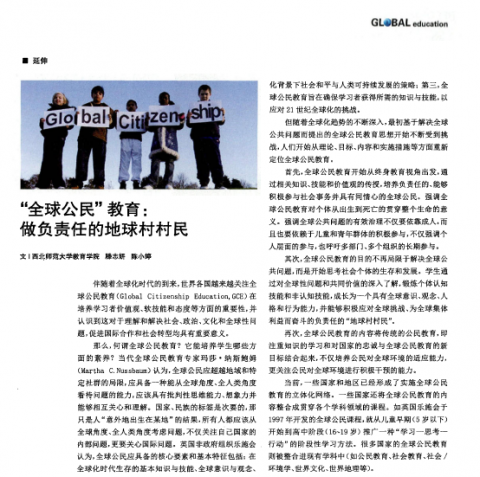 GCED towards Responsible villagers of the Global Village 出版年份: 2015 作者: Teng Zhiyan, Chen Xiaoting Global citizenship education has attracted an increasing attention in global era. This essay briefly introduce the definition of global citizenship education and how to develop it in today's society. This article believe that cultivating global citizens not only is a trend, but also is an important result of globalization. “全球公民”教育做负责任的地球村村民 出版年份: 2015 作者: Teng Zhiyan, Chen Xiaoting 在全球化时代,全球公民教育得到了越来越多的关注。本文简单介绍了全球公民教育的定义以及当今社会如何发展全球公民教育。文章认为培养全球公民不仅是一种趋势,更是全球化的重要产物。
 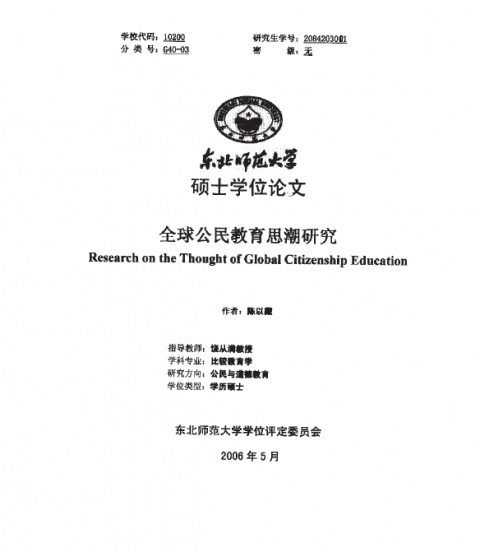 Research on the Thought of Global Citizenship Education 出版年份: 2006 作者: Chen Yicang Based on the literature review, the thesis tries to expound the thought of global citizenship education, by ascending to the its origin and development, exploring the characteristics of the conceptions of global citizenship and education for global citizenship, and examining its influences.The paper is comprised of a preface and four parts. Part 1 mainly examines the origin and development of the thought of global citizenship education. The characteristcs of the thought in different stages are analyzed according to the threestage division of the history: pre-modern times, mordern times and post-modern times. Part2 explores into the characteristics of the conception of global citizenship after analyzing the features of modern citizenship, examining the challenges of globalization for the modern citizenship.Part3 mainly examines and analuzes the conception of education for global citizenship.Part4 provides a brief evaluation of the thought of education for citizenship on the basis of summarizing the characteristics of the thought of education for global citizenship, and examining the effect of the thought upon the educational theory and practice. 全球公民教育思潮研究 出版年份: 2006 作者: Chen Yicang 通过教育使个体成为一个合格的公民,这是每个民族国家对成员个体发展的基本期望,也是教育最基本的目标之一。正是由于这样的背景,公民资格和公民教育理论,不断得到发展。然而自20世纪80年尤其是90年代以来,随着全球化趋势的增强以及全球化论的兴起,公民的定位、现代公民资格理论以及公民教育理论不断受到了挑战。全球公民教育教育思想就是在这样的背景形成了一股思潮。这一思潮在发达国家的教育实践中已经有所体现。我国已经加入了世界贸易组织,与国际交往日益扩大和加深。因此,在全球化的浪潮中,我国的公民教育怎样应对全球化的挑战,是一个必须面对的课题。因此,研究全球公民教育思潮,其意义是不言而喻的。本文主要基于文献研究,考察与分析全球公民教育思潮,追溯其历史渊源和发展历程,探讨全球公民资格观和全球公民教育观的特征及其影响。本文共由绪论和正文四个部分组成。第一部分主要是追溯全球公民教育思想的历史渊源和发展历程,按照前现代时期、现代时期和后现代时期这一历史分期,考察和分析了全球公民教育思想在每个阶段的特征。第二部分在分析了现代公民资格观的特征、全球化对现代公民资格观的挑战之后,探讨了全球公民资格观的内涵。第三部分主要分析和考察了全球公民教育观的主要内容。第四部分在归纳和总结了全球公民教育思潮的特征和考察了全球公民教育思潮的理论和实践性影响的基础上,对其作了简短的评价。
  Global Citizenship Education in Hong Kong and Shanghai Secondary Schools: Ideals, Realities and Expectations (Citizenship Teaching and Learning vol 2, no. 2) 出版年份: 2006 作者: Wing On Lee | Sai Wing Leung 机构作者: Intellect The world has become increasingly interdependent with the ongoing trend of globalization. Preparation for citizenship obviously needs to extend beyond students’ national boundary, such as understanding the impact of citizenship behaviors in one region upon the other parts of the world, and the promotion of peace and justice across nations. This paper reports a study on global citizenship education (GCE) in secondary schools in Hong Kong and Shanghai conducted from December 2002 to June 2003, organized by the Centre for Citizenship Education of the Hong Kong Institute of Education, the Department of Education of the Shanghai Teachers' University, and the Love Outreach Education Academy and Oxfam Hong Kong, with funding provided by the latter. The study aimed at understanding (1) teachers’ knowledge, skills and values toward GCE, (2) GCE curriculum available in schools and its implementation; (3) difficulties in implementing GCE in schools; and (4) the kind of change and support that teachers expected for enhancing the development of GCE. The study also provided data for comparing the similarities and differences in the two major international cities in China. The study finds that that teachers in Hong Kong and Shanghai both support global citizenship education in their schools, but they have encountered problems and difficulties such as pressure from the exam-oriented curriculum, lack of training, lack of support from the school and government, and also a lack in self-efficacy, not feeling that personal efforts can bring about changes in the world. There are interesting contrasts between Hong Kong and Shanghai teachers. Shanghai teachers are comparatively more interested in global affairs, whereas Hong Kong teachers are relatively more interested in local affairs. Shanghai teachers tend to focus on knowledge and skills in global citizenship education, whereas Hong Kong teachers tend to focus on values.