
相关资源
探索丰富的全球公民教育资源,深化理解,促进研究、倡导、教学与学习。
共找到1,726条结果
 Informe sobre el derecho a la educación en la movilidad humana en América Central, República Dominicana y México: Hacia una educación inclusiva, equitativa, de calidad y con oportunidades de aprendizaje permanente 出版年份: 2024 机构作者: UNESCO San José | Central American Educational and Cultural Coordination | Central American Integration System Si bien la movilidad humana no es un fenómeno nuevo, los datos indican que la cantidad de personas en esta situación ha alcanzado su punto más alto desde que se tiene registro y no hay indicios de que la tendencia vaya disminuyendo en los próximos años. Este escenario amenaza con volverse una situación estructural, impactando fuertemente en el derecho a la educación y los sistemas educativos. Por ello, es perentorio el compromiso profundo de los Estados y otros actores clave para garantizar el derecho fundamental a la educación de las personas en situación de movilidad a través de medidas urgentes, en sintonía con lo estipulado en el Objetivo de Desarrollo Sostenible (ODS) 4 de la Agenda 2030 de las Naciones Unidas. Por ello se ha emprendido la elaboración del presente Informe sobre el derecho a la educación de las personas en situación de movilidad en Belice, Costa Rica, El Salvador, Guatemala, Honduras, México, Nicaragua, Panamá y República Dominicana. El Informe constituye un esfuerzo de la UNESCO y la Coordinación Educativa y Cultural Centroamericana (CECC/SICA) en colaboración con ACNUR, OIM, UNICEF, el Consejo Noruego para Refugiados y RET International, y con el apoyo técnico de la Fundación SES y la Cátedra UNESCO para el Desarrollo de la Educación Internacional en la Universidad George Washington (Estados Unidos)
  Safe Schools Declaration 出版年份: 2015 机构作者: Global Coalition to Protect Education from Attack (GCPEA) The Safe Schools Declaration is an intergovernmental political commitment that was developed at an international conference held in Oslo, Norway, on 28-29 May 2015. The Declaration allows countries the opportunity to express their political support for the protection of students, teachers and schools during times of armed conflict; the importance of the continuation of education during armed conflict; and the implementation of the Guidelines for Protecting Schools and Universities from Military Use during Armed Conflict. Declaración sobre escuelas seguras 出版年份: 2015 机构作者: Global Coalition to Protect Education from Attack (GCPEA) La Declaración sobre Escuelas Seguras es un compromiso político intergubernamental que se construyó en el marco de una conferencia internacional celebrada en Oslo, Noruega, el 28-29 de mayo de 2015.La Declaración permite a los países la oportunidad de expresar su apoyo político para la protección de los estudiantes, maestros y escuelas durante tiempos de conflicto armado; la importancia de la continuación de la educación durante los conflictos armados y la aplicación de las Directrices para Proteger Escuelas y Universidades de Uso Militar durante Conflicto Armado.
  The Teaching of the Holocaust in Latin America the Challenges for Educators and Legislators 出版年份: 2017 作者: María Celeste Adamoli | Emmanuel Kahan, Pablo Luzuriaga | Ministerio de Educación 机构作者: UNESCO Santiago This book provides an overview of opportunities that may arise from educating about the Holocaust in diverse cultural contexts and educational situations, with a special focus on Latin American countries. We can actually be away from the places where the genocide against the Jewish people was perpetrated, but Latin America is still taking charge of its own past of violence and crimes against humanity. With this publication, Latin American educators will have at their fingertips an updated account of the most outstanding topics that are discussed on pedagogy and policy making. You can also explore how, even today in Europe, education about the Holocaust shapes a culture of memory. On the other hand, you can see how in other places the memory of the Holocaust can be a starting point to relate to other difficult pasts. UNESCO is convinced that the prevention of genocide begins at school. In a world where mass violence is possible, this publication will show the importance of teaching young people about the Holocaust and about other genocides in history. It is a condition to prevent similar crimes from happening in the future. La Enseñanza del Holocausto en América Latina: los desafíos para los educadores y legisladores 出版年份: 2017 作者: María Celeste Adamoli | Emmanuel Kahan, Pablo Luzuriaga | Ministerio de Educación 机构作者: UNESCO Santiago Este libro proporciona un panorama de oportunidades que pueden surgir de educar sobre el Holocausto en diversos contextos culturales y situaciones educativas, con un foco especial en los países latinoamericanos. Podemos en realidad estar lejos de los lugares donde el genocidio contra el pueblo judío fue perpetrado, pero también América Latina está todavía haciéndose cargo de su propio pasado de violencia y crímenes contra la humanidad. Con esta publicación, los educadores latinoamericanos van a tener al alcance de la mano un recuento actualizado de los temas más destacados que se discuten sobre pedagogía y construcción de políticas. También podrán explorar cómo, todavía hoy en Europa, la educación sobre el Holocausto da forma a una cultura de la memoria. Por otra parte, pueden ver cómo en otros lugares la memoria del Holocausto puede ser un punto de partida para relacionarse con otros pasados difíciles. La UNESCO está convencida de que la prevención del genocidio comienza en la escuela. En un mundo en donde la violencia masiva es posible, esta publicación mostrará lo importante de enseñar a los jóvenes sobre el Holocausto y sobre otros genocidios en la historia. Es una condición para prevenir que crímenes similares sucedan en el futuro.
  The Program of the Government of the Kyrgyz Republic on Countering Extremism and Terrorism for 2017-2022 出版年份: 2017 机构作者: Government of the Kyrgyz Republic The document contains the main provisions of the program of the Government of the Kyrgyz Republic on countering extremism and terrorism for 2017-2022.The program provides a set of measures to ensure effective countering the threats of extremism and terrorism, rigorous observance of human rights and freedoms, the rule of law and others constitutional principles of the Kyrgyz Republic. Purpose of this program is changing the current situation in the field countering extremism and preventing terrorism.Successful implementation of the program depends on coherence government bodies, organizations and institutions of the Kyrgyz Republic to counter extremism and terrorism. Программа Правительства Кыргызской Республики по противодействию экстремизму и терроризму на 2017-2022 годы 出版年份: 2017 机构作者: Government of the Kyrgyz Republic Документ содержит основные положения программы Правительства Кыргызской Республики по противодействию экстремизму и терроризму на 2017-2022 годы.Программа предусматривает комплекс мер, обеспечивающих эффективное противодействие угрозам экстремизма и терроризма, неукоснительное соблюдение прав и свобод человека, верховенства закона и других конституционных принципов Кыргызской Республики. Целью настоящей Программы является изменение складывающейся ситуации в области противодействия экстремизму и профилактики терроризма.Успешная реализация Программы зависит от согласованности действий государственных органов, организаций и учреждений Кыргызской Республики для противодействия экстремизму и терроризму.
  Report of the Director-General of the United Nations Educational, Scientific and Cultural Organization on the follow-up to the implementation of the Declaration and Program of Action on a Culture of Peace 出版年份: 2013 机构作者: United Nations. Secretary-General, 2007-2016 (Ban, Ki-moon) | UNESCO. Director-General, 2009-2017 (Bokova, I.G.) This is a report submitted by the Director-General of the United Nations Educational, Scientific and Cultural Organization, pursuant to General Assembly resolution 67/1, to follow up on the implementation of the Declaration and Program of Action on a Culture of Peace. The Director-General has reviewed an overview of the activities carried out to promote a culture of peace and non-violence, jointly with the United Nations Educational, Scientific and Cultural Organization (UNESCO) as the lead agency in the United Nations system on this subject. تقرير المديرة العامة لمنظمة الأمم المتحدة للتربية والعلم والثقافة عن متابعة تنفيذ الإعلان وبرنامج العمل المتعلقين بثقافة السلام 出版年份: 2013 机构作者: United Nations. Secretary-General, 2007-2016 (Ban, Ki-moon) | UNESCO. Director-General, 2009-2017 (Bokova, I.G.) هذا هو تقريـر مقـدم مـن المـديرة العامـة لمنظمـة الأمـم المتحـدة للتربيـة والعلم والثقافة عملاً بقرار الجمعية العامة ٦٧/١، لمتابعة تنفيذ الإعلان وبرنامج العمل المتعلقين بثقافة السلام. وقد استعرضت المديرة العامة لمحة عامة عن الأنشطة المنفذة لترويج ثقافة السلام واللاعنف، بالاشتراك مع منظمة الأمم المتحدة للتربية والعلم والثقافة (اليونيسكو) باعتبارها الوكالة الرائدة في منظومة الأمم المتحدة المعنية بهذا الموضوع.
 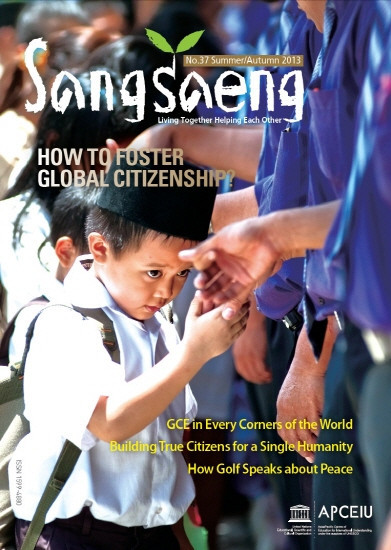 Building true citizens for a single humanity (SangSaeng no. 37 summer autumn 2013) 出版年份: 2013 机构作者: APCEIU SangSaeng No. 37- How to Foster Global Citizenship? has been published. In order to help our readers better grasp the concept of global citizenship and provide useful information and new ideas, this issue deals with various aspects of global citizenship education.3 Director’s Message4 Special ColumnBuilding True Citizens for a Single Humanity8 Focus: How to Foster Global Citizenship?8 Eliminating World Challenges through Global Citizenship Education 13 Developing Global Citizens with a Global Perspective18 Living in a New World Starts with Education23 GCE in Every Corners of the World28 Best Practices28 Hands-on Hand Print for Environmental Sustainability32 Bhutan Teachers Learn New Models of Education35 Comic Relief: Song of the City36 Special ReportPaving the Way Together for Global Citizenship Education40 InterviewBuilding a Global Community out of the Ashes of Poverty42 LetterCapturing Moments of Living in Harmony44 Peace in My MemoryHow Golf Speaks about Peace47 Understanding the Asia-Pacific RegionDiscovering Locks beyond the Function of Opening and Closing50 APCEIU in Action