
相关资源
探索丰富的全球公民教育资源,深化理解,促进研究、倡导、教学与学习。
共找到2,199条结果
 L’éducation à la Citoyenneté: a-t-il une place dans le programme? 出版年份: 2005 作者: Carol Mutch 机构作者: NZCER Press L’appel à propositions sur l'éducation à la citoyenneté comme une partie obligatoire du programme a rencontré une réponse variée dans le monde entier. Alors que tout le monde serait épouser les idéaux de sorte que nos jeunes grandissent pour devenir des citoyens actifs et équitable d'esprit, pourquoi l'éducation à la citoyenneté figurait pas une place plus importante dans notre programme? Cet article décrit le passé, le présent et l'avenir possible de l'éducation civique dans le programme Nouvelle-Zélande. 2013 Asia-Pacific Education Research Institutes Network (ERI-Net) regional study on: transversal competencies in education policy and practice (Phase I): regional synthesis report 出版年份: 2015 机构作者: UNESCO Bangkok The Asia-Pacific region has been spearheading global, social, and economic development for the last several decades. Millions of people have been lifted out of poverty and basic education (primary and lower secondary) has become near universal in many countries in the region. Upper secondary and higher education enrollment rates have also increased significantly. However, while these are tremendous achievements, education quality remains a major concern among emerging economies and industrialized nations alike. While some countries in the region excel in international assessments, such as the Programme for International Student Assessment (PISA), the Trends in International Mathematics and Science Study (TIMSS), and the Progress in International Reading Literacy Study (PIRLS), other countries still attain low scores. National assessment results of countries that have not participated in international assessments reveal large knowledge and skills disparities among students of the same country. In some cases the results also indicate a very low attainment level of basic skills, even after years of schooling.At the same time, the debate surrounding what actually constitutes quality education and learning in the 21st century is ongoing. There is a growing concern that education systems are focusing too much on the accumulation of academic “cognitive” skills at the expense of the more elusive and hard-to-measure “nonacademic” skills and competencies. The accumulation of these skills and competencies, which include skills and competencies in efficient communication with others, innovative thinking, respect for diversity and the environment, conflict resolution, team work, problem solving, and so on, is not only important for students to be adequately prepared for the world of work, but is also paramount in ensuring future generations are equipped to live meaningful, sustainable, and responsible lives in a rapidly changing and interconnected world.1 The effects of the limited attention paid to such skills and competencies in education can be felt in a number of domains and include, for example: poor respect for diversity (including socio-economic, ethnic, and gender equality), neglect of environmental issues, and a lack of innovation and social entrepreneurship among students.To counter these challenges, many countries and economies in the Asia-Pacific region have introduced, or are in the process of introducing, policy and curriculum changes aimed at enhancing the cultivation of such “non-academic” skills and competencies in learners. To date, these important reforms in the Asia-Pacific region have not been widely documented, and hence, in 2013 members of the Asia-Pacific Education Research Institutes Network (ERI-Net), hosted by UNESCO Bangkok since 2009, agreed to make this their next topic of investigation. The research aims to document and consolidate reform initiatives for knowledge dissemination and policy consideration to the benefit of countries and economies in the Asia-Pacific region and beyond. In phase I, the 2013 ERI-Net research examined how different countries and economies in the region define and apply “non-academic” skills (often termed “non-cognitive skills”) in their education policies, practices, and curriculum frameworks, and identified emerging trends and challenges. This report synthesizes ten case studies and includes important information and insights gained from the discussions held during the ERI-Net annual meeting 2013.The objectives of the report are: (i) to capture the movements in the realm of “non-academic” learning in ten education systems in the Asia-Pacific region; (ii) to identify possible policy recommendations for promoting and enhancing well-rounded and holistic learning; and, (iii) to suggest further stages of investigation. 2013 Réseau des instituts de recherche en éducation en Asie-Pacifique (ERI-Net) 出版年份: 2015 机构作者: UNESCO Bangkok La région Asie-Pacifique a été le fer de lance du développement mondial, social et économique depuis plusieurs décennies. Des millions de personnes ont été sorties de la pauvreté et de l'éducation de base (primaire et secondaire) est devenue quasi universelle dans de nombreux pays de la région. taux de scolarisation secondaire et le supérieur ont également augmenté de manière significative. Cependant, alors que ce sont des réalisations remarquables, la qualité de l'éducation demeure une préoccupation majeure parmi les économies émergentes et les pays industrialisés aussi bien. Alors que certains pays de la région d'exceller dans les évaluations internationales, telles que le Programme international pour le suivi des acquis des élèves (PISA), les Tendances de l'enquête internationale sur les mathématiques et les sciences (TEIMS) Le Programme international de recherche en lecture scolaire (PIRLS), et d'autres pays encore atteindre des scores faibles. Les résultats nationaux des pays qui n'ont pas participé aux évaluations internationales d'évaluation révèlent de grandes disparités entre les connaissances et les compétences chez les élèves d'un même pays. Dans certains cas, les résultats indiquent également un niveau de réalisation très faible des compétences de base, même après des années de scolarité.Dans le même temps, le débat entourant ce qui constitue effectivement l'éducation et un apprentissage de qualité dans le 21ème siècle est en cours. Il y a une préoccupation croissante que les systèmes éducatifs se concentrent trop sur l'accumulation de compétences académiques «cognitives» au détriment des compétences plus insaisissables et difficiles à mesurer "non académiques" et les compétences. L'accumulation de ces aptitudes et compétences, qui comprennent les compétences et les compétences en communication efficace avec les autres, la pensée novatrice, le respect de la diversité et de l'environnement, la résolution des conflits, le travail d'équipe, la résolution de problèmes, et ainsi de suite, est non seulement important pour les étudiants d'être adéquatement préparé pour le monde du travail, mais elle est aussi primordiale pour assurer les générations futures sont équipés pour mener une vie enrichissante, durables et responsables dans un monde1 en évolution rapide et interconnecté les effets de l'attention accordée à ces aptitudes et compétences en matière d'éducation peut se faire sentir dans un certain nombre de domaines et comprennent, par exemple: faible respect de la diversité (y compris l'égalité socio-économique, ethnique et le sexe), la négligence des questions environnementales, et un manque d'innovation et de l'entrepreneuriat social chez les étudiants.Pour contrer ces difficultés, de nombreux pays et économies de la région Asie-Pacifique ont mis en place ou sont en train d'introduire des changements de politiques et de programmes visant à améliorer la culture de ces aptitudes et compétences «non universitaires» chez les apprenants. À ce jour, ces réformes importantes dans la région Asie-Pacifique n'a pas été largement documentés, et donc, en 2013 les membres de l'Education Research Institutes Réseau Asie-Pacifique (ERI-Net), organisé par l'UNESCO à Bangkok depuis 2009, a aCECpté de faire cette leur sujet suivant l'enquête. La recherche vise à documenter et à consolider les initiatives de réforme pour la diffusion des connaissances et l'examen de la politique au profit des pays et des économies de la région Asie-Pacifique et au-delà. Dans la phase I, la recherche 2013 ERI-Net examiné comment les pays et les économies différentes dans la région de définir et d'appliquer les compétences «non universitaires» (souvent appelés «compétences non cognitives») dans leurs politiques d'éducation, des pratiques et des cadres du curriculum, et identifié les tendances et les défis nouveaux. Ce rapport synthétise dix études de cas et comprend des informations et des connaissances importantes acquises à partir des discussions tenues lors de la réunion annuelle ERI-Net 2013.Les objectifs du rapport sont les suivants: (i) de capturer les mouvements dans le domaine de la «non-académique" apprentissage dans dix systèmes d'éducation dans la région Asie-Pacifique; (Ii) de formuler des recommandations politiques possibles pour la promotion et l'amélioration de l'apprentissage bien équilibrée et holistique; et, (iii) à proposer d'autres stades de l'enquête.
 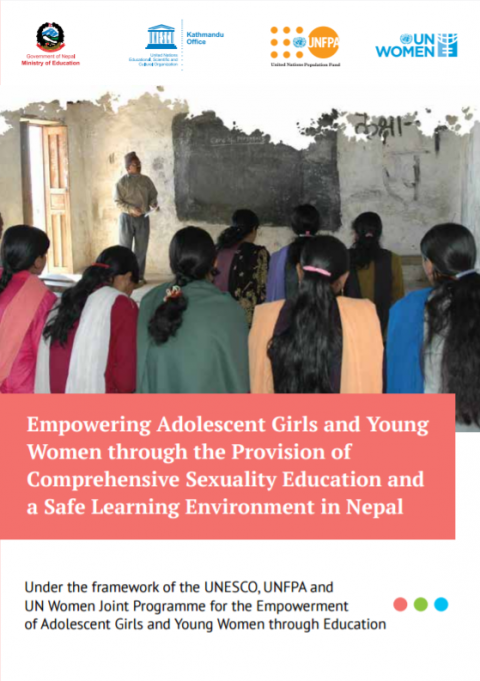 Empowering Adolescent Girls and Young Women through the Provision of Comprehensive Sexuality Education and a Safe Learning Environment in Nepal 出版年份: 2016 机构作者: UNESCO Kathmandu | United Nations Entity for Gender Equality and the Empowerment of Women (UN Women) | United Nations Population Fund (UNFPA) There are many challenges for adolescent girls and young women in Nepal in terms of access, participation, and completion of good quality education. Child marriage and early pregnancy, gender-based violence, lack of knowledge or provision of proper hygiene facilities such as WASH (water, sanitation and hygiene) are factors preventing adolescent girls and young women from accessing education. This publication is a project plan for empowering adolescent girls and young women in Nepal.
  디지털 리터러시 교육 1부: 정보를 읽는 능력을 키워라! #1 出版年份: 2020 机构作者: 한국교육방송공사 급변하는 매체환경, 범람하는 가짜뉴스 속에서 진짜 정보와 가짜 정보를 구분하는 능력인 디지털리터러시가 중요하게 여겨지고 있는 상황. 우리 학생들이 미래를 바꿀 수 있는 역량을 갖도록 하기 위해 시대의 흐름에 맞는 교육의 변화 또한 필요하다. 이번 <미래교육 플러스>에서는 변화한 흐름에 맞는 디지털리터러시 교육에 대해서 논의 한다. 디지털 리터러시 교육 1부 ‘정보를 읽는 능력을 키워라!’에서는 디지털 리터러시의 중요성과 디지털 리터러시 교육의 현주소를 점검해 본다.
  디지털 리터러시 교육 1부: 정보를 읽는 능력을 키워라! #2 出版年份: 2020 机构作者: 한국교육방송공사 급변하는 매체환경, 범람하는 가짜뉴스 속에서 진짜 정보와 가짜 정보를 구분하는 능력인 디지털리터러시가 중요하게 여겨지고 있는 상황. 우리 학생들이 미래를 바꿀 수 있는 역량을 갖도록 하기 위해 시대의 흐름에 맞는 교육의 변화 또한 필요하다. 이번 <미래교육 플러스>에서는 변화한 흐름에 맞는 디지털리터러시 교육에 대해서 논의 한다. 디지털 리터러시 교육 1부 ‘정보를 읽는 능력을 키워라!’에서는 디지털 리터러시의 중요성과 디지털 리터러시 교육의 현주소를 점검해 본다.
 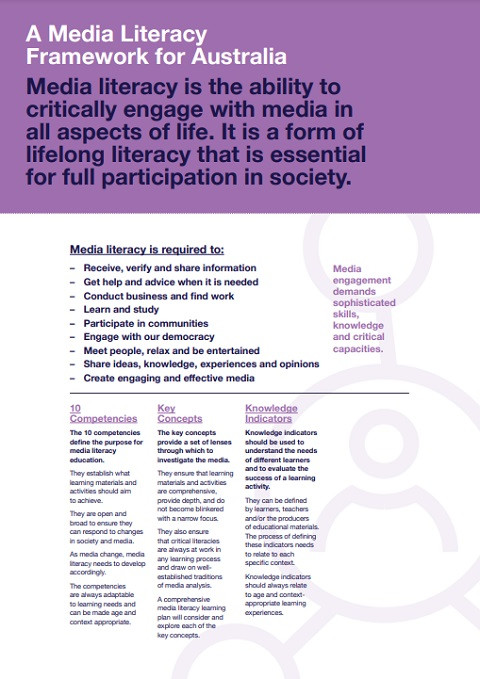 A Media Literacy Framework for Australia 出版年份: 2020 机构作者: Australian Media Literacy Alliance (AMLA) AMLA define media literacy as the ability to critically engage with media in all aspects of life.Media literacy complements Digital Literacy and Digital Safety – and all three are required to thrive in a digital world. Digital literacy focuses on the skills and knowledge required to access and use digital technologies. Digital Safety focuses on issues like online hate and abuse, bullying, the protection of personal information and online scams.Media Literacy encourages people to ask critical questions about the media and media technologies using a set of six key concepts. For any example of media (an advertisement, a news story, a film or television program, a YouTube video, video game or a social media post), we can ask the following questions:Institutions: who made this media and why did they make it?Audiences: who was this media made for and how are they likely to respond to it?Representations: how are people, places or ideas portrayed in this media, and what are the impacts of this?Technologies: what technology was used to produce, access and circulate this media? Does the technology gather personal data from users?Languages: how does this media communicate using image, sounds and written text?Relationships: what kind of relationships are being developed through the distribution and use of this media?These questions will have very different answers and follow-on questions depending on the media example, but the process of asking and answering these questions leads to critical understandings, and forms the basis for more successful media experiences. These questions can be asked during the process of consuming, sharing or creating media. They can be integrated as part of any Digital Literacy and Digital Safety learning program.
  코로나19와 미래핵심역량: 디지털 리터러시, 자기주도적 학습 능력, 협업 능력을 중심으로 出版年份: 2020 作者: 김자영 | 옥현진 | 신태섭 | 박미희 | 이정연 | 최보미 机构作者: 경기도교육연구원 코로나19로 인한 원격수업 과정에서 미래핵심역량인 디지털 리터러시, 자기주도적 학습 능력, 협업 능력 신장에 대한 중요성이 부각되고 있으며 이에 대한 실태를 분석하고 교육의 방향을 설정하는 것이 중요할 것이다. 본 연구는 경기도 지역의 초중고 일반 학교 및 혁신학교, 연구 및 시범학교(디지털교과서 시범학교, 민주시민교육실천학교 등)를 대상으로 미래핵심역량인 디지털 리터러시, 자기주도적 학습 능력, 협업능력에 대한 실태를 조사하고 이러한 미래핵심역량에 영향을 미칠 수 있는 학생 및 학교 맥락변인을 분석하였으며, 분석 결과를 토대로 미래교육이 나아가야 할 방향을 제시하고자 한다.
  2019 꿈다락 토요문화학교 드림 아트랩 4.0 'Everyday is Playful Media' 결과자료집 出版年份: 2019 机构作者: 한국예술종합학교 융합예술센터 2019 꿈다락 토요문화학교 드림 아트랩 4.0 프로그램 관련, 한국예술종합학교 융합예술센터가 운영하고 성북구립미술관, N15가 협력하여 진행한 'Everyday is Playful Media' 프로그램 결과자료집으로 자료집은 Playful Thinking, Playful Learning, Playful Making 3개의 세부 프로그램 운영 내용 및 결과 전시 등의 과정이 기록되어있다. 본 저작물은 한국예술종합학교 융합예술센터에서 2019년 작성하여 공공누리 제4유형으로 개방한 ‘2019 꿈다락 토요문화학교 드림 아트랩 4.0 'Everyday is Playful Media' 결과자료집’을 이용하였으며 해당 저작물은 한국문화예술교육진흥원 arte 라이브러리 홈페이지(lib.arte.or.kr)에서 무료로 다운받으실 수 있습니다.
  세계시민을 위한 미디어정보리터러시 교안 개발 연구 出版年份: 2022 作者: 김아미 | 김영은 | 박다혜 | 박유신 | 고기식 | 김현정 机构作者: 유네스코한국위원회 어린이·청소년은 디지털 공간에서 세계시민이자 디지털 시민으로 성장하고 있다. 그러나 지금까지 어린이·청소년과 디지털 미디어를 논할 때에는 어린이·청소년을 미디어로부터 보호하거나 과의존을 방지하는 교육을 강조하거나 디지털 공간에서의 에티켓 교육 등에 치우친 경향이 있다. 하지만 어린이·청소년은 이미 디지털 공간의 중요한 구성원이자 성인과 미디어를 함께 경험해 나가는 주체이므로, 어린이·청소년이 디지털 세상에서 누려야 하는 권리는 무엇인지, 그리고 그러한 권리를 어떻게 지킬 것인지에 대한 보다 활발한 논의가 필요하다.어린이·청소년의 경험과 요구를 이해하고 학습자와 교육자가 함께 만들어가는 미디어정보리터러시 교육이야말로 지금 디지털 시민이자 세계시민으로 성장하는 어린이·청소년에게 필수적인 역량을 함양시킬 수 있는 교육일 것이다.이에 본 연구는 어린이·청소년이 경험하는 여러 미디어 관련 이슈에 대한 이해를 바탕으로 하여, 세계시민을 위한 미디어정보리터러시 교육안을 개발하는 것을 목적으로 한다. 특히 유엔아동권리협약 제12조에서 강조하고 있는 어린이·청소년의 참여권을 지원하기 위하여, 당사자의 목소리를 듣고 이를 반영하는 어린이·청소년 참여형 연구(participatory research)를 계획하였다.