
相关资源
探索丰富的全球公民教育资源,深化理解,促进研究、倡导、教学与学习。
共找到3,376条结果
 Education for global citizenship 出版年份: 2004 作者: Audrey Osler Cosmopolitan Citizenship is described as a concept of Global learning based on international agreements of UNESCO and the Council of Europe. To live in a global world people would need – besides basic education – different social skills as competencies of political literacy.
  Translating globalization theories into educational research : thoughts on recent shifts in Holocaust education Much educational research on globalization aims to prepare students to be successful citizens in a global society. We propose a set of three concepts, drawing on systems theory (Nassehi, Stichweh) and theories of the subject (Butler, Foucault), to think the global which enables educational research to step back from hegemonic discourses and reflect on current practices. Globalization is understood in this approach as referring to: (1) a cognitive shift; (2) expanding relevancy spaces; and (3) new forms of subjectivation. The framework is illustrated with examples from educational policy and learning materials, with an extended look at how globalization is articulated in recent shifts in Holocaust education. (By the author)
  The Elusive and Exclusive Global Citizen 出版年份: 2015 作者: Jill Koyama 机构作者: Mahatma Gandhi Institute of Education for Peace and Sustainable Development (MGIEP) In this paper, the author interrogate the notion of global citizenship, both as an aspiration and an improbable practice, by situating it within contemporary understandings of citizenship and globalization.It is a conceptualization that suffers from the dangers inherent in the term “citizenship” and misconceptions of the terms “global,” and it is rooted in the West’s long engagement in normative undertakings in non-Western countries. The writer refute ideas of the autonomous and agentic global citizen. he encourage a rethinking of global citizenship and global citizenship education (GCE) and offer recommendations for redirecting attention to contemporary global stratifications and issues of human rights to address the issues of social justice and inequality that, due to the problematic definition of global citizenship, are currently inadequately covered in existing GCE curricula.
  Building Citizenship from Universities; University Social Responsibility and Challenges in the XXI century 出版年份: 2011 作者: Eduardo Gasca-Pliego | Julio César Olvera-García 机构作者: Universidad Autónoma del Estado de México The present essay contributes with a reflection on the role universities must take as agents of transformation and consolidation of the democratic model, mainly before the challenge of building full citizens, interested in the need of the physical and social environment, in collective decision making, who think of themselves as participant citizens and not only voters with their own interests in view. Distinguishable is the primordial role of university social responsibility to promote the social management of knowledge for everyone, which has as an end the construction of informed, responsible and participant citizenship, which responds to injustice, non-sustainability, violence and corruption. Rethinking the social function of the university requires defending the values proper to public education, in the sense that every citizen has equal opportunities to develop their capabilities, eliminating obstacles of social and economic nature, as well as the cultural and political that affect and hinder said development. Construir ciudadanía desde las universidades, responsabilidad social universitaria y desafíos ante el siglo XXI 出版年份: 2011 作者: Eduardo Gasca-Pliego | Julio César Olvera-García 机构作者: Universidad Autónoma del Estado de México El presente ensayo aporta una reflexión respecto al rol que deben adquirir las universidades como agentes de transformación y consolidación del modelo democrático, principalmente ante al reto de construir ciudadanos completos, interesados por las necesidades del entorno físico y social, por la toma de decisiones colectivas, que se conciben a sí mismos como ciudadanos partícipes y no únicamente como votantes con miras a satisfacer sus propios intereses. Destaca el papel prioritario de la responsabilidad social universitaria que promueva la gestión social del conocimiento para todos los actores sociales, que tenga como finalidad la construcción de una ciudadanía informada, responsable y participativa, que responda ante la injusticia, la insostenibilidad, la violencia y la corrupción. Repensar la función social de la universidad pública requiere defender los valores propios de la educación pública, en el sentido de que todos los ciudadanos tengan la igualdad de oportunidades para desarrollar sus capacidades, eliminando obstáculos de carácter económico y social, así como los culturales y políticos que afectan e impiden ese desarrollo.
  Public Universities and Neoliberal Common Sense: Seven Iconoclastic Thesis 出版年份: 2014 作者: Carlos Alberto Torres 机构作者: Universidad Nacional de Tres de Febrero (UNTREF) Neoliberalism has utterly failed as a viable model of economic development, yet the politics of culture associated with neoliberalism is still in force, becoming the new common sense shaping the role of government and education. This ‘common sense’ has become an ideology playing a major role in constructing hegemony as moral and intellectual leadership in contemporary societies. Neoliberal globalisation, predicated on the dominance of the market over the state and on deregulatory models of governance, has deeply affected the university in the context of ‘academic capitalism’. The resulting reforms, rationalised as advancing international competitiveness, have affected public universities in four primary areas: efficiency and accountability, accreditation and universalisation, international competitiveness and privatisation. There is also growing resistance to globalisation as top-down-imposed reforms reflected in the public debates about schooling reform, curriculum and instruction, teacher training and school governance. Many question whether neoliberal reforms attempt to limit the effectiveness of universities as sites of contestation of the national and global order and thus undermine the broader goals of education. Neoliberal reforms have limited access and opportunity along class and racial lines, including limiting access to higher education through the imposition of higher tuition and reduced government support to institutions and individuals. Las universidades públicas y el sentido común neoliberal: siete tesis iconoclastas 出版年份: 2014 作者: Carlos Alberto Torres 机构作者: Universidad Nacional de Tres de Febrero (UNTREF) El neoliberalismo ha fracasado completamente como un modelo viable de desarrollo económico, sin embargo, la política de la cultura asociada con el neoliberalismo sigue en vigor, convirtiéndose en el nuevo sentido común definiendo el rol del gobierno y de la educación. Este “sentido común“ se ha convertido en una ideología que juega un papel importante en la construcción de un liderazgo moral e intelectual hegemónico en las sociedades contemporáneas. La globalización neoliberal, basada en el predominio del mercado sobre el Estado y en modelos desregulados de gobierno, ha afectado profundamente a la universidad en el contexto del “capitalismo académico“. Las reformas resultantes, justificadas como avances en la competitividad internacional, han afectado a las universidades públicas en cuatro áreas principales: la eficiencia y la rendición de cuentas, la acreditación y universalización, la competitividad internacional y la privatización. También hay una creciente resistencia a la globalización y a las reformas impuestas de arriba hacia abajo reflejadas en los debates públicos sobre la reforma de la escolaridad, el currículo y la instrucción, la formación de docentes y la gestión escolar. Muchos se preguntan si las reformas neoliberales intentan limitar la eficacia de las universidades como lugares de disputa del orden nacional y global y así socavar los objetivos últimos de la educación. Las reformas neoliberales brindan un acceso y oportunidades limitadas según las clases y grupos raciales, incluyendo la restricción del acceso a la educación superior a través de la imposición de matrículas más costosas y la reducción del apoyo gubernamental a instituciones e individuos.
 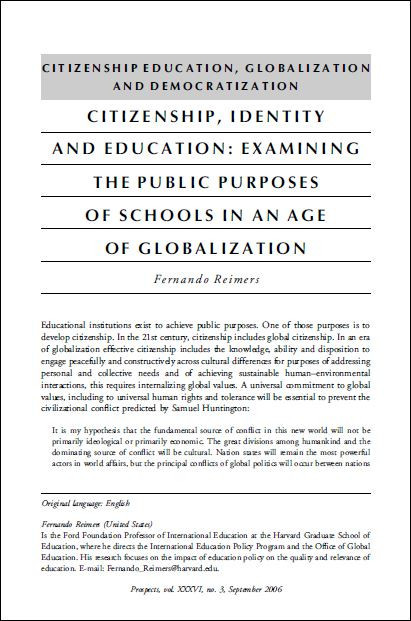 Citizenship, Identity, and Education: Examining the Public Purposes of Schools in an Age of Globalization 出版年份: 2006 作者: Fernando Reimers 机构作者: UNESCO International Bureau of Education (IBE) One of the purposes of educational institutions is to develop citizenship. In the 21st century, citizenship includes global citizenship. Addressing the challenges of globalization will require making citizenship education and the development of global values an explicit objective of efforts to improve quality throughout the world, critically examining theories and evidence about the effectiveness of various approaches to developing citizenship and global citizenship and supporting activities aligned with this public purpose. In this article, the author does not argue for an exclusive effort to focus schools on civic education, but rather for a balanced effort to elevate educational quality making it more relevant to address global challenges and opportunities, of which civic education and global education are components, much neglected at present. The author also does not suggest making civic education the only purpose of the curriculum or making it a priority to the expense of science, math, arts or physical and health education, but he thinks that helping students develop a sense of purpose, situated within broader civic and global purposes, would also facilitate high level engagement with science, mathematical and artistic pursuits.
 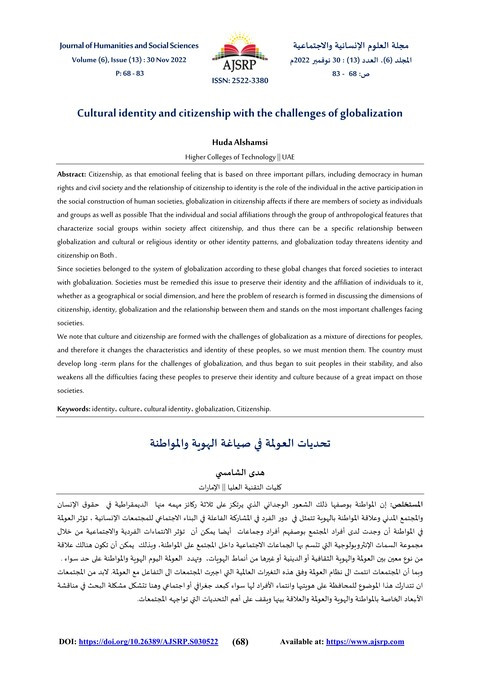 Cultural Identity and Citizenship With the Challenges of Globalization (Journal of Humanities and Social Sciences; Vol.6, No.13) 出版年份: 2022 作者: Huda Alshamsi 机构作者: Arab Institute of Science and Research Publishing (AISRP) Citizenship is the emotional feeling that is based on three important pillars, including democracy in human rights, civil society, and the relationship between citizenship and identity, is manifested in the active role of individuals in social construction within human societies. Globalization affects citizenship when it exists among individuals and groups in society. Individual and social affiliations, characterized by anthropological features within social groups, can also impact citizenship. Thus, there may be a specific relationship between globalization and cultural, religious, or other identity patterns. Today, globalization threatens both identity and citizenship. As societies adapt to the global system through these global changes that force interaction with globalization, it becomes essential for communities to address this issue to preserve their identity and individual belonging, whether geographically or socially. This forms the basis for researching the dimensions related to citizenship, identity, globalization, and their interrelationships, which pose significant challenges for societies. تحديات العولمة في صياغة الهوية والمواطنة (مجلة العلوم الإنسانية والإجتماعية; Vol. 6, No. 13) 出版年份: 2022 作者: Huda Alshamsi 机构作者: Arab Institute of Science and Research Publishing (AISRP) إن المواطنة بوصفها ذلك الشعور الوجداني الذي يرتكز على ثلاثة ركائز مهمه منها الديمقراطية في حقوق الإنسان والمجتمع المدني وعلاقة المواطنة بالهوية تتمثل في دور الفرد في المشاركة الفاعلة في البناء الاجتماعي للمجتمعات الإنسانية ، تؤثر العولمة في المواطنة أن وجدت لدى أفراد المجتمع بوصفهم أفراد وجماعات أيضا يمكن أن تؤثر الانتماءات الفردية والاجتماعية من خلال مجموعة السمات الإنثروبولوجية التي تتسم بها الجماعات الاجتماعية داخل المجتمع على المواطنة، وبذلك يمكن أن تكون هنالك علاقة من نوع معين بين العولمة والهوية الثقافية أو الدينية أو غيرها من أنماط الهويات، وتهدد العولمة اليوم الهوية والمواطنة على حد سواء . وبما أن المجتمعات انتمت الى نظام العولمة وفق هذه التغيرات العالمية التي اجبرت المجتمعات الى التفاعل مع العولمة. لابد من المجتمعات ان تتدارك هذا الموضوع للمحافظة على هويتيها وانتماء الأفراد لها سواء كبعد جغرافي أو اجتماعي وهنا تتشكل مشكلة البحث في مناقشة الأـبعاد الخاصة بالمواطنة والهوية والعولمة والعلاقة بينها ويقف على أهم التحديات التي تواجهه المجتمعات.