
相关资源
探索丰富的全球公民教育资源,深化理解,促进研究、倡导、教学与学习。
共找到1,471条结果
 Plan of action: world programme for human rights education; first phase 出版年份: 2006 机构作者: UN Office of the High Commissioner for Human Rights The Plan of Action for the first phase (2005-2007) of the World Programme was adopted by all United Nations Member States in July 2005. It proposes a concrete strategy and practical guidance for implementing human rights education in primary and secondary schools. On 10 December 2004, the General Assembly of the United Nations proclaimed the World Programme for Human Rights Education (2005-ongoing) to advance the implementation of human rights education programmes in all sectors. Building on the foundations laid during the United Nations Decade for Human Rights Education (1995-2004), this new initiative reflects the international community’s increasing recognition that human rights education produces far-reaching results. By promoting respect for human dignity and equality and participation in democratic decision-making, human rights education contributes to the long-term prevention of abuses and violent conflicts. To help make human rights a reality in every community, the World Programme seeks to promote a common understanding of the basic principles and methodologies of human rights education, to provide a concrete framework for action and to strengthen partnerships and cooperation from the international level down to the grass roots. Plan d’action Programme: mondial en faveur de l’éducation aux droits de l’homme; Première phase 出版年份: 2006 机构作者: UN Office of the High Commissioner for Human Rights Le Plan d’action pour la première phase (2005-2007) du Programme mondial a été adopté par l’ensemble des États membres de l’ONU en juillet 2005. Il propose une stratégie concrète et des conseils pratiques pour intégrer l’éducation dans le domaine des droits de l’homme dans les écoles primaires et secondaires. Le 10 décembre 2004, l’Assemblée générale de l’ONU a adopté le Programme mondial d’éducation dans le domaine des droits de l’homme (qui est en cours depuis 2005) afin de promouvoir l’exécution des programmes d’éducation en la matière dans tous les secteurs2. S’appuyant sur le travail accompli au cours de la Décennie des Nations Unies pour l’éducation dans le domaine des droits de l’homme (1995-2004), cette nouvelle initiative traduit la reconnaissance croissante par la communauté internationale du fait que l’éducation dans le domaine des droits de l’homme produit des résultats d’une portée considérable. En favorisant le respect de la dignité humaine, l’égalité et la participation à la prise de décisions de façon démocratique, cette éducation contribue à prévenir à long terme les violations des droits de l’homme et les confl its violents. Pour aider à faire des droits de l’homme une réalité dans chaque société, la communauté internationale s’eff orce par le biais du Programme mondial à promouvoir une conception commune des principes fondamentaux et des méthodes d’éducation dans ce domaine, à mettre en place un cadre concret d’intervention et à renforcer les partenariats et la coopération sur tous les niveaux, depuis le niveau international jusqu’à l’échelon communautaire.
 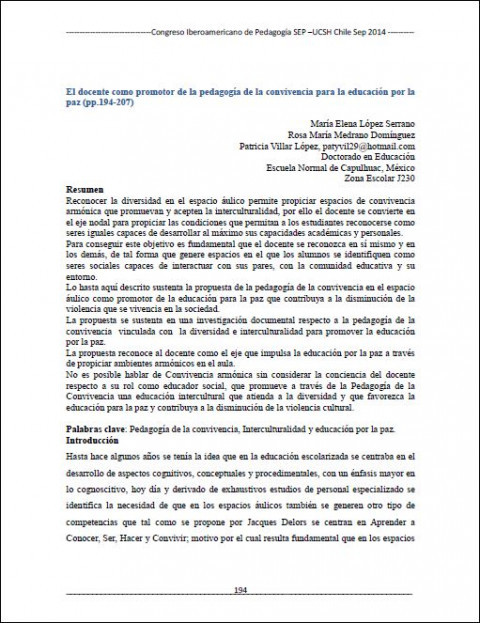 The Teacher as a Promoter of the Pedagogy of Coexistence for Education for Peace 出版年份: 2014 作者: María Elena López Serrano | Rosa María Medrano Domínguez | Patricia Villar López 机构作者: Universidad Católica Silva Henríquez Recognizing the diversity in the aulic space allows to create spaces of harmonious coexistence that promote and accept interculturality, for this the teacher becomes the nodal axis to propitiate the conditions that allow the students to recognize themselves as equal beings capable of developing their capacities to the maximum academic and personal. To achieve this goal it is essential that the teacher recognizes himself and others, in such a way that generates spaces in which students identify as social beings able to interact with their peers, the educational community and their environment. What has been described here supports the proposal of the pedagogy of coexistence in the aulic space as a promoter of education for peace that contributes to the reduction of the violence experienced in society. The proposal is based on a documentary research on the pedagogy of coexistence linked to diversity and interculturality to promote education for peace. The proposal recognizes the teacher as the axis that drives education for peace through fostering harmonious environments in the classroom. It is not possible to speak of harmonic coexistence without considering the teacher's awareness of his role as a social educator, which promotes through Pedagogy of Coexistence an intercultural education that attends to diversity and that favors education for peace and contributes to the decrease of cultural violence. El docente como promotor de la pedagogía de la convivencia para la educación por la paz 出版年份: 2014 作者: María Elena López Serrano | Rosa María Medrano Domínguez | Patricia Villar López 机构作者: Universidad Católica Silva Henríquez Reconocer la diversidad en el espacio áulico permite propiciar espacios de convivencia armónica que promuevan y acepten la interculturalidad, por ello el docente se convierte en el eje nodal para propiciar las condiciones que permitan a los estudiantes reconocerse como seres iguales capaces de desarrollar al máximo sus capacidades académicas y personales. Para conseguir este objetivo es fundamental que el docente se reconozca en sí mismo y en los demás, de tal forma que genere espacios en el que los alumnos se identifiquen como seres sociales capaces de interactuar con sus pares, con la comunidad educativa y su entorno. Lo hasta aquí descrito sustenta la propuesta de la pedagogía de la convivencia en el espacio áulico como promotor de la educación para la paz que contribuya a la disminución de la violencia que se vivencia en la sociedad. La propuesta se sustenta en una investigación documental respecto a la pedagogía de la convivencia vinculada con la diversidad e interculturalidad para promover la educación por la paz.La propuesta reconoce al docente como el eje que impulsa la educación por la paz a través de propiciar ambientes armónicos en el aula. No es posible hablar de Convivencia armónica sin considerar la conciencia del docente respecto a su rol como educador social, que promueve a través de la Pedagogía de la Convivencia una educación intercultural que atienda a la diversidad y que favorezca la educación para la paz y contribuya a la disminución de la violencia cultural.
  Teaching Two Lessons about UNESCO and Other Writings on Human Rights 出版年份: 2017 作者: Fernando Reimers This book presents two lessons for use in college or high school, to educate students on the mission and work of UNESCO as it relates to the advancement of Human Rights. It includes also a series of a short essays on Human Rights, the Right to Education, Teaching Human Rights and the role of Teachers and Universities in Teaching Human Rights which will be useful to educators interested in educating their students to advance the values of freedom and justice. For more information about this book, please visit the link below.URL: https://www.amazon.com/Teaching-Lessons-Unesco-writings-Rights/dp/1978367996#reader_1978367996 The lessons(Two Lessons About UNESCO) are designed to help high school and college students understand the mission of UNESCO, the reason the organization was created, the work it does, how it is structured and funded, and how its work relates to the Universal Declaration of Human Rights. The lessons can be taught at the High School or College level. They can be taught in a variety of courses including social studies, history, humanities, and can be integrated in courses in other disciplines. For more information, please visit the link below.URL: https://medium.com/@fernandomreimers/teaching-two-lessons-about-unesco-7531c5fe9395
  Plano de ação: Programa Mundial para Educação em Direitos Humanos 出版年份: 2012 机构作者: UN Office of the High Commissioner for Human Rights The Plan of Action for the first phase (2005-2007) of the World Programme was adopted by all United Nations Member States in July 2005. It proposes a concrete strategy and practical guidance for implementing human rights education in primary and secondary schools. On 10 December 2004, the General Assembly of the United Nations proclaimed the World Programme for Human Rights Education (2005-ongoing) to advance the implementation of human rights education programmes in all sectors. Building on the foundations laid during the United Nations Decade for Human Rights Education (1995-2004), this new initiative reflects the international community’s increasing recognition that human rights education produces far-reaching results. By promoting respect for human dignity and equality and participation in democratic decision-making, human rights education contributes to the long-term prevention of abuses and violent conflicts. To help make human rights a reality in every community, the World Programme seeks to promote a common understanding of the basic principles and methodologies of human rights education, to provide a concrete framework for action and to strengthen partnerships and cooperation from the international level down to the grass roots. 行动计划世界人权教育方案 : 第一阶段 出版年份: 2006 机构作者: UN Office of the High Commissioner for Human Rights The Plan of Action for the first phase (2005-2007) of the World Programme was adopted by all United Nations Member States in July 2005. It proposes a concrete strategy and practical guidance for implementing human rights education in primary and secondary schools. On 10 December 2004, the General Assembly of the United Nations proclaimed the World Programme for Human Rights Education (2005-ongoing) to advance the implementation of human rights education programmes in all sectors. Building on the foundations laid during the United Nations Decade for Human Rights Education (1995-2004), this new initiative reflects the international community’s increasing recognition that human rights education produces far-reaching results. By promoting respect for human dignity and equality and participation in democratic decision-making, human rights education contributes to the long-term prevention of abuses and violent conflicts. To help make human rights a reality in every community, the World Programme seeks to promote a common understanding of the basic principles and methodologies of human rights education, to provide a concrete framework for action and to strengthen partnerships and cooperation from the international level down to the grass roots.
  Engaging Girls, Boys and Youth as Active Citizens: Plan International’s Position Paper 出版年份: 2020 机构作者: Plan International Plan International believes that every child and young person has the right to express their views freely and safely; influence decisions and take action on issues that matter to them. However, around the world children and young people – particularly girls and young women – face significant challenges in realising this right. They tend to be wrongly dismissed as insufficiently mature to participate in political and civic processes. They also tend to be stigmatised as potential perpetrators of disruption, not as valued citizens and contributors to society who can lead and drive positive change. Plan International is calling for a paradigm shift in the way the international community talks about, engages and partners with children and young people. Children and young people are not just the future. They are the present. Young people constitute almost half of the world’s population, yet they are dramatically underrepresented – even excluded – in political decision-making. It is critical that their views and needs are taken into account politically, socially, legally and economically. Promoting the voices and views of children and young people – especially girls and women – in all their diversity and supporting them to actively engage in decision-making on issues that affect their lives must be an urgent priority for the world’s power holders. Realising children and young people’s civil and political rights is a prerequisite for building sustainable and peaceful societies, and a gender just world envisioned in international human rights frameworks and the 2030 Agenda’s Sustainable Development Goals (SGDs).Across the 75+ countries Plan International works in, young people have consistently identified the denial of their political and civil rights as a priority issue. In March 2017, Plan International conducted consultations with young women and men aged 14 to 30 from 14 countries. In every country, young people reported a sense of “citizen responsibility” and an interest in public life, yet identified the lack of platforms to meaningfully engage with decision-makers and inability to ensure their opinions are taken seriously as key barriers. Girls and young women in particular have called for the removal of gendered norms that increase those barriers, silence their voices and disproportionately hold them back from leadership and active citizenship. Impliquer les filles, garçons et jeunes en tant que citoyens actifs : Prise de position de Plan International 出版年份: 2020 机构作者: Plan International Ce rapport expose la position de Plan International sur le droit à la participation à la vie publique, ainsi qu’une analyse : du cadre juridique et politique ; de l’impact des normes sociales et genrées sur la participation ; et des problèmes spécifiques relatifs à l’émancipation politique et à la citoyenneté active. Ce rapport appuie 100 Millions de Raisons, la Stratégie Mondiale 2017-2022 de Plan International, dont la priorité principale est le soutien des filles, des garçons et des jeunes en tant qu’acteurs actifs du changement. Il défend notre travail en relation avec l’Agenda 2030 et les Objectifs de Développement Durable – plus spécifiquement les objectifs 5, 10 et 16. Un certain nombre de recommandations importantes sont incluses afin de guider le plaidoyer. Involucrar a niñas, niños y jóvenes como ciudadanos activos: Documento de Posición de Plan International 出版年份: 2020 机构作者: Plan International En este documento se expone la posición de Plan International sobre el derecho a participar en la vida pública, así como el análisis del marco jurídico y político; las repercusiones de las normas sociales y de género en la participación; y aspectos específicos relacionados con el empoderamiento político y la ciudadanía activa. Este instrumento apunta a 100 Millones de Razones, la Estrategia Global de Plan International 2017-2022, que define como prioridad apoyar a las niñas, los niños y las/los jóvenes como motores del cambio. También apoya nuestra labor en relación con la Agenda 2030 y los Objetivos de Desarrollo Sostenible, en particular los Objetivos 5, 10 y 16. Para orientar las actividades de incidencia se incluyen varias recomendaciones de alto nivel.