
相关资源
探索丰富的全球公民教育资源,深化理解,促进研究、倡导、教学与学习。
共找到2,781条结果
 Diversity, Dialogue and Sharing: Online Resources for a More Resourceful World 出版年份: 2017 作者: Francine Saillant 机构作者: UNESCO The different societies and regions of the world are developing original perspectives on diversity, cultural rapprochement and intercultural dialogue. These perspectives arise through the complex interactions between regional structures, governmental bodies, civil society and cultural institutions. The tools available to these actors are easily identifiable on a global scale, particularly those regularly produced by UNESCO. However, other tools exist - intercultural universities, virtual libraries, training programs for urban policies, MOOCS, video conferences, virtual exhibitions, online archives, to name but a few - their visibility limited by their fragmented distribution. It is through these resources that countries and regions succeed in producing responses in support and promotion of diversity adapted to their context specific problems.This book provides a reinterpretation of the concept of intercultural dialogue rooted in regional perspectives on diversity, giving a broad panorama of the shared theoretical, practical and technical tools and online resources available.This book comprises three parts. Part 1 examines the perspectives selected for our inquiry from a conceptual and reflective standpoint. Topics covered will include the notions of diversity and dialogue, an examination of these notions, and finally our methodology. Part 2 introduces the regions (in the sense established by UNESCO), their diversity-related characteristics and issues, and the regional strategies adopted in order to promote not only diversity but also rapprochement and dialogue. Finally, Part 3 details the various actions that embody the regions’ strategies and broad orientations, with each action being presented based on its underlying aims. Parts 2 and 3 represent two different ways of approaching the shared and shareable resources in question, of which we hope to present the most promising aspects.
 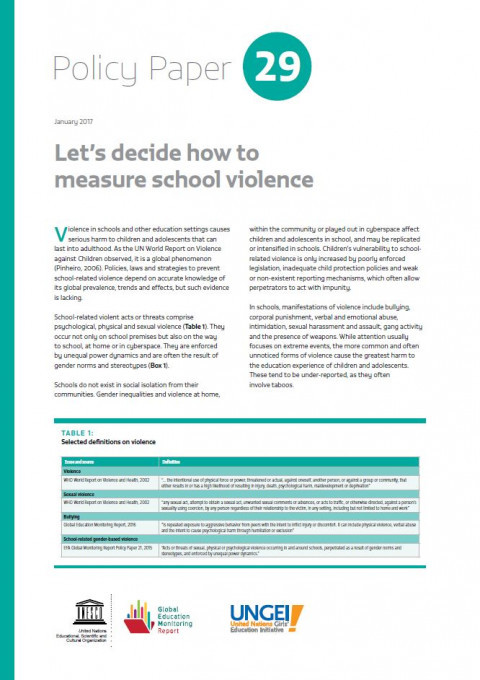 Let's Decide How to Measure School Violence (Policy Paper 29) 出版年份: 2017 机构作者: UNESCO Violence in schools and other education settings causes serious harm to children and adolescents that can last into adulthood. As the UN World Report on Violence against Children observed, it is a global phenomenon (Pinheiro, 2006). Policies, laws and strategies to prevent school-related violence depend on accurate knowledge of its global prevalence, trends and effects, but such evidence is lacking.In schools, manifestations of violence include bullying, corporal punishment, verbal and emotional abuse, intimidation, sexual harassment and assault, gang activity and the presence of weapons. While attention usually focuses on extreme events, the more common and often unnoticed forms of violence cause the greatest harm to the education experience of children and adolescents. These tend to be under-reported, as they often involve taboos.To collect data on aspects of violence in schools, large-scale, multi-country school-based surveys are increasingly used; some countries also have well-established monitoring mechanisms. Overall, however, consistent evidence on the global prevalence and trends of school-related violence is lacking. To ensure reliable data is gathered, action is needed to bridge differences between the various monitoring methods. This paper, launched to coincide with the International Symposium on School Violence and Bullying: From Evidence to Action, in Seoul, Republic of Korea (January 17–19, 2017), aims to inform the current debate and propose options for the future.
  Agree to Differ 出版年份: 2015 机构作者: UNESCO Dialogue on the basis of respect, tolerance, human rights and dignity has never been so important. This is the spirit of the International Decade for the Rapprochement of Cultures (2013-2022). The International Decade originates in the United Nations General Assembly Resolution 67/104 adopted in December 2012, co-sponsored by Kazakhstan and designating UNESCO as lead agency. This drew on a Resolution of the UNESCO General Conference and the experience of the 2010 International Year for the Rapprochement of Cultures which UNESCO led forward with activities across the world.The objective of the International Decade is to promote mutual understanding and respect for diversity, rights and equal dignity between peoples, through intercultural dialogue and concrete initiatives. This is essential for all societies today, undergoing deep transformation. The surge of conflict, acts of violence, extremism and intolerance pose a threat to peace, undermining the unity of humanity and calling on us all to redouble our efforts to advance a culture of peace, through dialogue, the safeguarding of cultural heritage, and the promotion of global citizenship education.The International Decade for the Rapprochement of Cultures embodies a commitment to explore new articulations between cultural diversity and universal values. The rapprochement of cultures calls for a commitment to the principles of human dignity and solidarity as the corner stones of living together within and between societies, making the most of all sources of diversity.This publication bears testimony to the urgency of addressing contemporary challenges through intercultural and interreligious dialogue in order to deepen understanding and cooperation for peace. Through concrete examples, including experiences at the community level from across the world, the publication showcases why cultural diversity, intercultural dialogue and responsive democratic governance are vital for the enhancement of mutual understanding, the growth of tolerance, and the building of bridges of mutual respect and dignity.
  Culture: Urban Future; Global Report on Culture for Sustainable Urban Development 出版年份: 2016 机构作者: UNESCO As the cornerstone of society, culture must lie at the heart of sustainable policies and strategies. Yet, despite its vital importance, key questions such as: ‘How has culture influenced urban development across the world?’ and ‘How can culture make a difference to our urban future?’ have often remained unexplored.This report, the first of its kind, explores the role of culture for sustainable urban development. It is intended as a policy framework document to support governments in the implementation of the 2030 Agenda for Sustainable Urban Development and the New Urban Agenda.In search of a common thread between the past and the future, the report examines the contribution of culture to urban sustainability from two analytical angles: a global survey implemented with nine regional partners across the world; and key thematic insights. The report thus analyses the situation, trends, threats and existing opportunities in different regional contexts, and presents a global picture of urban heritage safeguarding, conservation and management, as well as the promotion of cultural and creative industries, as resources for sustainable urban development. The report also includes a set of maps and a section on UNESCO’s strategic networks reflecting the Organization’s various fields of competence.Building on the findings of this global research and thematic reflection, the report presents new guidelines and recommendations, rooted in culture, to ensure that the cities of tomorrow are safe, inclusive, resilient and sustainable.
  The King Abdullah bin Abdulaziz International Programme for a Culture of Peace and Dialogue: Key Achievements of Phase I 出版年份: 2016 机构作者: UNESCO The King Abdullah bin Abdulaziz International Programme for a Culture of Peace and Dialogue arose from the institutional framework of UNESCO’s Programme for a Culture of peace and non-violence. More than a concept, the Culture of Peace is a commitment to make peace a tangible reality for all. It denotes “a set of values, attitudes, traditions and modes of behaviour and ways of life based on respect for life, ending of violence and […] adherence to the principles of freedom, justice, democracy, tolerance, solidarity, cooperation, pluralism, cultural diversity, dialogue and understanding at all levels of society and among nations” (Article 1, Declaration and Programme of Action of a Culture of Peace, UNESCO, 1999). UNESCO continue its work to nurture a Culture of Peace, with development considerations, by joining forces with committed stakeholders in education, the sciences, culture, and communication and information.
  Global Citizenship Education: Taking It Local 出版年份: 2018 机构作者: UNESCO UNESCO is leading global efforts on Global Citizenship Education (GCED), which is at the core of Target 4.7 of Sustainable Development Goal 4 on Education. To address the perception that the concept of GCED is concerned mainly with global matters and maybe dissociated from local needs and realities, UNESCO has identified local/national/traditional precepts and concepts that are similar to the UNESCO understanding of global citizenship.As culturally relevant expressions of GCED and to contribute to building peace through the implementation of GCED, the concepts identified here can serve as entry-points to teach and learn about GCED in more locally relevant ways. Education à la citoyenneté mondiale: pour une approche locale 出版年份: 2018 机构作者: Organisation des Nations Unies pour l'éducation, la science et la culture (UNESCO) L’UNESCO mène les efforts mondiaux portant sur l’éducation à la citoyenneté mondiale, qui est au coeur de la cible 4.7 de l’Objectif 4 de développement durable sur l’éducation. Afin de clarifier la perception selon laquelle le concept de l’éducation à la citoyenneté mondiale concerne principalement des questions mondiales et qu’il est peut-être dissocié des réalités et des besoins locaux, l’UNESCO a identifié des préceptes et des concepts locaux/nationaux/traditionnels qui sont comparables à la compréhension qu’a l’UNESCO de la citoyenneté mondiale. En tant qu’expressions culturellement pertinentes de l’éducation à la citoyenneté mondiale, et dans le but de contribuer à l’édification de la paix grâce à la mise en oeuvre de l’éducation à la citoyenneté mondiale, les concepts identifiés dans ce document peuvent servir de points d’entrée pour enseigner l’éducation à la citoyenneté mondiale et pour l’apprendre, de manière plus pertinente au niveau local.
  [Video] Global Citizenship Education: Taking it Local! 出版年份: 2018 机构作者: UNESCO | APCEIU Societies across the world have long lived according to principles that emphasize solidarity, dialogue and respect for diversity. It is from this rich well of practices that UNESCO’s Global Citizenship Education (GCED) programme draws inspiration -- to instill in learners the skills, values, attitudes and behaviors to ‘live together’ and help shape more peaceful, sustainable societies and world. GCED is not a new concept, but an aspiration long-held across the world.
 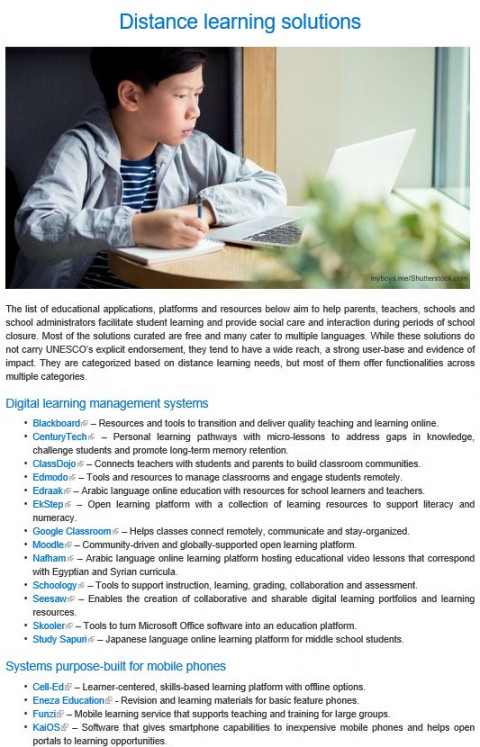 Soluciones para un aprendizaje a distancia 出版年份: 2020 机构作者: Organización de las Naciones Unidas para la Educación, la Ciencia y la Cultura (UNESCO) A continuación, ofrecemos una lista de aplicaciones y plataformas educativas para ayudar a los padres, docentes, centros educativos y sistemas escolares a facilitar el aprendizaje de los alumnos y garantizar las interacciones y los servicios sociales durante el periodo de cierre de las escuelas. Aunque no han sido explícitamente respaldadas por la UNESCO, estas soluciones tienen un amplio alcance, numerosos usuarios y una eficacia probada. La mayor parte de las soluciones son gratuitas y muchas se encuentran en varios idiomas.Si usted es un proveedor de servicios de aprendizaje digital y posee un producto sólido que cree merece figurar en la siguiente lista de recursos, favor envíenos un correo electrónico a la dirección: COVID19taskforce@unesco.org Инструменты дистанционного обучения 出版年份: 2020 机构作者: Организация Объединенных Наций по вопросам образования, науки и культуры (UNESCO) Приведенный ниже список образовательных приложений, платформ и ресурсов призван помочь родителям, учителям, школам и школьным администраторам облегчить процесс обучения учащихся и обеспечить социальную помощь и взаимодействие в периоды закрытия школ. Большинство предложений доступны бесплатно и многие поддерживаются на нескольких языках. Хотя эти предложения не имеют непосредственной поддержки ЮНЕСКО, они, как правило, имеют широкий охват, мощную базу пользователей и подтверждения достигнутых результатов. Они распределены исходя из потребностей дистанционного обучения, но большинство из них предлагают функциональные возможности по нескольким категориям.