
相关资源
探索丰富的全球公民教育资源,深化理解,促进研究、倡导、教学与学习。
共找到1,402条结果
 Dialogue for Prevention 出版年份: 2025 机构作者: UNESCO In an era where geopolitical power struggles disrupt traditional peacebuilding, where identity and misinformation fuel divisions, and where trust in institutions is eroding, UNESCO’s Intercultural Dialogue for Conflict Transformation briefs series presents an adaptable, culturally grounded, and people-centred approach to peacebuilding. With 1.5 billion people living in contexts with low intercultural dialogue where global challenges such as absolute poverty, terrorism and forced displacement are more prevalent, this four-part series draws on firsthand experience, country case studies, and expert analysis to demonstrate the transformative potential of dialogue in fragile and conflict-sensitive settings. The Dialogue for Prevention brief, developed with the Auschwitz Institute for the Prevention of Genocide and Mass Atrocities, explores the powerful role intercultural dialogue can play in preventing large-scale identity-based violence, particularly in the upstream and downstream phases of conflict. Grounded in the idea that dialogue can bridge divides and foster mutual understanding, the brief argues that enabling environments for intercultural dialogue—marked by stability, inclusive governance, freedom of expression, horizontal equality, and social cohesion—also mitigate key risk factors for atrocity violence. Drawing on diverse examples from Cambodia, Colombia, Italy, and Kenya, it showcases creative, context specific applications of dialogue. Through practical guidance, the brief equips policymakers, practitioners and civil society seeking to embed dialogue into prevention strategies.
  Dialogue for Social Cohesion 出版年份: 2025 作者: Isaure Vicarini | Euan Mackway-Jones 机构作者: UNESCO In an era where geopolitical power struggles disrupt traditional peacebuilding, where identity and misinformation fuel divisions, and where trust in institutions is eroding, UNESCO’s Intercultural Dialogue for Conflict Transformation briefs series presents an adaptable, culturally grounded, and people-centred approach to peacebuilding. With 89% of conflicts worldwide occurring in countries with limited capacity for intercultural dialogue, this four-part series draws on firsthand experience, country case studies, and expert analysis to demonstrate the transformative potential of dialogue in fragile and conflict-sensitive settings. The Dialogue for Social Cohesion brief—developed in collaboration with the Berghof Foundation and Search for Common Ground—bridges theory and practice to explore the horizontal (community-to-community) and vertical (citizen-to-state) dimensions of social cohesion and highlights how inclusive dialogue can support both. Case studies from Afghanistan, Germany, Somalia, and South Sudan illustrate how dialogue—whether through theatre, education, local governance, or environmental peacebuilding—can cultivate mutual understanding and trust, bridge identity-based divides, and restore, step by step, the social fabric in fractured societies. Through actionable recommendations, this brief equips practitioners, policymakers, and civil society with the essential guidance needed to tailor and embed dialogue in their respective contexts, helping to ensure that peace processes are inclusive, locally driven, and enduring.
  Mainstreaming the General History of Africa into Education Systems: The Curriculum Pathway 出版年份: 2025 机构作者: UNESCO Education about the history of Africa in formal, non-formal and informal learning settings continues to be dominated by Eurocentric perspectives, which has led to imbalanced representation of Africa’s history and preconceptions.This publication is a tool to support countries in challenging the skewed perspectives on how African history is taught and how Africa is perceived. It aims to bring to the foreground Africa’s history, cultures and heritage through the curriculum to strengthen knowledge, skills, values and attitudes that contribute towards addressing long-standing hegemonic, colonial thinking and connected racial bias, while forging a united, prosperous and peaceful Africa and world.Stemming from the decolonial vision and content of the volumes of the General History of Africa, the publication proposes guiding principles and approaches for designing and implementing the General History of Africa into the curriculum. It puts forth curriculum outlines for basic and secondary education to offer renewed and broader perspectives on the history of Africa and its diasporas, and their contributions to humanity.The curriculum outlines are structured around nine thematic Learning Units, arranged chronologically from the origins of humanity and civilizations to Africa’s most recent history.
  The Representation of Jews, Judaism and Antisemitism in School Textbooks and Curricula in Europe 出版年份: 2025 机构作者: UNESCO Jewish communities have been integral to Europe’s social fabric for centuries, preserving rich religious and cultural traditions while facing recurring periods of exclusion, persecution, and resilience. School textbooks are important vantage points to understand how this history and heritage is represented, (de)constructed and embedded into a shared historical and cultural memory. They are also important practical tools used daily by students, teachers, and parents.This comprehensive research, carried out by UNESCO in collaboration with the Georg-Eckert-Institute and supported by funding from the European Commission, examines the ways in which Jewish culture, history, life, and anti-Jewish prejudice are represented in secondary school materials across eight European nations.The publication highlights opportunities within curricula to address Jewish experiences and antisemitism, reviews how these themes are incorporated into textbooks, and analyzes the narratives and portrayals that arise. The study also looks at the use of visual sources and assesses whether Jewish viewpoints and agency are sufficiently reflected. The findings highlight both recurring stereotypes and promising practices. By showcasing these contrasts, the study provides targeted recommendations to guide the creation of more inclusive educational materials.
  Consultation Paper on AI Regulation: Emerging Approaches Across the World 出版年份: 2024 作者: Juan David Gutiérrez 机构作者: UNESCO Since 2016, over thirty countries have passed laws explicitly mentioning AI, and in 2024, the discussion about AI bills in legislative bodies has increased globally. This policy brief aims to inform legislators about the different regulatory approaches to artificial intelligence (AI) being considered worldwide by legislative bodies. The brief explains nine emerging regulatory approaches, each illustrated with specific cases worldwide. The order in which the nine AI regulatory approaches are presented is deliberately structured to guide readers from less interventionist, light-touch regulatory measures to more coercive, demanding approaches. These regulatory approaches are not mutually exclusive and AI bills often combine two or more approaches:1. Principles-Based Approach2. Standards-Based Approach3. Agile and Experimentalist Approach4. Facilitating and Enabling Approach5. Adapting Existing Laws Approach6. Access to Information and Transparency Mandates Approach7. Risk-Based Approach8. Rights-Based Approach9. Liability Approach The policy brief suggests parliamentarians how they can address three key questions before adopting AI regulations:1. Why regulate? Determine whether regulation is needed to address public problems, fundamental and collective rights, or desirable futures.2. When to regulate? Reach a consensus on why regulation is needed, map available regulatory instruments, compare them with other policy instruments, and assess the feasibility of adopting the former.3. How to regulate? Identify a combination of AI regulatory approaches that are tailored to specific contexts.
  UNESCO Women for Ethical AI: Outlook Study on Artificial Intelligence and Gender 出版年份: 2024 机构作者: UNESCO The gender chapter of the UNESCO Recommendation on the Ethics of AI is a concrete commitment by 194 Member States to advance gender equality in the AI ecosystem. To track progress in the implementation of the gender provisions of UNESCO’s Recommendation, and to assess the impacts of AI on gender equality, the UNESCO Women for Ethical AI (W4EAI) Platform has been established. This report advances the workstream through evidence-based insights in three critical areas: women’s participation in AI development and deployment, the inclusion of gender equality concerns in AI governance and the impact of AI on gender equality. It highlights the significant underrepresentation of women in AI, the lack of gender-disaggregated data, and the compounded challenges women face in the field. The report also addresses the neglect of gender dimensions in AI policy, the risks posed by AI systems to women, and the need for responsible and ethical AI governance to promote gender equality. Finally, it outlines actionable recommendations to enhance gender equality through and in AI, emphasizing the importance of comprehensive data collection, targeted interventions, and inclusive policy-making.
 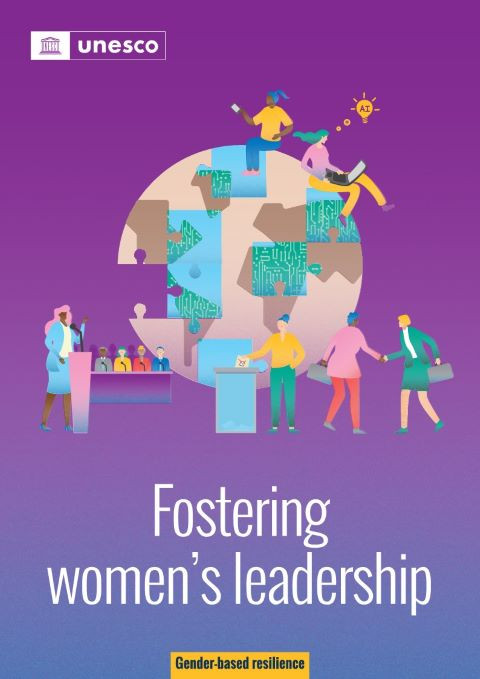 Fostering Women's Leadership 出版年份: 2024 作者: Mariagrazia Squicciarini | Anna Rita Manca | Garance Sarlat 机构作者: UNESCO No (leadership) share no gain (for societies and economies)! Leveraging UNESCO’s unique Gender-Based Resilience Framework, this report explores the role of women in leadership positions in both decision-making and high-tech, including in artificial intelligence-related innovations. It further highlights progress towards the G20 Brisbane Target, aimed to accelerate progress on gender equality by reducing the gender gap in labour market participation rates by 25% by 2025. Women remain underrepresented in decision-making, holding only about 26% of seats in national parliaments worldwide on average. In the world of work, female labour participation continues to lag behind men’s, at 47% for women against 72% for men on average. Despite progress by G20 members towards the Brisbane Target, a 2% average gap in absolute terms remained to be filled in 2022. In the high-tech world, women make up only 30% of AI professionals, and even less of leaders. Female inventors in AI account for about 37% of patents filed in 2022-23.
  Address by Irina Bokova, Director-General of UNESCO on the occasion of the Seminar on Climate Change and Education at the UN University: Responding to Climate Change Starts with Education; Tokyo, 26 November 2010 出版年份: 2010 机构作者: UNESCO. Director-General, 1999-2009 (Matsuura, K.) This document is an address of Irina Bokova, Director-General of UNESCO on the occasion of the Seminar on Climate Change and Education at the UN University “Responding to Climate Change Starts with Education” in Tokyo, 26 November 2010. She highlighted the importance of climate change education for the sustainable future and underlined the importance of several programme such as Sandwatch and YouthXchange which have been lead by the UNESCO. Discours de Mme Irina Bokova, Directrice générale de l'UNESCO à l'occasion du Séminaire sur les changements climatiques et l'éducation à l'Université des Nations Unies: Réagir aux changements climatiques commence par l'éducation 出版年份: 2010 机构作者: UNESCO. Director-General, 1999-2009 (Matsuura, K.) Ce document est une adresse de Irina Bokova, Directrice générale de l'UNESCO à l'occasion du Séminaire sur les changements climatiques et l'éducation à l'Université des Nations Unies "Réagir aux changements climatiques commence par l'éducation" à Tokyo, le 26 Novembre 2010. Elle a souligné l'importance de la l'éducation au changement climatique pour l'avenir durable et a souligné l'importance de plusieurs programmes tels que Sandwatch et YouthXchange qui ont été prêcher par l'UNESCO. Climate change starter's guidebook: an issues guide for education planners and practitioners 出版年份: 2011 作者: Alejandro Deeb | Amber French | Julia Heiss | Jason Jabbour | Dominique LaRochelle | Arkadiy Levintanus | Anna Kontorov | Rummukainen Markku | Gerardo Sanchez Martinez | Rosalyn McKeown | Nicolay Paus | Antoine Pecoud | Guillaume Pénisson | Daniel Puig | Vanessa Retana | Serban Scrieciu | Morgan Strecker | Vimonmas Vachatimanont | Benjamin Witte | Noriko Yamada. 机构作者: United Nations Environment Programme (UNEP) The Climate Change Starter’s Guide provides an introduction and overview for education planners and practitioners on the wide range of issues relating to climate change and climate change education, including causes, impacts, mitigation and adaptation strategies, as well as some broad political and economic principles. The aim of this guide is to serve as a starting point for mainstreaming climate change education into school curricula. It has been created to enable education planners and practitioners to understand the issues at hand, to review and analyse their relevance to particular national and local contexts, and to facilitate the development of education policies, curricula, programmes and lesson plans. The guide covers four major thematic areas: 1. the science of climate change, which explains the causes and observed changes; 2. the social and human aspects of climate change including gender, health, migration, poverty and ethics; 3. policy responses to climate change including measures for mitigation and adaptation; and 4. education approaches including education for sustainable development, disaster reduction and sustainable lifestyles. A selection of key resources in the form of publication titles or websites for further reading is provided after each of the thematic sections. The United Nations Educational, Scientific and Cultural Organization (UNESCO) provides its expertise and know-how in areas such as education, culture, and the social sciences. In particular, UNESCO emphasises the role of education in support of climate change adaptation and mitigation in providing skills and capacities but also through shaping the values, attitudes and behaviours needed to put the world on a more sustainable path. The United Nations Environment Programme (UNEP) works with countries to strengthen their ability to adapt to climate change, move towards low-carbon growth, reduce emissions from deforestation and forest degradation, improve understanding of climate science, and raise public awareness of the changing climate. UNEP is supporting countries to seize the opportunities of moving towards low-carbon growth, while improving human health and well-being, generating green jobs and moving towards a green economy. With this publication, the two organizations have embarked on a collaboration on climate change education that we are committed to building upon and expanding in the period ahead.