
相关资源
探索丰富的全球公民教育资源,深化理解,促进研究、倡导、教学与学习。
共找到2,161条结果
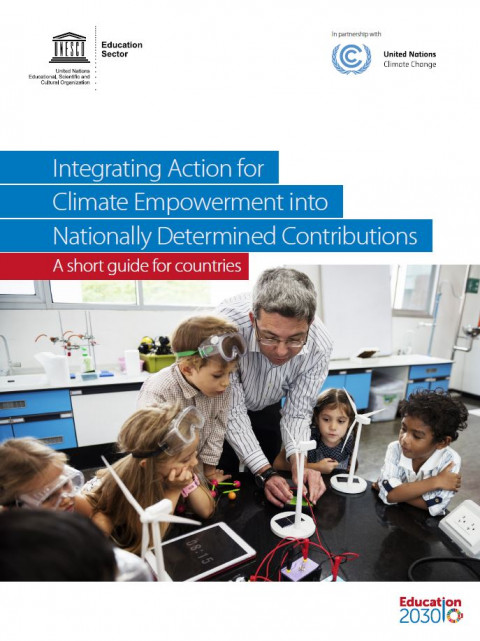 Integrating Action for Climate Empowerment into Nationally Determined Contributions: A Short Guide for Countries 出版年份: 2020 机构作者: UNESCO In the framework of the 2020 review of Nationally Determined Contributions (NDCs) under the Paris Agreement, this guide aims to provide countries with advice on how to enhance ambition and address the six elements of ‘Action for Climate Empowerment’ (ACE) – Education, Training, Public Awareness, Public Access to Information, Public Participation and International Cooperation – in their respective NDCs.In five simple questions and answers, it provides suggestions for elements that can be integrated into the NDCs in order to make ACE an integral part of countries’ climate responses. The guide also shows why ACE is key to achieve the goals of the Paris Agreement and its greenhouse gas emission targets.
  Measuring Intercultural Dialogue: A Conceptual and Technical Framework 出版年份: 2020 作者: Ciara Aucoin | Euan Mackway-Jones | Marcel Smits 机构作者: UNESCO | Institute for Economics and Peace The challenges of addressing growing diversity have amply demonstrated that this vision is needed now more than ever. We all have much to gain from more open and connected societies yet misunderstanding, exclusion and discrimination continue to push identity and culture-based grievances towards conflict and violence, challenging the very foundations of sustainable and inclusive development.This report represents a first step in the UNESCO-IEP joint initiative to strengthen the evidence-base on dialogue for peace and development. Through mobilizing better data on effective dialogue, it is our sincere hope that policymakers and practitioners can better support meaningful and transformative dialogue, holistically supporting the aspirations of the 2030 Agenda. Through this, we hope to elevate dialogue as a connecting enabler of all pillars of UN action, accelerating progress towards the Sustainable Development Goals and making good on the promise of ‘leaving no one behind’. Mesurer le dialogue interculturel: cadre conceptuel et technique 出版年份: 2020 作者: Ciara Aucoin | Euan Mackway-Jones | Marcel Smits 机构作者: UNESCO | Institute for Economics and Peace Les défis rencontrés pour tenir compte de la diversité croissante ont amplement démontré que cette vision était plus que jamais nécessaire. Nous avons tous beaucoup à gagner de sociétés plus ouvertes et plus connectées, mais l’incompréhension, l’exclusion et la discrimination continuent de nourrir les griefs identitaires et culturels conduisant au conflit et à la violence, en remettant en question les fondements mêmes du développement durable et inclusif.Ce rapport représente une première étape dans l’initiative conjointe UNESCO-IEP visant à renforcer la base de données factuelles sur le dialogue pour la paix et le développement. En favorisant la collecte de données de meilleure qualité sur un dialogue efficace, nous espérons sincèrement que les décideurs politiques et les spécialistes pourront mieux soutenir un dialogue constructif et transformateur, afin d’appuyer de manière globale les objectifs du Programme 2030. Ainsi, nous espérons faire du dialogue un élément essentiel commun à tous les piliers de l’action des Nations Unies, afin d’accélérer les progrès vers la réalisation des objectifs de développement durable et de la promesse de « ne laisser personne de côté ».
  Homophobic and Transphobic Bullying in Educational Centers: Awareness Workshop for its Prevention; Facilitation Guide 出版年份: 2015 机构作者: UNESCO This publication presents strategies for teachers and educational authorities with the aim of addressing homophobic and transphobic violence from a Human Rights perspective. Through lessons that incorporate concepts, activities and reflections, it underlines the importance of respect for sexual diversity through the acquisition of knowledge, and the strengthening of teaching skills to overcome stigmas and prejudices. El Bullying Homofóbico y Transfóbico en los Centros Educativos: Taller de Sensibilización Para Su Prevención; Guía de Facilitación 出版年份: 2015 机构作者: UNESCO Esta publicación formula estrategias de apoyo a los docentes y las autoridades educativas con el objetivo de abordar la violencia homofóbica y transfóbica desde un enfoque de Derechos Humanos. A través de lecciones que incorporan conceptos, actividades y reflexiones, subraya la importancia del respeto a la diversidad sexual mediante la adquisición de conocimientos, y el fortalecimiento de competencias docentes para superar estigmas y prejuicios.
 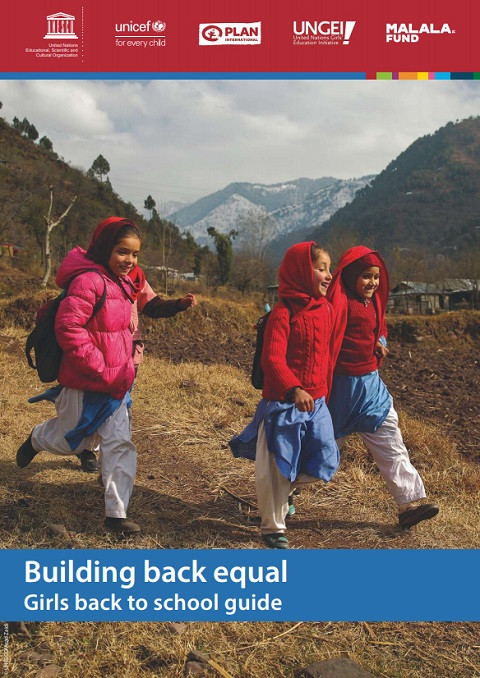 Building Back Equal: Girls Back to School Guide 出版年份: 2020 机构作者: UNESCO | United Nations Children's Fund (UNICEF) | Plan International | United Nations Girls' Education Initiative (UNGEI) | Malala Fund The guide provides targeted inputs to ensure continuity of learning during school closures, and comprehensive, timely and evidence-based plans for reopening schools in a way that is safe, gender-responsive and child-friendly, and meets the needs of the most marginalised girls. This guide emphasizes an approach to ‘build back equal’ through gender-responsive measures that transform education systems, prioritise resilience and address the key bottlenecks and barriers to girls’ education, including: Gender-responsive data and evidence to inform action, including data disaggregated by sex and gender-responsive monitoring to identify promising practices to promote gender equality. Policies, laws and plans to advance girls’ rights, including the removal of discriminatory practices that impede girls’ educational participation and completion, and ability to apply their learning. Sustained financing to achieve results, protecting education financing for girls’ education, alongside health, social protection and economy recovery initiatives with an equity lens. Reforzar la igualdad: Guía para el regreso de las niñas a la escuela 出版年份: 2020 机构作者: UNESCO | United Nations Children's Fund (UNICEF) | Plan International | United Nations Girls' Education Initiative (UNGEI) | Malala Fund La guía proporciona información específica para garantizar la continuidad del aprendizaje durante los cierres escolares, así como planes integrales, oportunos y fundados en datos empíricos para reabrir escuelas de forma segura, con perspectiva de género, adaptada a las necesidades de los niños, y que satisfaga las necesidades de las niñas más marginadas. Esta guía enfatiza un enfoque basado en “reforzar la igualdad”, a través de medidas con perspectiva de género que transformen los sistemas educativos, den prioridad a la resiliencia, y aborden los principales obstáculos y limitaciones para la educación de las niñas, incluyendo: Datos y pruebas con perspectiva de género para fundamentar las acciones, incluidos datos desglosados por sexo, y un seguimiento con perspectiva de género para identificar prácticas prometedoras para promover la igualdad de género. Políticas, leyes y planes para promover los derechos de las niñas, incluida la eliminación de las prácticas discriminatorias que impidan la participación y finalización educativa de las niñas, y la posibilidad de aplicar los conocimientos adquiridos. Financiamiento sostenido para lograr resultados, protegiendo el financiamiento educativo para las niñas, junto con iniciativas de salud, protección social y recuperación económica, con una perspectiva de igualdad de género. Reconstruire l’égalité: Guide de rescolarisation des filles 出版年份: 2020 机构作者: UNESCO | United Nations Children's Fund (UNICEF) | Plan International | United Nations Girls' Education Initiative (UNGEI) | Malala Fund Le guide fournit des contributions ciblées pour assurer la continuité de l’apprentissage pendant les fermetures d’écoles ainsi que des plans complets et opportuns basés sur les données pour rouvrir les écoles de manière sûre, en tenant compte des questions de genre, ainsi qu’en répondant aux besoins des enfants et des filles les plus marginalisées. Ce guide met l’accent sur une approche visant à « reconstruire l’égalité », à travers des mesures tenant compte des questions de genre afin de transformer les systèmes éducatifs, de favoriser la résilience et de résoudre les principaux freins et obstacles à l’éducation des filles, dont : des données et des preuves tenant compte des questions de genre pour éclairer les actions, y compris des données ventilées par sexe et un suivi visant à identifier les pratiques prometteuses pour l’égalité des genres ; des politiques, des lois et des plans pour faire avancer les droits des filles, y compris l’élimination des pratiques discriminatoires qui entravent la participation des filles à l’éducation et leur capacité à mettre leur savoir en pratique ; des financements pérennes pour obtenir des résultats, qui protègent le financement de l’éducation des filles, ainsi que les initiatives en matière de santé, de protection sociale et de redressement économique sur un principe d’équité.
 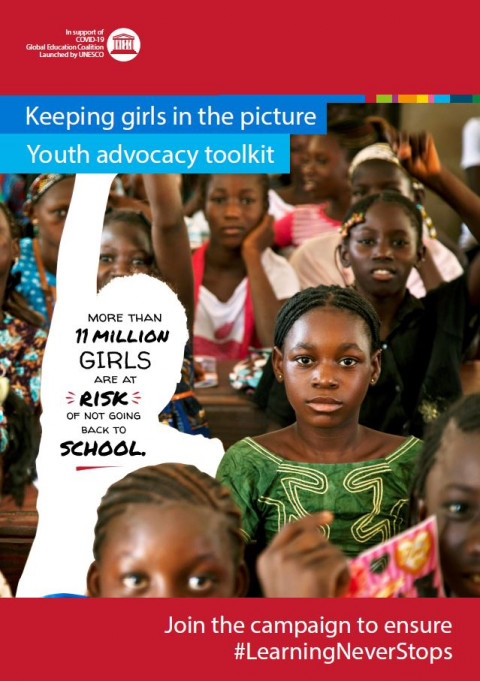 Keeping Girls in the Picture: Youth Advocacy Toolkit 出版年份: 2020 机构作者: UNESCO | Global Education Coalition The COVID-19 pandemic has caused the largest school closures and education disruption in history, with more than 1.5 billion students affected at the height of the crisis. Over 767 million of these students were girls.Now, another major challenge is looming. Over 11 million girls – from pre-primary to tertiary education - may not return to school in 2020. This alarming number not only threatens decades of progress made towards gender equality, but also puts girls around the world at risk of adolescent pregnancy, early and forced marriage, and violence. For many girls, school is more than just a key to a better future. It’s a lifeline.This is why UNESCO and members of the Global Education Coalition’s Gender Flagship are launching a new #LearningNeverStops campaign focusing on ‘keeping girls in the picture.’The campaign calls for efforts to safeguard progress made on girls’ education, ensure girls’ learning continuity during school closures, and promote girls’ safe return to school once these reopen. It also sheds light on the 130 million girls who were already out of school before the pandemic, and calls on the international community to urgently work together to guarantee their right to education.
  Teaching Journalism for Sustainble Development: New syllabi 出版年份: 2015 作者: Banda Fackson 机构作者: UNESCO This work aims to expand the curriculum of UNESCO in education in journalism and includes new curricula covering current topics in the field of journalism education around the world. The document was prepared on the basis of standard curricula, as well as additional UNESCO publications under the general title “Collection of new curricula” in order to effectively respond to new problems faced by specialists and teachers in the field of journalism.