
相关资源
探索丰富的全球公民教育资源,深化理解,促进研究、倡导、教学与学习。
共找到3,454条结果
 Global guidance on addressing school related gender based violence 出版年份: 2016 机构作者: UNESCO | United Nations Entity for Gender Equality and the Empowerment of Women (UN Women) More than 246 million children are subjected to gender-based violence in or around schools every year. This is a violation of their human rights, and a form of gender-discrimination that has far-reaching physical, psychological and educational consequences. Ending schoolrelated gender-based violence (SRGBV) is a priority for countries wishing to achieve ambitious global goals on inclusive and quality education for all and gender equality.WHAT IS THE AIM OF THIS GUIDANCE? This guidance aims to provide a comprehensive, one-stop resource on school-related gender-based violence (SRGBV), including clear, knowledge-based operational guidance, diverse case studies drawn from examples of promising practice and recommended tools for the education sector and its partners working to eliminate gender-based violence. It distils programme knowledge based on existing global literature, promising practices, expert recommendations and practitioner consensus.WHO IS THIS GUIDANCE FOR? The primary audience for this global guidance is the national education sector, including government policy-makers, education ministries, school administrators, educators and other school staff. The guidance may also have wider interest for other national and international stakeholders that are interested in addressing SRGBV, including NGOs, bilateral and multilateral agencies, teachers’ trade unions and policy-makers in other domestic sectors. The guidance is intended primarily for use in low- and middle-income settings, but is based on norms and principles that are universally applicable.WHAT IS COVERED IN THIS GUIDANCE? Promising practice case studies and recommended tools are embedded throughout the relevant sub-sections of the guidance. These provide readers with illustrative examples of implementation in real-life contexts and can serve as resources that have been successfully used – and can be adapted – for application in different contexts.This guidance complements other existing tools and materials for specific bilateral, multilateral and NGO audiences on violence against women and girls, and violence in schools. An expanded online version, which will be regularly updated, is available at www.endvawnow.org Lutte contre la violence de genre en milieu scolaire: orientations mondiales: 出版年份: 2016 机构作者: Organisation des Nations Unies pour l'éducation, la science et la culture (UNESCO) | United Nations Entity for Gender Equality and the Empowerment of Women (UN Women) More than 246 million children are subjected to gender-based violence in or around schools every year. This is a violation of their human rights, and a form of gender-discrimination that has far-reaching physical, psychological and educational consequences. Ending schoolrelated gender-based violence (SRGBV) is a priority for countries wishing to achieve ambitious global goals on inclusive and quality education for all and gender equality.WHAT IS THE AIM OF THIS GUIDANCE? This guidance aims to provide a comprehensive, one-stop resource on school-related gender-based violence (SRGBV), including clear, knowledge-based operational guidance, diverse case studies drawn from examples of promising practice and recommended tools for the education sector and its partners working to eliminate gender-based violence. It distils programme knowledge based on existing global literature, promising practices, expert recommendations and practitioner consensus.WHO IS THIS GUIDANCE FOR? The primary audience for this global guidance is the national education sector, including government policy-makers, education ministries, school administrators, educators and other school staff. The guidance may also have wider interest for other national and international stakeholders that are interested in addressing SRGBV, including NGOs, bilateral and multilateral agencies, teachers’ trade unions and policy-makers in other domestic sectors. The guidance is intended primarily for use in low- and middle-income settings, but is based on norms and principles that are universally applicable.WHAT IS COVERED IN THIS GUIDANCE? Promising practice case studies and recommended tools are embedded throughout the relevant sub-sections of the guidance. These provide readers with illustrative examples of implementation in real-life contexts and can serve as resources that have been successfully used – and can be adapted – for application in different contexts.This guidance complements other existing tools and materials for specific bilateral, multilateral and NGO audiences on violence against women and girls, and violence in schools. An expanded online version, which will be regularly updated, is available at www.endvawnow.org
 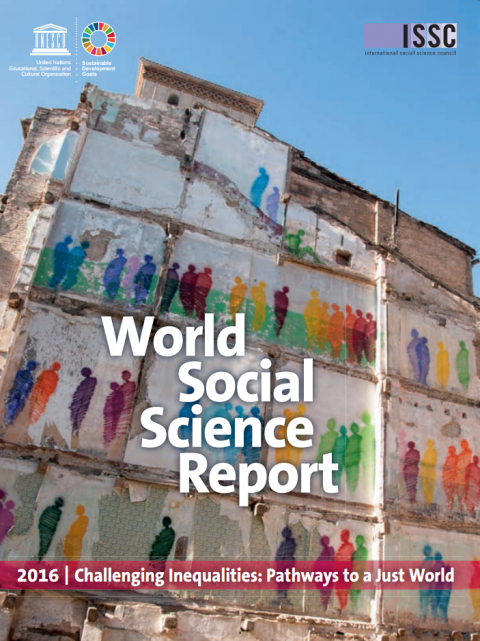 World social science report, 2016: Challenging inequalities; pathways to a just world 出版年份: 2016 机构作者: UNESCO Never before has inequality been so high on the agenda of policy-makers worldwide, or such a hot topic for social science research. More journal articles are being published on the topic of inequality and social justice today than ever before. This Report draws on the insights of over 100 social scientists and other thought leaders from all over the world, across various disciplines, to emphasize transformative responses to inequality at all levels, from the grass roots to global governance. Too many countries are investing too little in researching the long-term impact of inequality on the sustainability of their economies, societies and communities. Unless we address this urgently, inequalities will make the cross-cutting ambition of the Sustainable Development Goals (SDGs) to ‘leave no one behind’ by 2030 an empty slogan.
  2017 CCNGO, Education 2030: implementing SDG4-Education 2030; Global meeting declaration 出版年份: 2017 机构作者: Organisation des Nations Unies pour l'éducation, la science et la culture (UNESCO) | Collective Consultation of NGOs on Education for All We, the representatives of national, regional and international non-governmental and civil society organisations and members of the Collective Consultation of NGOs (CCNGO) for Education 2030 from different parts of the world have gathered in Siem Reap, Cambodia on 8 and 9 May 2017.We re-affirm that education is a fundamental human right and a public good that is key to promoting social, economic and environmental justice. States have the duty to provide free quality equitable public education at all levels and lifelong learning for all, and to ensure the right to education is enshrined in law and enforceable.We have met to take stock and discuss the implementation of SDG4-Education 2030 since its adoption and make recommendations. Participants discussed initiatives undertaken, key challenges encountered, opportunities identified and ways forward, as well as debated the role of civil society organizations in supporting the implementation of SDG4-Education 2030 at national, regional and global levels, and the contributions of the CCNGO in this regard. We furthermore agreed upon the revised working procedures of the CCNGO in light of SDG4-Education 2030 and elected a new CCNGO Coordination Group for 2017- 2019. In this context, we reaffirm:· Our endorsement of the vision, principles, goals and targets laid out under SDG 4 within ‘The 2030 Agenda for Sustainable Development’; the Incheon Declaration; the ‘Education 2030 Framework for Action’; and the 2015 Incheon Final Declaration of the NGO Forum;· The important role of civil society organisations in the implementation of SDG4-Education 2030, and their engagement and involvement at all stages, from policy formulation and planning through to monitoring and evaluation with their participation institutionalized and guaranteed, as stated in the Education 2030 Framework for Action.
  Mainstreaming SDG4-Education 2030 in sector-wide policy and planning: technical guidelines for UNESCO field offices 出版年份: 2016 机构作者: UNESCO The main responsibility for implementing the SDG4-Education 2030 Agenda lies with governments, with UNESCO and partners providing support through coordinated policy advice, technical assistance, capacity development and monitoring of progress at global, regional and national levels. By their position, UNESCO field offices have a key role to play in providing such support at country level and therefore require adequate technical capacity to fulfil their mission.These guidelines aim at providing a basic resource to field offices for ensuring adequate technical support to national authorities in this process. In doing so, it takes into account different profiles of country needs and capacities, thus avoiding a one-size-fits-all approach. Countries may have different levels of awareness of, or political commitment to, Sustainable Development Goal 4 (SDG4). In all cases, UNESCO is expected to ensure that all the relevant information about SDG4-Education 2030 is properly disseminated and that national authorities and stakeholders are reminded of its importance. To assist field offices in this task UNESCO has developed and made available a number of resources and support materials, notably the Unpacking SDG4-Education 2030 Guide, parts of which are excerpted here, and will continue coordination efforts in this respect.Inevitably, field staff will have to adapt the guidelines provided here to the reality of the country they are serving. That is why this document is full of resources and pointers that can be combined and tailored to fit the particular context of each country. At the same time, field staff are invited to require additional technical guidance from the corresponding regional bureaus, which can rely on the backstopping of Headquarters services and support from the specialized institutes.These guidelines represent a first attempt to provide specific directions and resources to allow field offices to technically support Member States. After a first evaluation, in which all field staff are invited to participate, the guidelines will be improved so as to make them even more suitable and useful. They will also be supplemented with other material to ensure that UNESCO plays its role as the leading United Nations agency in the field.
 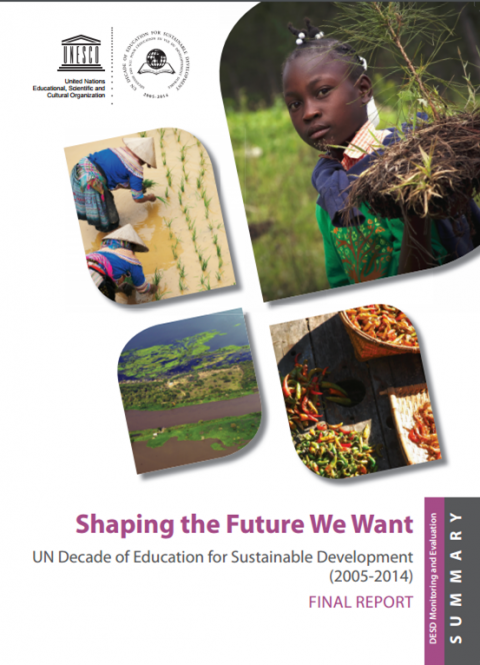 Shaping the future we want: UN decade of education for sustainable development (2005-2014); final report; summary 出版年份: 2014 作者: Carolee Buckler | Heather Creech 机构作者: UNESCO This summary for policy- and decision-makers provides a brief overview of the key findings and trends, a synopsis of highlights, challenges and actions across all levels and areas of education, and steps for scaling up actions presented in the UNESCO 2014 Global Monitoring and Evaluation Final Report, Shaping the Future We Want – UN Decade of Education for Sustainable Development (2005-2014). The Final Report provides an assessment of progress towards embedding education for sustainable development (ESD) into education systems and into sustainable development efforts. Building on the findings of the past two DESD Global Monitoring and Evaluation reports, and based upon Member States’ and other stakeholders’ assessments of the current state of ESD, the Final Report maps the achievements and challenges of a decade of progress and action on ESD at the global, national, regional and local levels, and within all areas and levels of education. The Final Report concludes that a solid foundation has been laid for ESD at the end of the DESD, achieved by raising awareness, influencing policies and generating significant numbers of good practice projects in all areas of education and learning. At the end of 10 years of work, 10 key findings and trends have emerged that will guide ESD into the future. The report also shows that despite the successes, a full integration of ESD into education systems has yet to take place in most countries. Façonner l’avenir que nous voulons: Décennie des Nations Unies pour l’éducation au service du développement durable (2005-2014) RAPPORT FINAL 出版年份: 2014 作者: Carolee Buckler | Heather Creech 机构作者: Organisation des Nations Unies pour l'éducation, la science et la culture (UNESCO) Destiné aux responsables politiques et aux décideurs, ce document résume les principales conclusions et les grandes tendances, présente une synthèse des points clés, des défis et des initiatives à tous les niveaux et dans tous les domaines de l’éducation, ainsi que les mesures à adopter pour intensifier les actions décrites dans le Rapport final de suivi et d’évaluation 2014, Façonner l’avenir que nous voulons − Décennie des Nations Unies pour l’éducation au service du développement durable (2005-2014). Le Rapport final de suivi et d’évaluation examine les progrès qui ont été accomplis afin d’intégrer l’Éducation au développement durable (EDD) aux systèmes éducatifs et aux efforts déployés en faveur du développement durable. À partir des conclusions des deux précédents rapports mondiaux de suivi et d’évaluation de la Décennie et de l’évaluation de l’état actuel de l’EDD par les États membres et autres parties prenantes, ce rapport final décrit les résultats obtenus et les problèmes rencontrés au terme de dix années de progrès et d’action sur le plan de l’EDD aux niveaux mondial, national, régional et local, ainsi que dans tous les domaines et à tous les niveaux de l’éducation. Le rapport note en conclusion qu’au terme de la Décennie, l’EDD repose désormais sur des fondements solides et ce, grâce à une prise de conscience renforcée, à l’influence exercée sur les politiques et à la réalisation d’un grand nombre de projets respectueux des bonnes pratiques dans tous les domaines de l’éducation et de l’apprentissage. Les dix conclusions et tendances clés qui se dégagent à l’issue de ces dix années de travail serviront à l’avenir de guide à l’EDD. Le rapport montre également qu’en dépit des progrès accomplis, dans la plupart des pays, l’EDD n’a toujours pas été pleinement intégrée aux systèmes éducatifs.
 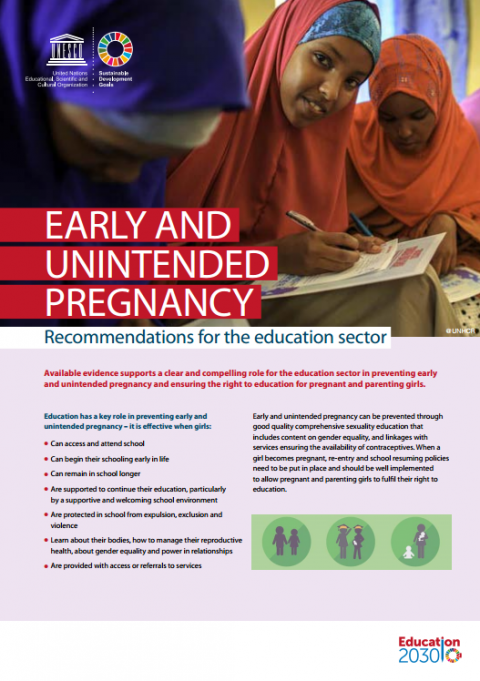 Early and unintended pregnancy: recommendations for the education sector 出版年份: 2017 机构作者: 联合国教科文组织 (UNESCO) Early and unintended pregnancy (EUP) is a major concern in many countries. It has a major impact on the lives of adolescents – especially girls – in terms of their health, social, economic and education outcomes. This brief contains the summary of recommendations from an evidence review to support the education sector to prevent and respond to EUP.
  School-related gender-based violence: global guidance (Infographic) 出版年份: 2016 机构作者: UNESCO | United Nations Entity for Gender Equality and the Empowerment of Women (UN Women) School-related gender-based violence: global guidance (Infographic) Lutte contre la violence de genre en milieu scolaire: orientations mondiales (Infographique) 出版年份: 2016 机构作者: Organisation des Nations Unies pour l'éducation, la science et la culture (UNESCO) | United Nations Entity for Gender Equality and the Empowerment of Women (UN Women) Lutte contre la violence de genre en milieu scolaire: orientations mondiales (Infographique)