
相关资源
探索丰富的全球公民教育资源,深化理解,促进研究、倡导、教学与学习。
共找到3,790条结果
 Civil Society and the Question of Citizenship : Opportunities for Activation and Limits of Influence 出版年份: 2017 作者: Assia Belkhir 机构作者: Larbi Ben M'Hidi The rapid and progressive changes that contemporary societies have undergone, have led to a reconsideration of the system of concepts associated to the state and the society, the nature of their relationship, and the connection of individuals to their societies and states. The power of the state is not only measured by its Military capabilities but mainly by its ability to implement public policies that provide essential services to the citizens, and its capacity to distribute roles within civil society, there by increasing participation and achieving the requirements of political and social citizenship, which is questioned as well, with the emergence of the idea of a global citizenship.
  What Makes a Good Global Citizenship Resource? 机构作者: Reading International Solidarity Centre (RISC) This guidance document provides tips, ideas and a criteria of do's and don'ts for selecting a good Global Citizenship resource, from story books, to holiday photos and maps. With advice on how to evaluate resources, improve and add to existing ones, and suggestions for creating new ones, this is an invaluable starting point for any educator and any age group.
  Éducation aux médias et à l’information: École collège lycée 出版年份: 2019 机构作者: Centre pour l’éducation aux médias et à l’information (CLEMI) | Réseau Canopé Cette édition 2019-2020 a été entièrement revue et augmentée afin d'approcher au mieux les besoin des nouveaux enseignants. Elle s'adresse aussi bien au 1er qu'au 2nd degré.Vous y trouverez notamment : Les informations pratiques (socle commun, textes réglementaires...) et les dispositifs du CLEMI (Semaine de la presse et des médias dans l'école, Concours Médiatiks, #ZéroCliché...), afin de présenter les enjeux de l'Éducation aux médias et à l'information et les moyens proposés par le CLEMI pour la mettre en œuvre .Le focus Déclic' Critique, qui présente des exemples d'ateliers proposés en classe par le CLEMI et explique comment utiliser ces séquences pour développer l'esprit critique des élèves.Une partie est consacrée aux médias scolaires, à la fois pour encourager cette pratique mais aussi mieux la valoriser.Dans la partie 1er degré, vous trouverez les ressources nécessaires pour découvrir la presse, vérifier les images sur internet ou encore analyser un journal télévisé.La partie 2nd degré va s'intéresser à la publicité cachée, au journalisme de vérification, mais aussi aux nouveaux formats de l'info, comme la «story».
  Citizenship education and coexistence: guides for citizenship and coexistence from the colective construction of meaning and networks; social and political participation 出版年份: 2015 机构作者: Centro de Investigación y Educación Popular (CINEP) | Secretaría de Educación del Distrito (SED) Social and political participation is one of the main themes related with education for citizenship and coexistence. Therefore, this manual identifies three areas of reflection: 1) Social and political participation as human action , 2) Spaces of social and political participation, 3) Actions of transformation. Each one of these areas is accompanied by didactic tools that allow to deepen into the contents that are based on fundamental, theoretical and practical elements, which could be useful in the pedagogical process leaded by the participants of the project. Educación para la ciudadanía y la convivencia: manual de ciudadanía y convivencia desde la construcción colectiva de sentidos y redes; participación social y política 出版年份: 2015 机构作者: Centro de Investigación y Educación Popular (CINEP) | Secretaría de Educación del Distrito (SED) Social and political participation is one of the main themes related with education for citizenship and coexistence. Therefore, this manual identifies three areas of reflection: 1) Social and political participation as human action , 2) Spaces of social and political participation, 3) Actions of transformation. Each one of these areas is accompanied by didactic tools that allow to deepen into the contents that are based on fundamental, theoretical and practical elements, which could be useful in the pedagogical process leaded by the participants of the project. Education à la citoyenneté et de la coexistence: la citoyenneté manuelle et la coexistence de construction collective du sens et de réseaux; participation sociale et politique 出版年份: 2015 机构作者: Centro de Investigación y Educación Popular (CINEP) | Secretaría de Educación del Distrito (SED) La participation sociale et politique est l'un des principaux thèmes liés à l'éducation à la citoyenneté et à la coexistence. Par conséquent, ce manuel identifie trois domaines de réflexion: 1) la participation sociale et politique que l'action humaine, 2) espaces de participation sociale et politique, 3) Actions de transformation. Chacun de ces domaines est accompagné d'outils didactiques qui permettent d'approfondir dans le contenu qui sont basés sur des éléments fondamentaux, théoriques et pratiques, qui pourraient être utiles dans le processus pédagogique mené par les participants du projet. Citizenship education and coexistence: guides for citizenship and coexistence from the colective construction of meaning and networks; diversity and gender 出版年份: 2015 机构作者: Centro de Investigación y Educación Popular (CINEP) | Secretaría de Educación del Distrito (SED) Cultural diversity education is one of the main topis related to education for citizenship and coexistence. Therefore, this manual identifies three areas of reflection: 1) Diversity and Gender: identities and imaginaries, 2) Relations and tensions : diversity, gender and power, 3) Being together and respecting the differences. Each one of these areas is accompanied by didactic tools that allow to deepen into the contents that are based on fundamental theoretical and practical elements, which could be useful in the pedagogical process leaded by the participants of the project. Educación para la ciudadanía y la convivencia:manual de ciudadanía y convivencia desde la construcción colectiva de sentidos y redes; diversidad y género 出版年份: 2015 机构作者: Centro de Investigación y Educación Popular (CINEP) | Secretaría de Educación del Distrito (SED) Cultural diversity education is one of the main topis related to education for citizenship and coexistence. Therefore, this manual identifies three areas of reflection: 1) Diversity and Gender: identities and imaginaries, 2) Relations and tensions : diversity, gender and power, 3) Being together and respecting the differences. Each one of these areas is accompanied by didactic tools that allow to deepen into the contents that are based on fundamental theoretical and practical elements, which could be useful in the pedagogical process leaded by the participants of the project. Education à la citoyenneté et de la coexistence: citoyenneté manuelle et la coexistence de construction collective du sens et de réseaux; la diversité et l'égalité 出版年份: 2015 机构作者: Centro de Investigación y Educación Popular (CINEP) | Secretaría de Educación del Distrito (SED) L’éducation à la diversité culturelle est l'un des principaux topis liés à l'éducation à la citoyenneté et à la coexistence. Par conséquent, ce manuel identifie trois domaines de réflexion: 1) la diversité et l'égalité: identités et Imaginaires, 2) Relations et tensions: la diversité, genre et de pouvoir, 3) étant ensemble et en respectant les différences. Chacun de ces domaines est accompagné d'outils didactiques qui permettent d'approfondir dans le contenu qui sont basés sur des éléments théoriques et pratiques fondamentales, qui pourraient être utiles dans le processus pédagogique mené par les participants du projet.
 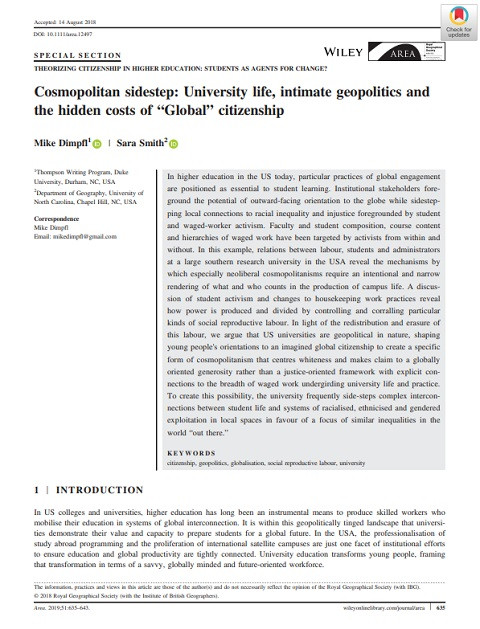 Cosmopolitan Sidestep: University Life, Intimate Geopolitics and the Hidden Costs of “Global” Citizenship (Area; Vol. 51, No. 4) 出版年份: 2018 作者: Mike Dimpfl | Sara Smith 机构作者: Royal Geographical Society | Wiley In higher education in the US today, particular practices of global engagement are positioned as essential to student learning. Institutional stakeholders foreground the potential of outward‐facing orientation to the globe while sidestepping local connections to racial inequality and injustice foregrounded by student and waged‐worker activism. Faculty and student composition, course content and hierarchies of waged work have been targeted by activists from within and without. In this example, relations between labour, students and administrators at a large southern research university in the USA reveal the mechanisms by which especially neoliberal cosmopolitanisms require an intentional and narrow rendering of what and who counts in the production of campus life. A discussion of student activism and changes to housekeeping work practices reveal how power is produced and divided by controlling and corralling particular kinds of social reproductive labour. In light of the redistribution and erasure of this labour, we argue that US universities are geopolitical in nature, shaping young people's orientations to an imagined global citizenship to create a specific form of cosmopolitanism that centres whiteness and makes claim to a globally oriented generosity rather than a justice‐oriented framework with explicit connections to the breadth of waged work undergirding university life and practice. To create this possibility, the university frequently side‐steps complex interconnections between student life and systems of racialised, ethnicised and gendered exploitation in local spaces in favour of a focus of similar inequalities in the world “out there.”