
相关资源
探索丰富的全球公民教育资源,深化理解,促进研究、倡导、教学与学习。
共找到3,227条结果
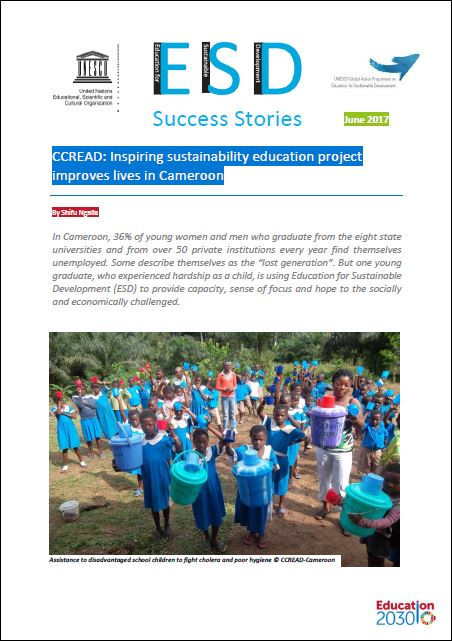 CCREAD: Un Estimulante Proyecto Sobre Educación para la Sostenibilidad Mejora la Vida en el Camerún 出版年份: 2017 作者: Shifu Ngalla 机构作者: Organización de las Naciones Unidas para la Educación, la Ciencia y la Cultura (UNESCO) Este es un artículo acerca de proyecto sobre el educación para la sostenibilidad en Camerún.En el Camerún, 36% de las mujeres y de los hombres jóvenes que se gradúan anualmente en alguna de las ocho universidades estatales o en alguna de las 50 instituciones privadas se encuentran sin empleo. Algunos se describen a sí mismos como la “generación perdida”. Pero un joven diplomado que experimentó dificultades cuando era niño está utilizando la educación para el desarrollo sostenible (EDS) como un medio para proporcionar capacidades, centrar mejor las prioridades y dar esperanza a las personas social y económicamente desfavorecidas.
  Education 2030: Déclaration d'Incheon et Cadre d'action pour la mise en oeuvre de l'Objectif de développement durable 4: Assurer à tous une éducation équitable, inclusive et de qualité et des possibilités d'apprentissage tout au long de la vie 出版年份: 2016 机构作者: Organisation des Nations Unies pour l'éducation, la science et la culture (UNESCO) La Déclaration d’Incheon présente la vision collective et l’engagement de la communauté internationale envers l’éducation mondiale. Le Cadre d’action 2030 fournit des directives pour l’attente de l’Objectif de développement durable 4. Educación 2030: Declaración de Incheon y Marco de Acción para la realización del Objetivo de Desarrollo Sostenible 4: Garantizar une aducación inclusiva y equitativa de calidad y promover oportunidades de aprendizaje permanente para todos 出版年份: 2016 机构作者: Organización de las Naciones Unidas para la Educación, la Ciencia y la Cultura (UNESCO) The Incheon Declaration articulates the collective vision and commitment of the international community on global education. The 2030 Framework for Action provides guidance for the implementation of Sustainable Development Goal 4. 2030年教育:仁川宣言和行动框架实现可持续发展目标4——确保包容和公平的优质教育,让全民终身享有学习机会 出版年份: 2016 机构作者: 联合国教科文组织 (UNESCO) 《仁川宣言》阐明了国际社会在全球教育方面的集体愿景和承诺。“2030年行动框架”为可持续发展目标4的实施提供了指导。
  [Резюме] Подотчетность в образовании: выполнение обязательств. Резюме всемирного доклада по мониторингу образования 出版年份: 2017 机构作者: Организация Объединенных Наций по вопросам образования, науки и культуры (UNESCO) Во второй публикации из серии Всемирного доклада по мониторингу образования (ВДМО) за 2017 год был продолжен анализ прогресса в достижении цели в области устойчивого развития, касающейся образования (ЦУР 4) и выполнения десяти предусмотренных в рамках этой цели задач. Кроме этого, задач, связанных с образованием и включенных в Повестку дня в области устойчивого развития.Наряду с этим в документе рассматриваются аспекты, касающиеся подотчетности в сфере образования, в частности, анализируются возможности повышения всеми вовлеченными сторонами эффективности, действенности и справедливости предоставляемых образовательных услуг. Доклад включает обзор различных механизмов, используемых для обеспечения подотчетности правительств, школ, учителей, родителей, международных организаций и частных структур в интересах всеохватности, справедливости и качества образования.На основе оценки эффективности подходов, существующих в вопросах подотчетности, и анализа внешних факторов, которые могут влиять на эту эффективность, в ВДМО 2017/18 гг. были сформулированы конкретные рекомендации, направленные на укрепление систем образования. [요약본] 교육의 책무성: 우리의 공약을 어떻게 이행할 것인가; 세계 교육 현황 보고서 2017/8 出版年份: 2017 机构作者: 유네스코 두 번째로 발간되는 세계 교육 현황 보고서는 유엔 지속가능발전목표의 교육 목표를 향한 전 세계적 이행 현황에 대한 최신 증거를 제시합니다.여전히 수억 명의 사람들이 학교에 다니지 못하고, 많은 이들이 학교에서 최소한의 기술을 습득하지 못하고 있습니다. 이것은 현 교육 시스템이 글로벌 목표를 달성하기 위한 올바른 방향으로 나아가지 못하고 있음을 나타냅니다. 현재 소외 계층이 이러한 여파를 가장 크게 받고 있지만, 정책 입안자가 이들의 필요에 충분히 주의를 기울인다면 이들이 가장 큰 혜택을 받을 수도 있습니다. 이러한 과제에 직면해 있고 예산 부족 및 돈에 합당한 결과 지향적 가치의 강조에 어려움을 겪고 있는 국가들은 해결책을 모색하고 있습니다. 대부분의 경우 책무성 증진이 최우선 해결책으로 명시되고 있습니다.2017/8 세계 교육 현황 보고서 요약본은 교육의 책무성에 대한 모든 접근법을 보여 줍니다. 이 보고서는 책무성에 대한 개념이 낯선 국가 및 교육에 대한 권리 침해가 문제시 되지 않는 국가에서부터 책무성이 그 자체로 포괄적이고 공평한 양질의 교육과 평생 학습을 위한 수단이 아닌 목적이 된 국가까지를 포괄합니다.본 보고서는 교육이 공동의 책임이라는 점을 강조합니다. 교육에 대한 기본적인 책임은 정부에 있지만, 학교, 교사, 학부모, 학생, 국제기구, 민간 부문 제공자, 시민사회 및 미디어 등 모든 주체는 교육제도 향상을 위한 역할을 지닙니다. 본 보고서는 투명성과 정보 가용성의 중요성을 강조하지만 자료 사용 방법에 대한 주의를 촉구합니다. 협소하게 정의된 결과와 처벌적 제재에 대한 불균형적 집중은 책무성 시스템을 회피하게 만드는 경우를 만듭니다. 여러 책무성 도구들이 존재하는 시대에 본 보고서는 어떠한 도구가 효과가 있고 그렇지 않은지에 대한 분명한 증거를 제시하고 있습니다.
  Sandwatch: adapting to climate change and educating for sustainable development 出版年份: 2010 作者: Gillian Cambers | Paul Diamond 机构作者: UNESCO Sandwatch provides a framework for children, youth and adults, with the help of teachers and local communities, to work together to critically evaluate the problems and conflicts facing their beach environments, and to develop sustainable approaches to address these issues. It also helps beaches become more resilient to climate change. The preliminary chapters of this publication focus on how to get started with Sandwatch activities and examine ways to address climate change impacts. The principle aim of this publication is to document the Sandwatch methodology: monitoring, analysing, sharing and taking action. An activities-orientated approach is used to provide step-by-step instructions to cover monitoring methods and data analysis, including observation and recording, erosion and accretion, beach composition, human activities, beach debris, water quality, waves, longshore currents, plants and animals. The activities are related to (a) sustainable development issues, including: beach ownership, mining beaches for construction material, conflict resolution between different beach users, pollution, conservation of endangered species, and (b) climate change adaptation issues: sea level rise, rising temperatures, ocean acidification and increased extreme events. Ways to share findings and create a Sandwatch network are detailed including methods such as the use of local media, websites, social networking and video production. Finally, ways are discussed to design, plan and implement a Sandwatch project to fulfill one or all of the following criteria: (a) addressing a particular beach-related issue, (b) enhancing the beach, and (c) promoting climate change adaptation. Sandwatch stands as an example of Education for Sustainable Development in action, and is being targeted as one of several flagship projects for the United Nations Decade of Education for Sustainable Development (2005–2014). As the world confronts the growing threat of climate change, Sandwatch presents an opportunity to help people and ecosystems respond to present and future changes in a practical manner. Beaches are among the ecosystems most at risk from climate change as they face rising sea levels and increased more intense storms. By contributing to ecosystem health and resilience, Sandwatch can help people from all walks of life learn about climate change and how their actions can contribute to the adaptation process.
  National journeys towards education for sustainable development, 2013: reviewing national ESD experiences from Costa Rica, Morocco, South Africa, Sweden, VietNam 出版年份: 2013 机构作者: UNESCO This publication has sourced information from a series of national reviews commissioned by UNESCO in 2011/2012 and was written by experts in Costa Rica, Morocco, South Africa, Sweden and Viet Nam. The countries presented in this report are not necessarily the ‘best’ examples of the region, as many other countries are also progressing effectively towards implementing Education for Sustainable Development (ESD). Rather, the countries selected illustrate the wide diversity of ESD approaches and initiatives taking place in different parts of the world. The national studies were then edited and harmonized before common themes and lessons learnt were identified to support other national efforts in moving towards the end of the UN Decade of Education for Sustainable Development. Voyages nationaux vers l'éducation pour le développement durable, 2013: examen des expériences nationales EDD du Costa Rica, Maroc, Afrique du Sud, Suède, Vietnam 出版年份: 2013 机构作者: Organisation des Nations Unies pour l'éducation, la science et la culture (UNESCO) Cette publication a source d'informations à partir d'une série d'examens nationaux mandatés par l'UNESCO en 2011/2012 et a été rédigé par des experts au Costa Rica, Maroc, Afrique du Sud, la Suède et le Viet Nam. Les pays présentés dans ce rapport ne sont pas nécessairement les exemples «meilleurs» de la région, comme beaucoup d'autres pays progressent également de manière efficace pour mettre en œuvre l'éducation pour le développement durable (EDD). Au contraire, les pays sélectionnés illustrent la grande diversité des approches et des initiatives qui se déroulent dans différentes parties du monde EDD. Les études nationales ont ensuite été modifiés et harmonisés avant les thèmes et les enseignements tirés ont été identifiés pour soutenir d'autres efforts nationaux dans le déplacement vers la fin de la Décennie des Nations Unies pour l'éducation au développement durable communs. التربية من أجل التنمية المستدامة: كتاب مرجعي 出版年份: 2013 机构作者: منظمة الأمم المتحدة للتربية والعلم والثقافة (UNESCO) The target audiences for the Education for Sustainable Development Sourcebook are primary and secondary teachers and mid-level decision-makers, who have responsibility for primary and secondary education. Another primary audience is teacher educators who work with pre-service and in-service primary and secondary school teachers. The purpose of the publication is to describe ways in which education for sustainable development (ESD) can be integrated into primary and secondary schooling. This collection of briefs is designed to complement other ESD materials published by UNESCO. The topics for the briefs were selected in consultation with UNESCO Field Offices and Institutes. The briefs for primary and secondary teachers are specifically written for professional educators who work in formal education settings. The briefs for teachers as well as those for decision-makers address “gaps” in the UNESCO ESD literature.