
相关资源
探索丰富的全球公民教育资源,深化理解,促进研究、倡导、教学与学习。
共找到3,385条结果
 L’ABC de l’éducation à la citoyenneté mondiale 出版年份: 2016 机构作者: Organisation des Nations Unies pour l'éducation, la science et la culture (UNESCO) Les progrès considérables des technologies de l’information et de la communication (TIC) ont permis aux individus de se rapprocher et d’interagir les uns avec les autres, où que ce soit et à tout moment. Cela a contribué à intensifier le sentiment et le fait d’être interconnectés et de vivre au-delà des frontières. En outre, l’augmentation des migrations transnationales rend les communautés locales inévitablement plus hétérogènes et accroît la nécessité d’apprendre à vivre ensemble. De plus, les tensions et les conflits entre populations, ainsi que les défis liés au développement durable, tel que le changement climatique ont des origines et des conséquences qui dépassent les frontières nationales. Cela et, exige plus de coopération et à la mise en œuvre d’actions collectives aux niveaux local et mondial.
  L'ABC de l'éducation à la citoyenneté mondiale 出版年份: 2016 机构作者: UNESCO UNESO's FAQ on Global citizenship education
 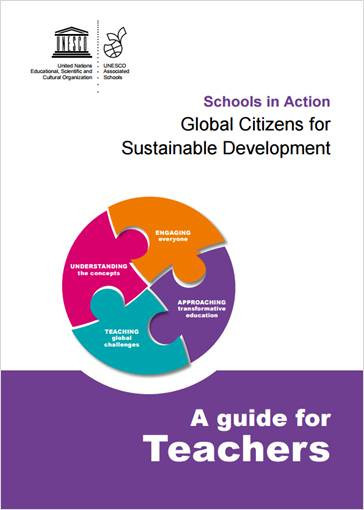 Le réSEAU en action: Citoyens du monde connectés pour le développement durable: guide à l'intention des enseignants 出版年份: 2016 机构作者: Organisation des Nations Unies pour l'éducation, la science et la culture (UNESCO) The Global Citizens for Sustainable Development Teachers’ guide aims to introduce teachers to Global Citizenship Education (GCED) and Education for Sustainable Development (ESD). It provides secondary school teachers with ideas and activities to help students become global citizens and sustainable development actors. The Teachers’ guide draws on the discussions and activities of almost 1,100 participants from 104 countries, including ASPnet National Coordinators, school principals, teachers, students and experts who contributed to the Online Collaborative Platform ASPnet in Action: Global Citizens Connected for Sustainable Development in 2014 and 2015 [http://en.unesco. org/aspnet/globalcitizens] with associated activities and initiatives. The Teachers’ guide provides: An overview of what it means for learners to become global citizens and of how learners can contribute to sustainable development. Ideas for classroom activities that can help secondary school students to develop knowledge, skills, values, attitudes and behaviours that promote GCED and ESD. Selected activities on GCED and ESD from ASPnet schools around the world. Escuelas en acción, ciudadanos del mundo para el desarrollo sostenible: guía para el profesorado 出版年份: 2016 机构作者: Organización de las Naciones Unidas para la Educación, la Ciencia y la Cultura (UNESCO) The Global Citizens for Sustainable Development Teachers’ guide aims to introduce teachers to Global Citizenship Education (GCED) and Education for Sustainable Development (ESD). It provides secondary school teachers with ideas and activities to help students become global citizens and sustainable development actors. The Teachers’ guide draws on the discussions and activities of almost 1,100 participants from 104 countries, including ASPnet National Coordinators, school principals, teachers, students and experts who contributed to the Online Collaborative Platform ASPnet in Action: Global Citizens Connected for Sustainable Development in 2014 and 2015 [http://en.unesco. org/aspnet/globalcitizens] with associated activities and initiatives. The Teachers’ guide provides: An overview of what it means for learners to become global citizens and of how learners can contribute to sustainable development. Ideas for classroom activities that can help secondary school students to develop knowledge, skills, values, attitudes and behaviours that promote GCED and ESD. Selected activities on GCED and ESD from ASPnet schools around the world.
 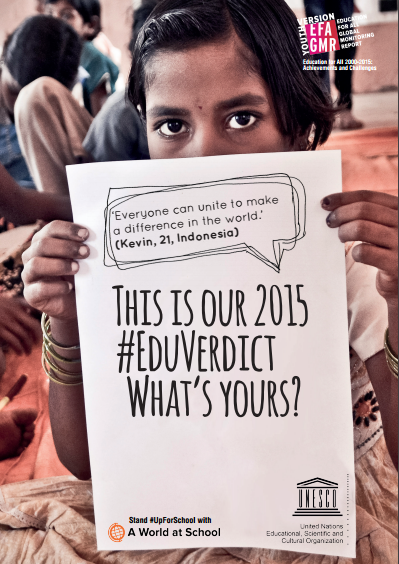 这是我们的2015 教育回望#EduVerdict 你的呢? 出版年份: 2015 机构作者: 联合国教科文组织 (UNESCO) This report highlights the progress and challenges that countries have faced over 15 years, brining together the voices of young people to show how Education for All (EFA) has affected their lives.
  Contributing to peace and human development in an era of globalization 出版年份: 2002 机构作者: UNESCO The Medium-Term Strategy (2002-2007) for the countries of the Africa region is an essential programme axis of UNESCO’s new decentralization policy. It forms an integral part of the Organization’s overall strategic objectives defined by the Member States in the UNESCO MediumTerm Strategy for 2002-2007 (31 C/4), which aims to contribute to peace and human development through education, the sciences, culture and communication.
 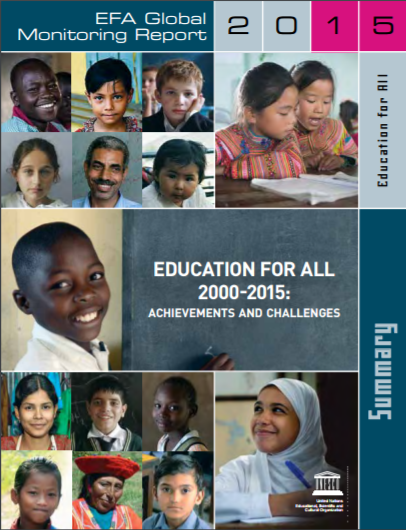 Other lang. title: L'Education pour tous 2000-2015: progrès et enjeux, rapport mondial de suivi sur l'EPT, 2015, résumé; La Educación para Todos, 2000-2015: logros y desafíos, informe de seguimiento de la EPT en el mundo, 2015, resumen 出版年份: 2015 机构作者: Organización de las Naciones Unidas para la Educación, la Ciencia y la Cultura (UNESCO) At the World Education Forum in Dakar, Senegal, in 2000, governments from 164 countries, together with representatives of regional groups, international organizations, donor agencies, non-government organizations (NGOs) and civil society, adopted a Framework for Action to deliver Education for All (EFA) commitments. The Dakar Framework comprised 6 goals and their associated targets to be achieved by 2015, and 12 strategies to which all stakeholders would contribute. The EFA Global Monitoring Report (GMR) has monitored progress on an almost annual basis towards the EFA goals and the two education-related Millennium Development Goals (MDGs). The 2015 GMR provides a complete assessment of progress since 2000 towards the target date for reaching the Dakar Framework’s goals. It takes stock of whether the world achieved the EFA goals and stakeholders upheld their commitments. It explains possible determinants of the pace of progress. Finally, it identifies key lessons for shaping the post-2015 global education agenda. Образование для всех 2000-2015 гг.: достижения и вызовы, всемирный доклад по мониторингу ОДВ, 2015 г., резюме 出版年份: 2015 机构作者: Организация Объединенных Наций по вопросам образования, науки и культуры (UNESCO) At the World Education Forum in Dakar, Senegal, in 2000, governments from 164 countries, together with representatives of regional groups, international organizations, donor agencies, non-government organizations (NGOs) and civil society, adopted a Framework for Action to deliver Education for All (EFA) commitments. The Dakar Framework comprised 6 goals and their associated targets to be achieved by 2015, and 12 strategies to which all stakeholders would contribute. The EFA Global Monitoring Report (GMR) has monitored progress on an almost annual basis towards the EFA goals and the two education-related Millennium Development Goals (MDGs). The 2015 GMR provides a complete assessment of progress since 2000 towards the target date for reaching the Dakar Framework’s goals. It takes stock of whether the world achieved the EFA goals and stakeholders upheld their commitments. It explains possible determinants of the pace of progress. Finally, it identifies key lessons for shaping the post-2015 global education agenda. 2000-2015年 全民教育: 成就与挑战; 全民教育 全球监测报告, 2015; 摘 要 出版年份: 2015 机构作者: 联合国教科文组织 (UNESCO) At the World Education Forum in Dakar, Senegal, in 2000, governments from 164 countries, together with representatives of regional groups, international organizations, donor agencies, non-government organizations (NGOs) and civil society, adopted a Framework for Action to deliver Education for All (EFA) commitments. The Dakar Framework comprised 6 goals and their associated targets to be achieved by 2015, and 12 strategies to which all stakeholders would contribute. The EFA Global Monitoring Report (GMR) has monitored progress on an almost annual basis towards the EFA goals and the two education-related Millennium Development Goals (MDGs). The 2015 GMR provides a complete assessment of progress since 2000 towards the target date for reaching the Dakar Framework’s goals. It takes stock of whether the world achieved the EFA goals and stakeholders upheld their commitments. It explains possible determinants of the pace of progress. Finally, it identifies key lessons for shaping the post-2015 global education agenda.
  Non-formal and Informal Programs and Activities that Promote the Acquisition of Knowledge and Skills in Areas of Global Citizenship Education (GCED) and Education for Sustainable Development (ESD) 出版年份: 2016 作者: Ashley Stepanek Lockhart 机构作者: UNESCO This study will examine the nature of, and how, non-formal and informal programs and activities contribute to the acquisition of knowledge and skills for children, adolescents, youth and adults in precise areas of Target 4.7. This will be done by highlighting different definitions, conceptual approaches and history, along with policies of GCED and ESD and non-formal education and informal learning, comparing attempts to operationalize GCED and ESD to indicators for measurement and monitoring and challenges therein, and by identifying relevant sample programs and activities from around the world to analyze and consider using as data sources. How non-formal and informal provision related to GCED and ESD links to formal education will be considered, along with its connection to the larger notion of lifelong learning.