
相关资源
探索丰富的全球公民教育资源,深化理解,促进研究、倡导、教学与学习。
共找到3,454条结果
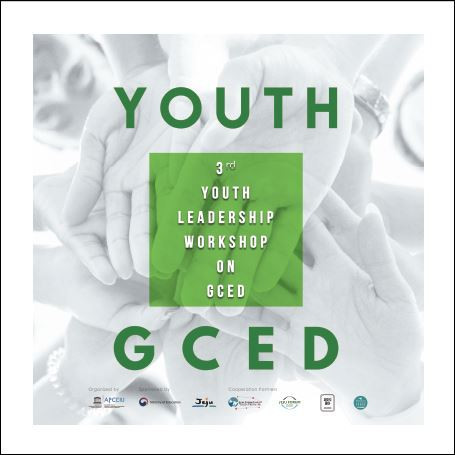 3rd Youth Leadership Workshop on GCED: Final Report 出版年份: 2017 机构作者: APCEIU This report provides an overview of the activities carried out during the 3rd Youth Leadership Workshop on Global Citizenship Education (GCED) held in Jeju, Republic of Korea, from 28 May - 3 June 2017. This programme invited 50 youth activists from 43 countries around the world to exchange their ideas and identify GCED leadership strategies in order to mobilize young people for GCED in local and national contexts and advance the agenda globally. This report also aims to convey the voice of the youth represented by GCED Youth Network: their thoughts and reflections on GCED and its priority areas. The workshop was organized by APCEIU and in partnership with GCED Youth Network, Jeju Forum for Peace and Prosperity, Jaejudo Joa and Global Inner Peace; it was sponsored by Ministry of Education of the Republic of Korea and Jeju Special Self-Governing Province.For more information, please contact APCEIU's Office of Education and Training at ent@unescoapceiu.org. 제3차 세계시민교육 청년리더십 워크숍: 최종보고서 出版年份: 2017 机构作者: 유네스코 아시아태평양 국제이해교육원 본 보고서는 2017년 5월 28일부터 6월 3일까지 제주에서 열린 ‘제3차 세계시민교육 청년리더십 워크숍(3rd Youth Leadership Workshop on GCED)’에서 이루어진 활동 개요를 제공한다. 이 워크숍은 유네스코 아태교육원 주최, 세계시민교육 청년네트워크, 평화와 번영을 위한 제주포럼, 재주도좋아, 글로벌 이너피스가 파트너로 참여하였으며, 대한민국 교육부 및 제주특별자치도청이 후원하였다. 이 프로그램에는 전세계 43개국 50명의 청년활동가들이 참가하여 세계시민교육에 대한 아이디어를 교환하며, 세계시민교육을 전 세계적으로 확산하고 지역·국가적 차원의 청년활동을 증진하기 위한 리더십 전략을 논의하였다. 본 보고서는 7일간의 워크숍 활동들에 대한 기록과 더불어 세계시민교육의 주체인 청년들을 대표하여 세계시민교육 청년 네트워크가 생각하는 세계시민교육의 의미와 우선 과제들에 대한 목소리를 담고자 했다. 문의: 유네스코 아태교육원 교육연수실(ent@unescoapceiu.org)
 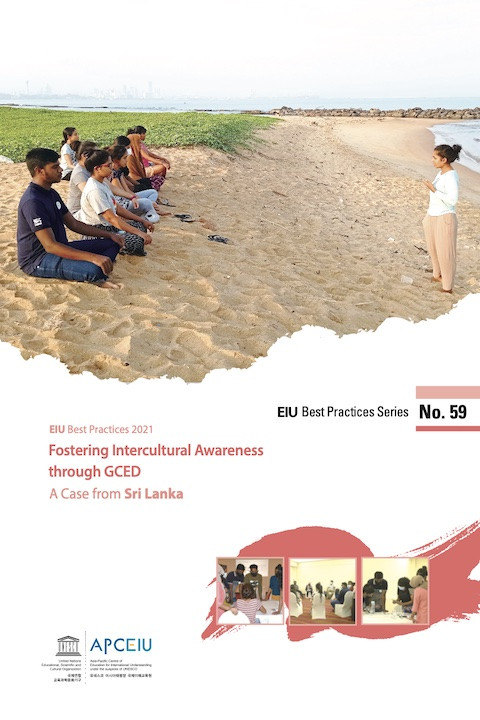 EIU Best Practices 2021: Fostering Intercultural Awareness through GCED; A Case from Sri Lanka (EIU Best Practices Series; no.59) 出版年份: 2021 作者: Oshan Madushanka Gunathilake 机构作者: APCEIU This monograph is one of APCEIU's EIU Best Practices Series, which aims to encourage educators, scholars, and activists to implement and share local initiatives on EIU. The Series No.59 introduces ‘Citizen Culture’ which is designed to foster intercultural and interreligious understanding within youth communities through the theories and learnings of GCED. The programme focused on a selected group of young individuals who are representing both vulnerable communities as well as privileged, also belonging to a diverse mixture of cultural, religious, social and ethnic backgrounds. The learners will go into their respective communities and spread this message as agents of positive change and actively contribute to the social cohesion, trust and awareness building through volunteer participation for transforming popular harmful narratives and practices which are structured in our society - cultivating a culture of peace.
 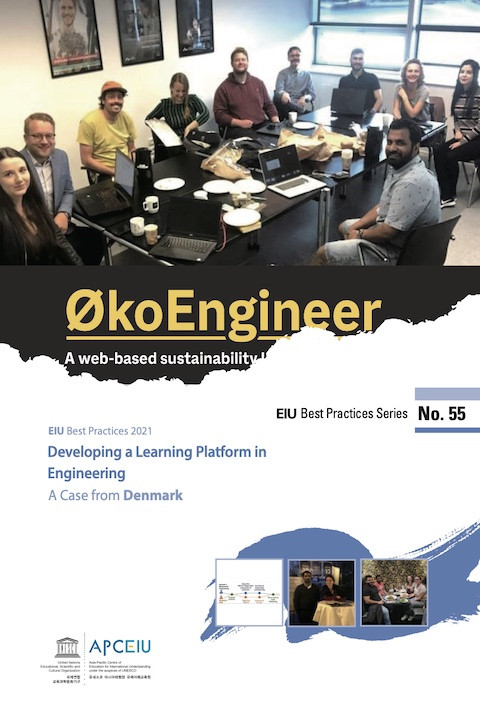 EIU Best Practices 2021: Developing a Learning Platform in Engineering; A Case from Denmark (EIU Best Practices Series; no.55) 出版年份: 2021 作者: Serena Leka 机构作者: APCEIU This monograph is one of APCEIU's EIU Best Practices Series, which aims to encourage educators, scholars, and activists to implement and share local initiatives on EIU. The Series No.55 introduces ‘ØkoEngineer’ which is a sustainability learning platform created to educate engineering students in Aarhus on sustainability concepts and how they couple with engineering design through the gamification of project-based learnings. The project aims to prepare the future engineers to play their crucial role in the significant global issues that we face. In response to the above challenges, future engineers, today's students are embracing initiatives that stimulate sustainability education. The students are motivated by the urge to relate sustainability with their domain-specific engineering theories. ØkoEngineer is a web-based game platform designed for integrating sustainability learning in engineering curricula.
 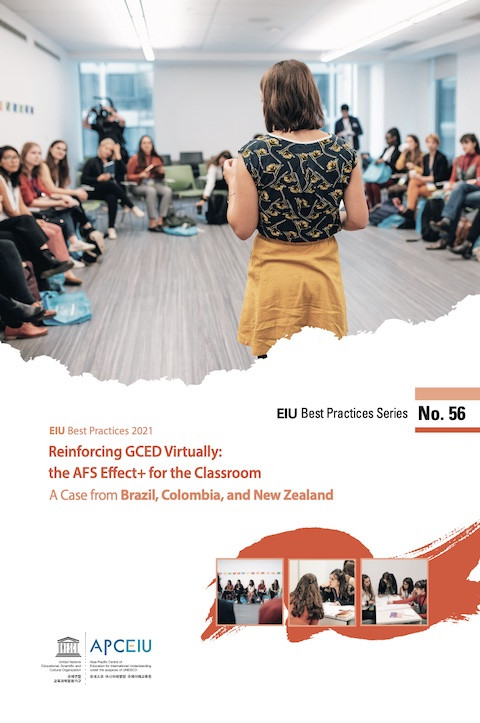 EIU Best Practices 2021: Reinforcing GCED Virtually; the AFS Effect+ for the Classroom, a Case from Brazil, Colombia, and New Zealand (EIU Best Practices Series; no.56) 出版年份: 2021 作者: Ana Carolina Cassiano 机构作者: APCEIU This monograph is one of APCEIU's EIU Best Practices Series, which aims to encourage educators, scholars, and activists to implement and share local initiatives on EIU. The Series No.56 introduces ‘the AFS Effect+ for the Classroom Programme’ which is launched in September 2020. The programme has engaged 150+ high-school teachers from Brazil, Colombia, and New Zealand who completed 20 hours of virtual teacher training, collaborated virtually with each other and piloted activities developed by AFS with their classrooms, reaching over 2,500 students. As a result of the programme, the AFS Effect+ for the Classroom: Toolkit for Educators is now available to teachers worldwide to use as a resource for teaching Active Global Citizenship & the SDGs for high school students. The toolkit is currently available in English, Spanish and Portuguese, and being disseminated through AFS Network Organizations which are present in 50+ countries.
 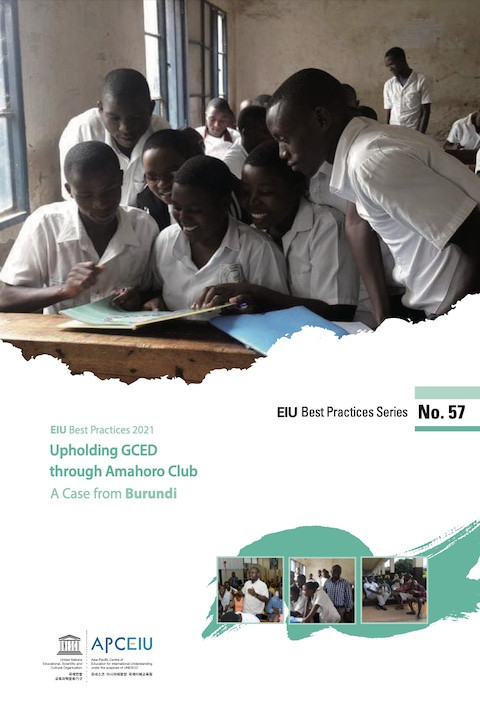 EIU Best Practices 2021: Upholding GCED through Amahoro Club; A Case from Burundi (EIU Best Practices Series; no.57) 出版年份: 2021 作者: Sinai Bakanibona 机构作者: APCEIU This monograph is one of APCEIU's EIU Best Practices Series, which aims to encourage educators, scholars, and activists to implement and share local initiatives on EIU. The Series No.57 introduces ‘Amahoro Clubs’ which means Peace Education Clubs. It is a project that has been initiated in other secondary schools of Burundi in terms of consolidating culture of peace and stability in Burundian society by applying different concepts of Global Citizenship Education in our life. This programme influence positively different social stratifications of people to know how to live together and be united by facing diverse challenges which can somber the population in violent conflicts. Amahoro Clubs serve as a platform in which people become aware of the various social issues. Students and teachers are gaining the necessary knowledge and skills that will help prevent the occurrence of conflicts.
 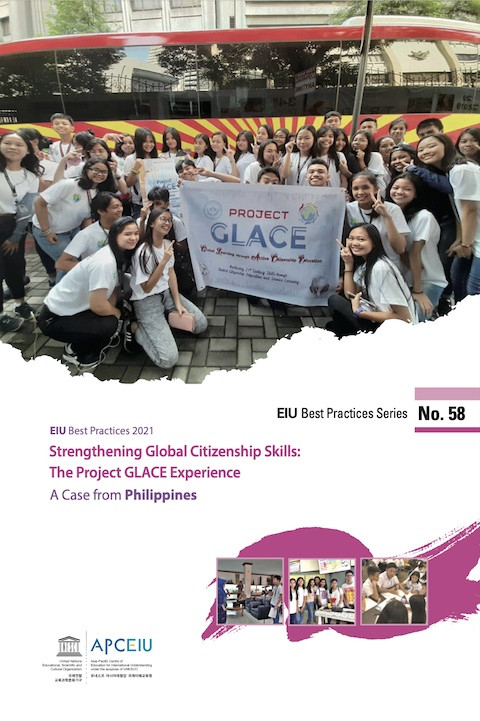 EIU Best Practices 2021: Strengthening Global Citizenship Skills; The Project GLACE Experience, A Case from Philippines (EIU Best Practices Series; no.58) 出版年份: 2021 作者: Marco Meduranda 机构作者: APCEIU This monograph is one of APCEIU's EIU Best Practices Series, which aims to encourage educators, scholars, and activists to implement and share local initiatives on EIU. The Series No.58 introduces ‘Project GLACE’ or ‘Global Learning through Active Citizenship Education’. It is an after-school enhancement program that sought to enhance students' global citizenship skills through afterschool learning sessions, off-campus intercultural education experiences, and service-learning or community outreach activities. Using the 4-I's (Inquire, Investigate, Innovate and Impact), selected teachers taught global citizenship education concepts for a span of 12 - 15 weeks with the first six to ten weeks exploring the themes of social justice and equity, identity and diversity, self-awareness and reflection, concern for the environment, commitment to sustainable development, and commitment to participation and inclusion.
 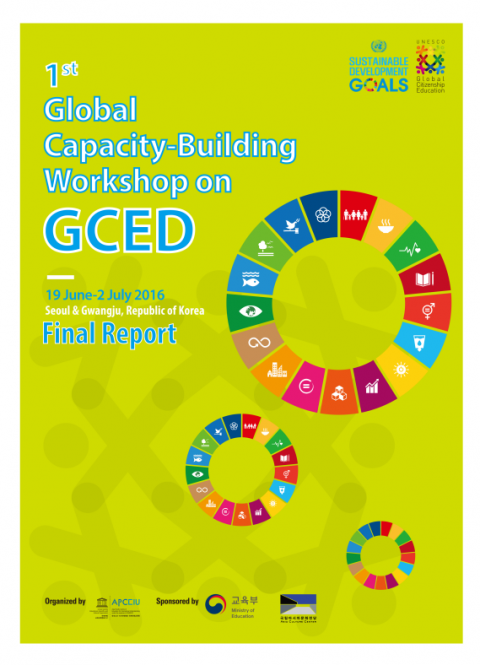 Final Report: 1st Global Capacity-Building Workshop on GCED 出版年份: 2016 机构作者: APCEIU This report provides an overview of the activities carried out during the 1st Global Capacity-Building Workshop on GCED held in Seoul and Gwangju, Republic of Korea from 19 June - 2 July, 2016. APCEIU organized the 1st Global Capacity-Building Workshop on GCED in collaboration with UNESCO in order to contribute to achieving the Sustainable Development Goals(SDGs) target 4.7 by enhancing the capacity of teacher educators and trainers in implementing GCED. This intensive 2-week workshop provided the participating educators with the opportunities to better understand the concept and internalize the pedagogical principles of GCED while sharing their experiences and working on collaborative action plans. For more information, please contact APCEIU's Office of Education and Training at ent@unescoapceiu.org.
 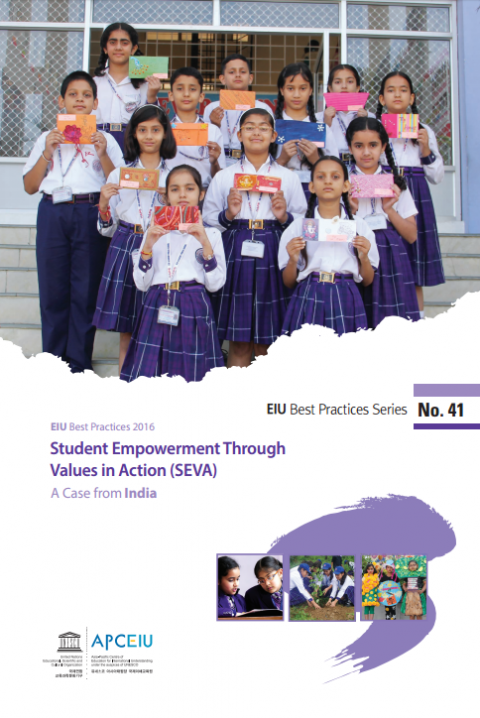 EIU Best Practices Series No. 41: Student Empowerment Through Values in Action (SEVA) 出版年份: 2016 机构作者: APCEIU This monograph is one of APCEIU's EIU Best Practices Series, which aims to encourage educators, scholars, and activists to implement and share local initiatives on EIU. The Series No. 41 introduces a programme called “Student Empowerment through Values in Action (SEVA)" carried out by a school in India. The programme encouraged students to put the values of respect, responsibility, care, integrity, resilience and cyber-wellness in day to day actions. The programme has been successful in motivating the school staffs to enthusiastically participate in the programme as they witnessed the impact of the progarmme on the students. The programme sends out important messages to the school education system, where evaluation of success tends to be heavily based on academic performance.
 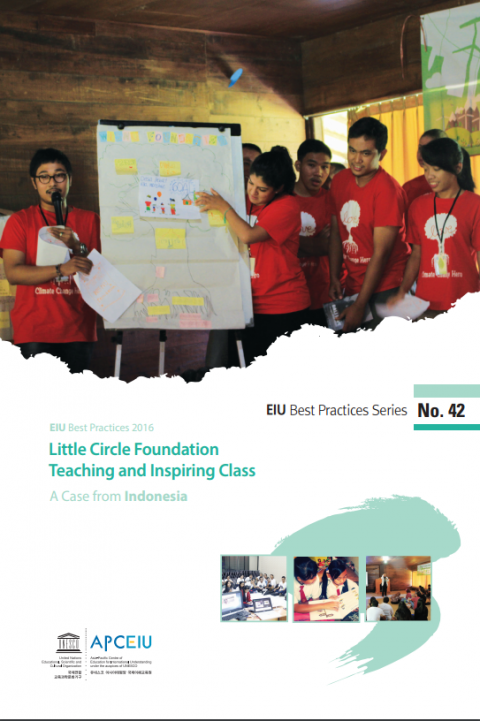 EIU Best Practices Series No. 42: Little Circle Foundation Teaching and Inspiring Class 出版年份: 2016 机构作者: APCEIU This monograph is one of APCEIU's EIU Best Practices Series, which aims to encourage educators, scholars, and activists to implement and share local initiatives on EIU. The Series No. 42 introduces a programme called “Little Circle Foundation Teaching and Inspiring Class”, a great example of young people taking action to improve the quality of education in their community in Bali, Indonesia. The activities presented in this case are solely organized by youth for youth themselves. This proves that young people are not only recipients of education, but also active participants and providers of education.