
相关资源
探索丰富的全球公民教育资源,深化理解,促进研究、倡导、教学与学习。
共找到3,453条结果
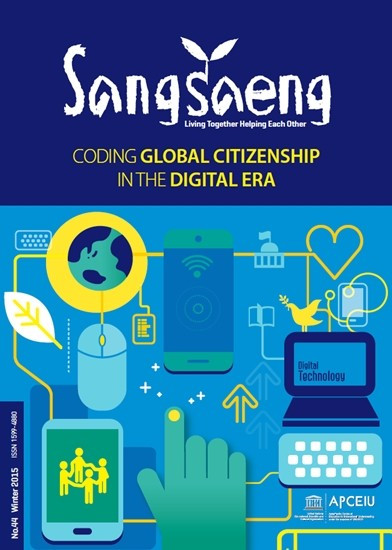 Codage de la citoyenneté mondiale à l'ère du numérique (SangSaeng no 44 hiver 2015) 出版年份: 2015 机构作者: Centre Asie-Pacifique d'éducation pour la compréhension internationale (APCEIU) Le 44e numéro de SangSaeng, intitulé «Codage de la citoyenneté mondiale à l'ère numérique», a été publié. L'avancement de la technologie numérique a connecté le monde, l'accélération de la mondialisation. À l'ère numérique mondiale, l'éducation à la citoyenneté mondiale (ECM) attire l'attention. Reconnaissant son importance, cette édition d'hiver met en évidence le thème du ECM pour les citoyens numériques à travers l'optique des responsables de l'éducation, des enfants et des jeunes et des entreprises. En particulier, les articles proposent de participer activement à la société de l'information et de contribuer à celle-ci par une utilisation éthique, sûre et responsable des technologies numériques comme compétence fondamentale pour les citoyens du monde à l'ère du numérique.8 Trouver un équilibre entre les Débouchés Numériques et les Risques Connexes12 Les Jeunes en tant que Citoyens Actifs à l'ère du Numérique16 Permettre aux enfants de devenir des leaders numériques créatifs20 Favoriser l'innovation inclusive pour un monde meilleur38 Entretien38 Comprendre la Culture par le biais des Médias et de la Langue40 Adopter la Diversité pour Vivre Ensemble42 La Paix dans ma MémoirePour atteindre la paix, il faut comprendre la paix46 Comprendre la région Asie-PacifiqueDécouvrez le rituel de guérison antique d'Ulik Mayang50 APCEIU en action
  Electronic resources on education for sustainable development 出版年份: 2007 机构作者: APCEIU | UNESCO Bangkok The Asia-Pacific Programme of Educational Innovation for Development (APEID) of UNESCO Bangkok and the Asia-Pacific Centre of Education for International Understanding (APCEIU) collaborated to produce this document listing these electronic resources. The value of such resources is not limited to teachers alone; it is also useful to policy and decision makers, teacher educators, researchers and academics as well as students themselves. Les ressources électroniques sur l'éducation pour le développement durable 出版年份: 2007 机构作者: Centre Asie-Pacifique d'éducation pour la compréhension internationale (APCEIU) | UNESCO Bangkok Le Programme d'innovation éducative en vue du développement en Asie et dans le Pacifique(APEID)e l'UNESCO à Bangkok et le Centre d'Asie-Pacifique pour la Compréhension Internationale(APCECI) ont collaboré pour produire ce document énumérant ces ressources électroniques. La valeur de ces ressources ne se limite pas aux seuls enseignants; il est également utile pour les politiques et les décideurs, formateurs d'enseignants, des chercheurs et des universitaires ainsi que des étudiants eux-mêmes.
 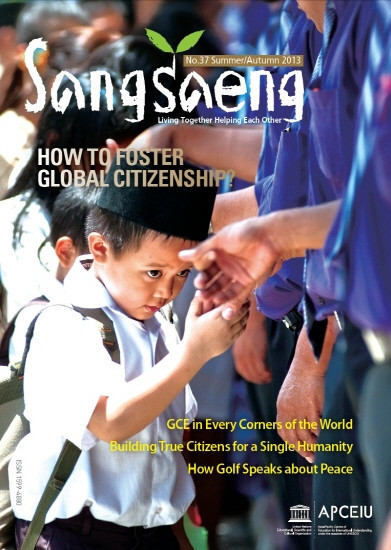 Building a global community out of the ashes of poverty (SangSaeng no. 37 summer autumn 2013) 出版年份: 2013 机构作者: APCEIU SangSaeng No. 37- How to Foster Global Citizenship? has been published. In order to help our readers better grasp the concept of global citizenship and provide useful information and new ideas, this issue deals with various aspects of global citizenship education.3 Director’s Message4 Special ColumnBuilding True Citizens for a Single Humanity8 Focus: How to Foster Global Citizenship?8 Eliminating World Challenges through Global Citizenship Education 13 Developing Global Citizens with a Global Perspective18 Living in a New World Starts with Education23 GCE in Every Corners of the World28 Best Practices28 Hands-on Hand Print for Environmental Sustainability32 Bhutan Teachers Learn New Models of Education35 Comic Relief: Song of the City36 Special ReportPaving the Way Together for Global Citizenship Education40 InterviewBuilding a Global Community out of the Ashes of Poverty42 LetterCapturing Moments of Living in Harmony44 Peace in My MemoryHow Golf Speaks about Peace47 Understanding the Asia-Pacific RegionDiscovering Locks beyond the Function of Opening and Closing50 APCEIU in Action
 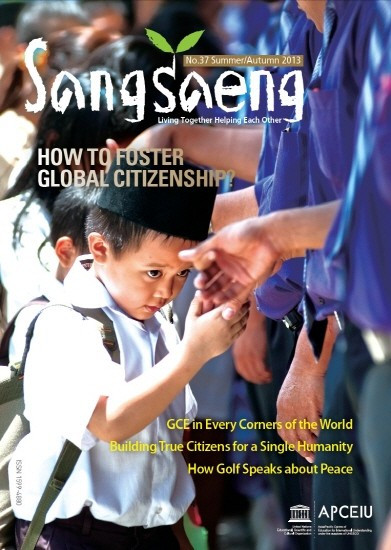 Paving the way together for global citizenship education (SangSaeng no. 37 summer autumn 2013) 出版年份: 2013 机构作者: APCEIU SangSaeng No. 37- How to Foster Global Citizenship? has been published. In order to help our readers better grasp the concept of global citizenship and provide useful information and new ideas, this issue deals with various aspects of global citizenship education.3 Director’s Message4 Special ColumnBuilding True Citizens for a Single Humanity8 Focus: How to Foster Global Citizenship?8 Eliminating World Challenges through Global Citizenship Education 13 Developing Global Citizens with a Global Perspective18 Living in a New World Starts with Education23 GCE in Every Corners of the World28 Best Practices28 Hands-on Hand Print for Environmental Sustainability32 Bhutan Teachers Learn New Models of Education35 Comic Relief: Song of the City36 Special ReportPaving the Way Together for Global Citizenship Education40 InterviewBuilding a Global Community out of the Ashes of Poverty42 LetterCapturing Moments of Living in Harmony44 Peace in My MemoryHow Golf Speaks about Peace47 Understanding the Asia-Pacific RegionDiscovering Locks beyond the Function of Opening and Closing50 APCEIU in Action
 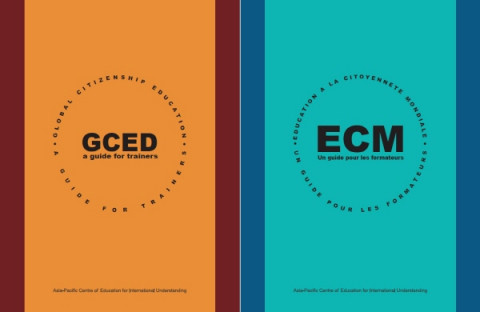 Global Citizenship Education: A Guide for Trainers 出版年份: 2018 机构作者: APCEIU APCEIU has published Global Citizenship Education: A Guide for Trainers in order to aid trainers to conduct introductory workshops for educators on Global Citizenship Education (GCED). Designed as a training manual for trainers, the Guide offers overview of GCED, including backgrounds and core concepts as well as pedagogical principles, but also provides guidelines on the workshop design and facilitation. Consisting of five chapters, the Guide first introduces the rise of GCED within the latest shift in education and global development agendas. Under this framework, the next chapter explores the meanings of a ‘global citizen’ and ‘global citizenship,’ and introduces key concepts and principles of GCED. The next two chapters deal with how to teach GCED, presenting topic areas and themes as well as pedagogies and strategies. The Guide concludes with the last chapter that summarizes and integrates the contents learned in previous chapters by sharing case studies as examples and providing guidelines on how to design GCED activities.The Guide is available in English and French. <Contents> Chapter 1- Why GCED Now?Chapter 2- What is GCED?Chapter 3- GCED: What to Teach?Chapter 4- How to Teach GCED?Chapter 5- Preparing for ActionAnnex: Global Education AgendasUNESCO’s Topics and Learning ObjectivesGCED Resources & Reference Materials ECM: Un guide pour les formateurs 出版年份: 2018 机构作者: Centre Asie-Pacifique d'éducation pour la compréhension internationale (APCEIU) Ce guide est un manuel de formation pour les formateurs qui organiseront un atelier de formation des éducateurs en éducation à la citoyenneté mondiale (ECM) avec les objectifs suivants: - Présenter les informations de base et les concepts clés de l’ECM aux participants de l’atelier- Aider les participants à découvrir les notions de base de l’ECM et les méthodes constructifs connexes en termes d’enseignement/apprentissage - Encourager les participants à explorer les méthodes et les opportunités à travers lesquelles ils peuvent pratiquer l’ECM à l’école et dans d’autres contextes éducatifs
 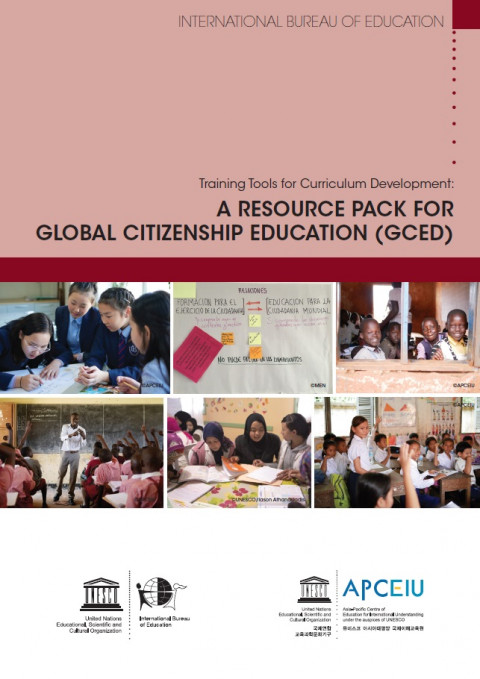 Training Tools for Curriculum Development: A Resource Pack for Global Citizenship Education (GCED) 出版年份: 2018 机构作者: UNESCO International Bureau of Education (IBE) | APCEIU The overarching objective of ‘A Resource Pack for Global Citizenship Education (GCED)’ is to share a broader understanding of GCED theory and practice, in order to support its effective development and implementation at the policy, school and classroom levels. The Resource Pack provides comprehensive guidance for national policymakers, curriculum specialists and developers, teacher educators, teachers, school leaders and district level administrators.The key topics covered are:Module 1: IntroductionModule 2: National PoliciesModule 3: CurriculumModule 4: Teaching, Learning and AssessmentModule 5: Teaching and Learning ResourcesModule 6: Whole School ApproachModule 7: Teacher Education and Professional Development
 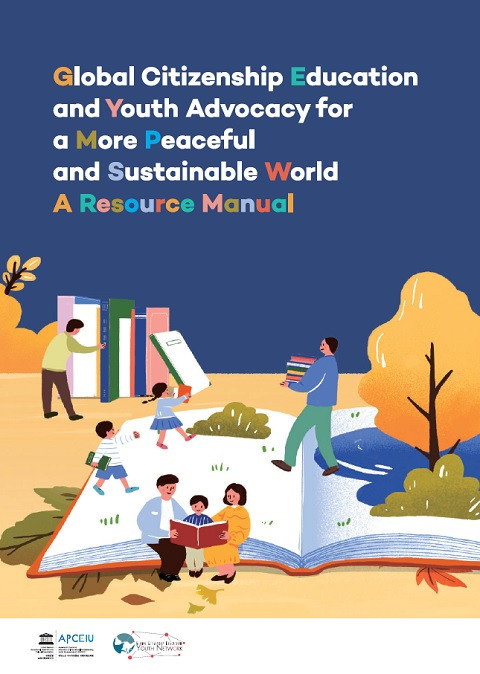 Global Citizenship Education and Youth Advocacy for a More Peaceful and Sustainable World: A Resource Manual 出版年份: 2020 作者: Dylan Wray | Lisa Van Wyk | Rigoberto D. Banta Jr. | Roy Hellenberg | Anna Susarenco | Diego Manrique | Guranda Bursulaia | Noora Elkenawi | Shawgi Ahmed | Tshering Zangmo | Valeriia Moroz 机构作者: APCEIU Since 2016 the Global Citizenship Education (GCED) Youth Network and UNESCO Asia-Pacific Centre of Education for International Understanding(APCEIU) have been working together to support young people to take action to make their communities and the world a better place.This manual, which is the outcome of a joint initiative by the GCED Youth Network and APCEIU, is intended to provide a useful resource for those who teach GCED, for youth organisations that are engaged in advocacy on themes that relate to global citizenship, and those who are supporting youth advocacy.The manual is organized in three main sections: Section 1 focuses on GCED and the teaching of history as a strategy for building a peaceful world.Section 2 provides step by step practical guidelines and ideas for youth advocacy organisations to help them plan advocacy initiatives.Section 3 includes background information and practical ideas for youth advocacy on a series of themes that are relevant to GCED, including empowerment of vulnerable communities, media literacy and peace building. It also considers the role of GCED, and young people, in global crises, using the example of the COVID-19 pandemic, and provides suggestions to help youth advocacy and other organisations to prepare for and respond to such crises
 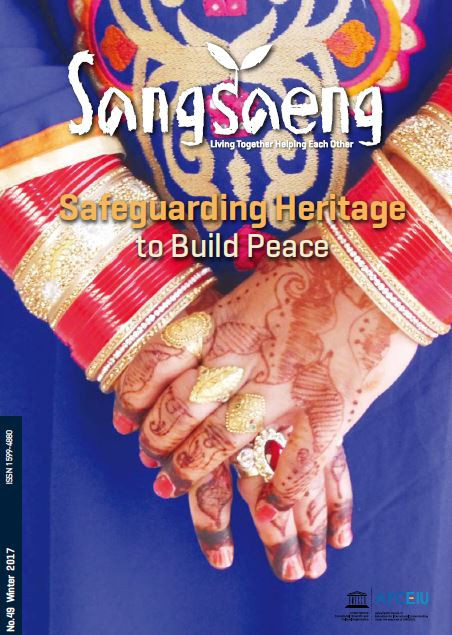 Safeguarding Heritage to Build Peace (SangSaeng no. 49 Winter 2017) 出版年份: 2017 机构作者: APCEIU The 49h issue of SangSaeng, “Safeguarding Heritage to Build Peace,” has been published. All ancient civilizations have contributed in some way to the development of modern society. Therefore, all are equally deserving of study. This edition of SangSaeng aims to examine heritage in its different contexts and to help identify our responsibilities as a global community to understand and tolerate other people’s heritages. 3 Director’s Message4 Special Column4 Taking Stewardship of Our Planet8 Focus: Heritage8 Heritage for Peace and Prosperity12 Heritage Education: Opportunity to Enhance Cultural Literacy17 Photo Essay: World Heritage Sites of 2017 21 Special ReportUNAI Impacts Scholarship, Research for Greater Good24 Best Practices24 Frontier Education on the Frontier for Life29 Encouraging the Heart of the Matter33 InterviewGCED Challenge Issued36 Youth NetworkYouth Building Peace 40 LetterJourney to the Heart of Peace42 Peace in My MemoryPeace in a World of Violence46 Understanding the Asia-Pacific RegionEgg, Tambourine and Commemoration49 APCEIU in Action