
相关资源
探索丰富的全球公民教育资源,深化理解,促进研究、倡导、教学与学习。
共找到3,790条结果
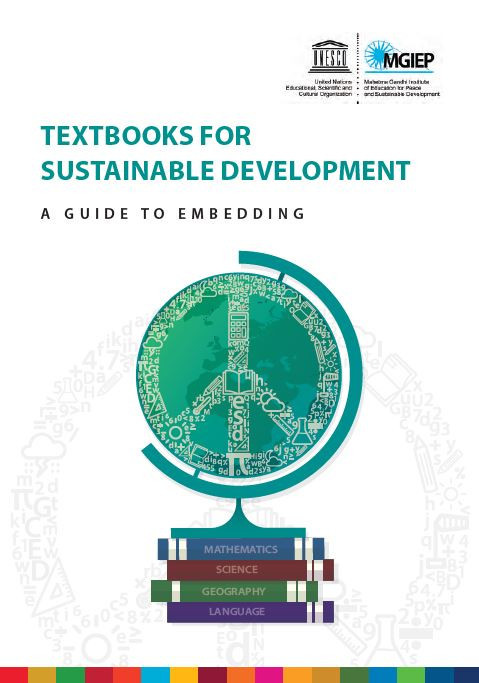 Textbooks for Sustainable Development: A Guide to Embedding 出版年份: 2017 机构作者: UNESCO | Mahatma Gandhi Institute of Education for Peace and Sustainable Development (MGIEP) This guidebook introduces the approach of embedding education for sustainable development into core subjects, building on the German initiative as well as consolidating other existing efforts. This ambitious work began when the UNESCO Mahatma Gandhi Institute of Education for Peace and Sustainable Development (MGIEP), with support from Engagement Global gGmbH, brought together 30 international experts in mathematics, sciences, languages, geography and education for sustainable development in Bangalore, India, in June 2016. These experts co-drafted this guidebook. This publication is designed as a guide for stakeholders in textbook development – education ministries, national curriculum authorities, textbook writers and publishers – to help them produce a new generation of textbooks. Such textbooks will make a clear departure from the mechanistic transmission of information and procedural knowledge devoid of meaning and contextual relevance. They will also advocate a new vision of learning and contribute to fostering young people’s competencies and capabilities to shape more peaceful and sustainable societies. Competencies such as critical and systemic thinking, appreciation of diversity, empathy and commitment to change are the key goals of this ambitious publication. Учебные пособия по устойчивому развитию. Руководство по внедрению 出版年份: 2017 机构作者: Организация Объединенных Наций по вопросам образования, науки и культуры (UNESCO) | Mahatma Gandhi Institute of Education for Peace and Sustainable Development (MGIEP) Данное руководство представляет подход по внедрению образования для устойчивого развития в учебные дисциплины, основываясь на опыте Германии, а также объединяя другие существующие усилия. В июне 2016 года Институт Махатмы Ганди по образованию в интересах мира и устойчивого развития ЮНЕСКО, при поддержке Engagement Global gGmbH, собрал в г. Бангалор, Индия, 30 международных экспертов по математике, естественным наукам, языкам, географии и образованию для устойчивого развития. Эти эксперты участвовали в разработке данного руководства.Данная публикация разработана в качестве руководства для заинтересованных сторон – министерств образования, органов, разрабатывающих государственные образовательные стандарты и учебные планы, авторов и издателей учебников в помощь и поддержку в создании ими учебных материалов нового поколения. Такие учебники станут очевидным отступлением от механической передачи информации и методических знаний, лишенных смысла и контекстуальной значимости. Они также поддержат новое видение обучения и будут способствовать укреплению компетенции и возможностей молодежи в создании более мирных и устойчивых обществ. Ключевыми целями этого амбициозного руководства являются развитие таких компетенции, как критическое и систематическое мышление, правильное восприятие разнообразия, сопереживание и приверженность изменениям.
  Educação 2030 Declaração de Incheon Rumo a uma educação de qualidade inclusiva e equitativa e à educação ao longo da vida para todos 出版年份: 2016 机构作者: UNESCO | United Nations Development Programme (UNDP) | UN. Office of the United Nations High Commissioner for Refugees (UNHCR) | United Nations Children's Fund (UNICEF) | United Nations Entity for Gender Equality and the Empowerment of Women (UN Women) | United Nations Population Fund (UNFPA) This framework — painstakingly drafted over many months with input from governments, international agencies, civil society and experts — provides guidance for implementing the education commitments made in the 2030 Agenda for Sustainable Development at a national, regional and global level. In particular: it aims at mobilizing all countries and partners around Sustainable Education Goal 4 and its targets; it proposes ways of implementing, coordinating, financing and monitoring the new commitments; and it proposes indicative strategies which countries may wish to draw upon in developing their plans, taking into account different national realities, capacities and levels of development and respecting national policies and priorities.
  Survey on Privacy in Media and Information Literacy with Youth Perspectives 出版年份: 2017 作者: Sherri Hope Culver | Alton Grizzle 机构作者: UNESCO Media and information literate individuals are more empowered to make informed decisions about their privacy online and offline, among other things. Accordingly, governments and policy-makers who are committed to ensuring that the privacy of citizens is respected should also be committed to media and information literacy (MIL) for all. If they are not, then their efforts will be less sustainable. Equally, private and public enterprises that genuinely want to respect the privacy of citizens should purposefully contribute to MIL awareness among users qua citizens. Two research surveys are referenced in this report. The first investigated youth attitudes towards MIL and social and democratic discourses. One of the seven themes addressed in the context of social and democratic discourses was privacy. The research was carried out by UNESCO. The second survey studied privacy in MIL courses globally and was conducted for UNESCO by the UNESCO-UNAOC University Network on Media and Information Literacy and Intercultural dialogue (MILID Network), and members of the Global Alliance for Partnerships in Media and Information Literacy (GAPMIL). The report responds to UNESCO’s efforts to stimulate global research into privacy in MIL. Ultimately, this report aims to provide conceptual, development and policy recommendations to foster privacy in MIL, while enabling the critical engagement of people, including young women and men, in an environment conducive to sustainable development and to freedom of expression online and offline. It seeks to provide clarity on the complex issue of how MIL and privacy intersect. UNESCO GCED eNewsletter Issue 3 出版年份: 2016 机构作者: UNESCO Feature: Expanding partenrships around Global Citizenship EducationUNESCO – IEA partnershipPresident Park Geun-hye announces initiatives to widen prtnership with UNESCOUNESCO and the United States promote education to prevent violent extremismUNESCO signs partnership with Asia Society to advance Global Citizenship EducationInternational Mother Language DayUNESCO Category 2 Institute on mother languages established in BangladeshUCLA establishes new UNESCO Chair in Global Learning and Global Citizenship EducationWorkshop in Abidjan focuses on learning to live together through history educationLeading French network of rural vocational institutions puts Global Citizenship Education firstSub-regional Workshop on Global Citizenship Education in Central AsiaRabat Conference on Democratic Citizenship and Human Rights Education: Trends and Innovation from CSOsConference on Global Citizenship Education in SudanConference on Global Citizenship Education in SharjahFocus on: ongoing UNESCO school initiative: the Happy Schools ProjectCurriculum development and review for democratic citizenship and human rights educationKey TweetsUpcoming Events
  Human rights education in the school systems of Europe, Central Asia and North America: a compendium of good practice 出版年份: 2009 机构作者: Council of Europe | UNESCO | UN. Office of the United Nations High Commissioner for Human Rights (UN. OHCHR) | OSCE. Office for Democratic Institutions and Human Rights (ODIHR) “Human Rights Education in the School Systems of Europe, Central Asia and North America: A Compendium of Good Practice” is a compilation of 101 examples of good practice in human rights education in primary schools, secondary schools and teacher training institutions in the Organization for Security and Co-operation in Europe (OSCE) area, which is also covered by the United Nations Educational, Scientific and Cultural Organization (UNESCO), the Office of the United Nations High Commissioner for Human Rights (OHCHR) and, partially, the geographical mandate of the Council of Europe (CoE).The term “human rights education” is often used in this resource in a broader sense, to also include educationfor democratic citizenship and education for mutual respect and understanding, which are all based on internationally agreed human rights standards. These three areas are seen as interconnected and essential within educational systems in order to prepare youth to be active, responsible and caring participants in their communities, as well as at the national and global levels.Human rights education has been defined as education, training and information aimed at building a universal culture of human rights. A comprehensive education in human rights not only provides knowledge about human rights and the mechanisms that protect them, but also imparts the skills needed to promote, defend and apply human rights in daily life. Education for democratic citizenship focuses on educational practices and activities designed to help young people and adults to play an active part in democratic life and exercise their rights and responsibilities in society. Education for mutual respect and understanding highlights self-respect, respect for others, and the improvement of relationships between people of differing cultural traditions.This book aims to support quality teaching in these areas and to inspire educational policymakers (those working in education ministries and local school boards) and administrators, teachers, teacher trainers, non-formal educators and all other interested actors, as well as to facilitate networking and the exchange of experience among education professionals.
  글로벌시민교육: 새로운 교육의제 出版年份: 2014 机构作者: 유네스코 본 문서는 2013년 9월 9-10일 서울에서 개최된, 우리 정부(외교부, 교육부)와 유네스코가 공동 주최하고 유네스코 아시아태평양 국제이해교육원이 실행 기관으로 참여한 ‘글로벌 시민교육 전문가회의(Technical Consultation on Global Citizenship Education)에 기초하여 작성되었다. 본 문서에는 a) 사전 설문지에 대한 전문가들의 응답, b) 전문가들의 회의 발표(프레젠테이션) 내용, 3) 회의에서의 토론 내용 및 d) 참고 자료 및 레퍼런스가 수록되어 있다. 본 문서의 최종본은 파리 유네스코 본부의 ‘평화와 지속 가능 발전을 위한 교육(Education for Peace and Sustainable Development)’ 부서가 작성하였다.
  Global Citizenship Education: Preparing Learners for the Challenges of the 21st Century 出版年份: 2014 机构作者: UNESCO The United Nations Secretary-General’s Global Education First Initiative (GEFI) has established education as a means to ‘foster global citizenship’ – one of its three priority areas. To support this, UNESCO organized two landmark meetings on GCE in 2013. This publication aims to define the parameters of GCE by using the collective expertise, experience and wisdom of those participants who gathered at these landmark events, and to plan for future action in line with emerging thinking and other ongoing work. The review establishes that GCE has a critical role to play in equipping learners with competencies to deal with the dynamic and interdependent world of the twenty-first century. While GCE has been applied in different ways in different contexts, regions and communities, it has a number of common elements, which include fostering in learners. In formal settings, GCE can be delivered as an integral part of an existing subject (such as civic or citizenship education, social studies, environmental studies, geography or culture), or as an independent subject area. Integrated models appear to be more common. Some less traditional, but at least as effective, pathways for GCE have included the following: the use of information and communication technologies and social media, sport competitions and the use of art and music, and youth-led initiatives employing a wide variety of approaches. Both traditional and new horizons for GCE are profiled in this review. This publication also explores a number of enabling conditions for the promotion and implementation of GCE. These include: the existence of an open environment for universal values, the implementation of transformative pedagogy and support for youth-led initiatives.The review acknowledges that there are a number of ongoing tensions with the concepts of global citizenship and global citizenship education. While these tensions vary, they all point to the fundamental question of how to promote universality (e.g. common and collective identity, interest, participation, duty), while respecting singularity (e.g. individual rights, self-improvement). Some ways forward to resolve these tensions are suggested, whilst maintaining that challenges around theoretical elements of GCE should not undermine its practice. The processes documented in this publication have strengthened partnerships, built coalitions and contributed to improving the evidence base on the theory and practice of global citizenship education. While there are tasks that remain, this foundation bodes well for improving the enabling conditions and the practices highlighted in this review. By preparing learners to fulfil their potential in an increasingly globalized world, we are promoting transformed societies that are also better equipped to deal with the twenty-first century challenges and to seize twenty-first century opportunities. Éducation à la citoyenneté mondiale : Préparer les apprenants aux défis du XXIe siècle 出版年份: 2014 机构作者: Organisation des Nations Unies pour l'éducation, la science et la culture (UNESCO) Qu’est-ce que l’éducation à la citoyenneté mondiale ? Est-ce que nous l’apprenons à l’école ? Quels changements peut-elle générer ? Comment peut-elle être introduite dans les programmes scolaires et devenir une pratique courante ? Cette publication cherche à répondre à ces questions, ainsi qu’à d’autres encore.Pour l’UNESCO, l’éducation à la citoyenneté mondiale (ECM) renforce les connaissances, les compétences, les valeurs et les comportements dont les apprenants ont besoin pour construire un monde plus juste, pacifique et durable, et pour prospérer en tant que citoyens du monde au XXIe siècle.Dans un monde globalisé en rapide mutation, il est fondamental que les générations actuelles et futures développent la capacité d’agir dès aujourd’hui et de trouver des solutions aux problèmes mondiaux de demain.Le point de départ de l’ECM est la reconnaissance de l’apport de l’éducation dans la compréhension et la résolution de problèmes mondiaux complexes. C’est aussi la reconnaissance du rôle qu’elle a à jouer pour aller au-delà du simple développement de capacités cognitives – par exemple, lire, écrire et compter – en inculquant aux apprenants des valeurs et des compétences sociales et émotionnelles capables de promouvoir le changement social et la coopération entre les nations.Cette publication a pour objectif : d’améliorer la compréhension de l’ECM en tant qu’approche éducative et de ses implications sur les contenus éducatifs et les méthodes d’enseignement ; d’identifier des approches novatrices et de bonnes pratiques en matière d’ECM ; et de partager les enseignements tirés et les moyens de promouvoir davantage encore l’ECM. Cette publication a été préparée à l’intention des responsables des politiques chargés de l’éducation, des praticiens, des organisations de la société civile et des leaders de la jeunesse, à partir des conclusions de deux conférences internationales consacrées à l’ECM. Educación para la Ciudadanía Mundial: Preparar a los Educandos para los Retos del Siglo XXI 出版年份: 2014 机构作者: Organización de las Naciones Unidas para la Educación, la Ciencia y la Cultura (UNESCO) Esta publicación explora una serie de condiciones favorables para la promoción y la puesta en práctica de la ECM. Entre estos se incluyen: la existencia de un entorno abierto para los valores universales, la aplicación de pedagogía transformativa y el apoyo a las iniciativas dirigidas por los jóvenes. El estudio reconoce que hay una serie de tensiones vigentes para con los conceptos de ciudadanía mundial y educación para la ciudadanía mundial. Si bien estas tensiones varían, todas ellas apuntan a la cuestión fundamental de cómo promover la universalidad (p. ej. la identidad, el interés, la participación, el deber comunes y colectivos), respetando al mismo tiempo la singularidad (es decir, los derechos individuales, la superación personal). Se proponen algunas maneras de avanzar para resolver estas tensiones, a la vez que se mantiene que las dificultades que plantean los elementos teóricos de la ECM no deben socavar su práctica.