
相关资源
探索丰富的全球公民教育资源,深化理解,促进研究、倡导、教学与学习。
共找到3,436条结果
 The prospects of development education in African countries: building a critical mass of citizenry for civic engagement 出版年份: 2015 作者: Simon Eten 机构作者: Centre for Global Education (CGE) This article argues that development education is often framed in an African context within notions of national citizenship designed to engender support for public institutions and policies rather than develop critical thinking skills. This limited concept and application of development education often results in public apathy and disengagement from participation in community, national and global development initiatives. The author argues that recourse to the more radical, Freirean conception of development education practice in African states could potentially support more engaged public activism in issues underpinning poverty and injustice locally and globally. The author draws upon his knowledge and experience of the public sector in Ghana and general trends across Africa to propose potentially fertile areas of research that could support more effective DE practice that nurtures enhanced civic engagement. Les perspectives de l'éducation au développement dans les pays africains: la construction d'une masse critique de citoyens pour l'engagement civique 出版年份: 2015 作者: Simon Eten 机构作者: Centre for Global Education (CGE) Cet article soutient que l'éducation au développement est souvent encadrée dans un contexte africain dans les notions de citoyenneté nationale visant à susciter le soutien des institutions et des politiques publiques plutôt que de développer la pensée critique. Ce concept limité et l'application de l'éducation au développement se traduit souvent par l'apathie du public et le désengagement de la participation à la communauté, les initiatives nationales et mondiales de développement. L'auteur fait valoir que le recours à la plus radicale, la conception freirienne de la pratique de l'éducation au développement dans les pays africains pourrait soutenir l'activisme public plus engagé dans les questions qui sous-tendent la pauvreté et de l'injustice localement et globalement. L'auteur puise dans ses connaissances et de l'expérience du secteur public au Ghana et les tendances générales à travers l'Afrique pour proposer des zones potentiellement fertiles de la recherche qui pourrait soutenir la pratique DE plus efficace qui favorise l'engagement civique renforcée.
 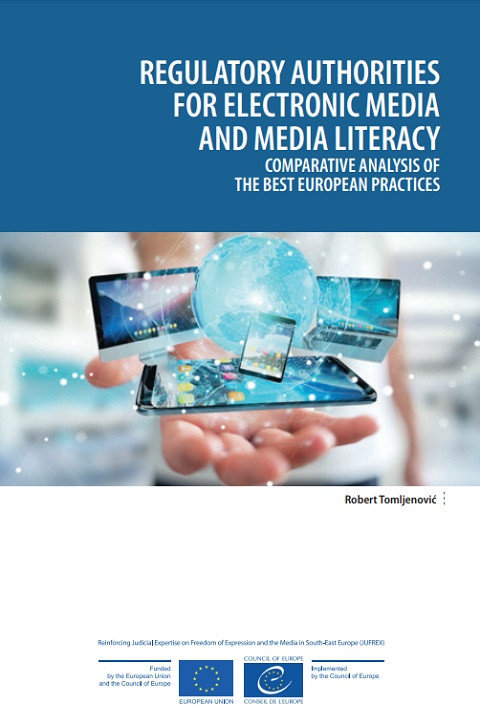 Regulatory Authorities for Electronic Media and Media Literacy: Comparative Analysis of the Best European Practices 出版年份: 2018 作者: Robert Tomljenović 机构作者: Council of Europe Information event for stakeholders of the media community in Serbia on presentation of the Study “Regulatory Authorities for Electronic Media and Media Literacy - Comparative analysis of the best European practices” was organized by the Council of Europe Office in Belgrade, JUFREX Programme and the Embassy of Finland in Serbia, on 20 December 2018, in order to jointly point out the importance of the development of media literacy in Serbia and the Western Balkans region.The study analyzes and indicates challenges and issues that come with living in a digitalized, hypertechnological mediated world, in which we are faced with countless information, issues of disinformation and fake news, algorithmic separation in ideological echo chambers, hate speech, clickbait journalism, and decreased trust in both mainstream media and the level of journalistic professionalism. With such a media ecosystem, it is vital to define the position of a regulatory authority for electronic media as well as its responsibilities and obligations, and stress the regulator's role in promoting and developing media literacy, one of the key skills for living in the 21st century and the answer to many questions and challenges that come with the modern era."The Council of Europe considers media literacy one of the main tools for strengthening media pluralism and the quality of media content. All media actors in Serbia have the responsibility to promote media literacy to enable understanding and critical analysis of content offered by traditional and digital media. Especially children have the right to a safe and stimulating media environment" said Head of the Council of Europe Office in Belgrade, Tobias Flesenkemper.The study emphasizes that a prerequisite for every democratic process is a well-informed citizen. The Study presents several examples of best European practices and how to engage regulatory bodies and all other relevant actors to increase media literacy, with a particular focus on the Finnish model in this area. Media education is implemented in Finland wherever there are children and youth, not only in kindergartens and schools, but also in libraries, playrooms, youth centers, even in virtual communities and digital games.As pointed out by the Ambassador of Finland in Belgrade, Perti Ikonen, the high level of media literacy of citizens is what the media in Finland forces to adhere to high professional standards, and basically the work of the institutions responsible for the promotion of media literacy. Finland took over the chairmanship of the Committee of Ministers of the Council of Europe in November this year, and during its term of office, until May 2019, the priorities of the Finnish Presidency will be to strengthen the human rights and rule of law system in Europe, support equality as well as inclusiveness with a particular focus on youth and the prevention of radicalization.The study was developed within the framework of the Joint European Union and the Council of Europe Programme "Strengthening the Judicial Expertise on Freedom of Expression and Media in South-East Europe (JUFREX)".
 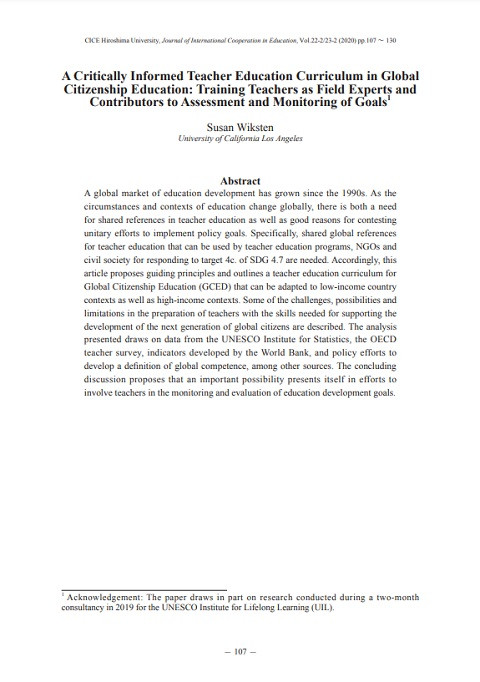 A Critically Informed Teacher Education Curriculum in Global Citizenship Education: Training Teachers as Field Experts and Contributors to Assessment and Monitoring of Goals (Journal of International Cooperation in Education; Vol.22-2/23-2) 出版年份: 2020 作者: Susan Wiksten 机构作者: CICE Hiroshima University A global market of education development has grown since the 1990s. As the circumstances and contexts of education change globally, there is both a need for shared references in teacher education as well as good reasons for contesting unitary efforts to implement policy goals. Specifically, shared global references for teacher education that can be used by teacher education programs, NGOs and civil society for responding to target 4c. of SDG 4.7 are needed. Accordingly, this article proposes guiding principles and outlines a teacher education curriculum for Global Citizenship Education (GCED) that can be adapted to low-income country contexts as well as high-income contexts. Some of the challenges, possibilities and limitations in the preparation of teachers with the skills needed for supporting the development of the next generation of global citizens are described. The analysis presented draws on data from the UNESCO Institute for Statistics, the OECD teacher survey, indicators developed by the World Bank, and policy efforts to develop a definition of global competence, among other sources. The concluding discussion proposes that an important possibility presents itself in efforts to involve teachers in the monitoring and evaluation of education development goals.
 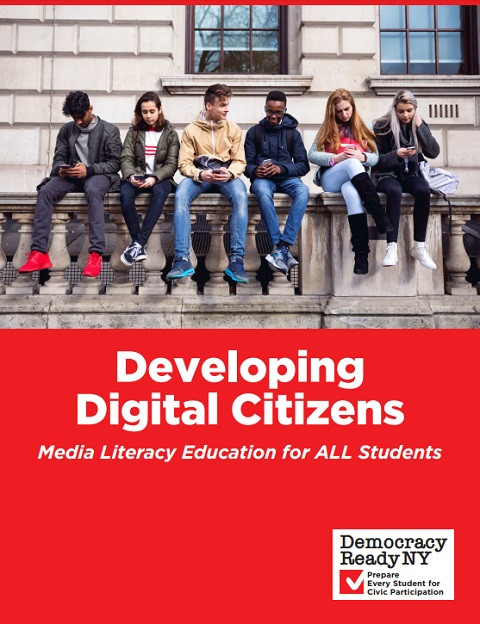 Developing Digital Citizens: Media Literacy Education for All Students 出版年份: 2020 作者: Jessica R. Wolff | Ann LoBue | Michael A. Rebell 机构作者: DemocracyReady NY Developing Digital Citizens: Media Literacy Education for All Students, a new report from DemocracyReady NY, calls for immediate and decisive steps to require media literacy education in schools throughout New York State. Stressing that “the internet has become the new public square,” it asserts that “to be democracy ready, all students must be media literate.”. The report defines what media literacy encompasses in an increasingly digital age, and establishes a clear framework to ensure that all students become media literate civic participants. This report includes recommendations for:Clear state standards for media literacy educationQualified personnel for teaching media literacySuitable MLE curricula and course offeringsUp-to-date facilities, instructional materials, and technologyTransparent monitoring and reporting of MLE resources and results.
 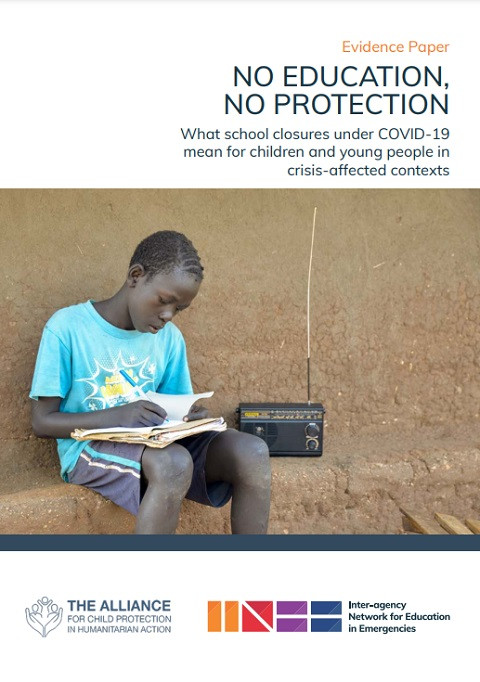 No Education, No Protection: What School Closures Under COVID-19 Mean for Children and Young People in Crisis-Affected Contexts 出版年份: 2021 机构作者: Inter-agency Network for Education in Emergencies (INEE) | Alliance for Child Protection in Humanitarian Drawing from research and experience on previous infectious disease outbreaks and an emergent body of work from the current COVID-19 pandemic, this report highlights the primarily negative effects resulting from the combination of sudden school closures and restricted access to and availability of services, social networks, and other protective facilities for children and young people living in crisis-affected contexts. The consequences of school closures on education and child protection can be categorized into three principal areas:1. Loss of learning and impediments to providing inclusive, equitable, quality education2. Negative impact on child well-being and healthy development3. Amplified child protection risks and harms experienced by children and young people
 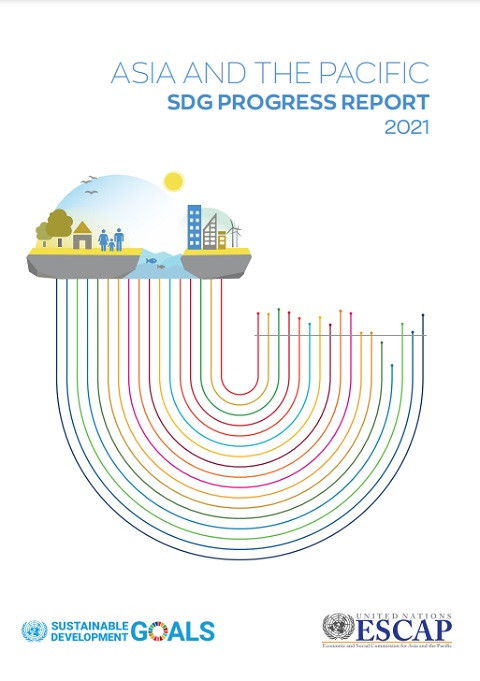 Asia and the Pacific: SDG Progress Report 2021 出版年份: 2021 机构作者: UN. Economic and Social Commission for Asia and the Pacific (UN. ESCAP) This report analyses progress towards the Sustainable Development Goals (SDGs) in Asia and the Pacific and its five subregions as well as the availability of data. It assesses gaps which must be closed to achieve the goals by 2030. This assessment is designed to ensure the region’s actions remain on target and shortcomings are addressed as they arise. It is a resource for all stakeholders involved in prioritization, planning, implementation and follow-up of the 2030 Agenda for Sustainable Development in Asia and the Pacific.
 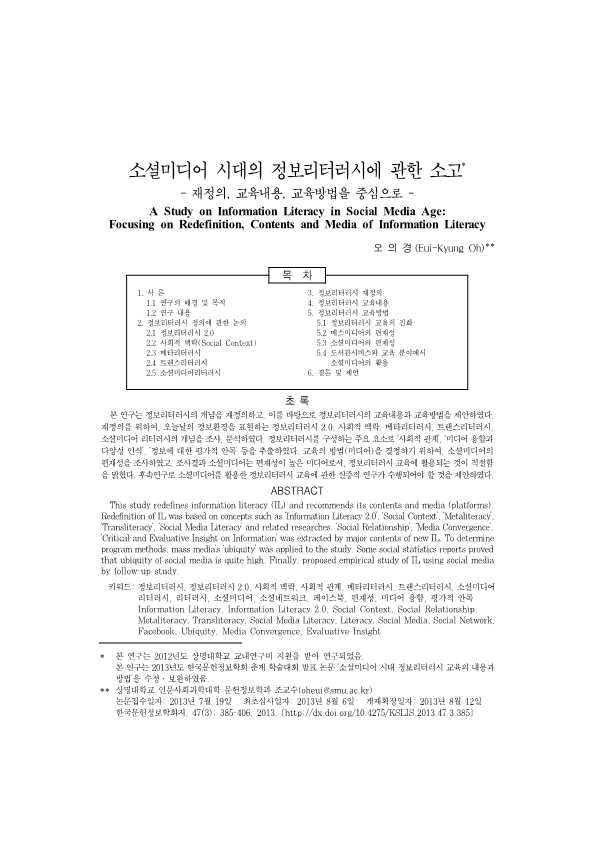 A Study on Information Literacy in Social Media Age: Focusing on Redefinition, Contents and Media of Information Literacy 出版年份: 2013 作者: Euikyung Oh 机构作者: Korean Society for Library and Information Science This study redefines information literacy (IL) and recommends its contents and media (platforms). Redefinition of IL was based on concepts such as ‘Information Literacy 2.0’, ‘Social Context’, ‘Metaliteracy’, ‘Transliteracy’, ‘Social Media Literacy’ and related researches. ‘Social Relationship’, ‘Media Convergence’, ‘Critical and Evaluative Insight on Information’ was extracted by major contents of new IL. To determine program methods, mass media’s ‘ubiquity’ was applied to the study. Some social statistics reports proved that ubiquity of social media is quite high. Finally, proposed empirical study of IL using social media by follow-up study.)
  소셜미디어 시대의 정보리터러시에 관한 소고: 재정의, 교육내용, 교육방법을 중심으로 出版年份: 2013 作者: Euikyung Oh 机构作者: Korean Society for Library and Information Science 본 연구는 정보리터러시의 개념을 재정의하고, 이를 바탕으로 정보리터러시의 교육내용과 교육방법을 제안하였다. 재정의를 위하여, 오늘날의 정보환경을 표현하는 정보리터러시 2.0, 사회적 맥락, 메타리터러시, 트랜스리터러시, 소셜미디어 리터러시의 개념을 조사, 분석하였다. 정보리터러시를 구성하는 주요 요소로 ‘사회적 관계’, ‘미디어 융합과 다양성 인식’, ‘정보에 대한 평가적 안목’ 등을 추출하였다. 교육의 방법(미디어)을 결정하기 위하여, 소셜미디어의 편재성을 조사하였고, 조사결과 소셜미디어는 편재성이 높은 미디어로서, 정보리터러시 교육에 활용되는 것이 적절함을 밝혔다. 후속연구로 소셜미디어를 활용한 정보리터러시 교육에 관한 실증적 연구가 수행되어야 할 것을 제안하였다.
 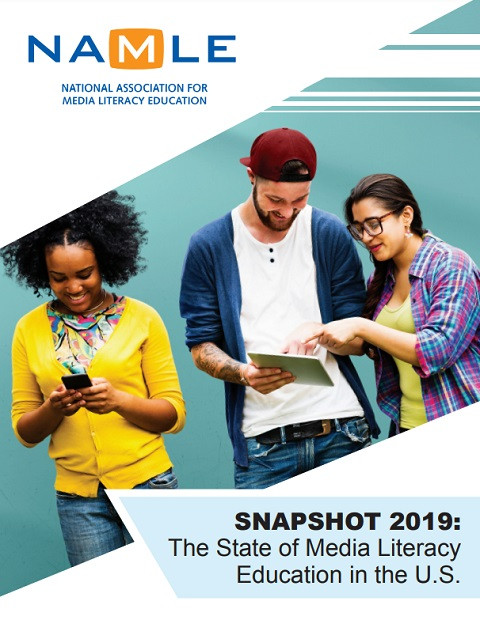 Snapshot 2019: The State of Media Literacy Education in the U.S. 出版年份: 2019 作者: Sherri Hope Culver | Theresa Redmond 机构作者: National Association for Media Literacy Education (NAMLE) Since 2015, NAMLE’s membership has grown from about 300 members to over 5,000 members, signifying a remarkable expansion of interest in and demand for media literacy education. Despite general awareness of the persuasive nature and pervasive inclusion of media in our lives, media literacy education has not been formerly prioritized in U.S. education efforts. Yet, several recent trends indicating progress and development are important to mention:– Growth– Inclusion in Standards– Legislative Involvement– AwarenessDespite broad agreement about the need to ensure that people of all ages are equipped to understand and negotiate the influence of media in their lives, the United States does not devote any significant government effort, nor funding, for media literacy education research, training, or implementation. While funding initiatives have benefits and drawbacks, decades of grassroots advocacy has not been enough to establish media literacy education as a foundational or core dimension of schooling.This SNAPSHOT is a step towards that goal.