
相关资源
探索丰富的全球公民教育资源,深化理解,促进研究、倡导、教学与学习。
共找到3,380条结果
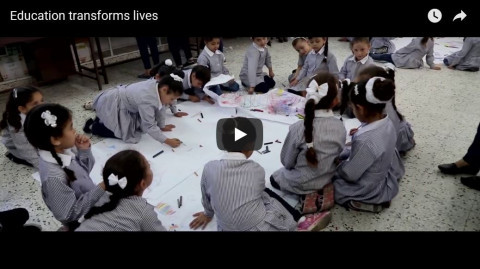 [Video] Education Transforms Lives 出版年份: 2017 机构作者: UNESCO Education transforms lives every day and in every corner of society. This video explores the power of education and UNESCO’s role in leading and coordinating the Education 2030 Agenda, which is part of a global movement to eradicate poverty through 17 Sustainable Development Goals by 2030.Education is the right of every woman, man and child. Together, we are shaping the global citizens of tomorrow, empowered on the path of education to build a more sustainable future.UNESCO's campaign "Education transforms lives" supports the effort to build peace in the minds of men and women. [Видео] Образование меняет жизни 出版年份: 2017 机构作者: Организация Объединенных Наций по вопросам образования, науки и культуры (UNESCO) Образование преображает жизнь людей каждый день во всех слоях общества. Ролик повествует о важности образования и роли ЮНЕСКО в ведении и координации Повестки дня «Образование-2030», которая является частью глобального движения для искоренения бедности посредством достижения 17 Целей устойчивого развития до 2030 года.Каждая женщина, каждый мужчина и каждый ребенок имеют право на образование. Вместе мы создаем мировых сограждан завтрашнего дня и даем им силу образования для построения более устойчивого будущего.Кампания ЮНЕСКО "Образование преображает жизнь людей" направлена на то, чтобы нести мир в сознание мужчин и женщин.
  UNESCO, UNFPA & UN Women Joint Programme: on Empowering Adolescent Girls and Young Women through Education 出版年份: 2019 机构作者: UNESCO | United Nations Population Fund (UNFPA) The Joint Programme on Empowering Adolescent Girls and Young Women through Education leverages the collective expertise, experience and networks of three United Nations agencies – UNESCO, UNFPA and UN Women.It aims to empower adolescent girls and young women aged 10 to 24 to make successful and healthy transitions into adulthood, in and through quality education.Taking a lifecycle perspective and a holistic approach, the Joint Programme strengthens the links between education, health and gender equality.
  Evaluation of UNESCO's work in information and communication technologies (ICT) in education 出版年份: 2019 作者: Seán Ó Siochru and Graham Attwell 机构作者: UNESCO ICT in Education is a fast-growing area globally that offers many strategic opportunities. As the leader and coordinator of the SDG 4 – Education 2030 with the aim to “Ensure inclusive and equitable quality education and promote lifelong learning opportunities for all”, UNESCO has the mandate and expertise needed to strategically position itself as a world leader in this field. UNESCO’s work in ICT in Education aims at enhancing the quality and relevance of learning and at strengthening inclusion. While technology can facilitate wider access to education and bridge learning divides, can advance gender equality and inclusion as well as digital skills development, the rapidly changing technologies and work processes require the development of new pedagogies, both for the use of ICT for teaching and learning in the classroom and through open access and distance learning. Compared to other players, UNESCO leverages its comparative strengths in its ICT in Education interventions - especially its impartiality, convening power, and policy expertise - through an inclusive and humanistic approach to achieving quality education in coherence with Sustainable Development Agenda 2030. Its expertise across all levels of Education and its multidisciplinary potential of working across its Programme Sectors are also considered among UNESCO’s specific strengths. The evaluation revealed that UNESCO achieved important results, at the level of the learning environment, at the policy level and in institutional capacity building, but it also showed that UNESCO still needs to strengthen its positioning and visibility within the wider landscape of ICT in Education. For example, UNESCO has to continue positioning itself for producing forward-looking knowledge on ICT in Education and as a laboratory of ideas for future-oriented thinking. While the evaluation came across various specific interventions successfully addressing the needs of disadvantaged groups, the evaluation found that considerations of inclusion and gender equality were not consistently mainstreamed into policy-related and capacity building interventions. Other challenges are mainly linked to the current dispersion of resources and fragmentation of expertise across different entities within the Organization, which also leads to reduced visibility. While the key entities active in this area recognize that they are working within a common theme, collaboration and coordination still needs to be improved. The strategic measures proposed by the evaluation towards an overall organizational framework for ICT in Education aim at establishing an enabling environment for inter- and multidisciplinary approaches and greater coherence and collaboration.
  4th Meeting of the SDG-Education 2030 Steering Committee, Paris, 28 February-02 March 2018: meeting report 出版年份: 2018 机构作者: UNESCO This report summarizes the deliberations, the main recommendations adopted, and the decisions made at the 4th meeting of the SDG-Education 2030 Steering Committee (Paris, 28 February - 2 March 2018).The objectives of the meeting were: To define positions and recommendations of the SDG-Education 2030 Steering Committee on key strategic areas. To agree on a strategy for global review, monitoring and reporting process, in view of HLPF 2018 and the 2019 Reviews. To refine the advocacy, communication and outreach strategy of the SDG-Education 2030 Steering Committee To define next steps for the SDG-Education 2030 Steering Committee (next meeting, rotation of members, and the Global Education Meeting 2018). Quatrième Réunion du Comité directeur ODD-Education 2030, Paris, 28 février-02 mars 2018: rapport de la reunion 出版年份: 2018 机构作者: Organisation des Nations Unies pour l'éducation, la science et la culture (UNESCO) Le présent rapport résume les débats qui ont eu lieu lors de la quatrième réunion du Comité directeur ODD – Éducation 2030 (Paris, 28 février – 2 mars 2018) et reprend les principales recommandations et décisions adoptées.La réunion s’était fixé les objectifs suivants : Définir les positions et les recommandations du Comité directeur ODD – Éducation 2030 dans des domaines stratégiques clés. Convenir d’une stratégie globale portant sur le processus d’examen, de suivi et d’établissement de rapports en vue de l’examen du HLPF 2018 et 2019. Affiner la stratégie du Comité directeur ODD – Éducation 2030 en matière de plaidoyer, de communication et de sensibilisation. Définir les prochaines étapes du Comité directeur ODD – Éducation 2030 (prochaine réunion, renouvellement des membres et Réunion mondiale sur l’éducation 2018).
 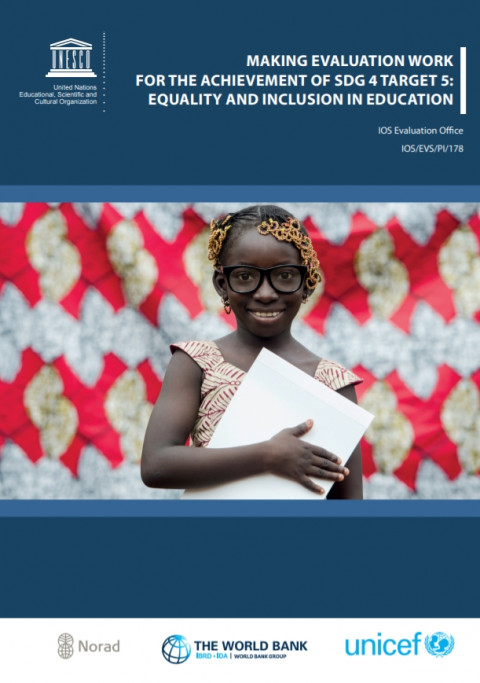 Making evaluation work for the achievement of SDG 4 target 5: equality and inclusion in Education 出版年份: 2019 机构作者: UNESCO The adoption of the Sustainable Development Goals (SDGs) and the Education 2030 Framework for Action has placed gender parity, equality and inclusion in education at the heart of the international development agenda and is specifically formulated in SDG 4 Target 5. Now, as never before, relevant and contextualised evidence, driven in part by robust evaluation data, is needed to track and strengthen progress on educational equity. To this end, a group of international organisations, led by UNESCO, have combined efforts to explore how their education evaluations can better support Member States to strengthen progress on gender parity, equality and inclusion in education. The following report synthesises evidence from publicly available independent evaluations from 13 organisations, highlighting evidence gaps and summarising ‘what works’ for whom and in what contexts for advancing gender equality and equity for vulnerable groups. The study also reports on responses to the synthesis from national stakeholders in five countries: Ghana, Guatemala, Lebanon, Nepal and Peru. The report culminates in a discussion and recommendations, which outline the need for greater coordination and collaboration in four key areas to further enhance the contribution of evaluations to global and country level progress on SDG 4 Target 5.
 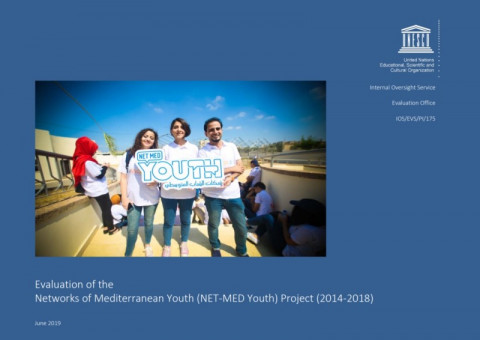 Evaluation of the Networks of Mediterranean Youth (NET-MED Youth) Project (2014-2018) 出版年份: 2019 作者: Maksymilian Fras | Yael Ohana | Kimiko Hibri Pedersen | Christophe Dietrich | Mamoun Besaiso 机构作者: UNESCO The Networks of Mediterranean Youth (NET-MED Youth) Project is a regional project funded by the European Union and implemented by UNESCO from 2014 until 2018. It followed a comprehensive approach through interdisciplinary activities in different thematic areas aimed at advancing youth legal and policy frameworks, enhancing youth representation in media, and reinforcing youth employability and skills in response to the challenges experienced by young women and men in the region regarding their transition to full autonomous citizenship in the civic, political, economic, social and cultural spheres. NET-MED Youth contributed to the creation of an enabling environment for young women and men from nine of the Southern countries of the European Neighbourhood Policy (i.e. Algeria, Israel, Jordan, Lebanon, Libya, Morocco, Palestine, Syria and Tunisia) to develop their competencies, to exercise their rights and meaningfully engage as active citizens in the development and implementation of national strategies on youth. The evaluation found that, overall, the NET-MED Youth Project was a successful initiative and created a momentum for Youth empowerment in the respective beneficiary countries. Its high relevance in the context of the Agenda 2030 resulted not least from UNESCO’s longstanding experience and good practices in working with youth organizations and youth-related stakeholders through youth engagement as partners and beneficiaries. The Project thus constituted a significant contribution to the UNESCO Operational Strategy on Youth 2014-2021. Gender equality was a central concern of NET-MED Youth, and systematically embedded throughout all activities as a transversal feature. In line with the Agenda 2030 commitment of leaving no one behind, several activities focused on issues of disadvantaged or traditionally underserved groups, such as youth with disabilities. Challenges identified are mainly related to the often difficult and in some countries unstable political environments. Together with the needs-based and rather context-specific approach in each country, this also affected to some extent the full implementation of the regional perspective. Furthermore, in the absence of a coherent and explicit longer-term exit strategy, the structures and results achieved risk not to be maintained, or scaled up over time, despite the strong local commitment and ownership created over the project duration. Through successfully incorporating youth aspirations in its design and implementation, the NET-MED Youth Project represented a new and innovative approach to youth engagement and empowerment in an interdisciplinary fashion, and should thus be considered as a basis for new thinking on which to build in the future. The high potential for replication of the NET-MED Youth Project, as a continuation or as an example of good practice for a comprehensive and interdisciplinary approach is thus to be further explored.
 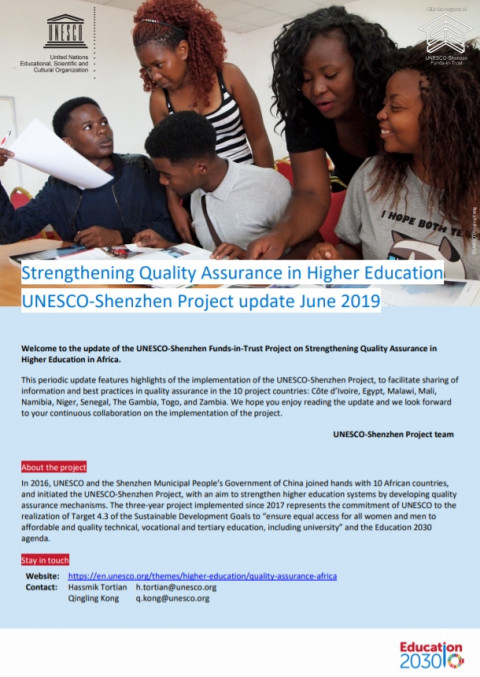 Strengthening Quality Assurance in Higher Education UNESCO-Shenzhen Project Update, June 2019 出版年份: 2019 机构作者: UNESCO In 2016, UNESCO and the Shenzhen Municipal People’s Government of China joined hands with 10 African countries, and initiated the UNESCO-Shenzhen Project, with an aim to strengthen higher education systems by developing quality assurance mechanisms. The three-year project implemented since 2017 represents the commitment of UNESCO to the realization of Target 4.3 of the Sustainable Development Goals to “ensure equal access for all women and men to affordable and quality technical, vocational and tertiary education, including university” and the Education 2030 agenda.
 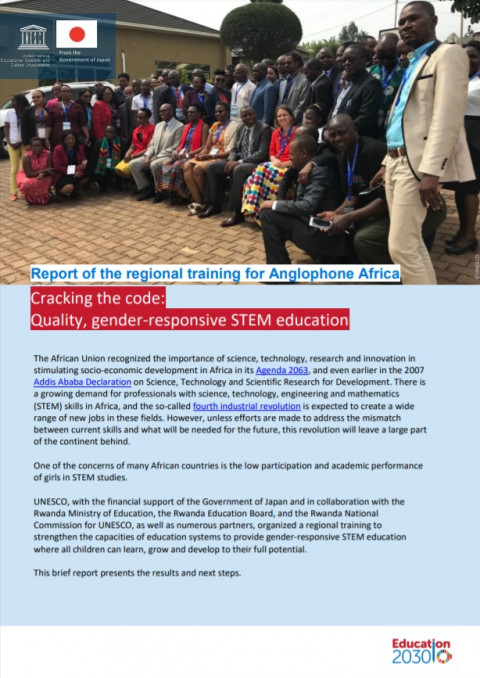 Report of the regional training for Anglophone Africa, Cracking the code: quality, gender-responsive STEM education 出版年份: 2019 机构作者: UNESCO The African Union recognized the importance of science, technology, research and innovation in stimulating socio-economic development in Africa in its Agenda 2063, and even earlier in the 2007 Addis Ababa Declaration on Science, Technology and Scientific Research for Development. There is a growing demand for professionals with science, technology, engineering and mathematics (STEM) skills in Africa, and the so-called fourth industrial revolution is expected to create a wide range of new jobs in these fields. However, unless efforts are made to address the mismatch between current skills and what will be needed for the future, this revolution will leave a large part of the continent behind. One of the concerns of many African countries is the low participation and academic performance of girls in STEM studies. UNESCO, with the financial support of the Government of Japan and in collaboration with the Rwanda Ministry of Education, the Rwanda Education Board, and the Rwanda National Commission for UNESCO, as well as numerous partners, organized a regional training to strengthen the capacities of education systems to provide gender-responsive STEM education where all children can learn, grow and develop to their full potential. This brief report presents the results and next steps.