
相关资源
探索丰富的全球公民教育资源,深化理解,促进研究、倡导、教学与学习。
共找到1,402条结果
 Le guide du changement climatique démarreur: un guide de questions pour les planificateurs de l'éducation et des praticiens 出版年份: 2011 作者: Alejandro Deeb | Amber French | Julia Heiss | Jason Jabbour | Dominique LaRochelle | Arkadiy Levintanus | Anna Kontorov | Rummukainen Markku | Gerardo Sanchez Martinez | Rosalyn McKeown | Nicolay Paus | Antoine Pecoud | Guillaume Pénisson | Daniel Puig | Vanessa Retana | Serban Scrieciu | Morgan Strecker | Vimonmas Vachatimanont | Benjamin Witte | Noriko Yamada. 机构作者: United Nations Environment Programme (UNEP) Le guide du changement de démarrage climatique fournit une introduction et un aperçu des planificateurs de l'éducation et de praticiens sur le large éventail de questions relatives au changement climatique et éducation au changement climatique, y compris les causes, les impacts, l'atténuation et les stratégies d'adaptation, ainsi que certains grands principes politiques et économiques. Le but de ce guide est de servir de point de départ pour l'intégration de l'éducation au changement climatique dans les programmes scolaires. Il a été créé pour permettre aux planificateurs de l'éducation et les praticiens à comprendre les questions à portée de main, pour examiner et analyser leur pertinence pour des contextes nationaux et locaux, et de faciliter le développement des politiques d'éducation, des programmes, des programmes et des plans de leçon.Le guide couvre quatre grands domaines thématiques: 1. La science du changement climatique, ce qui explique les causes et les changements observés; 2. les aspects sociaux et humains du changement climatique, y compris le sexe, la santé, la migration, la pauvreté et l'éthique; 3. les réponses politiques aux changements climatiques, y compris les mesures d'atténuation et d'adaptation; et 4. approches éducatives, y compris l'éducation pour le développement durable, la prévention des catastrophes et de modes de vie durables. Une sélection de ressources clés sous forme de titres de publications ou sites web pour davantage de lecture est fourni après chacune des sections thématiques. L'Organisation des Nations Unies pour l'éducation, la science et (UNESCO) fournit son expertise et son savoir-faire dans des domaines tels que l'éducation, la culture et les sciences sociales. En particulier, l'UNESCO met l'aCECnt sur le rôle de l'éducation à l'appui de l'adaptation au changement climatique et l'atténuation dans la fourniture de compétences et de capacités mais aussi à travers l'élaboration des valeurs, des attitudes et des comportements nécessaires pour mettre le monde sur une voie plus durable. Le Programme des Nations Unies pour l'Environnement (PNUE) travaille avec les pays pour renforcer leur capacité d'adaptation au changement climatique, se déplacer vers une croissance faible en carbone, la réduction des émissions dues à la déforestation et à la dégradation des forêts, d'améliorer la compréhension de la science du climat, et de sensibiliser le public au changement climatique . Le PNUE aide les pays à saisir les opportunités de progresser vers une croissance à faible émission de carbone, tout en améliorant la santé humaine et le bien-être, la création d'emplois verts et avancer vers une économie verte. Avec cette publication, les deux organisations se sont engagées dans une collaboration sur le changement climatique éducation que nous sommes déterminés à bâtir sur et en expansion dans la période à venir. Water education for sustainable development: a global synthesis 出版年份: 2012 机构作者: International Hydrological Programme (IHP) Water education is key to achieve the water related MDGs. While there is a range of materials and projects focusing on water-related education, these are not well connected to offer customised solutions to individual countries. Some of the limitations identified with the existing water education include use of outdated, biased or irrelevant information; poor medium of instruction; lack of continuity between different levels of water education; lack of integration with the wider curriculum and with local knowledge; lack of practical relevance to local and community needs; lack of resources; and poor linkages with locally available professional bodies. The programme on “Water Education” is an initiative of the International Hydrological Programme (IHP) of UNESCO, Water and Sustainable Education focused on an integrated understanding of biological and hydrological processes at a catchment’s scale in order to create a scientific basis for a new, cost-effective and systemic approach to the sustainable management of freshwater resources. L'éducation relative à l'eau pour le développement durable: une synthèse globale 出版年份: 2012 机构作者: International Hydrological Programme (IHP) L'éducation relative à l'eau est essentielle pour atteindre les OMD(Objectifs du Millénaire pour le Développement) liées à l'eau. Bien qu'il existe toute une gamme de matériels et de projets axés sur l'éducation relative à l'eau, ceux-ci ne sont pas bien reliés pour offrir des solutions personnalisées à chaque pays. Certaines des limitations identifiées avec l'éducation en matière d'eau existante incluent l'utilisation d'information périmée, biaisée ou non pertinente; Milieu pauvre d'instruction; Manque de continuité entre les différents niveaux de l'éducation relative à l'eau; Le manque d'intégration avec le programme d'études plus large et avec les connaissances locales; Manque de pertinence pratique pour les besoins locaux et communautaires; manque de ressources; Et les faibles liens avec les organismes professionnels disponibles sur place. Le programme sur l'éducation à l'eau est une initiative du Programme Hydrologique International (PHI) de l'UNESCO, Eau et éducation durable, axé sur une compréhension intégrée des processus biologiques et hydrologiques à l'échelle d'un bassin versant afin de créer une base scientifique pour une nouvelle, Rentable et systémique de la gestion durable des ressources en eau douce. Address by Irina Bokova, Director-General of UNESCO, on the occasion of Ministerial Breakfast Meeting: Scaling up Action on Education for Sustainable Development; UNESCO, 8 November 2013 出版年份: 2013 作者: UNESCO. Director-General, 2009-2017 (Bokova, I.G.) 机构作者: UNESCO. Director-General, 2009-2017 (Bokova, I.G.) This address was given by Irina Bokova, Director-General of UNESCO, on the occasion of Ministerial Breakfast Meeting "Scaling up Action on Education for Sustainable Development." Discours de Mme Irina Bokova, Directrice générale de l'UNESCO, à l'occasion de la ministérielle Petit-déjeuner: étendre l'action sur l'éducation pour le développement durable; UNESCO, le 8 Novembre 2013 出版年份: 2013 作者: UNESCO. Director-General, 2009-2017 (Bokova, I.G.) 机构作者: UNESCO. Director-General, 2009-2017 (Bokova, I.G.) Cette adresse a été donnée par Irina Bokova, Directrice générale de l'UNESCO, à l'occasion de la Ministérielle Petit-déjeuner «Amplifier Action sur l'Éducation pour le Développement Durable. »
  Green School Quality Standard: Greening Every Learning Environment 出版年份: 2024 机构作者: UNESCO Climate change threatens our planet and future. Schools and other learning institutions are central places for accelerating climate action among learners and local communities. By empowering teachers and students to understand climate change in their own context contribute to making societies more sustainable and climate resilient. This publication provides for the first time ever a quality standard for greening schools and other learning environments. It outlines four core areas for integrating sustainability principles and climate action: 1) school governance, 2) facilities and operation, 3) teaching and learning, and 4) community engagement. Through the Greening Education Partnership, this standard establishes a common language for all stakeholders to jointly reach the global target of greening at least 50% of schools in all countries by 2030. Policy-makers and ministries in charge of education accreditation schemes, as well as educators, learners and communities are encouraged to use the green school quality standard and join the climate-ready school movement to ensure that every learner is equipped to address climate challenges. Normes de qualité des écoles vertes: pour des cadres d’apprentissage verts 出版年份: 2024 机构作者: UNESCO Le changement climatique menace notre planète et notre avenir. Les écoles et autres institutions d'apprentissage sont des lieux centraux pour accélérer l'action climatique parmi les apprenants et les communautés locales. En donnant aux enseignants et aux élèves les moyens de comprendre le changement climatique dans leur propre contexte, ils contribuent à rendre les sociétés plus durables et plus résilientes face au climat. Cette publication fournit pour la première fois une norme de qualité pour la « vérdisation » des écoles et autres environnements d'apprentissage. Elle présente quatre domaines clés pour intégrer les principes de durabilité et l'action climatique : 1) la gouvernance scolaire, 2) les infrastructures et l'exploitation, 3) l'enseignement et l'apprentissage, et 4) l'engagement communautaire. Grâce au Partenariat pour une éducation verte, cette norme établit un langage commun pour tous les acteurs afin d'atteindre ensemble l'objectif mondial de verdir au moins 50 % des écoles dans tous les pays d'ici 2030. Les décideurs politiques et les ministères responsables des schémas d'accréditation éducatifs, ainsi que les éducateurs, les apprenants et les communautés, sont encouragés à utiliser la norme de qualité des écoles vertes et à rejoindre le mouvement des écoles prêtes pour le climat, afin de garantir que chaque apprenant soit équipé pour relever les défis climatiques. Предлагаемая тематическая программа по образованию в области водных ресурсов в рамках Десятилетия образования в интересах устойчивого развития ООН (ДОУР, 2005-2014 ГГ.) 出版年份: 2006 机构作者: International Hydrological Programme (IHP) Water education is a very important component of UNESCO’s overall effort in water, including within the International Hydrological Programme. The UNESCO Executive Board has called for a UNESCO-wide strategy for water education at all levels. This document reviews the evolution of water education within UNESCO, and draws attention to the Draft Action Plan for the UN Decade on Education for Sustainable Development (DESD), which includes 12 Thematic Programmes one of which would be devoted to “Education for Sustainable Water Management”. The IHP would be expected to play an important role in such a UNESCO-wide effort for water education.
 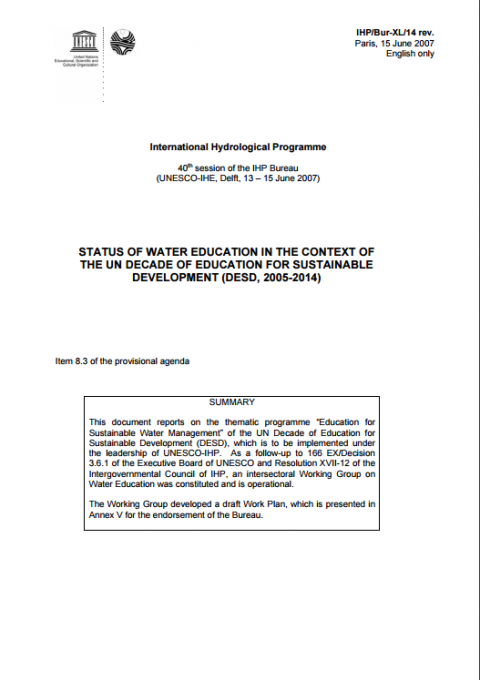 Status of water education in the context of the UN Decade of Education for Sustainable Development (DESD, 2005-2014) 出版年份: 2007 机构作者: International Hydrological Programme (IHP) This document reports on the thematic programme “Education for Sustainable Water Management” of the UN Decade of Education for Sustainable Development (DESD), which is to be implemented under the leadership of UNESCO-IHP. As a follow-up to 166 EX/Decision 3.6.1 of the Executive Board of UNESCO and Resolution XVII-12 of the Intergovernmental Council of IHP, an intersectoral Working Group on Water Education was constituted and is operational. The Working Group developed a draft Work Plan, which is presented in Annex V for the endorsement of the Bureau. Situation de l'éducation relative à l'eau dans le contexte de la Décennie des Nations Unies pour l'éducation au service du développement durable (DEDD, 2005-2014) 出版年份: 2007 机构作者: International Hydrological Programme (IHP) Ce document rend compte du programme thématique «Education pour une gestion durable de l'eau» de la Décennie des Nations Unies pour l'éducation au service du développement durable (DEDD), qui sera mis en œuvre sous la direction du PHI de l'UNESCO. Conformément à la décision 166 EX / 3.6.1 du Conseil exécutif de l'UNESCO et à la Résolution XVII-12 du Conseil intergouvernemental du PHI, un groupe de travail intersectoriel sur l'éducation relative à l'eau a été créé et est opérationnel. Le groupe de travail a élaboré un projet de plan de travail qui est présenté à l'annexe V pour approbation par le Bureau.