
相关资源
探索丰富的全球公民教育资源,深化理解,促进研究、倡导、教学与学习。
共找到3,790条结果
 La enseñanza del Holocausto en América Latina - Los desafios para los educadores y legisladores 出版年份: 2015 机构作者: Organisation des Nations Unies pour l'éducation, la science et la culture (UNESCO) L'Holocauste est devenu un point de référence dans le monde entier afin de sensibiliser sur les violations des droits de l'homme et de la violence de l'État. Quelle est l'importance de l'enseignement de l'Holocauste dans les régions du monde qui ont aucun rapport direct avec l'histoire du peuple juif et les crimes du nazisme, en particulier en Amérique latine? Y at-il une augmentation des pratiques éducatives pertinentes au niveau international en raison de l'expansion de l'éducation sur l'Holocauste? Comment les enseignants peuvent aborder un sujet si complexe et chargé d'émotion dans l'évolution des sociétés multiculturelles? Cette publication de l'UNESCO rassemble les contributions d'historiens et éducateurs du monde entier et les cadres débats actuels dans le domaine importants, en insistant sur les questions que les éducateurs en Amérique latine sont confrontés et révéler les raisons pour lesquelles il est essentiel de continuer à enseigner l'histoire de l'Holocauste dans le monde aujourd'hui , peu importe où nous vivons. (Par l'éditeur - traduction)
  Collection des meilleures pratiques en éducation pour une citoyenneté mondiale en Afrique centrale 出版年份: 2015 机构作者: UNESCO This collection of best practices in human rights education in Central Africa and Ethiopia was prepared in order to respond to UNESCO’s demand to promote such initiatives and to ensure a multiplier effect considering human rights education in the region. The objective is to support the concept of UNESCO’s ‘Global Citizenship Education’ in the field of human rights education in identifying its best practices. In order to identify the best practices, UNESCO’s activities in the field of human rights education in the region were mapped out. This mapping out has shown big differences in implementing the initiatives focused on achieving global citizenship education through human rights education, particularly in primary and secondary education, as indicated in the first phase of the World Programme for human rights education. Nevertheless, various initiatives collected are either conducted/supported by UNESCO or not, in terms of three themes: citizenship education, intercultural dialogue, and the peace and security which are considered to be relevant to Africa in general and particularly to Central Africa, in order to address the main theme of global citizenship education. The selected best practices deal with the tertiary level and are in line with the second phase of the World Programme for human rights education, covering the period between 2009 and 2014 and focusing on higher and vocational education. The practices include 1) citizenship education which supports the principles set out in the Universal Declaration of Human Rights and which is reiterated in the two phases of the World Programme for human rights education, 2) the intercultural dialogue which supports education for understanding and evaluating unity in diversity, and which fits well with the objectives of the UN Decade of Education for Sustainable Development proclaimed by the UN General Assembly and managed by UNESCO, and 3) education for peace and security.It is obvious that many linkages exist among the three subjects mentioned above. Therefore, the examples presented in this collection can affect one or several problems. Each example is presented with the following sequence: identification, background, implementation, and results.
 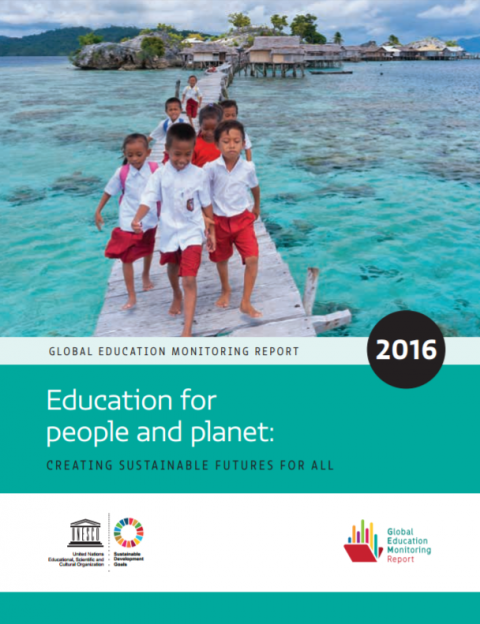 Education for People and Planet: Creating Sustainable Futures for All, Global Education Monitoring Report, 2016 出版年份: 2016 机构作者: UNESCO | Global Education Monitoring Report Team Education for People and Planet: Creating Sustainable Futures for All explores the complex relationship between education and the new 2030 Agenda for Sustainable Development, covering six fundamental pillars – Planet, Prosperity, People, Peace, Place and Partnerships. This report shows that education will not deliver its full potential unless participation rates increase dramatically and sustainable development guides education system reform. It also warns of the destructive impact that climate change, conflict, unsustainable consumption and the increasing gap between rich and poor have on education. A huge transformation is needed if we are to create sustainable futures for all.
 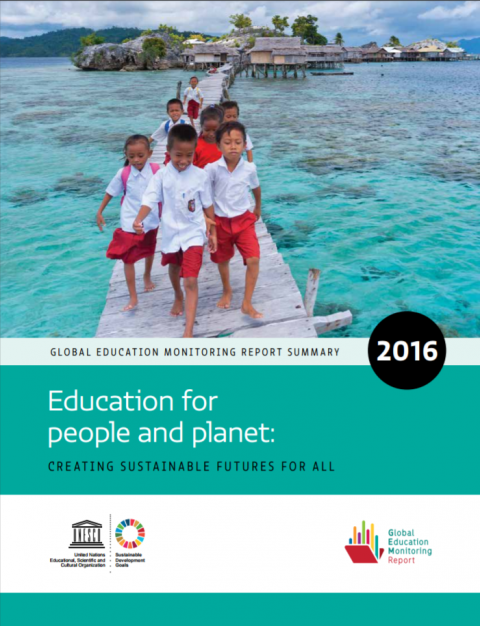 [Summary] Education for People and Planet: Creating sustainable Futures for All, Global Education Monitoring Report, 2016; Summary 出版年份: 2016 机构作者: UNESCO Education for People and Planet: Creating Sustainable Futures for All explores the complex relationship between education and the new 2030 Agenda for Sustainable Development, covering six fundamental pillars – Planet, Prosperity, People, Peace, Place and Partnerships. This report shows that education will not deliver its full potential unless participation rates increase dramatically and sustainable development guides education system reform. It also warns of the destructive impact that climate change, conflict, unsustainable consumption and the increasing gap between rich and poor have on education. A huge transformation is needed if we are to create sustainable futures for all.
  [Резюме] Подотчетность в образовании: выполнение обязательств. Резюме всемирного доклада по мониторингу образования 出版年份: 2017 机构作者: Организация Объединенных Наций по вопросам образования, науки и культуры (UNESCO) Во второй публикации из серии Всемирного доклада по мониторингу образования (ВДМО) за 2017 год был продолжен анализ прогресса в достижении цели в области устойчивого развития, касающейся образования (ЦУР 4) и выполнения десяти предусмотренных в рамках этой цели задач. Кроме этого, задач, связанных с образованием и включенных в Повестку дня в области устойчивого развития.Наряду с этим в документе рассматриваются аспекты, касающиеся подотчетности в сфере образования, в частности, анализируются возможности повышения всеми вовлеченными сторонами эффективности, действенности и справедливости предоставляемых образовательных услуг. Доклад включает обзор различных механизмов, используемых для обеспечения подотчетности правительств, школ, учителей, родителей, международных организаций и частных структур в интересах всеохватности, справедливости и качества образования.На основе оценки эффективности подходов, существующих в вопросах подотчетности, и анализа внешних факторов, которые могут влиять на эту эффективность, в ВДМО 2017/18 гг. были сформулированы конкретные рекомендации, направленные на укрепление систем образования. [요약본] 교육의 책무성: 우리의 공약을 어떻게 이행할 것인가; 세계 교육 현황 보고서 2017/8 出版年份: 2017 机构作者: 유네스코 두 번째로 발간되는 세계 교육 현황 보고서는 유엔 지속가능발전목표의 교육 목표를 향한 전 세계적 이행 현황에 대한 최신 증거를 제시합니다.여전히 수억 명의 사람들이 학교에 다니지 못하고, 많은 이들이 학교에서 최소한의 기술을 습득하지 못하고 있습니다. 이것은 현 교육 시스템이 글로벌 목표를 달성하기 위한 올바른 방향으로 나아가지 못하고 있음을 나타냅니다. 현재 소외 계층이 이러한 여파를 가장 크게 받고 있지만, 정책 입안자가 이들의 필요에 충분히 주의를 기울인다면 이들이 가장 큰 혜택을 받을 수도 있습니다. 이러한 과제에 직면해 있고 예산 부족 및 돈에 합당한 결과 지향적 가치의 강조에 어려움을 겪고 있는 국가들은 해결책을 모색하고 있습니다. 대부분의 경우 책무성 증진이 최우선 해결책으로 명시되고 있습니다.2017/8 세계 교육 현황 보고서 요약본은 교육의 책무성에 대한 모든 접근법을 보여 줍니다. 이 보고서는 책무성에 대한 개념이 낯선 국가 및 교육에 대한 권리 침해가 문제시 되지 않는 국가에서부터 책무성이 그 자체로 포괄적이고 공평한 양질의 교육과 평생 학습을 위한 수단이 아닌 목적이 된 국가까지를 포괄합니다.본 보고서는 교육이 공동의 책임이라는 점을 강조합니다. 교육에 대한 기본적인 책임은 정부에 있지만, 학교, 교사, 학부모, 학생, 국제기구, 민간 부문 제공자, 시민사회 및 미디어 등 모든 주체는 교육제도 향상을 위한 역할을 지닙니다. 본 보고서는 투명성과 정보 가용성의 중요성을 강조하지만 자료 사용 방법에 대한 주의를 촉구합니다. 협소하게 정의된 결과와 처벌적 제재에 대한 불균형적 집중은 책무성 시스템을 회피하게 만드는 경우를 만듭니다. 여러 책무성 도구들이 존재하는 시대에 본 보고서는 어떠한 도구가 효과가 있고 그렇지 않은지에 대한 분명한 증거를 제시하고 있습니다. Innovative practices of youth participation in media: a research study on twelve initiatives from around the developing and underdeveloped regions of the world 出版年份: 2006 作者: Sanjay Asthana 机构作者: UNESCO This book will be useful as a research and reference guide to community-based media centres, media education practitioners, non-governmental organizations, policy-makers, planners, media professionals, social activists, researchers, etc. A direct contribution of the book are the several examples that can be adapted and/or replicated by various initiatives as they embark on building youth media programmes around the world. Les pratiques innovantes de la participation des jeunes dans les médias: une étude de recherche sur les douze initiatives du monde en développement et régions sous-développées du monde 出版年份: 2006 作者: Sanjay Asthana 机构作者: Organisation des Nations Unies pour l'éducation, la science et la culture (UNESCO) Ce livre sera utile en tant que guide de recherche et de référence aux centres communautaires multimédias, les professionnels des médias de l'éducation, les organisations non-gouvernementales, les décideurs, les planificateurs, les professionnels des médias, des activistes sociaux, des chercheurs, etc. Une contribution directe du livre sont les quelques exemples qui peuvent être adaptés et / ou reproduits par diverses initiatives qui se lancent dans la création de programmes de médias de la jeunesse dans le monde entier.
 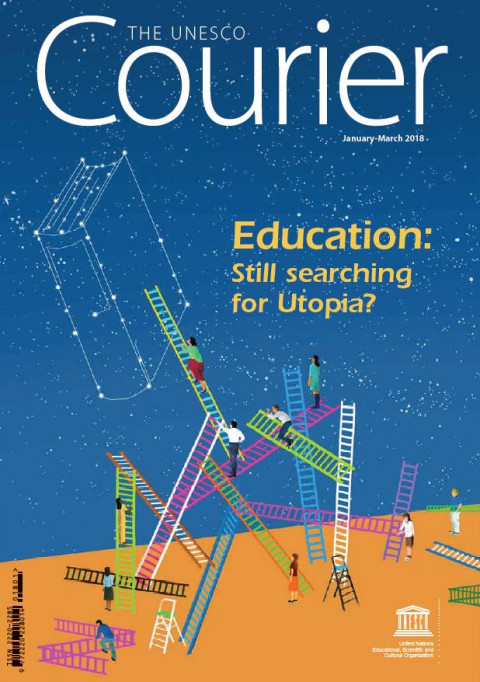 Education: Still Searching for Utopia? (The UNESCO Courier no. 1, January-March 2018) 出版年份: 2018 机构作者: UNESCO At a time of heightened global tension, when human rights, freedom of speech, peace and the future of the planet itself may seem challenged as never before, the transformational power of education is of critical importance.In Learning: The Treasure Within, the landmark Report to UNESCO by the International Commission on Education for the Twenty-first Century in 1996, Jacques Delors, then Chairman of the Commission (1992 to 1996), spoke of education as “the necessary Utopia” and “an indispensable asset in its attempt to attain the ideals of peace, freedom and social justice.”Education was held up as neither miracle nor magic, but rather the best means to foster a climate where humanity would be improved −. and where the rich potential for learning, inherent in every individual, would be tapped. Our humanity is confronted with a very strange paradox: the world’s population has never been better educated, and yet, according to the UNESCO Institute for Statistics, 263 million children and young people are out of school, 617 million children and adolescents worldwide do not meet the minimum threshold for literacy and mathematics, at least 750 million adults are illiterate, and girls remain more likely than boys to never set foot in a classroom. Yet education is still called upon to address inequalities, poverty, terrorism and conflict. It is seen as one of the keys to global citizenship and sustainable development, two of UNESCO’s fields of action. The Organization is also mandated to lead the Education 2030 global agenda with a special focus on ensuring that no one is left behind. Under the title, “Education: Still searching for Utopia?”, the UNESCO Courier evaluates the state of global education and explores how it responds to some of the main challenges we face. Education: en quête d'une utopie nécessaire (Le Courrier de l’UNESCO no. 1, Janvier-Mars 2018) 出版年份: 2018 机构作者: Organisation des Nations Unies pour l'éducation, la science et la culture (UNESCO) À une époque où la tension ne cesse de croître, où les droits de l'homme, la liberté d'expression, la paix et l'avenir de la planète semblent plus que jamais remis en question, le pouvoir de transformation véhiculé par l'éducation revêt une importance cruciale.L’éducation est une « utopie nécessaire », elle est « un atout indispensable pour permettre à l’humanité de progresser vers les idéaux de paix, de liberté et de justice sociale », lit‑on dans le rapport historique de l’UNESCO, L’éducation : un trésor est caché dedans, élaboré par la Commission internationale sur l'éducation pour le XXIe siècle, présidée en 1996 par Jacques Delors.L'éducation n'y est présentée ni comme miracle, ni comme baguette magique, mais comme le meilleur moyen de favoriser un climat permettant à l'humanité de s’améliorer.Notre humanité est confrontée à un paradoxe très étrange : la population mondiale n’a jamais été aussi instruite, alors que, selon l’Institut de statistiques de l’UNESCO, 263 millions d’enfants et de jeunes ne sont pas scolarisés, que 617 millions d’enfants et d’adolescents dans le monde n’atteignent pas le seuil minimal de compétence en lecture et en mathématiques, qu’au moins 750 millions d’adultes sont analphabètes, et que les filles demeurent plus susceptibles que les garçons de ne jamais mettre les pieds dans une classe. Cependant l’éducation est toujours appelée à remédier aux inégalités, à la pauvreté, au terrorisme et aux conflits. Elle est considérée comme une des clés essentielles de la citoyenneté mondiale et du développement durable, deux domaines d’action de l’UNESCO, qui a aussi pour mandat de diriger l’agenda mondial Éducation2030 en veillant tout particulièrement à ce que personne ne soit laissé pour compte.Sous le titre « Éducation : en quête d'une utopie nécessaire », Le Courrier de l'UNESCO porte un regard panoramique sur l'éducation dans le monde et explore comment elle peut répondre à certains grands défis.