
相关资源
探索丰富的全球公民教育资源,深化理解,促进研究、倡导、教学与学习。
共找到3,376条结果
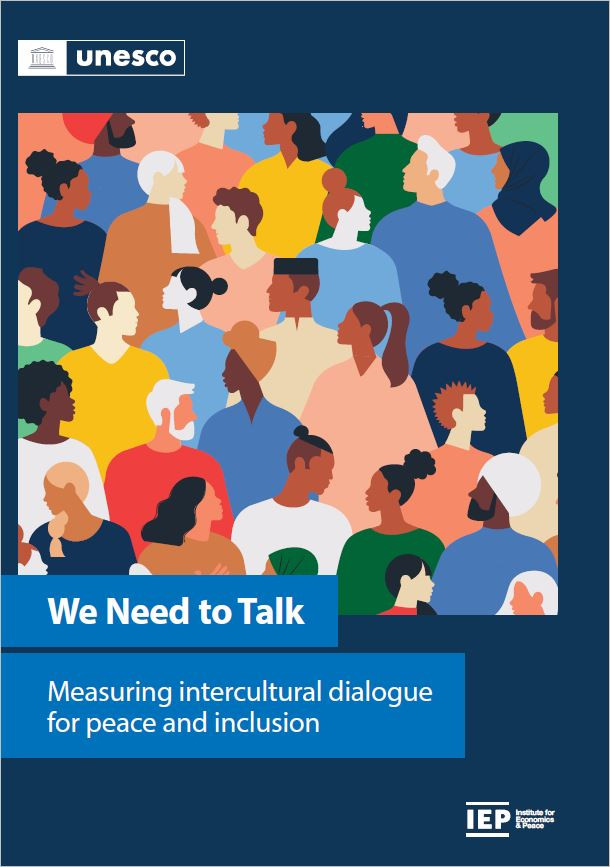 We Need to Talk: Measuring Intercultural Dialogue for Peace and Inclusion 出版年份: 2022 机构作者: UNESCO | Institute for Economics and Peace An analysis into the power of intercultural dialogue and the new UNESCO Framework for Enabling Intercultural Dialogue, We Need to Talk presents the first evidence of the link between intercultural dialogue and peace, conflict prevention and non-fragility, and human rights. Using data covering over 160 countries in all regions, the report presents a framework of the structures, processes and values needed to support intercultural dialogue, examining the dynamics and interlinkages between them to reveal substantial policy opportunities with broad spanning benefits. Providing policy support and guidance, the report also includes information on regional trends as well as deep diving case studies.The data, case studies, and think pieces contained in this report highlight key policy and intervention opportunities for intercultural dialogue as an instrument for inclusion, peace and wider societal benefits. Policy makers, development workers, peace and security actors, academics and more are invited to leverage the analysis in this report and findings of the Framework to strengthen intercultural dialogue around the world. Parlons-en : mesurer le dialogue interculturel pour la paix et l’inclusion 出版年份: 2022 机构作者: Organisation des Nations Unies pour l'éducation, la science et la culture (UNESCO) | Institute for Economics and Peace Parlons-en ! Alors que le monde devient de plus en plus interconnecté, l’amélioration des capacités à engager et à mener un dialogue efficace est nécessaire afin de relever les défis mondiaux. Actuellement, 1,5 milliard de personnes vivent dans des pays où le dialogue interculturel est faible et où les enjeux mondiaux tels que la pauvreté absolue, le terrorisme et les déplacements forcés de population sont plus répandus. Pour forger une coopération efficace et maintenir la paix, le renforcement du dialogue interculturel doit être une priorité.Pour la première fois, Parlons-en présente des preuves empiriques du lien entre le dialogue interculturel et la paix, la prévention de conflits, la non-fragilité, ainsi que les droits de l'Homme. En s'appuyant sur les données innovantes du nouveau Cadre de l'UNESCO pour favoriser le dialogue interculturel, ce rapport met en évidence les principales politiques et opportunités d'intervention pour le dialogue interculturel en tant qu'instrument d'inclusion et de paix.À l'aide de données couvrant plus de 160 pays dans toutes les régions, le rapport présente un cadre des structures, des processus et des valeurs nécessaires pour soutenir le dialogue interculturel, en examinant les dynamiques et les liens entre eux pour révéler des opportunités politiques substantielles aux avantages étendus.Les décideurs politiques, les agents de développement, les acteurs de la paix et de la sécurité, les universitaires et bien d'autres sont invités à tirer parti de l'analyse de ce rapport et des conclusions du Cadre pour renforcer le dialogue interculturel à travers le monde.Ensemble, parlons-en !
  Reimaginar juntos nuestros futuros: un nuevo contrato social para la educación 出版年份: 2021 机构作者: International Commission on the Futures of Education | UNESCO Nuestra humanidad y el planeta Tierra están bajo amenaza. La pandemia solo ha servido para demostrar nuestra fragilidad y nuestra interconexión. Ahora se necesita una acción urgente, tomada en conjunto, para cambiar el rumbo y reimaginar nuestro futuro. Este informe de la Comisión Internacional sobre el Futuro de La educación reconoce el poder de la educación para generar cambios profundos. Nos enfrentamos al doble desafío de cumplir la promesa incumplida de garantizar el derecho a una educación de calidad para todos los niños, niñas, jóvenes y adultos y realizar plenamente el potencial transformador de la educación como vía para futuros colectivos sostenibles Para ello, necesitamos un nuevo contrato social para la educación que pueda reparar las injusticias mientras transforma el futuro. Este nuevo contrato social debe fundamentarse en los derechos humanos y basarse en los principios de no discriminación, justicia social, respeto por la vida, la dignidad humana y la diversidad cultural. Debe abarcar una ética del cuidado, la reciprocidad y la solidaridad. Debe fortalecer la educación como un esfuerzo público y un bien común. Este informe, que se preparó durante dos años y se basó en un proceso de consulta global en el que participaron alrededor de un millón de personas, invita a los gobiernos, instituciones, organizaciones y ciudadanos de todo el mundo a forjar un nuevo contrato social para la educación que nos ayudará a construir un futuro pacífico, justo y futuros sostenibles para todos. Las visiones, principios y propuestas que aquí se presentan son meramente un punto de partida. Traducirlos y contextualizarlos es un esfuerzo colectivo. Ya existen muchos puntos brillantes. Este informe intenta capturarlos y construir sobre ellos. No es ni un manual ni un anteproyecto, sino la apertura de una conversación vital. Repenser nos futurs ensemble: Un nouveau contrat social pour l'éducation 出版年份: 2021 机构作者: International Commission on the Futures of Education | UNESCO L’avenir de l’humanité sur la planète est, nous le savons aujourd’hui, compromis. La pandémie a eu au moins le mérite de démontrer combien nos existences sont fragiles et combien nos destins sont inextricablement liés. Il est nécessaire et urgent désormais, d’agir collectivement pour changer de cap et réinventer notre avenir. Dans ce tournant, l’éducation jouera un rôle crucial pour sa capacité, universellement reconnue, à provoquer le changement. Mais pour jouer son rôle, elle devra surmonter un double défi : honorer, d’une part, sa plus vieille promesse, c’est-à-dire d’être effective et d’assurer le droit à une éducation de qualité pour chaque enfant, chaque jeune, chaque adulte partout à travers le monde ; et, d’autre part, assumer entièrement son potentiel transformateur, afin d’ouvrir la voie vers un avenir collectif durable. Pour y parvenir, il convient de s’engager dans un nouveau contrat social pour l’éducation, qui permette de corriger les injustices tout en transformant l’avenir.Ce nouveau contrat social doit être enraciné dans les droits humains et être fondé sur les principes de non- discrimination, de justice sociale, de respect de la vie, de la dignité humaine et de la diversité culturelle ; il doit aussi s’appuyer sur une éthique de la sollicitude, de la réciprocité et de la solidarité ; il doit enfin renforcer l’éducation comme projet public et un bien commun de l’humanité.Le présent rapport, préparé durant deux ans et qui a pu s’appuyer sur une consultation mondiale de près d’un million de personnes, invite les gouvernements, les partenaires et les citoyens du monde entier à élaborer un nouveau contrat social en faveur de l’éducation, pour construire un avenir pacifique, juste et durable pour toutes et tous.Les conceptions, les principes et les propositions avancés ici ne constituent qu’un point de départ. Seul un effort collectif pourra les traduire en actes et les adapter aux situations locales. Il existe en effet de vraies lueurs d’espoir. Ce rapport essaie de les ressaisir afin que l’avenir se construise sur ces fondations. Qu’on n’y voit donc pas un manuel ou un plan directeur : c’est le début d’une conversation vitale.
  International Forum on AI and the Futures of Education: Developing Competencies for the AI Era Synthesis Report; 7-8 December 2020 出版年份: 2021 作者: Fengchun Miao | Wayne Holmes 机构作者: UNESCO This synthesis report has been developed by the UNESCO Unit for Technology and Artificial Intelligence in Education within the Future of Learning and Innovation Team, drawing on the International Forum on AI and the Futures of Education held in Beijing and simultaneously online from 7 to 8 December 2020.The Forum underlined the importance of reviewing the very purpose of education, together with the opportunity for real transformation, and the role that AI might play. It is widely acknowledged that current educational practices and educational environment are very rigid, and that the future of education should be more flexible and responsive to changing circumstances and innovation. National education authorities should identify what skills young people need to enable them to live and thrive in the new realities of a constantly changing world, and what digital transformation makes possible in the national and international context. In short, new education models are needed to put students at the centre, to move away from a focus on memorizing content, to integrate the digital and the analogue, and to foster human cognitive, socioemotional and critical skills, all of which might – with foresight and careful attention – be enabled by AI and other digital technologies.
  Artificial Intelligence for Sustainable Development: Synthesis Report; Mobile Learning Week 2019 出版年份: 2019 机构作者: UNESCO During the five-day event for Mobile Learning Week 2019, UNESCO gathered participants from around the world to share experiences, initiatives and plan joint actions with a view to harnessing artificial intelligence (AI) to achieve Sustainable Development Goal (SDG) 4. The report stems from the work that the speakers presented and the insights that all the participants shared at the event.
  AI and Education: Guidance for Policy-Makers 出版年份: 2021 作者: Fengchun Miao | Wayne Holmes | Ronghuai Huang | Hui Zhang 机构作者: UNESCO Artificial intelligence (AI) is envisioned as a new tool to accelerate the progress towards the achievement of SDG 4. Policies and strategies for using AI in education are central to maximizing AI’s benefits and mitigating its potential risks. Fostering AI-ready policy-makers is the starting point of the policy development process.This publication offers guidance to policy-makers in understanding AI and responding to the challenges and opportunities in education presented by AI. Specifically, it introduces the essentials of AI such as its definition, techniques, technologies, capacities and limitations. It also delineates the emerging practices and benefit-risk assessment on leveraging AI to enhance education and learning, and to ensure inclusion and equity, as well as the reciprocal role of education in preparing humans to live and work with AI.The publication summarizes three approaches to the policy responses from existing practices: independent approach, integrated approach and thematic approach. In a further step, it proposes more detailed recommendations and examples for planning AI and education policies, aligned with the recommendations made in the 2019 Beijing Consensus on AI and Education. 人工智能与教育: 政策制定者指南 出版年份: 2021 作者: Fengchun Miao | Wayne Holmes | Ronghuai Huang | Hui Zhang 机构作者: UNESCO 该文件为政策制定者提供关于人工智能在教育领域内应用于发展的相关知识,包括其定义与技术一级对教学和教育的影响,并为政策制定者提供相关政策建议。
  The Chilling: Global Trends in Online Violence Against Women Journalists; Research Discussion Paper 出版年份: 2021 作者: Julie Posetti | Nabeelah Shabbir | Diana Maynard | Kalina Bontcheva | Nermine Aboulez 机构作者: UNESCO This report demonstrates that online violence against women journalists is a global phenomenon, albeit one with uneven impacts that are heightened at various intersectional points, including racism, religious bigotry, sectarianism, homophobia and disinformation. There is a climate of impunity surrounding online attacks on women journalists which must be more urgently and effectively addressed because impunity emboldens the perpetrators, demoralises the victim, erodes the foundations of journalism, and undermines freedom of expression. For too long, the emphasis has been on making women journalists responsible for their own defence and protection, rather than making the perpetrators and instigators, the platform enablers, and law enforcement and media employers accountable.These methods of attack are growing more sophisticated, and they are evolving with technology. They are also increasingly networked and fuelled by political actors. This points to the need for responses to online violence to grow equally in technological sophistication and collaborative coordination. Another point highlighted by this research: most women journalists do not report or make public the online attacks they experience, in line with low levels of reporting when it comes to violence against women more broadly. Many media employers still appear reluctant to take online violence seriously. This aligns with the evident failure of the internet communications companies - whose social networks, messaging and search services facilitate much of the harassment, intimidation, abuse and threats targeting women journalists - to take effective action to address this freedom of expression and gender equality crisis.
  When Schools Shut: Gendered Impacts of COVID-19 School Closures 出版年份: 2021 机构作者: UNESCO School closures to mitigate the spread of COVID-19 have caused unprecedented disruption for nearly 1.6 billion learners across the globe. Beyond alarming effects on learning loss and school dropout, they pose an immediate and long-term threat to gender equality, with gender-specific effects on health, well-being and protection. This publication exposes these impacts and calls for effective strategies to ensure education continuity, promote gender equality and improve lives and futures. Through a review of published research, a global survey of actions taken by organizations in favour of gender equality in education, and in-depth data collection in five countries, UNESCO and its partners underline the challenges faced by children and young people to continue learning, and to return to school safely. When schools shut also showcases the efforts made by governments and the international community to mitigate harm and safeguard progress towards gender equality in and through education. While it is too soon to grasp the full scope of the impact of school closures, the publication sets out early evidence from across different contexts globally on how girls and boys have been participating in remote learning, planning for the return to school, and coping with mental and physical health challenges during the closures. It is a call to governments and their partners to put gender at the centre of education recovery to tackle declining participation and low return-to-school rates. When schools shut is a timely reminder that schools are essential sites not only for learning, but also lifelines when it comes to health, well-being and protection of all learners.