
相关资源
探索丰富的全球公民教育资源,深化理解,促进研究、倡导、教学与学习。
共找到1,405条结果
 Educación en pro de la 'ciudadanía mundial': marco para el debate 出版年份: 2013 作者: Sobhi Tawil 机构作者: UNESCO The notion of ‘global citizenship’ has recently gained prominence in international development discourse with the recently-adopted United Nations Secretary-General’s Global Education First Initiative (2012). Among the three priority areas outlined in this global initiative, the third aims to ‘foster global citizenship’. Education must fully assume its central role in helping people to forge more just, peaceful, tolerant and inclusive societies. It must give people the understanding, skills and values they need to cooperate in resolving the interconnected challenges of the 21st century. The notion of ‘global citizenship’, however, remains very broad, if not contested, and consequently difficult to operationalize in education. There are two possible reasons for this. Firstly, it is unclear whether the very notion of ‘global citizenship’ is a metaphor, a contradiction of terms, or an oxymoron (Davies, 2006). What does ‘global citizenship’ possibly imply both from a legal perspective, as well as from that of collective identity, sense of belonging, and civic engagement? Secondly, when applied to education, the notion of ‘global citizenship’ implies a certain degree of confusion. Is ‘global citizenship education’ (or ‘education for global citizenship’) merely an expression of a fundamental purpose of education systems? Does it also refer to a broad area of teaching and learning? If so, what are the contours of this domain? How does it relate to other often overlapping areas of learning associated with civic and political socialization?
  Education for 'global citizenship': a framework for discussion 出版年份: 2013 作者: Sobhi Tawil 机构作者: UNESCO The notion of ‘global citizenship’ has recently gained prominence in international development discourse with the recently-adopted United Nations Secretary-General’s Global Education First Initiative (2012). Among the three priority areas outlined in this global initiative, the third aims to ‘foster global citizenship’. Education must fully assume its central role in helping people to forge more just, peaceful, tolerant and inclusive societies. It must give people the understanding, skills and values they need to cooperate in resolving the interconnected challenges of the 21st century. The notion of ‘global citizenship’, however, remains very broad, if not contested, and consequently difficult to operationalize in education. There are two possible reasons for this. Firstly, it is unclear whether the very notion of ‘global citizenship’ is a metaphor, a contradiction of terms, or an oxymoron (Davies, 2006). What does ‘global citizenship’ possibly imply both from a legal perspective, as well as from that of collective identity, sense of belonging, and civic engagement? Secondly, when applied to education, the notion of ‘global citizenship’ implies a certain degree of confusion. Is ‘global citizenship education’ (or ‘education for global citizenship’) merely an expression of a fundamental purpose of education systems? Does it also refer to a broad area of teaching and learning? If so, what are the contours of this domain? How does it relate to other often overlapping areas of learning associated with civic and political socialization?
 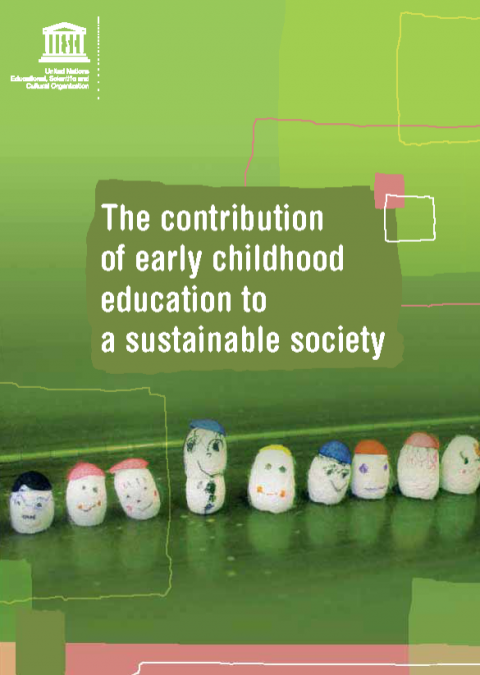 La contribution de l'éducation de la petite enfance à une société durable 出版年份: 2008 机构作者: Organisation des Nations Unies pour l'éducation, la science et la culture (UNESCO) Ce rapport provient de l'atelier international, «Le rôle de l'éducation de la petite enfance pour une société durable», organisé conjointement à Göteborg, en Suède, par l'Université de Göteborg, Chalmers University of Technology et la ville de Göteborg, du 2 au 4 mai 2007. Il a réuni trente-cinq participants de seize pays différents (voir «Liste des participants»). L'atelier a été suivi à l'éducation de internationalconférenceon pour le développement durable, «Apprendre à changer notre monde», tenue en mai 2004, à Göteborg. Il était l'un des quatre ateliers préparatoires menant à une autre éducation internationalconférenceon pour le développement durable, qui sera organisée en 2008 ou 2009, dans la même ville. L'objectif des quatre ateliers est de discuter des promoteurs et des obstacles liés à l'apprentissage de la durabilité, et de proposer des recommandations pour la prochaine conférence internationale. Le présent atelier a été conçu pour les raisons suivantes. Tout d'abord, nos sociétés ont un besoin urgent de nouveaux types d'éducation qui peuvent aider à prévenir une nouvelle dégradation de notre planète, et qui favorisent les soins et les citoyens responsables véritablement concernés par et capables de contribuer à un monde juste et pacifique. Deuxièmement, ces nouvelles formes d'éducation doivent être aCECssibles à tous - non seulement une poignée de gens - et se déroulent dans divers milieux, y compris les familles et les communautés. Troisièmement, ils doivent commencer au début de l'enfance, comme les valeurs, les attitudes, les comportements et les compétences acquises dans cette période peuvent avoir un impact durable dans la vie plus tard. Ainsi, l'éducation de la petite enfance a clairement une place importante dans les efforts pour parvenir à un développement durable. Decenio de las Naciones Unidas de la Educación para el Desarrollo Sostenible, 2005-2014: el Decenio en pocas palabras 出版年份: 2005 机构作者: UNESCO This document briefs on the Decade of Education for Sustainable Development (DESD), detailing its objectives, the implementation plans, good practices, and challenges that DESD faces. Décennie des Nations Unies pour l'Education en vue du Développement Durable, 2005-2014: la DEDD en bref 出版年份: 2005 机构作者: UNESCO This document briefs on the Decade of Education for Sustainable Development (DESD), detailing its objectives, the implementation plans, good practices, and challenges that DESD faces. Reflexiones sobre el progreso, el desarrollo sostenible y la ciudadanía mundial 出版年份: 2013 作者: Georges Haddad 机构作者: UNESCO The arguments developed in this concise presentation demonstrate that sustainable development, progress and global citizenship, efficiently embedded in the context of the Knowledge Society, undeniably participate in the development of the New Humanism promoted by the Director-General of UNESCO, and which we all agree to consider essential for the wealth and prosperity of Humanity in an agreeable, peaceful and friendly common environment. Quelques réflexions sur le progrès, le développement durable et la citoyenneté globale 出版年份: 2013 作者: Georges Haddad 机构作者: UNESCO The arguments developed in this concise presentation demonstrate that sustainable development, progress and global citizenship, efficiently embedded in the context of the Knowledge Society, undeniably participate in the development of the New Humanism promoted by the Director-General of UNESCO, and which we all agree to consider essential for the wealth and prosperity of Humanity in an agreeable, peaceful and friendly common environment.
  Reflections on Progress, Sustainable Development and Global Citizenship 出版年份: 2013 作者: Georges Haddad 机构作者: UNESCO The arguments developed in this concise presentation demonstrate that sustainable development, progress and global citizenship, efficiently embedded in the context of the Knowledge Society, undeniably participate in the development of the New Humanism promoted by the Director-General of UNESCO, and which we all agree to consider essential for the wealth and prosperity of Humanity in an agreeable, peaceful and friendly common environment. Buenas prácticas de educación para el desarrollo sostenible en la primera infancia 出版年份: 2012 机构作者: UNESCO To support the growing interest in early childhood issues and ESD, UNESCO is publishing this volume containing 12 examples of programmes addressing ESD in early childhood settings and practices. These good practices and shared experiences, which were provided by a range of different stakeholders, are concrete examples of successful implementation of ESD in different fields and sectors, from the political to the school level, and including formal, nonformal and informal learning situations. Éducation pour le développement durable: bonnes pratiques dans l'éducation de la petite enfance 出版年份: 2012 机构作者: UNESCO To support the growing interest in early childhood issues and ESD, UNESCO is publishing this volume containing 12 examples of programmes addressing ESD in early childhood settings and practices. These good practices and shared experiences, which were provided by a range of different stakeholders, are concrete examples of successful implementation of ESD in different fields and sectors, from the political to the school level, and including formal, nonformal and informal learning situations.