
相关资源
探索丰富的全球公民教育资源,深化理解,促进研究、倡导、教学与学习。
共找到684条结果
 Citizenship and Digital Literacy Plan 2024 出版年份: 2024 机构作者: Chile. Ministerio Secretaría General de Gobierno | Chile. Ministerio de Educación The Ministry of the General Secretariat of the Government together with the Ministry of Education have launched the “Citizenship and Digital Literacy” Plan with the aim of addressing the growing challenges, opportunities and risks involved in the use of digital technologies in everyday life. The actions presented in the plan seek to strengthen the skills of citizens in general and also with a focus on educational communities, supported by the frameworks of digital citizenship and media, information and digital literacy. This plan includes three axes: 1.) Training for citizenship and digital literacy; 2.) Incorporation of media literacy and digital citizenship in the national school curriculum; and 3.) Resources and guidelines for strengthening citizenship and digital literacy. Plan ciudadanía y alfabetización digital 2024 出版年份: 2024 机构作者: Chile. Ministerio Secretaría General de Gobierno | Chile. Ministerio de Educación El Ministerio Secretaria General de Gobierno junto al Ministerio de Educación han lanzado el Plan “Ciudadanía y Alfabetización Digital” con el objetivo de abordar los crecientes desafíos, oportunidades y riesgos que implica el uso de tecnologías digitales en la vida cotidiana. Las acciones presentadas en el plan buscan fortalecer las competencias de la ciudadanía en general y también con foco en las comunidades educativas, amparados en los marcos de ciudadanía digital y de alfabetización mediática, informacional y digital. Este plan contempla tres ejes: 1.) Formación para la ciudadanía y alfabetización digital; 2.) Incorporación de la alfabetización mediática y la ciudadanía digital en el currículum escolar nacional; y 3.) Recursos y orientaciones para el fortalecimiento de la ciudadanía y la alfabetización digital.
 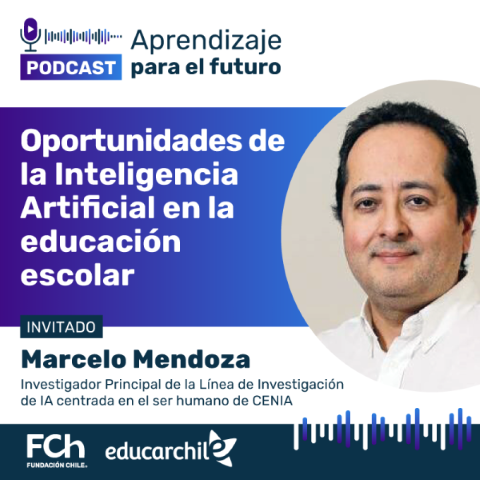 Podcast: Learning for the Future; Opportunities of Artificial Intelligence in School Education 出版年份: 2024 作者: Marcelo Mendoza 机构作者: Chile Foundation | Educarchile In this edition of the podcast: Learning for the Future, we spoke with Marcelo Mendoza, Principal Investigator of the Human-Centered AI Research Line at CENIA, with whom we developed the topic: Opportunities for Artificial Intelligence in school education. We also learned about the experience of the Bicentennial People Help People High School in Pilmaiquén using AI in various processes, together with teacher Cristóbal Morales. Podcast: Aprendizaje para el futuro; Oportunidades de la Inteligencia Artificial en la educación escolar 出版年份: 2024 作者: Marcelo Mendoza 机构作者: Chile Foundation | Educarchile En esta edición del podcast: Aprendizaje para el Futuro, conversamos con Marcelo Mendoza, Investigador Principal de la Línea de Investigación de IA centrada en el ser humano de CENIA, con quien desarrollamos el tema: Oportunidades de la Inteligencia Artificial en la educación escolar. También, conocimos la experiencia del Liceo Bicentenario People Help People de Pilmaiquén usando la IA en diversos procesos, junto al docente Cristóbal Morales.
  Resource Kit for Working With Families in Digital Citizenship 出版年份: 2024 机构作者: Chile. Ministry of Education The role of families and guardians is essential to help children and adolescents learn to navigate the digital environment, taking advantage of its opportunities and minimizing its risks. For this reason, it is important that schools work with families and guardians to provide support in the digital environment, safeguarding the rights of children and adolescents and promoting their autonomy in a progressive way, through the development of digital citizenship. This kit is composed of: Capsules for parents/guardians that deal with issues related to the digital environment, Booklets “Recommendations for working with families on their mediating role in the use of mobile devices” and a training module “Digital Citizenship”. Kit de recursos para el trabajo con familias en ciudadanía digital 出版年份: 2024 机构作者: Chile. Ministerio de Educación El rol de las familias y tutores es fundamental para ayudar a los niños, niñas y adolescentes a aprender a desenvolverse en el entorno digital aprovechando sus oportunidades y minimizando sus riesgos. Por esta razón, resulta importante que desde el espacio escolar se trabaje con las familias y tutores para realizar un acompañamiento en el entorno digital, resguardando la protección de los derechos de niños, niñas y adolescentes y favoreciendo su autonomía de forma progresiva, a través del desarrollo de la ciudadanía digital. Este kit está compuesto por: Cápsulas para apoderados/as que tratan temas relacionados con el entorno digital, Cartillas “Recomendaciones para trabajar con familias su rol mediador en el uso de dispositivos móviles” y un módulo de formación “Ciudadanía Digital”.
  Средства массовой информации как партнеры в сфере образования для устойчивого развития. Учебно-ресурсный комплект 出版年份: 2009 作者: Eleanor Bird | Richard Lutz | Christine Warwick 机构作者: UNESCO Media as Partners in Education for Sustainable Development addresses issues that are being discussed on the social, economic and environmental fronts. It does not pretend to know all the answers, but draws on existing experience and recommends resources for further inquiry and research. It encourages the media to engage in public participation and to debate improvements that can lead to sustainable development. It also seeks to contribute to media awareness and understanding of sustainability, as outlined by the Agenda 21 Plan of Action for all nations endorsed at the 1992 Earth Summit in Rio de Janeiro. Les médias, partenaires de l'éducation au développement durable: kit de formation et de référence 出版年份: 2008 作者: Eleanor Bird | Richard Lutz | Christine Warwick 机构作者: UNESCO Media as Partners in Education for Sustainable Development addresses issues that are being discussed on the social, economic and environmental fronts. It does not pretend to know all the answers, but draws on existing experience and recommends resources for further inquiry and research. It encourages the media to engage in public participation and to debate improvements that can lead to sustainable development. It also seeks to contribute to media awareness and understanding of sustainability, as outlined by the Agenda 21 Plan of Action for all nations endorsed at the 1992 Earth Summit in Rio de Janeiro. Education à la citoyenneté mondiale: préparer les apprenants aux défis du XXIe siècle 出版年份: 2015 机构作者: Organisation des Nations Unies pour l'éducation, la science et la culture (UNESCO) The United Nations Secretary-General’s Global Education First Initiative (GEFI) has established education as a means to ‘foster global citizenship’ – one of its three priority areas. To support this, UNESCO organized two landmark meetings on GCE in 2013. This publication aims to define the parameters of GCE by using the collective expertise, experience and wisdom of those participants who gathered at these landmark events, and to plan for future action in line with emerging thinking and other ongoing work. The review establishes that GCE has a critical role to play in equipping learners with competencies to deal with the dynamic and interdependent world of the twenty-first century. While GCE has been applied in different ways in different contexts, regions and communities, it has a number of common elements, which include fostering in learners. In formal settings, GCE can be delivered as an integral part of an existing subject (such as civic or citizenship education, social studies, environmental studies, geography or culture), or as an independent subject area. Integrated models appear to be more common. Some less traditional, but at least as effective, pathways for GCE have included the following: the use of information and communication technologies and social media, sport competitions and the use of art and music, and youth-led initiatives employing a wide variety of approaches. Both traditional and new horizons for GCE are profiled in this review. This publication also explores a number of enabling conditions for the promotion and implementation of GCE. These include: the existence of an open environment for universal values, the implementation of transformative pedagogy and support for youth-led initiatives. The review acknowledges that there are a number of ongoing tensions with the concepts of global citizenship and global citizenship education. While these tensions vary, they all point to the fundamental question of how to promote universality (e.g. common and collective identity, interest, participation, duty), while respecting singularity (e.g. individual rights, self-improvement). Some ways forward to resolve these tensions are suggested, whilst maintaining that challenges around theoretical elements of GCE should not undermine its practice. The processes documented in this publication have strengthened partnerships, built coalitions and contributed to improving the evidence base on the theory and practice of global citizenship education. While there are tasks that remain, this foundation bodes well for improving the enabling conditions and the practices highlighted in this review. By preparing learners to fulfil their potential in an increasingly globalized world, we are promoting transformed societies that are also better equipped to deal with the twenty-first century challenges and to seize twenty-first century opportunities.
  [Summary] Accountability in Education: Meeting Our Commitments: Global Education Monitoring Report Summary, 2017/8 出版年份: 2017 机构作者: UNESCO This summary of the 2017/8 GEM Report shows the entire array of approaches to accountability in education. It ranges from countries unused to the concept, where violations of the right to education go unchallenged, to countries where accountability has become an end in itself instead of a means to inclusive, equitable and high-quality education and lifelong learning for all.The report emphasizes that education is a shared responsibility. While governments have primary responsibility, all actors – schools, teachers, parents, students, international organizations, private sector providers, civil society and the media – have a role in improving education systems. The report emphasizes the importance of transparency and availability of information but urges caution in how data are used. It makes the case for avoiding accountability systems with a disproportionate focus on narrowly defined results and punitive sanctions. In an era of multiple accountability tools, the report provides clear evidence on those that are working and those that are not.