
相关资源
探索丰富的全球公民教育资源,深化理解,促进研究、倡导、教学与学习。
共找到97条结果
 Action Research to Improve Youth and Adult Literacy: Empowering Learners in a Multilingual World 出版年份: 2015 机构作者: UNESCO Institute for Lifelong Learning (UIL) | UNESCO Abuja This guidebook is about the quest for quality, which is a lifelong pursuit linked to social justice. As we move in time and space new challenges emerge, but our vision is that no one should be left behind in the quest for self- and collective realization. We have to consider all possible means for enabling the active participation of all citizens in education. We must look at both challenges and opportunities, such as those that technology offers us for making linkages and improving access to information, knowledge and skills. We must seek out possibilities for retaining positive values and acquiring new ones which foster deeper appreciation for human, linguistic, cultural and ecological diversity.
  Counting the Cost: Achieving Literacy in Countries of the Global Alliance for Literacy 出版年份: 2021 机构作者: UNESCO Institute for Lifelong Learning (UIL) This paper seeks to determine the cost of achieving Sustainable Development Goal 4 (SDG 4) Target 4.6: 'By 2030, ensure that all youth and a substantial proportion of adults, both men and women, achieve literacy and numeracy'. In an effort to answer this question, UNESCO ran simulations and identified the cost and funding gap for the 29 member countries of the Global Alliance for Literacy within the Framework of Lifelong Learning (GAL). This paper argues that 739 million youth and adults require additional literacy programmes of which 580 million are located in 9 of the 29 member countries (the E-9 countries). Based on the results of the simulation, an estimated US$ 190 billion is needed to achieve Target 4.6 by 2030 in the 29 GAL countries. The E-9 countries account for 80% of this cost as the large majority of the global population of youth and adults who lack basic literacy skills live in these territories. The estimation considers the impact of the COVID-19 crisis on GDP growth and presents several scenarios for consideration. If the 29 member countries allocate the recommended 3 per cent of their national education budget to youth and adult literacy, a funding gap of US$ 17 billion will still remain. However, this gap is greater in the 20 non-E9 countries, which account for US$ 12 billion of the funding gap. These 20 non-E9 countries already experience massive challenges for investing in their public education system due to low economic growth and low education development outcomes. A detailed description of the UNESCO GAL simulation model used to estimate the total cost and identify the financing gap for the 29 countries is presented to help interpret the results. The paper ends with a set of recommendations for governments and the international community to work together and ensure the availability of lifelong learning opportunities for all, especially those often left behind.
  5th Global Report on Adult Learning and Education: Citizenship Education; Empowering Adults for Change 出版年份: 2023 机构作者: UNESCO Institute for Lifelong Learning (UIL) Lifelong learning is not only a right; it is also a crucial asset in facing social and economic uncertainty and environmental and digital disruption. It is a culture that must be developed to ensure social cohesion, equal opportunities, gender equality and the economic vitality of societies.The Global Reports on Adult Learning and Education (GRALE) play a key role in meeting UNESCO's commitment to monitor and report on countries' implementation of the Belem Framework for Action. In this Framework, countries agreed to improve ALE across five areas of action: policy; governance; financing; participation, inclusion and equity; and quality. This report contributes to these goals by providing international reference data to support and inform public policies. 成人学习与教育全球报告(五): 公民教育; 增强成人的变革能力 出版年份: 2023 机构作者: UNESCO Institute for Lifelong Learning (UIL) 本报告的宗旨有两个 。首先是为了执行《贝伦行动框架》授予教科文组织的任 务,明确记录第六届国际成人教育大会参 与国为“定期收集和分析按性别与其他因素分类的有关……成人教育方案的数据和信息,以评估不同时期的变化并分享好的 做法”(UIL, 2010,第9页)所做的投入。 因此,本报告第一部分根据《贝伦行动框 架》确定的五个关键指标跟踪和分析在成人学习与教育方面取得的进展:政策、治 理、筹资、参与和质量。在报告第二部分中提及的第二个宗旨,是为全球和积极公民 意识以及成人学习与教育在追求这些公民 意识方面的作用提供详细的主题讨论和 分析。除了监测该领域的全球进展并深入探 讨成人学习者的公民教育的主题外,本报 告还为2022年6月在摩洛哥举行的第七 届国际成人教育大会开展进一步讨论奠定 了基础。《全球报告(五)》的最终目标是提 高主要利益相关方对成人学习与教育的认 识,并确保政策制定者对此给予更多关注 。 该报告提供了关于创新实践和良好做法的 案例,并为国际进展的评估工作提供了证 据基础。它还有助于了解成人学习与教育 对实现可持续发展目标 4的整体贡献,并 理解其具有的远远不局限于任何一个具体 目标的广泛效益的潜力 。尽管本报告概述了取得的成就和进 展,但成人学习与教育在教育政策中经常 面临“不受青睐”和资金不足的问题。《全 球报告(四)》要求政策制定者将成人学习 与教育置于实现可持续经济和社会所作的 努力的中心,并认识到其在开发综合全面 的解决方案方面起到的关键作用。该报告 则更进一步表明,建立将人类和地球置于 发展核心的公民意识是何其必要。
  [Executive Summary] 5th Global Report on Adult Learning and Education: Citizenship Education; Empowering Adults for Change 出版年份: 2022 机构作者: UNESCO Institute for Lifelong Learning (UIL) Lifelong learning is not only a right; it is also a crucial asset in facing social and economic uncertainty and environmental and digital disruption. It is a culture that must be developed to ensure social cohesion, equal opportunities, gender equality and the economic vitality of societies.The Global Reports on Adult Learning and Education (GRALE) play a key role in meeting UNESCO's commitment to monitor and report on countries' implementation of the Belem Framework for Action. In this Framework, countries agreed to improve ALE across five areas of action: policy; governance; financing; participation, inclusion and equity; and quality. This report contributes to these goals by providing international reference data to support and inform public policies. [Résumé exécutif] 5e rapport mondial sur l’apprentissage et l'éducation des adultes: Éducation à la citoyenneté; Donner aux adultes les moyens du changement 出版年份: 2022 机构作者: UNESCO Institute for Lifelong Learning (UIL) L'apprentissage tout au long de la vie n'est pas seulement un droit; c'est aussi un atout crucial pour faire face à l'incertitude sociale et économique et aux bouleversements environnementaux et numériques. C'est une culture qui doit être développée pour assurer la cohésion sociale, l'égalité des chances, l'égalité des genres et la vitalité économique des sociétés. Les Rapports mondiaux sur l'apprentissage et l'éducation des adultes (GRALE) jouent un rôle clé dans le respect de l'engagement de l'UNESCO de suivre et de rendre compte de la mise en œuvre par les pays du Cadre d'action de Belém. Dans ce cadre, les pays ont convenu d'améliorer l'AEA dans cinq domaines d'action : politique ; gouvernance; financement; participation, inclusion et équité; et qualité. Ce rapport contribue à ces objectifs en fournissant des données de référence internationales pour soutenir et éclairer les politiques publiques. [Resumen ejecutivo] 5° informe mundial sobre el aprendizaje y la educación de adultos: Educación para la ciudadanía; Empoderar a los adultos para el cambio 出版年份: 2022 机构作者: UNESCO Institute for Lifelong Learning (UIL) El aprendizaje permanente no es solo un derecho; también es un activo crucial para enfrentar la incertidumbre social y económica y la disrupción ambiental y digital. Es una cultura que debe desarrollarse para asegurar la cohesión social, la igualdad de oportunidades, la igualdad de género y la vitalidad económica de las sociedades. Los Informes mundiales sobre el aprendizaje y la educación de adultos (GRALE) desempeñan un papel clave en el cumplimiento del compromiso de la UNESCO de monitorear e informar sobre la implementación del Marco de Acción de Belem en los países. En este Marco, los países acordaron mejorar el AEA en cinco áreas de acción: política; gobernancia; financiación; participación, inclusión y equidad; y calidad. Este informe contribuye a estos objetivos al proporcionar datos de referencia internacional para apoyar e informar las políticas públicas. [ملخص تنفيذي] التقرير العالمي الخامس حول تعلم وتعليم الكبار: تعليم المواطنة؛ تمكين الكبار من أجل التغيير 出版年份: 2022 机构作者: UNESCO Institute for Lifelong Learning (UIL) Lifelong learning is not only a right; it is also a crucial asset in facing social and economic uncertainty and environmental and digital disruption. It is a culture that must be developed to ensure social cohesion, equal opportunities, gender equality and the economic vitality of societies.The Global Reports on Adult Learning and Education (GRALE) play a key role in meeting UNESCO's commitment to monitor and report on countries' implementation of the Belem Framework for Action. In this Framework, countries agreed to improve ALE across five areas of action: policy; governance; financing; participation, inclusion and equity; and quality. This report contributes to these goals by providing international reference data to support and inform public policies. [요약본] 제5차 세계 성인학습∙교육 보고서: 시민성 교육; 변화를 위한 성인 역량 강화 出版年份: 2022 机构作者: UNESCO Institute for Lifelong Learning (UIL) 2009년에 처음 나온 세계 성인학습・교육 보고서(Global Report on Adult Learning and Education, GRALE)는 공공 정책을 지원하고 이에 필요한 정보를 포함한 국제 참고 데이터를 제공한다. 본 보고서는 회원국들이 유네스코에 협조를 요청했던 성인학습・교육에 관한 벨렘 실행계획 (Belém Framework for Action, BFA)이 지난 10년간 실제로 추진되었음을 보여준다. 본 문서는 2022년에 발간된 제5차 성인학습・교육 보고서(GRALE 5)의 요약본이다.
 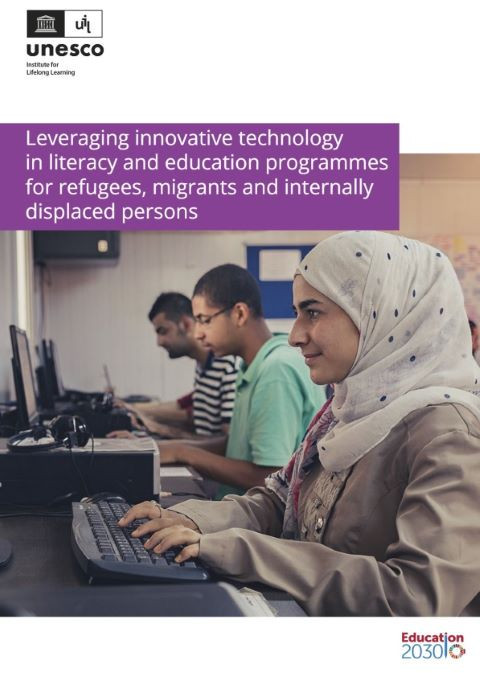 Leveraging Innovative Technology in Literacy and Education Programmes for Refugees, Migrants and Internally Displaced Persons 出版年份: 2022 机构作者: UNESCO Institute for Lifelong Learning (UIL) The publication Leveraging innovative technology in literacy and education programmes for refugees, migrants and internally displaced persons brings together a selection of 21 case studies showcasing how ICTs can be integrated both innovatively and effectively into literacy and education programmes for refugees, migrants and IDPs. The case studies in this compilation demonstrate the potential of technology to support learners’ acquisition of literacy skills through arts-based learning, integrated literacy programmes, entrepreneurship training or in combination with tertiary education opportunities. They highlight the multitude of stakeholders that have come together across sectors to shape innovative responses that can make a real difference to learners’ lives. At the same time, the compilation shows the various modalities through which technology can be harnessed to deliver effective literacy and educational opportunities in diverse and challenging environments while recognizing and remaining sensitive to the needs of learners, be they refugees, IDPs or migrants.