
相关资源
探索丰富的全球公民教育资源,深化理解,促进研究、倡导、教学与学习。
共找到1,402条结果
 [vidéo] Les Dix Cibles de l’Objectif de Développement Durable 4...avec Elyx ! 出版年份: 2017 机构作者: UNESCO Regardez cette nouvelle animation expliquant les dix cibles de l'Objectif de développement durable 4. Avec Elyx, le premier ambassadeur numérique de l'ONU, découvrez comment garantir une éducation inclusive et de qualité pour tous et promouvoir l'apprentissage tout au long de la vie. [Vídeo] Descubre las Diez Metas del Objetivo de Desarrollo Sostenible 4... ¡con Elyx! 出版年份: 2017 机构作者: UNESCO La UNESCO presenta su nuevo vídeo para explicar las diez metas del Objetivo de Desarrollo 4. Junto a Elyx, la primera embajadora digital de la UNESCO, descubre como garantizar una educación inclusiva, equitativa y de calidad y promover oportunidades de aprendizaje durante toda la vida para todos. Десять задач Цели 4 в области устойчивого развития ... с Эликс! 出版年份: 2017 机构作者: UNESCO Обеспечение качественного образования для всехПосмотрите эту новую анимацию ЮНЕСКО, объясняющую десять задач Цели 4 в области усточивого развития. Вместе с Эликс, первым цифровым послом ООН, узнайте, как обеспечить всеохватное и качественное образование для всех и содействовать обучению. [فيديو] الغايات العشر للهدف 4 من أهداف التنمية المستدامة ... مع إليكس! 出版年份: 2017 机构作者: UNESCO شاهد فيديو اليونسكو الجديد الذي يشرح الغايات العشر للهدف 4 من أهداف التنمية المستدامة. واكتشف مع إليكس، أول سفير رقمي للأمم المتحدة، كيفيةضمان وصول التعليم للجميع وتعزيز فرص التعلّم المتساوية والجيدة طوال العمر. The Ten Targets of the Sustainable Development Goal 4...with Elyx 出版年份: 2017 机构作者: 유네스코 This new UNESCO animation explaining the ten targets of the Sustainable Development Goal 4.Together with Elyx, the UN's first digital ambassador, discover how to ensure inclusive and quality education for all and promote lifelong learning.
 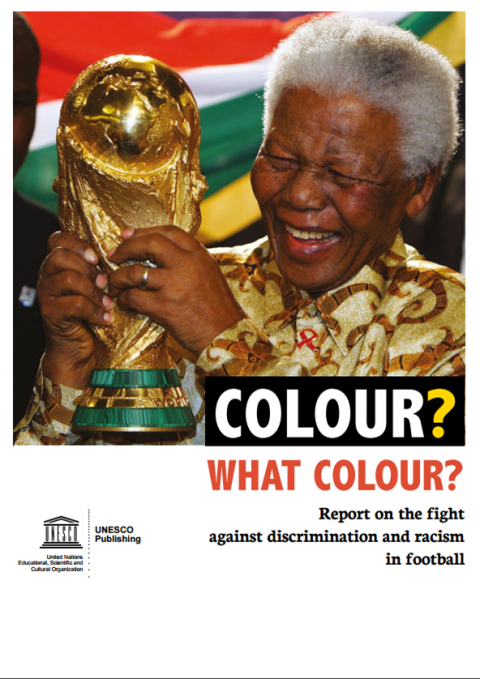 Colour? What colour? Report on the fight against discrimination and racism in football 出版年份: 2015 作者: Albrecht Sonntag | David Ranc 机构作者: UNESCO Football has been shown to be a mirror of society, it may also be viewed as providing a temporary suspension of reality for an interlude of high emotion and idealized hopes and dreams. Football’s public transcends differences of age, gender, culture, religion, and socioeconomic status to unite in support of their team. The broad diversity of backgrounds of football players represents tangible evidence of equal opportunity and meritocracy. The sport itself has team solidarity, fair play and mutual respect among members and for opponents ingrained within its rules and practices. Yet, the ‘beautiful game’ is one with an imbedded paradox. Football is also a game that may in many vaguely resemble war, where opponents face each other in a struggle to win over the other side, with the noisy and emphatic support of the spectators. An ‘us’ and ‘them’ mentality is an integral part of trying to help a team reach the objective, which is to win the game. This setting naturally produces a desire by supporters to intimidate the other side by encouraging their team and expressing both confidence and superiority through their words and actions. When the ‘us’ and ‘them’ mentality turns into symbolic exclusion of others, language of disparagement and insult based on racism or discrimination, or physical confrontation, the ‘beautiful game’ is debased. The existence of racism and discrimination in football is not a secret, but it is a shame on the game. Although much is already being done, both observers and experts feel too many problems persist and measures to tackle them have not been effective enough. This report was commissioned by UNESCO within the framework of UNESCO’s partnership with Juventus. It focuses on discrimination and racism in professional football and to some extent the amateur clubs that funnel into the leagues. It provides an overview of the historic and theoretical background. It reports on the state of affairs on the ground. It summarizes what has been done and is being done to mitigate racism and discrimination in domestic and international football, how the effects of these actions may be evaluated, and which new avenues for further, complementary action are promising. The report is based on a literature review, desk research, regional reports from the Unesco network and a field survey among a purposive sample of experts and actors in a number of countries. The report has a somewhat European focus, in its sources and examples. Europe has a unique position Executive Summary in the world of football, with its leading competitions, championships and clubs. It is the region where racism and discrimination in football has been most intensively researched. A number of civil society organisations from Europe have played a pioneering role in the fight against racism and discrimination in football. Moreover, the pressure that comes with the money invested in and generated by western European football, as well as its exposure in the media, has also made clubs, federations and UEFA particularly sensitive to the negative impact that discrimination can have on the game and its image, within Europe and worldwide. Europe must therefore occupy a central role in a study of the fight against discrimination in professional football and in determined policies to mitigate racism and discrimination related to football wherever they occur. The examples of incidents of discrimination and racism, as well as of existing measures to combat them have been selected to be as wide-ranging as possible. The authors do not, however, claim the report to be a comprehensive listing. Similarly, the examples of best practice have been collected through extensive reading and contacts, but must be looked at as an overview rather than as a directory. They are chosen by the authors to illustrate types of actions and institutions with the potential for greatest impact. The report also does not deal with the methods of allocation of resources to football, with issues of employment, or with womens’ football. While these are significant topics on which concerns can be expressed, the necessary focus of a report of this type means that they are alluded to without being treated in depth.
  Cracking The Code: Girls’ and Women’s Education in Science, Technology, Engineering and Mathematics (STEM) 出版年份: 2017 机构作者: UNESCO Despite significant improvements in recent decades, education is not universally available and gender inequalities persist. A major concern in many countriesis not only limited numbers of girls going to school, but also limited educational pathways for those that step into the classroom. This includes, more specifically,how to address the lower participation and learning achievement of girls in science, technology, engineering and mathematics (STEM) education. STEM underpins the 2030 Agenda for Sustainable Development, and STEM education can provide learners with the knowledge, skills, attitudes and behavioursrequired for inclusive and sustainable societies. Leaving out girls and women in STEM education and careers is a loss for all. This report aims to ‘crack the code’, or to decipher the factors that hinder or facilitate girls’ and women’s participation, achievement and continuation in STEMeducation, and what can be done by the education sector to promote girls’ and women’s interest in, and engagement with, STEM. Déchiffrer le Code: L'Éducation des Filles et des Femmes aux Sciences, Technologie, Ingénierie et Mathématiques (STEM) 出版年份: 2017 机构作者: Organisation des Nations Unies pour l'éducation, la science et la culture (UNESCO) Malgrédes améiorations notables ces dernièes déennies, l’éucation n’est pas universellement disponible et les inéalité entre les genres persistent, souvent en déaveur des filles. Des facteurs socio-culturels et éonomiques complexes et lié entre eux pèent non seulement sur les possibilité de scolarisation des filles mais aussi sur la qualitéde l’éucation qu’elles recevront, les éudes qu’elles suivront et, au bout du chemin, leurs carrièes et leurs parcours de vie. Une préccupation majeure tient àla faiblesse de la participation et des réultats des filles dans les éudes de sciences, technologie, ingéierie et mathéatiques (STEM). Les STEM sous-tendent le Programme de déeloppement durable àl’horizon 2030 et l’éucation aux STEM peut apporter aux apprenants les connaissances, les compéences et les comportements néessaires àdes sociéé inclusives et durables. Laisser les filles et les femmes àl’éart de l’éucation et des professions des STEM non seulement les prive de la possibilitéde contribuer aux STEM et d’en bééicier, mais aussi perpéue le fosséentre les sexes et, plus gééalement, les inéalité sociales et éonomiques. Le présent rapport vise à« déhiffrer le code » en déryptant les facteurs qui entravent ou facilitent la participation, la réssite et la réention des filles et des femmes dans l’éucation aux STEM et, en particulier, ce que peut faire le secteur de l’éucation pour promouvoir l’intéê et l’engagement des filles et des femmes dans l’éucation aux STEM et finalement dans les carrièes des STEM. Il entend constituer une ressource pour les parties prenantes de l’éucation et autres personnes qui travaillent àpromouvoir l’éalitédes genres.
  UNESCO at COP23: Climate Change Education 出版年份: 2017 机构作者: UNESCO This brochure contains information about UNESCO's role of education in climate change through ESD(Education for Sustainable Development). Education for Sustainable Development (ESD) is increasingly recognized around the world as an effective enabler for a more sustainable future. Building climate change awareness and building capacities for adaptation and mitigation are critical dimensions of ESD. The critical role of education in climate change responses was clearly recognized at the Paris Climate Conference (COP21) in December 2015. COP22 in Marrakesh and COP23 in Bonn reiterate the importance of climate change education in achieving the global agendas.
  From insult to inclusion: Asia-Pacific report on school bullying, violence and discrimination on the basis of sexual orientation and gender identity 出版年份: 2015 机构作者: UNESCO This review recognises the complexity in terminology globally, and within the region, on sex, sexuality and gender. For simplicity, ‘SOGIE-based bullying, violence and discrimination’ is used to refer to the various anifestations of violence and exclusion based on gender discrimination, gender role expectations and stereotypes, intersex prejudice, and societal expectations for heterosexual relationships. This is sometimes referred to as homophobic or transphobic bullying, violence and discrimination. This report considers violence experienced by children and young people because of actual or perceived sexual orientation and gender identity or expression, or because their bodies differ from typical definitions of male or female. The term ‘LGBTI people/youth’ is used in this report when inclusive of intersex persons, and LGBT when the situation or needs of intersex people/ youth have not been considered. Local terms and those from original studies are also included, and the glossary provides information for readers on concepts and terms in this report.