
相关资源
探索丰富的全球公民教育资源,深化理解,促进研究、倡导、教学与学习。
共找到3,376条结果
 Apprendre à vivre ensemble: un programme interculturel et interreligieux pour l'enseignement de l'éthique 出版年份: 2008 机构作者: Arigatou Foundation (Switzerland) | Interfaith Council on Ethics Education for Children Learning to Live Together has been developed for use in different religious and secular contexts as a resource for everyone concerned with promoting ethics and values. The objective has been to develop a resource that is relevant on a global level and yet flexible enough to be interpreted within different cultural and social contexts. The resource has been tested in many different regions and cultural contexts to assure that it is relevant in regional and local contexts (see ‘We did it like this’, p.187). Test workshops have been held in 10 different countries, where the GNRC was able to bring together various religious and secular organisations working with children. During the test workshops, this resource manual was used to the benefit of more than 300 children and youth, representing African Traditional Religions, Bahá’í Faith, Buddhism, Christianity, Hinduism, Islam, Judaism, members of Brahma Kumaris and a number of people of secular thinking. Test workshops as well as input and comments from experts in the area of education, ethics, spirituality, intercultural and interfaith learning and child rights have contributed important experiences and opportunities for learning for the development of this resource. Learning to Live Together is already having an impact. In a GNRC programme in Israel, the resource material was used during a six-day journey made by a group of Jewish, Christian, and Muslim youth to the historical sites of Israel and Palestine, all of which have symbolic relevance to the conflict in their region. At each stop, youth participants discussed their values and their differing perceptions of their shared history. Learning to Live Together is an adaptable resource that can be used with children from many different cultural, religious and social contexts to nurture common values and a mutual respect for different backgrounds and traditions. The resource provides space for enhancing children’s innate potential for spirituality and hope for a better world, as a contribution to changing the situation for children worldwide. The Users Guide provides all necessary information for its use. UNESCO and UNICEF have been closely involved in developing Learning to Live Together and have endorsed the material as an important contribution to a quality education, which takes a multicultural and multi-religious society into consideration. UNESCO’s Guidelines for Intercultural Education underpin the philosophy and the approach of the resource: “Religious education can be described as learning about one’s own religion or spiritual practices, or learning about other religions or beliefs. Interfaith education, in contrast, aims to actively shape the relations between people from different religions”. تعلم العيش معا: برنامج التواصل بين الثقافات والأديان لتعليم الأخلاق 出版年份: 2008 机构作者: Interfaith Council on Ethics Education for Children | Arigatou Foundation (Switzerland) Learning to Live Together has been developed for use in different religious and secular contexts as a resource for everyone concerned with promoting ethics and values. The objective has been to develop a resource that is relevant on a global level and yet flexible enough to be interpreted within different cultural and social contexts. The resource has been tested in many different regions and cultural contexts to assure that it is relevant in regional and local contexts (see ‘We did it like this’, p.187). Test workshops have been held in 10 different countries, where the GNRC was able to bring together various religious and secular organisations working with children. During the test workshops, this resource manual was used to the benefit of more than 300 children and youth, representing African Traditional Religions, Bahá’í Faith, Buddhism, Christianity, Hinduism, Islam, Judaism, members of Brahma Kumaris and a number of people of secular thinking. Test workshops as well as input and comments from experts in the area of education, ethics, spirituality, intercultural and interfaith learning and child rights have contributed important experiences and opportunities for learning for the development of this resource. Learning to Live Together is already having an impact. In a GNRC programme in Israel, the resource material was used during a six-day journey made by a group of Jewish, Christian, and Muslim youth to the historical sites of Israel and Palestine, all of which have symbolic relevance to the conflict in their region. At each stop, youth participants discussed their values and their differing perceptions of their shared history. Learning to Live Together is an adaptable resource that can be used with children from many different cultural, religious and social contexts to nurture common values and a mutual respect for different backgrounds and traditions. The resource provides space for enhancing children’s innate potential for spirituality and hope for a better world, as a contribution to changing the situation for children worldwide. The Users Guide provides all necessary information for its use. UNESCO and UNICEF have been closely involved in developing Learning to Live Together and have endorsed the material as an important contribution to a quality education, which takes a multicultural and multi-religious society into consideration. UNESCO’s Guidelines for Intercultural Education underpin the philosophy and the approach of the resource: “Religious education can be described as learning about one’s own religion or spiritual practices, or learning about other religions or beliefs. Interfaith education, in contrast, aims to actively shape the relations between people from different religions”.
 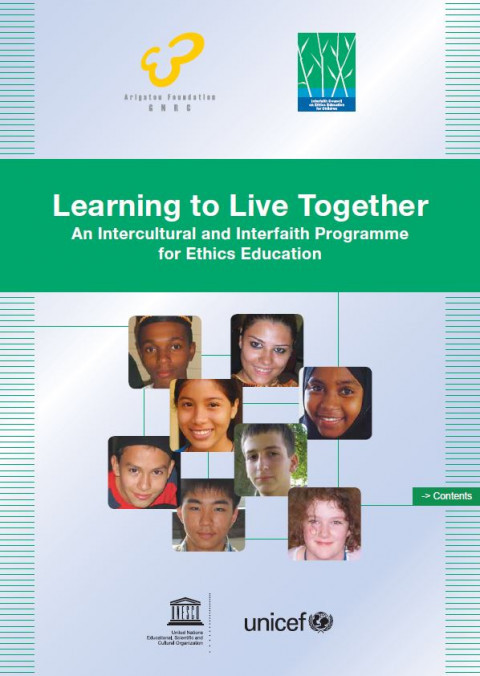 Learning to live together: an intercultural and interfaith programme for ethics education 出版年份: 2008 机构作者: Interfaith Council on Ethics Education for Children | Arigatou Foundation (Switzerland) Learning to Live Together has been developed for use in different religious and secular contexts as a resource for everyone concerned with promoting ethics and values. The objective has been to develop a resource that is relevant on a global level and yet flexible enough to be interpreted within different cultural and social contexts. The resource has been tested in many different regions and cultural contexts to assure that it is relevant in regional and local contexts (see ‘We did it like this’, p.187).Test workshops have been held in 10 different countries, where the GNRC was able to bring together various religious and secular organisations working with children. During the test workshops, this resource manual was used to the benefit of more than 300 children and youth, representing African Traditional Religions, Bahá’í Faith, Buddhism, Christianity, Hinduism, Islam, Judaism, members of Brahma Kumaris and a number of people of secular thinking. Test workshops as well as input and comments from experts in the area of education, ethics, spirituality, intercultural and interfaith learning and child rights have contributed important experiences and opportunities for learning for the development of this resource. Learning to Live Together is already having an impact. In a GNRC programme in Israel, the resource material was used during a six-day journey made by a group of Jewish, Christian, and Muslim youth to the historical sites of Israel and Palestine, all of which have symbolic relevance to the conflict in their region. At each stop, youth participants discussed their values and their differing perceptions of their shared history.Learning to Live Together is an adaptable resource that can be used with children from many different cultural, religious and social contexts to nurture common values and a mutual respect for different backgrounds and traditions. The resource provides space for enhancing children’s innate potential for spirituality and hope for a better world, as a contribution to changing the situation for children worldwide. The Users Guide provides all necessary information for its use. UNESCO and UNICEF have been closely involved in developing Learning to Live Together and have endorsed the material as an important contribution to a quality education, which takes a multicultural and multi-religious society into consideration. UNESCO’s Guidelines for Intercultural Education underpin the philosophy and the approach of the resource: “Religious education can be described as learning about one’s own religion or spiritual practices, or learning about other religions or beliefs. Interfaith education, in contrast, aims to actively shape the relations between people from different religions”. Nuestra diversidad creativa: informe de la comisión mundial de cultura y desarrollo 出版年份: 1996 机构作者: World Commission on Culture and Development This report is designed to address a diversified audience across the world that ranges from community activists, field workers, artists and scholars to government officials and politicians. We want it to inform the world’s opinion leaders and to guide its policy-makers. We want it to capture the attention of the world’s intellectual and artistic communities, as well as the general public. We aim to have shown them how culture shapes all our thinking, imagining and behaviour. It is the transmission of behaviour as well as a dynamic source for change, creativity, freedom and the awakening of innovative opportunities. For groups and societies, culture is energy, inspiration and empowerment, as well as the knowledge and acknowledgment of diversity: if cultural diversity is ‘behind us, around us and before us”, as Claude L&i-Strauss put it, we must learn how to let it lead not to the clash of cultures, but to their fruitful coexistence and to intercultural harmony. Just as in the tasks of building peace and consolidating democratic values, an indivisible set of goals, so too economic and political rights cannot be realized separately from social and cultural rights. The challenge to humanity is to adopt new ways of thinking, new ways of acting, new ways of organizing itself in society, in short, new ways of living. The challenge is also to promote different paths of development, informed by a recognition of how cultural factors shape the way in which societies conceive their own futures and choose the means to attain these futures. I have for some time been concerned with the “culture of peace”. There is now considerable evidence that neglect of human development has been one of the principal causes of wars and internal armed conflicts, and that these, in turn, retard human development. With government complicity and with the intention of raising export receipts, private businesses continue to sell advanced military technology, nuclear materials and equipment for the production of bacteriological and chemical warfare. The concept of state sovereignty which still prevails today has increasingly come under scrutiny. In the area of peace-keeping, the distinction between external aggression and internal oppression is often unrealistic. The predominant threat to stability are violent conflicts within countries and not between them. There is an urgent need to strengthen international human rights law. Many of the most serious troubles come from within states – either because of ethnic strife or repressive measures by governments. Conditions that lead to tyranny and large-scale violations of human rights at home sooner or later are likely to spill over into a search for enemies abroad. The temptation of repressive states to export internal difficulties is great. Consider the Soviet Union’s invasion of Hungary and Czechoslovakia after it had used domestic oppression and the persistent refusal - for many years - of the previous South African governments to grant independence to Namibia. An ounce of prevention is better than a ton of punishment. Notre diversité créatrice: rapport de la commission mondiale de la culture et du développement 出版年份: 1996 机构作者: World Commission on Culture and Development This report is designed to address a diversified audience across the world that ranges from community activists, field workers, artists and scholars to government officials and politicians. We want it to inform the world’s opinion leaders and to guide its policy-makers. We want it to capture the attention of the world’s intellectual and artistic communities, as well as the general public. We aim to have shown them how culture shapes all our thinking, imagining and behaviour. It is the transmission of behaviour as well as a dynamic source for change, creativity, freedom and the awakening of innovative opportunities. For groups and societies, culture is energy, inspiration and empowerment, as well as the knowledge and acknowledgment of diversity: if cultural diversity is ‘behind us, around us and before us”, as Claude L&i-Strauss put it, we must learn how to let it lead not to the clash of cultures, but to their fruitful coexistence and to intercultural harmony. Just as in the tasks of building peace and consolidating democratic values, an indivisible set of goals, so too economic and political rights cannot be realized separately from social and cultural rights. The challenge to humanity is to adopt new ways of thinking, new ways of acting, new ways of organizing itself in society, in short, new ways of living. The challenge is also to promote different paths of development, informed by a recognition of how cultural factors shape the way in which societies conceive their own futures and choose the means to attain these futures. I have for some time been concerned with the “culture of peace”. There is now considerable evidence that neglect of human development has been one of the principal causes of wars and internal armed conflicts, and that these, in turn, retard human development. With government complicity and with the intention of raising export receipts, private businesses continue to sell advanced military technology, nuclear materials and equipment for the production of bacteriological and chemical warfare. The concept of state sovereignty which still prevails today has increasingly come under scrutiny. In the area of peace-keeping, the distinction between external aggression and internal oppression is often unrealistic. The predominant threat to stability are violent conflicts within countries and not between them. There is an urgent need to strengthen international human rights law. Many of the most serious troubles come from within states – either because of ethnic strife or repressive measures by governments. Conditions that lead to tyranny and large-scale violations of human rights at home sooner or later are likely to spill over into a search for enemies abroad. The temptation of repressive states to export internal difficulties is great. Consider the Soviet Union’s invasion of Hungary and Czechoslovakia after it had used domestic oppression and the persistent refusal - for many years - of the previous South African governments to grant independence to Namibia. An ounce of prevention is better than a ton of punishment. Наше творч разно: Доклад Всемирной комиссии по культуре и развитию; сокращенный вариант 出版年份: 1996 机构作者: World Commission on Culture and Development This report is designed to address a diversified audience across the world that ranges from community activists, field workers, artists and scholars to government officials and politicians. We want it to inform the world’s opinion leaders and to guide its policy-makers. We want it to capture the attention of the world’s intellectual and artistic communities, as well as the general public. We aim to have shown them how culture shapes all our thinking, imagining and behaviour. It is the transmission of behaviour as well as a dynamic source for change, creativity, freedom and the awakening of innovative opportunities. For groups and societies, culture is energy, inspiration and empowerment, as well as the knowledge and acknowledgment of diversity: if cultural diversity is ‘behind us, around us and before us”, as Claude L&i-Strauss put it, we must learn how to let it lead not to the clash of cultures, but to their fruitful coexistence and to intercultural harmony. Just as in the tasks of building peace and consolidating democratic values, an indivisible set of goals, so too economic and political rights cannot be realized separately from social and cultural rights. The challenge to humanity is to adopt new ways of thinking, new ways of acting, new ways of organizing itself in society, in short, new ways of living. The challenge is also to promote different paths of development, informed by a recognition of how cultural factors shape the way in which societies conceive their own futures and choose the means to attain these futures. I have for some time been concerned with the “culture of peace”. There is now considerable evidence that neglect of human development has been one of the principal causes of wars and internal armed conflicts, and that these, in turn, retard human development. With government complicity and with the intention of raising export receipts, private businesses continue to sell advanced military technology, nuclear materials and equipment for the production of bacteriological and chemical warfare. The concept of state sovereignty which still prevails today has increasingly come under scrutiny. In the area of peace-keeping, the distinction between external aggression and internal oppression is often unrealistic. The predominant threat to stability are violent conflicts within countries and not between them. There is an urgent need to strengthen international human rights law. Many of the most serious troubles come from within states – either because of ethnic strife or repressive measures by governments. Conditions that lead to tyranny and large-scale violations of human rights at home sooner or later are likely to spill over into a search for enemies abroad. The temptation of repressive states to export internal difficulties is great. Consider the Soviet Union’s invasion of Hungary and Czechoslovakia after it had used domestic oppression and the persistent refusal - for many years - of the previous South African governments to grant independence to Namibia. An ounce of prevention is better than a ton of punishment. Notre diversité créatrice: rapport de la commission mondiale de la culture et du développement, version condensée 出版年份: 1996 机构作者: World Commission on Culture and Development This report is designed to address a diversified audience across the world that ranges from community activists, field workers, artists and scholars to government officials and politicians. We want it to inform the world’s opinion leaders and to guide its policy-makers. We want it to capture the attention of the world’s intellectual and artistic communities, as well as the general public. We aim to have shown them how culture shapes all our thinking, imagining and behaviour. It is the transmission of behaviour as well as a dynamic source for change, creativity, freedom and the awakening of innovative opportunities. For groups and societies, culture is energy, inspiration and empowerment, as well as the knowledge and acknowledgment of diversity: if cultural diversity is ‘behind us, around us and before us”, as Claude L&i-Strauss put it, we must learn how to let it lead not to the clash of cultures, but to their fruitful coexistence and to intercultural harmony. Just as in the tasks of building peace and consolidating democratic values, an indivisible set of goals, so too economic and political rights cannot be realized separately from social and cultural rights. The challenge to humanity is to adopt new ways of thinking, new ways of acting, new ways of organizing itself in society, in short, new ways of living. The challenge is also to promote different paths of development, informed by a recognition of how cultural factors shape the way in which societies conceive their own futures and choose the means to attain these futures. I have for some time been concerned with the “culture of peace”. There is now considerable evidence that neglect of human development has been one of the principal causes of wars and internal armed conflicts, and that these, in turn, retard human development. With government complicity and with the intention of raising export receipts, private businesses continue to sell advanced military technology, nuclear materials and equipment for the production of bacteriological and chemical warfare. The concept of state sovereignty which still prevails today has increasingly come under scrutiny. In the area of peace-keeping, the distinction between external aggression and internal oppression is often unrealistic. The predominant threat to stability are violent conflicts within countries and not between them. There is an urgent need to strengthen international human rights law. Many of the most serious troubles come from within states – either because of ethnic strife or repressive measures by governments. Conditions that lead to tyranny and large-scale violations of human rights at home sooner or later are likely to spill over into a search for enemies abroad. The temptation of repressive states to export internal difficulties is great. Consider the Soviet Union’s invasion of Hungary and Czechoslovakia after it had used domestic oppression and the persistent refusal - for many years - of the previous South African governments to grant independence to Namibia. An ounce of prevention is better than a ton of punishment.
  Our creative diversity: report of the world commission on culture and development; summary version 出版年份: 1996 机构作者: World Commission on Culture and Development This report is designed to address a diversified audience across the world that ranges from community activists, field workers, artists and scholars to government officials and politicians. We want it to inform the world’s opinion leaders and to guide its policy-makers. We want it to capture the attention of the world’s intellectual and artistic communities, as well as the general public. We aim to have shown them how culture shapes all our thinking, imagining and behaviour. It is the transmission of behaviour as well as a dynamic source for change, creativity, freedom and the awakening of innovative opportunities. For groups and societies, culture is energy, inspiration and empowerment, as well as the knowledge and acknowledgment of diversity: if cultural diversity is ‘behind us, around us and before us”, as Claude L&i-Strauss put it, we must learn how to let it lead not to the clash of cultures, but to their fruitful coexistence and to intercultural harmony. Just as in the tasks of building peace and consolidating democratic values, an indivisible set of goals, so too economic and political rights cannot be realized separately from social and cultural rights. The challenge to humanity is to adopt new ways of thinking, new ways of acting, new ways of organizing itself in society, in short, new ways of living. The challenge is also to promote different paths of development, informed by a recognition of how cultural factors shape the way in which societies conceive their own futures and choose the means to attain these futures. I have for some time been concerned with the “culture of peace”. There is now considerable evidence that neglect of human development has been one of the principal causes of wars and internal armed conflicts, and that these, in turn, retard human development. With government complicity and with the intention of raising export receipts, private businesses continue to sell advanced military technology, nuclear materials and equipment for the production of bacteriological and chemical warfare. The concept of state sovereignty which still prevails today has increasingly come under scrutiny. In the area of peace-keeping, the distinction between external aggression and internal oppression is often unrealistic. The predominant threat to stability are violent conflicts within countries and not between them. There is an urgent need to strengthen international human rights law. Many of the most serious troubles come from within states – either because of ethnic strife or repressive measures by governments. Conditions that lead to tyranny and large-scale violations of human rights at home sooner or later are likely to spill over into a search for enemies abroad. The temptation of repressive states to export internal difficulties is great. Consider the Soviet Union’s invasion of Hungary and Czechoslovakia after it had used domestic oppression and the persistent refusal - for many years - of the previous South African governments to grant independence to Namibia. An ounce of prevention is better than a ton of punishment. Notre diversité créatrice: rapport de la Commission mondiale sur la culture et le développement; version résumée 出版年份: 1996 机构作者: World Commission on Culture and Development Ce rapport est conçu pour répondre à un public diversifié à travers le monde qui va de militants communautaires, les travailleurs sur le terrain, des artistes et des chercheurs à des fonctionnaires et les hommes politiques. Nous voulons informer les leaders d'opinion du monde et pour guider ses décideurs. Nous voulons capter l'attention des communautés intellectuelles et artistiques du monde, ainsi que le grand public. Nous visons à leur ont montré comment la culture façonne toute notre pensée, d'imaginer et de comportement. Il est la transmission du comportement ainsi qu'une source dynamique pour le changement, la créativité, la liberté et l'éveil des possibilités novatrices. Pour les groupes et les sociétés, la culture est l'énergie, l'inspiration et l'autonomisation, ainsi que la connaissance et la reconnaissance de la diversité: si la diversité culturelle est «derrière nous, autour de nous et devant nous», comme Claude L & i-Strauss l'a dit, nous devons apprendre de le laisser conduire à ne pas le choc des cultures, mais à leur coexistence fructueuse et à l'harmonie interculturelle. Tout comme dans les tâches de consolidation de la paix et de la consolidation des valeurs démocratiques, un ensemble indivisible de buts, donc aussi des droits économiques et politiques ne peuvent pas être réalisés séparément des droits sociaux et culturels. Le défi pour l'humanité est d'adopter de nouvelles façons de penser, de nouvelles façons d'agir, de nouvelles façons de s'organiser dans la société, en bref, de nouvelles façons de vivre. Le défi est aussi de promouvoir différentes voies de développement, informés par une reconnaissance de la façon dont les facteurs culturels façonnent la manière dont les sociétés conçoivent leur propre avenir et de choisir les moyens d'atteindre ces contrats à terme. Je l'ai depuis un certain temps été concernés par la "culture de la paix". Il y a maintenant des preuves considérables que la négligence du développement humain a été l'une des causes principales des guerres et des conflits armés internes, et que ceux-ci, à son tour, retarder le développement humain. Avec la complicité du gouvernement et avec l'intention d'augmenter les recettes d'exportation, les entreprises privées continuent de vendre de la technologie militaire de pointe, les matières nucléaires et de l'équipement pour la production de guerre bactériologique et chimique. Le concept de la souveraineté étatique qui prévaut encore aujourd'hui de plus en plus scruté. Dans le domaine de maintien de la paix, la distinction entre les agressions extérieures et de l'oppression interne est souvent irréaliste. La principale menace à la stabilité sont des conflits violents au sein des pays et non pas entre eux. Il y a un besoin urgent de renforcer le droit international des droits humains. Beaucoup de troubles les plus graves proviennent de l'intérieur des Etats - soit en raison de conflits ethniques ou des mesures répressives par les gouvernements. Les conditions qui conduisent à la tyrannie et de violations massives des droits de l'homme à la maison, tôt ou tard sont susceptibles de déborder dans une recherche d'ennemis à l'étranger. La tentation des États répressifs à exporter des difficultés internes est grande. Envisager l'invasion de la Hongrie et la Tchécoslovaquie de l'Union soviétique, après avoir utilisé l'oppression nationale et le refus persistant - depuis de nombreuses années - des gouvernements sud-africains précédents d'accorder l'indépendance à la Namibie. Une once de prévention vaut mieux qu'une tonne de punition.
  Advancing a Just Energy Transition in Central Asia: Women’s Key Role in the Energy Sector 出版年份: 2024 机构作者: Организация по безопасности и сотрудничеству в Европе (ОБСЕ) | Global Women’s Network for the Energy Transition (GWNET) The OSCE study analyzes the socio-economic benefits of the energy transition for the five OSCE participating States in the region. It provides specific considerations for the strategic development of an appropriately skilled labour force and also contains critical yet unpublished data on the job creation potential of renewable energy in each Central Asian country.