
相关资源
探索丰富的全球公民教育资源,深化理解,促进研究、倡导、教学与学习。
共找到3,451条结果
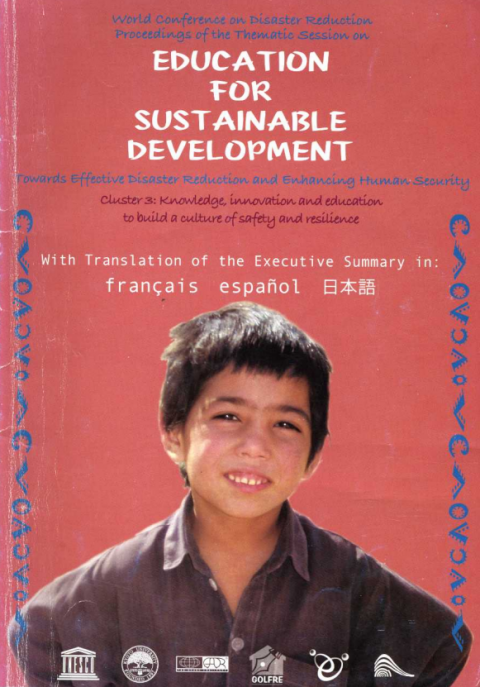 Proceedings of the thematic session on education for sustainable development: towards effective disaster reduction and enhancing human security; cluster 3: knowledge, innovation and education to build a culture of safety and resilience 出版年份: 2005 作者: Rajib Shaw | Badaoui Rouhban 机构作者: Kyoto University. Graduate School of Global Environmental Studies | Global Alliance for Disaster Reduction | Global Open Learning Forum on Risk Education | Disaster Reduction Alliance | International Institute of Earthquake Engineering and Seismology Ten years ago, the city of Kobe and its adjoining areas in Hyogo prefecture of Japan were hit by a strong earthquake, leaving behind a trail of death and destruction. This earthquake was a turning point in disaster reduction initiatives in Japan, resulting in two prominent changes: 1) a blending of technological and social issues in the field of research and application, and 2) an enhanced participation of civil society in disaster reduction Initiatives. Since Japan had long been one of the most developed countries in the field of earthquake engineering, the tragedy in Kobe posed a daunting question: 'how to fill the gap between knowledge and practice?' This question is not only for Japan, but is pertinent to many other countries. With the advancement of technology, the knowledge base is growing, and it is now time to tackle this question in order to save lives and properties from natural disasters. The World Conference on Disaster Reduction (WCDR), at the 10th anniversary of the Kobe earthquake, is therefore of special significance, providing an excellent platform to share experiences, expertise, and lessons from different parts of the world. The year 2005 is also the beginning of the United Nations Decade of Education for Sustainable Development (DESD: 2005-2014) which is led by UNESCO. Compte rendu de la session thématique sur l'éducation pour le développement durable: vers une réduction efficace des catastrophes et le renforcement de la sécurité humaine; groupe 3: la connaissance, l'innovation et l'éducation pour instaurer une culture de la sécurité et de résilience 出版年份: 2005 作者: Rajib Shaw | Badaoui Rouhban 机构作者: Kyoto University. Graduate School of Global Environmental Studies | Global Alliance for Disaster Reduction | Global Open Learning Forum on Risk Education | Disaster Reduction Alliance | International Institute of Earthquake Engineering and Seismology Il y a dix ans, la ville de Kobe et ses zones adjacentes dans la préfecture de Hyogo du Japon ont été touchés par un fort tremblement de terre, laissant derrière lui une traînée de mort et de destruction. Ce tremblement de terre a été un point tournant dans les initiatives de prévention des catastrophes au Japon, ce qui entraîne deux changements importants: 1) un mélange de questions technologiques et sociales dans le domaine de la recherche et de l'application, et 2) une participation accrue de la société civile dans les initiatives de prévention des catastrophes. Depuis que le Japon a longtemps été l'un des pays les plus développés dans le domaine de l'ingénierie des tremblements de terre, la tragédie de Kobe a posé une question de taille:? Comment combler le fossé entre les connaissances et la pratique ' Cette question est non seulement pour le Japon, mais est pertinent pour de nombreux autres pays. Avec l'avancement de la technologie, la base de connaissances est en croissance, et il est maintenant temps d'aborder cette question dans le but de sauver des vies et des propriétés des catastrophes naturelles. La Conférence mondiale sur la prévention des catastrophes (CMPC), au 10e anniversaire du tremblement de terre de Kobe, est donc d'une importance particulière, en fournissant une excellente plateforme pour partager des expériences, des compétences et des leçons de différentes parties du monde. L'année 2005 est aussi le début de la Décennie des Nations Unies pour l'éducation pour le développement durable (DEDD: 2005-2014) qui est dirigé par l'UNESCO.
  Streamlining the Global Path to Gender Equality: The Role of Feminist Foreign Policy 出版年份: 2023 机构作者: UN WOMEN Europe and Central Asia As of June 2023, 15 UN Member States introduced feminist lenses to their foreign policies (FFPs). The policy brief examines the various FFPs and identifies shared aspects and gaps across seven key themes: WPS, political participation, economic empowerment, diplomacy, official development assistance, human rights/humanitarianism, violence against women and girls. Ускорение глобального движения к гендерному равенству: роль феминистской внешней политики 出版年份: 2023 机构作者: UN WOMEN Europe and Central Asia По состоянию на июнь 2023 года 15 государств - членов ООН внедрили феминистские подходы в свою внешнюю политику. В аналитической записке рассматриваются различные FFP и выявляются общие аспекты и пробелы по семи ключевым темам: ЖМБ, участие в политической жизни, расширение экономических прав и возможностей, дипломатия, официальная помощь в целях развития, права человека/ гуманитарная деятельность, насилие в отношении женщин и девочек.
  교사. 인권교육. 하다: 교사를 위한 학교 인권교육 안내서 出版年份: 2021 机构作者: 국가인권위원회 이 자료는 「초·중등 학교 인권교육 내용 체계화 및 개정 교육과정 적용 방안 연구」 보고서 내용을 바탕으로, 교육 현장에서 인권교육을 실천하고 있거나 해보려는 많은 교사를 위해 학교 인권교육에 관한 이해를 높이고 실천 방법에 대한 유용한 정보를 제공하기 위해 만든 발간물로서 인권 과목의 지향점 및 교육과정 내용 체계 등을 간명하게 보여 줌으로써, 인권 과목을 통한 인권교육을 구체화할 수 있도록 했다. 또한 인권교육을 처음 시도하는 교사들이 부담 없이 접근할 수 있도록 읽을거리, 볼거리, 생각할 거리 등 다양한 자료를 제공한다.
  Espace presse de la FIDH 机构作者: Fédération internationale pour les droits humains (FIDH) Cet espace presse est un lieu où sont recensés tous les communiqués de presse produits par la FIDH. Si vous cherchez à être informé de l'avancée des droits humains dans le monde vous y retrouverez tous les derniers documents de recherche et de plaidoyer de la fondation This press room is a place where you can find all the press releases produced by FIDH. If you're looking to keep abreast of human rights developments around the world, you'll find all the latest FIDH research and advocacy documents here.
  Stepping Forward: Parliaments in the Fight Against Hate Speech 出版年份: 2023 作者: Kevin Deveaux | Tim Baker | Mary O’Hagan | David Ennis 机构作者: United Nations Development Programme (UNDP) This brief provides an overview of the background, drivers, enablers and the impact of hate speech and identifies strategies to counter it, with a focus on the role of parliaments as a positive force for change. Of particular relevance are the concrete actions parliaments can take to address and mitigate the prevalence and impact of hate speech on those who are most vulnerable in society, including women, minorities and other underrepresented groups. The objective of this brief is to provide meaningful and practical guidance for parliaments and parliamentarians, as well as those who programmatically support them, on steps they can take to reduce and counter hate speech while fostering peace, constructive dialogue and trust.
  L’université de paix, ressources pédagogiques 机构作者: L'université de paix L'Université de Paix diffuse des outils pédagogiques et des articles de fond pour apprendre à mieux communiquer et développer des relations plus sereines et constructives.The University of peace distributes teaching tools and in-depth articles to help people learn to communicate better and develop calmer, more constructive relationships.
  AntiClash 出版年份: 2023 作者: Rafael Tyszblat | Olivier Fournout 机构作者: AntiClash AntiClash est un concept d’émission qui va contre la culture du c"lash" en mettant en avant l’esprit et la méthode du dialogue. Lors des émissions thématiques, facilitées par des professionnels du dialogue, les intervenants – connus ou non, experts ou pas, mais en désaccord sur un sujet à potentiel polémique – sont invités à aller au fond de leurs divergences, avec authenticité et respect.Il ne s’agit pas d’une émission d’information. Les animateurs ne sont ni journalistes, ni experts dans les domaines abordés par les personnes invitées. Ainsi, ils ne font pas de « fact checking », ni de « debunking » mais invitent leurs auditeurs à vérifier eux-mêmes les faits avancés par les intervenants.L’objectif d’AntiClash est de montrer de quoi a l’air un véritable dialogue en permettant une meilleure compréhension des discours antagonistes, que la culture du clash dans les médias et les réseaux ne permet pas.Il ne s’agit pas de créer une société où tout le monde est d’accord, mais nos différences, si elles font l’objet d’une conversation constructive, doivent enrichir notre compréhension des lignes de fracture politique et nous permettre de nous rapprocher d’une vérité partagée en rétablissant des liens de confiance et une communication éthique entre citoyens.AntiClash, c’est la tentative de montrer une alternative à l’affrontement sur les sujets qui comptent. AntiClash is a program concept that goes against the culture of c "lash" by emphasizing the spirit and method of dialogue. During themed programs, facilitated by dialogue professionals, speakers - well-known or not, experts or not, but disagreeing on a potentially controversial subject - are invited to get to the bottom of their differences, with authenticity and respect.This is not a news program. The hosts are neither journalists nor experts in the fields covered by the guests. As such, they do not engage in "fact checking" or "debunking", but invite their listeners to verify for themselves the facts put forward by the speakers. The aim of AntiClash is to show what real dialogue looks like, by enabling a better understanding of antagonistic discourses, which the culture of clash in the media and networks does not allow. It's not about creating a society where everyone agrees, but our differences, if the subject of constructive conversation, should enrich our understanding of political fault lines and enable us to move closer to a shared truth by re-establishing bonds of trust and ethical communication between citizens. AntiClash is an attempt to show an alternative to confrontation on the issues that matter.
  Summit of the Future Outcome Document: Pact for the Future, Global Digital Compact, and Declaration on Future Generations 出版年份: 2024 机构作者: United Nations (UN) At the Summit of the Future on 22 September 2024, world leaders adopted a Pact for the Future that includes a Global Digital Compact and a Declaration on Future Generations. This Pact is the culmination of a years-long process to adapt international cooperation to the realities of today and the challenges of tomorrow. The hard work of implementation begins immediately. The adoption of the Pact demonstrates that countries are committed to an international system with the United Nations at its center. Leaders set out a clear vision of a multilateralism that can deliver on its promises, is more representative of today’s world and draws on the engagement and expertise of governments, civil society and other key partners.