
相关资源
探索丰富的全球公民教育资源,深化理解,促进研究、倡导、教学与学习。
共找到1,471条结果
 Education for Social Peace 出版年份: 2018 作者: Idris Sultan Saleh 机构作者: Morocco. Ministry of Awqaf and Islamic Affairs The author reviews the concept of social peace and its importance for individuals and societies. Then he goes on to refer to Islamic religion and its framing of societies with social peace. The article concludes with a discussion of education in the light of social peace. التربية من أجل السلام الاجتماعي 出版年份: 2018 作者: Idris Sultan Saleh 机构作者: Morocco. Ministry of Awqaf and Islamic Affairs يستعرض الكاتب مفهوم السلام ألاجتماعي وأهميته للإفراد والمجتمعات. ومن ثم يستطرد في الاشارة للدين الاسلامي وتأطيره للمجتمعات بالسلام الاجتماعي. ويختم المقال بمناقشة التربية في ضوء السلام الاجتماعي.
  Programs of Peace Education in Pre-University Education on the Light of Some Countries’ Experiences and the Extent of Benefit in Egypt 出版年份: 2014 作者: Amel Ahmed Hassan Mohamed 机构作者: Association of Arab Educators Education for peace has got an international, regional and local interests, in particular, today's world desperately needs more than ever before to face the problems afflicting the human race, and the conflict expected to increase in the coming years. This situation confirms the importance of achieving peace in all dimensions with oneself, family, society, and the environment.This study aimed to investigate the experiences of some countries in the field of education for peace and to draw some benefits from them. For achieving this aim, the study followed the Descriptive-Analytic Approach because of its appropriateness to the nature of the study. The sample of study dealt with three experiments in the field of education for peace in Northern Ireland, Bosnia and Herzegovina, and Sierra Leone, which were chosen after passing through a relatively long period of conflicts and disputes. By analyzing the three experiments, the similarities and differences among countries were reviewed in terms of, period and nature of conflict, foundations, objectives and content of the programs, teacher training. The study achieved some benefits through reviewing literature and analyzing the three experiences. The suggestions of the study were classified under some themes, including: foundations of peace education, its objectives, contents, and teacher training. برامج التربية من أجل السلام بالتعليم قبل الجامعي في بعض الدول وامكانية الاستفادة منها في مصر 出版年份: 2014 作者: Amel Ahmed Hassan Mohamed 机构作者: Association of Arab Educators تحظى التربية من أجل السلام باهتمام دولي وإقليمي ومحلى، ولا سيما أن عالم اليوم أحوج أكثر من ذي قبل لمواجهة المشكلات التي يعاني منها الجنس البشري والصراعات المرتقب زيادتها في السنوات القادمة؛ هذا بالإضافة إلى تنامي معدلات العنف المجتمعي ومظاهره؛ مما يدعم ضرورة السعي لتحقيق السلام بكافة أبعاده مع النفس وفي الأسرة وداخل المجتمع ومع البيئة. لذا هدفت هذه الدراسة إلى رصد تجارب بعض الدول في مجال التربية من أجل السلام وتقديم أوجه الاستفادة منها للارتقاء بمستوى تقديم هذا الاتجاه التعليمي المعاصر بنظام التعليم بمصر. لتحقيق هذا الهدف تم الاستناد إلى المنهج الوصفي التحليلي حيث أنه أكثر ملائمة لطبيعة الدراسة، وقد تكونت عينة الدراسة من ثلاث تجارب في مجال التربية من أجل السلام بالدول الآتية: إيرلندا الشمالية، والبوسنة والهرسك، وسيراليون، والتي تم اختيارها لكونها عاصرت فترة من الصراعات والنزاعات الطويلة نسبياً، تلتها مبادرات لدمج التربية من اجل السلام في النظام التعليمي. وقد تم تحليل التجارب الثلاث في ضوء عدد من المحاور شملت: السياق العام للدولة، والجهود المبكرة للتربية من أجل السلام، وأسسها، وأهدافها، وأليات تضمينها في نظام التعليم، وتدريب المعلمين بكل دولة. وقد توصلت الدراسة إلى عدد من الدروس المستفادة التي تم رصدها من خلال ما ورد من أدبيات عربية وأجنبية، وتجارب الدول الثلاث، والتي تم تصنيفها تحت المحاور الآتية: فترة الصراع وطبيعته، أسس التربية من أجل السلام، وأهدافها، وأليات تضمينها في نظام التعليم، وتدريب المعلمين.
  Education, Identity and Rising Extremism: From Preventing Violent Extremism to Promoting Peace, Resilience, Equal Rights and Pluralism (PREP) 出版年份: 2017 作者: Sanam Anderlini 机构作者: International Civil Society Action Network In November 2016, during ICAN’s fifth annual Women, Peace and Security forum, members of the Women’s Alliance for Security Leadership (WASL) and other women-led organizations in over 30 countries analyzed the role of formal and informal education in contributing to enabling conditions and mitigating extremist violence. They also highlighted their own practical experiences and lessons learnt in providing education to prevent violent extremism by fostering peace, resilience, equal rights and pluralism (PREP) in formal and informal spaces, including through the teachings of alternative religious narratives. Their experiences, combined with desk research on the state of current policy and practice, and the first multi-stakeholder Global Solutions Exchange (GSX) meeting on the nexus of education, gender and extremism held at the UNESCO headquarters in Paris in March 2017, inform the findings of this report. التعليم والهوية ومنع التطرف: من منع التطرف العنيف إلى تعزيز السالم والصمود والمساواة في الحقوق والتعددية )PREP) 出版年份: 2017 作者: Sanam Anderlini 机构作者: International Civil Society Action Network فـي تشـرين الثانـي / نوفمبـر 2016 ، خـال منتـدى ايـكان ICAN السـنوي الخامـس للمـرأة والسـام واألمـن ، قــام أعضــاء التحالــف النســائي مــن أجــل القيــادة األمنيــة )وصــل( وغيرهــا مــن المنظمــات التــي تقودهــا النســاء فــي أكثــر مــن 30 دولــة بتحليــل دور التعليــم الرســمي وغيــر الرســمي فــي المســاهمة فــي تمكيــن الظـروف و تخفيـف العنـف المتطرف.كمـا قامـوا بتسـليط الضـوء علـى تجاربهـم العمليـة الخاصـة والـدروس المســتفادة مــن توفيــر التعليــم لمنــع التطــرف العنيــف مــن خــال تعزيــز الســام والصمــود والمســاواة فــي الحقـوق والتعدديـة )PREP )فـي المسـاحات الرسـمية وغيـر الرسـمية، بمـا فـي ذلـك مـن خـال تعاليـم بديلـة إلـى جنـب مع األبحـاث المكتبيـة حـول حالـة السياسـات والممارسـات للروايـات الدينيـة.إن تجاربهـم، جنبـا الحاليــة، وأول اجتماع للمنصــة العالميــة لتبــادل الحلــول )GSX ) حــول العالقــة بيــن التعليــم والجنــدر والتطـرف الـذي عقـد فـي مقـر اليونسـكو فـي باريـس فـي مـارس 2017 ، تقـوم بإبـاغ نتائج هـذا التقريـر .
 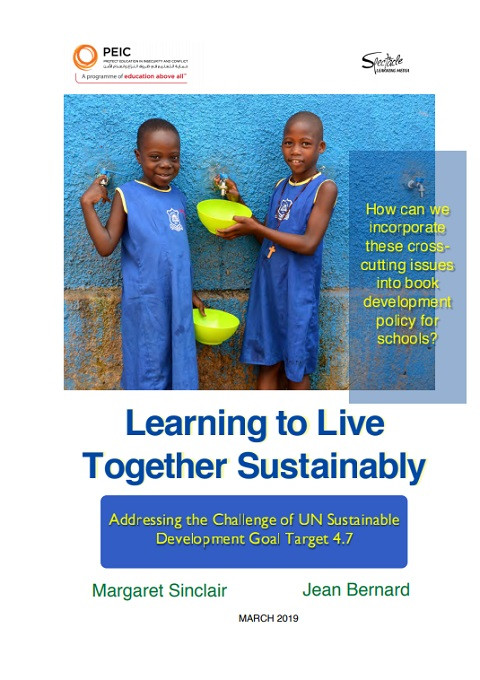 Learning to Live Together Sustainably: Addressing the Challenge of UN Sustainable Development Goal Target 4.7 出版年份: 2019 作者: Margaret Sinclair | Jean Bernard 机构作者: Protect Education in Conflict and Insecurity (PEIC) | Spectacle Learning Media The practical advice and guidelines in this book help support learning to live together, conflict transformation and peace at the individual, group and community levels. The framework for developing widely accessible, high quality learning materials supports the UN Sustainable Development Goals and is relevant to formal and non-formal education activities and projects. This document also raises important issues about the professional responsibilities of policy-makers at global and national level, who determine what content is addressed in the classroom. In particular, it addresses the need for education materials that support cross-cutting issues such as learning to live together, global citizenship education, and education for sustainable development.
  To live together: shaping new attitudes to peace through education 出版年份: 1997 作者: Daniel S. Halpérin 机构作者: UNESCO International Bureau of Education (IBE) The ‘To live together’ initiative was born at a meeting in February 1996 with Professor Emeritus Antoine Cuendet, a pediatric surgeon, former Dean of the Faculty of Medicine at Geneva University, and chairman of the Geneva Foundation to Protect Health in War (hereafter the Geneva Foundation). His foundation was in a process of trying to better define its scope of action within the large theme of ‘health and war’, and to identify areas of research that would deserve priority support. We agreed that, at a time when politicians had entered an era of peacemaking in the Middle-East, the situation might be suitable for Palestinians and Israelis to venture into joint research projects. In particular, a potentially fruitful project could be to examine the effects of long term, protracted conflicts-such as the Israeli-Palestinian one-on the mental and social health of children. Little was known about how much of their anxiety, psychosomatic complaints, agressivity, behavioural disorders or school failures may be linked with direct or indirect consequences of the conflict. What were the interventions or instruments that may counterbalance, or even correct such problems? Was there any kind of an educational programme, for instance, that might be demonstrated to be efficacious in counteracting those putative effects of the conflict; and that might prove of value in actually accelerating the healing of the traumatisms, while simultaneously strengthening the construction of peace? Pour vivre ensemble: l'élaboration de nouvelles attitudes à la paix par l'éducation 出版年份: 1997 作者: Daniel S. Halpérin 机构作者: UNESCO International Bureau of Education (IBE) L'initiative «Pour vivre ensemble» est né lors d'une réunion en Février 1996 avec le professeur Emeritus Antoine Cuendet, un chirurgien pédiatrique, ancien doyen de la Faculté de médecine de l'Université de Genève et président de la Fondation de Genève pour la protection de la santé dans la guerre (ci-après Fondation de Genève). Sa fondation était en train d'essayer de mieux définir son champ d'action au sein du grand thème de «la santé et de la guerre», et d'identifier les domaines de recherche qui mériterait un soutien prioritaire. Nous avons convenu que, à un moment où les politiciens étaient entrés dans une ère de rétablissement de la paix au Moyen-Orient, la situation pourrait être appropriée pour les Palestiniens et les Israéliens à se lancer dans des projets de recherche conjoints. En particulier, un projet potentiellement fructueux pourrait consister à examiner les effets de long terme, les conflits prolongés, tels que celui sur la santé israélo-palestinien mental et social des enfants. On ne savait pas combien de leur anxiété, troubles psychosomatiques, agressivité, troubles du comportement ou des échecs scolaires peuvent être liés avec des conséquences directes ou indirectes du conflit. Quelles ont été les interventions ou les instruments qui peuvent contrebalancer, voire corriger ces problèmes? Y avait-il tout type d'un programme d'éducation, par exemple, qui pourrait être démontré pour être efficace dans la lutte contre les effets putatifs du conflit; et qui pourrait se révéler utile pour accélérer effectivement la guérison des traumatismes, tout en renforçant simultanément la construction de la paix? Opening new windows to sow peace: building citizenship 出版年份: 2015 作者: Tatiana Zuluaga Zapata | Carlos Humberto Vélez Ocampo | Laura Juliana Pachón Rodríguez | María Julieta Ortiz Fernández 机构作者: Bogotá. Secretaría de Educación del Distrito (SED) This document aims to help students come with innovative ideas to generate transformations for peace and citizenship in Colombia. It is aimed at creating a conscious mobilization every April 9, during the commemoration of the victims and the missing in Colombia, and has the intention of motivating citizens to fill the streets with joy, raise their voices and commit to peace.