
相关资源
探索丰富的全球公民教育资源,深化理解,促进研究、倡导、教学与学习。
共找到1,407条结果
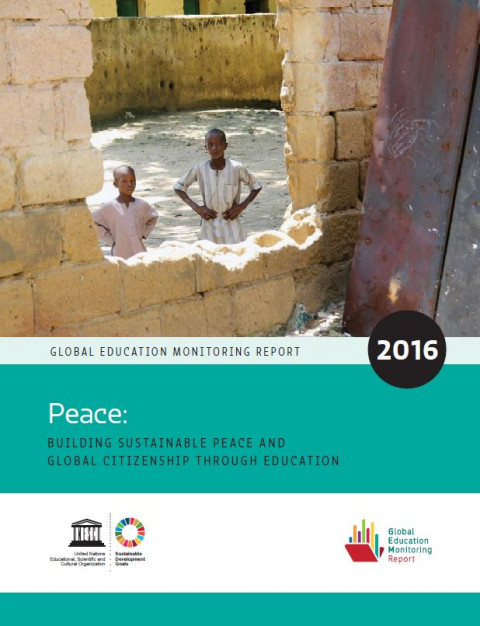 Peace: building sustainable peace and global citizenship through education;Global education monitoring report summary 2016 出版年份: 2017 机构作者: UNESCO The 2016 GEM Report, the first of a new 15-year series, shows that education will not deliver its full potential to catapult the world forward unless rates of improvement dramatically shift, and education systems consider sustainable development in the way services are delivered. This Peace: Building sustainable peace and global citizenship through education publication is a select extract from the full 2016 Global Education Monitoring (GEM) Report: Education for people and planet: Creating sustainable futures for all. It contains two chapters from that full Report – one on peace, political participation and access to justice and the other on education for global citizenship and sustainable development — , along with the associated policy recommendations and a short section of a recent GEM Report Policy Paper Textbooks pave the way to sustainable development.
 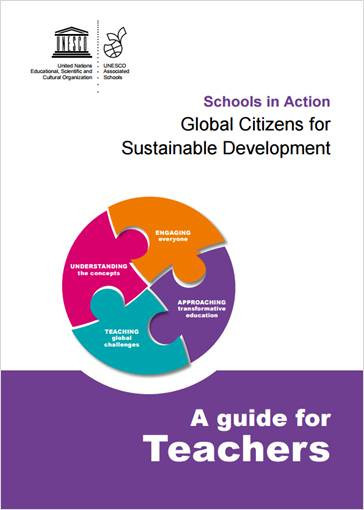 Schools in Action: Global Citizens for Sustainable Development: A Guide for Teachers 出版年份: 2016 机构作者: UNESCO The Global Citizens for Sustainable Development Teachers’ guide aims to introduce teachers to Global Citizenship Education (GCED) and Education for Sustainable Development (ESD). It provides secondary school teachers with ideas and activities to help students become global citizens and sustainable development actors. The Teachers’ guide draws on the discussions and activities of almost 1,100 participants from 104 countries, including ASPnet National Coordinators, school principals, teachers, students and experts who contributed to the Online Collaborative Platform ASPnet in Action: Global Citizens Connected for Sustainable Development in 2014 and 2015 [http://en.unesco. org/aspnet/globalcitizens] with associated activities and initiatives. The Teachers’ guide provides: An overview of what it means for learners to become global citizens and of how learners can contribute to sustainable development. Ideas for classroom activities that can help secondary school students to develop knowledge, skills, values, attitudes and behaviours that promote GCED and ESD. Selected activities on GCED and ESD from ASPnet schools around the world.
  Implementing the Right to Education: a Compendium of Practical Examples 出版年份: 2016 机构作者: UNESCO This publication is a compilation of practical examples of measures taken by Member States in implementing the provisions of the UNESCO Convention and Recommendation against Discrimination in Education. These examples are taken from national reports submitted to UNESCO for the Eighth Consultation of Member States on the implementation of these two international standard-setting instruments. The Convention and the Recommendation celebrated their fi fty-fi fth anniversary in 2015. Both express the fundamental principles of non-discrimination and equality of educational opportunities enshrined in UNESCO’'s Constitution. Since these fundamental principles were essential in the process of Education for All, the instruments have naturally become the cornerstone of this important domain.The Education 2030 development agenda will provide further opportunity to mobilise the Convention and the Recommendation in guiding Member States in the effective realization of the right to education. This compendium seeks to provide an overview of promising measures taken to ensure equality of educational opportunities and non-discrimination, while also serving as a tool for information sharing and advocacy in connection with the right to education.
  The ABCs of Global Citizenship Education 出版年份: 2016 机构作者: UNESCO UNESCO's FAQ flyers on GCED L’ABC de l’éducation à la citoyenneté mondiale 出版年份: 2016 机构作者: Organisation des Nations Unies pour l'éducation, la science et la culture (UNESCO) Les progrès considérables des technologies de l’information et de la communication (TIC) ont permis aux individus de se rapprocher et d’interagir les uns avec les autres, où que ce soit et à tout moment. Cela a contribué à intensifier le sentiment et le fait d’être interconnectés et de vivre au-delà des frontières. En outre, l’augmentation des migrations transnationales rend les communautés locales inévitablement plus hétérogènes et accroît la nécessité d’apprendre à vivre ensemble. De plus, les tensions et les conflits entre populations, ainsi que les défis liés au développement durable, tel que le changement climatique ont des origines et des conséquences qui dépassent les frontières nationales. Cela et, exige plus de coopération et à la mise en œuvre d’actions collectives aux niveaux local et mondial.
  L'ABC de l'éducation à la citoyenneté mondiale 出版年份: 2016 机构作者: UNESCO UNESO's FAQ on Global citizenship education Le réSEAU en action: Citoyens du monde connectés pour le développement durable: guide à l'intention des enseignants 出版年份: 2016 机构作者: Organisation des Nations Unies pour l'éducation, la science et la culture (UNESCO) The Global Citizens for Sustainable Development Teachers’ guide aims to introduce teachers to Global Citizenship Education (GCED) and Education for Sustainable Development (ESD). It provides secondary school teachers with ideas and activities to help students become global citizens and sustainable development actors. The Teachers’ guide draws on the discussions and activities of almost 1,100 participants from 104 countries, including ASPnet National Coordinators, school principals, teachers, students and experts who contributed to the Online Collaborative Platform ASPnet in Action: Global Citizens Connected for Sustainable Development in 2014 and 2015 [http://en.unesco. org/aspnet/globalcitizens] with associated activities and initiatives. The Teachers’ guide provides: An overview of what it means for learners to become global citizens and of how learners can contribute to sustainable development. Ideas for classroom activities that can help secondary school students to develop knowledge, skills, values, attitudes and behaviours that promote GCED and ESD. Selected activities on GCED and ESD from ASPnet schools around the world. Escuelas en acción, ciudadanos del mundo para el desarrollo sostenible: guía para el profesorado 出版年份: 2016 机构作者: Organización de las Naciones Unidas para la Educación, la Ciencia y la Cultura (UNESCO) The Global Citizens for Sustainable Development Teachers’ guide aims to introduce teachers to Global Citizenship Education (GCED) and Education for Sustainable Development (ESD). It provides secondary school teachers with ideas and activities to help students become global citizens and sustainable development actors. The Teachers’ guide draws on the discussions and activities of almost 1,100 participants from 104 countries, including ASPnet National Coordinators, school principals, teachers, students and experts who contributed to the Online Collaborative Platform ASPnet in Action: Global Citizens Connected for Sustainable Development in 2014 and 2015 [http://en.unesco. org/aspnet/globalcitizens] with associated activities and initiatives. The Teachers’ guide provides: An overview of what it means for learners to become global citizens and of how learners can contribute to sustainable development. Ideas for classroom activities that can help secondary school students to develop knowledge, skills, values, attitudes and behaviours that promote GCED and ESD. Selected activities on GCED and ESD from ASPnet schools around the world.
 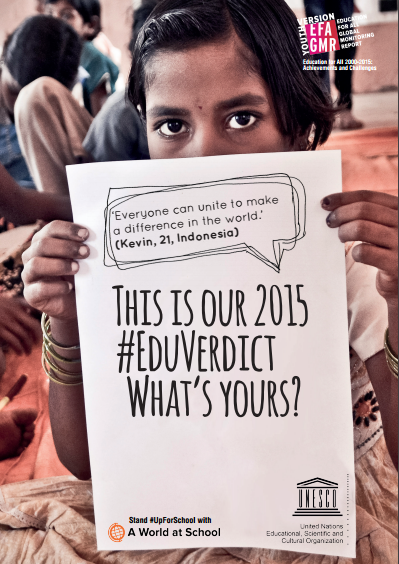 这是我们的2015 教育回望#EduVerdict 你的呢? 出版年份: 2015 机构作者: 联合国教科文组织 (UNESCO) This report highlights the progress and challenges that countries have faced over 15 years, brining together the voices of young people to show how Education for All (EFA) has affected their lives.
  Analysis of Determinants of a Measure of Sustainability Literacy 出版年份: 2017 作者: Aurélien Decamps 机构作者: UNESCO This paper highlights the contribution of the Sulitest to analyse the determinants of sustainability literacy in higher education. Sulitest is an open online training and assessment tool designed to assess and improve sustainability literacy. It is a multi-stakeholder initiative supported by several UN agencies and academic networks. Based on collaboration through the volunteer contribution of an international community, this tool aims to be internationally recognized and locally relevant by addressing global as well as local issues. With a growing community of more than 500 higher education institutions and other organizations from more than 50 countries, Sulitest begins to be recognized as a standard to assess and improve sustainability literacy. As the use of the tool is expanding, the data collected provides tangible indicators to map the current level of sustainability literacy and to monitor progress over time.