
相关资源
探索丰富的全球公民教育资源,深化理解,促进研究、倡导、教学与学习。
共找到730条结果
 UNESCO at COP23: Climate Change Education 出版年份: 2017 机构作者: UNESCO This brochure contains information about UNESCO's role of education in climate change through ESD(Education for Sustainable Development). Education for Sustainable Development (ESD) is increasingly recognized around the world as an effective enabler for a more sustainable future. Building climate change awareness and building capacities for adaptation and mitigation are critical dimensions of ESD. The critical role of education in climate change responses was clearly recognized at the Paris Climate Conference (COP21) in December 2015. COP22 in Marrakesh and COP23 in Bonn reiterate the importance of climate change education in achieving the global agendas.
 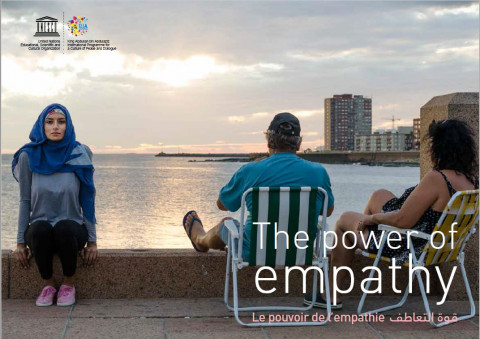 The Power of Empathy 出版年份: 2017 机构作者: UNESCO This photobook is a tribute to the power of empathy and solidarity felt and expressed by young people. Its photographs and stories were selected from the response to the global youth contest “If I were…”, launched by UNESCO on social media in Arabic, English, French and Spanish in early 2017. UNESCO received some 837 submissions, from 117 countries, covering a wide variety of issues and experiences.Despite the gravity of the themes addressed in these beautiful pictures, hope emerges from the testaments of the young photographers which demonstrate not only a sensitivity to the situations of “others”, but, moreover, a resolve to help people recover and protect their rights and dignity. Le Pouvoir de l'empathie 出版年份: 2017 机构作者: UNESCO This photobook is a tribute to the power of empathy and solidarity felt and expressed by young people. Its photographs and stories were selected from the response to the global youth contest “If I were…”, launched by UNESCO on social media in Arabic, English, French and Spanish in early 2017. UNESCO received some 837 submissions, from 117 countries, covering a wide variety of issues and experiences.Despite the gravity of the themes addressed in these beautiful pictures, hope emerges from the testaments of the young photographers which demonstrate not only a sensitivity to the situations of “others”, but, moreover, a resolve to help people recover and protect their rights and dignity. Cet ouvrage de photos rend hommage au pouvoir de l’empathie et aux sentiments de solidarité ressentis et exprimés par des jeunes. Les photographies et les textes qu’il contient ont été sélectionnés dans le cadre du concours mondial de la jeunesse « Et si j’étais… », lancé sur les réseaux sociaux de l’UNESCO en anglais, en arabe, en espagnol et en français, début 2017. L’UNESCO a reçu 837 candidatures de 117 pays, couvrant un large champ de questions et d’expériences. Malgré la gravité des thèmes abordés par chacune de ces superbes images, l’espoir se fait jour à mesure que les témoignages des jeunes photographes révèlent non seulement leur sensibilité à l’égard de la situation d’autrui, mais surtout une volonté d’aider les autres à recouvrer et à protéger leurs droits, leur dignité et la justice The Power of Empathy 出版年份: 2017 机构作者: 유네스코 This photobook is a tribute to the power of empathy and solidarity felt and expressed by young people. Its photographs and stories were selected from the response to the global youth contest “If I were…”, launched by UNESCO on social media in Arabic, English, French and Spanish in early 2017. UNESCO received some 837 submissions, from 117 countries, covering a wide variety of issues and experiences.Despite the gravity of the themes addressed in these beautiful pictures, hope emerges from the testaments of the young photographers which demonstrate not only a sensitivity to the situations of “others”, but, moreover, a resolve to help people recover and protect their rights and dignity.
  UNESCO World Heritage Education Programme 出版年份: 2013 机构作者: UNESCO The WORLD HERITAGE EDUCATION PROGRAMME gives young people a chance to voice their concerns and to become involved in the protection of our common cultural and natural heritage. Launched as a Special Project in 1994 by the United Nations Educational, Scientific and Cultural Organization (UNESCO), and officially called ‘Young People’s Participation in World Heritage Preservation and Promotion’, this programme seeks to encourage and enable tomorrow’s decision-makers to participate in heritage conservation and to respond to the continuing threats facing our World Heritage. Young people learn about World Heritage sites, about the history and traditions of their own and other cultures, about ecology and the importance of protecting biodiversity. They become aware of the threats facing the sites and learn how the international community works together to save our common heritage. Most importantly, they discover how they can contribute to heritage conservation and make themselves heard.
  MTB-MLE: mother tongue-based multilingual education; lessons learned from a decade of research and practice 出版年份: 2014 机构作者: UNESCO What role can language play in improving education for minority language communities? What are language rights? What place does Mother Tongue-Based Multilingual Education have in realizing other development goals?These important questions were addressed by the 4th International Conference on Language and Education. The conference brought together over 300 practitioners from 30 countries, reflecting the incredible diversity of the Asia-Pacific region and clearly demonstrating the importance of Mother Tongue-Based Multilingual Education (MTB-MLE). This brochure summarizes some of the key messages from this landmark event. MTB-MLE: langue maternelle basée sur l'éducation multilingue; les enseignements tirés d'une décennie de recherche et de pratique 出版年份: 2014 机构作者: UNESCO Quel rôle la langue peut jouer dans l'amélioration de l'éducation pour les communautés de langue minoritaire? Quels sont les droits linguistiques? Quelle est la place langue maternelle basée sur l'éducation multilingue ont dans la réalisation d'autres objectifs de développement?Ces questions importantes ont été abordées par la 4e Conférence internationale sur la langue et de l'éducation. La conférence a réuni plus de 300 praticiens de 30 pays, ce qui reflète l'incroyable diversité de la région Asie-Pacifique et démontre clairement l'importance de la langue maternelle basée sur l'éducation multilingue (MTB-MLE). Cette brochure résume les principaux messages de cet événement historique.
 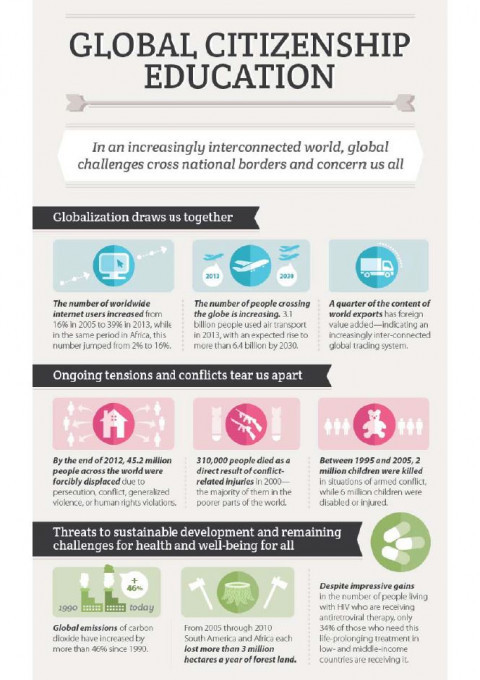 Global Citizenship Education infographic 出版年份: 2014 机构作者: UNESCO In an increasingly interconnected world, global challenges cross national borders and concern us all. With issues like these threatening human and environmental well-being, we need to re-think the role and relevance of education. We need Global Citizenship Education. Global Citizenship Education is transformative. What are the barriers to this kind of education? What needs to change in education? What is UNESCO doing? What can you do?
 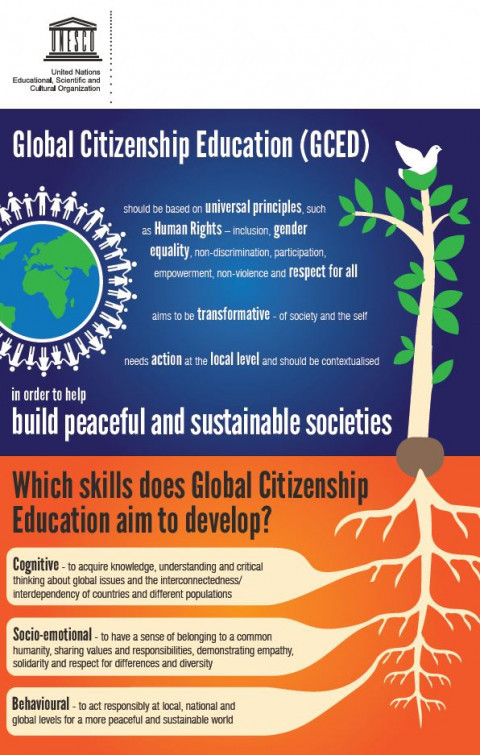 Global Citizenship Education (GCED) infographic 出版年份: 2015 机构作者: UNESCO Which skills does Global Citizenship Education aim to develop? How can effectively implement Global Citizenship Education? Who are the key players? Éducation à la citoyenneté mondiale infographique 出版年份: 2015 机构作者: UNESCO Quelles compétences pour l' Education citoyenneté mondiale visant à développer? Comment peut-on effectivement mettre en œuvre l'éducation à la citoyenneté mondiale? Quels sont les principaux acteurs?