
相关资源
探索丰富的全球公民教育资源,深化理解,促进研究、倡导、教学与学习。
共找到1,727条结果
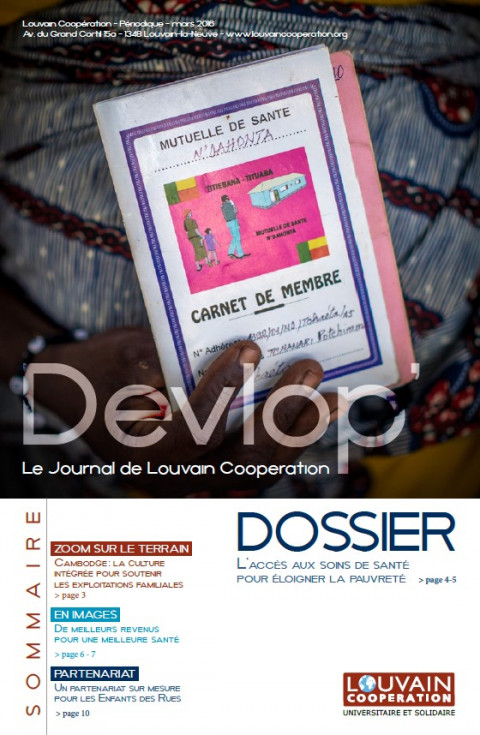 Devlop’ Le journal de Louvain Coopération 2 - Mars 2016 出版年份: 2016 机构作者: Louvain Coopération "2016 sera une annee charniere pour Louvain Cooperation" 2016 sera une annee charniere a beaucoup d’egards. Nous fetons les 10 ans d’un partenariat solide avec l’Union Nationale des Mutualites Libres, autour des mutuelles de sante au Benin et au Togo. Chaque annee la collaboration se renforce. Les echanges d’expertise se multiplient. Tout cela dans un contexte ou la protection sociale et la couverture maladie universelle sont en bonne place dans les agendas politiques africains. Au-dela des communes et districts, l’enjeu est national. Le programme MASMUT, alliant les differentes Unions mutualistes belges et leurs ONG partenaires , soutient ce plaidoyer. Differents modeles s’opposent. La mutuelle de sante est le seul qui repartit les responsabilites entre l’Etat, les prestataires de soins et les patients d’une maniere fonctionnelle et democratique. Mais 2016, c’est aussi l’annee de reflexions et decisions en vue de notre prochain plan strategique et notre programme 2017-2021. Une evaluation pointue de nos actions passees nous pousse a encore elargir notre comprehension des mecanismes sociaux ou culturels qui operent partout. Quels codes regissent les choix des micro-entrepreneurs, les reticences a adherer a une cooperative ou a une mutuelle, le type d’alimentation, la conception du bien-etre ? Nos equipes et partenaires, avec l’appui transdisciplinaire de l’UCL vont consacrer leur energie a ces analyses qui nourriront nos projets et actions. Enfin, 2016, ce sont aussi des nouveaux projets, de nouvelles zones d’intervention.
  Devlop’ Le journal de Louvain Coopération 3 - Octobre 2016 出版年份: 2016 机构作者: Louvain Coopération “Renforcer la collaboration entre ONG“ Quatre ONG universitaires belges, actives dans les pays du Sud et en Belgique, qui se rejoignent dans leurs domaines et lieux d’intervention, mais aussi dans leur specificite universitaire… Les points qui unissent Louvain Cooperation (ONG de l’UCL), ULB Cooperation (ONG de l’ULB), ADG (ONG de l’ULg-Gembloux) et la FUCID (ONG de l’UNamur) sont nombreux. Ces ONG ont en commun la realisation d’etudes ou de recherches-actions, la capitalisation des acquis, l’appel a des experts academiques universitaires, la diffusion la plus judicieuse possible des savoirs, la sensibilisation des etudiants a travers l’organisation de Campus Plein Sud… Ces collaborations existantes et points communs forment la base de l’idee d’une cooperation plus large, qui correspond a la dynamique du secteur de l’aide au developpement : rechercher des synergies, des apprentissages communs, des reseaux actifs. Les ONG, il faut bien l’admettre, ont souvent eu tendance a travailler de maniere trop isolee. A l’ere de la mondialisation, des nouvelles technologies de l’information et de la communication et des reseaux sociaux, il n’est plus possible, ni souhaitable de travailler dans son coin… Profitons au mieux de chacune des experiences, positive ou negative, des autres ! Juin 2016 fut donc une grande premiere dans l’histoire de ces quatre ONG : celles-ci ont decide de s’associer et de definir ensemble un programme quinquennal (2017-2021) qui vient d’etre soumis a la DGD pour une demande de financement commune. Ce programme comprend des actions au Sud dans les domaines de la Securite alimentaire et economique et de la Sante, et des actions en Belgique, d’Education a la Citoyennete Mondiale et Solidaire.
  SDG 4 on Ensuring Inclusive and Equitable Quality Education: A Toolkit of Legal & Institutional Practices 出版年份: 2019 机构作者: Centre for International Sustainable Development Law (CISDL) CISDL, in cooperation with the Dalhousie Schulich School of Law, Balsillie School of International Affairs/University of Waterloo, McGill University Faculty of Law/ Faculté de droit Université de Montréal, University of Victoria Peter A. Allard School of Law, and a consortium of institutional partners, held a multisite symposium on March 14, 2019 convening legal experts across Canada to discuss areas of opportunity to inform Canada’s 2030 agenda. This toolkit is a part of a series, which builds upon legal research conducted in collaboration with UN Environment. The by-projects of this research looking at legal measures for achievement of the SDGs in Canada is intended to inform policy-making moving forward.
  Accelerating Progress: An Empowered, Inclusive and Equal Asia and the Pacific 出版年份: 2019 机构作者: UN. Economic and Social Commission for Asia and the Pacific (UN. ESCAP) | Asian Development Bank (ADB) | United Nations Development Programme (UNDP) Accelerating progress: An empowered, inclusive and equal Asia and the Pacific responds to the theme of the 6th Asia Pacific Forum on Sustainable Development and the 2019 session of the high-level political forum on sustainable development.The report proposes a framework of four synergistic elements necessary to advance inclusion, empowerment and equality: rights and justice; norms and institutions; resources and capabilities; participation and voice. The need for action on all four fronts is illustrated by a deeper look at three pivotal challenges confronted by the region – (1) climate change and its potential to deepen inequality; (2) the urgent need to boost domestic resource mobilization; and (3) the need to strengthen social accountability and civic engagement. It draws out policy messages on how an empowerment-and-inclusion approach to policymaking can be fostered, including on addressing violence against women and girls. The report provides strong evidence that promoting empowerment and inclusion are necessary approaches to reduce inequality and accelerate progress towards a broad array of Sustainable Development Goals. It is a contribution to the ongoing national, regional and global dialogues on opportunities to empower people, ensure their inclusion and advance equality.The report is produced by the Asia-Pacific SDG partnership, comprising of the United Nations Economic and Social Commission for Asia and the Pacific (ESCAP), the Asian Development Bank, and the United Nations Development Programme.
 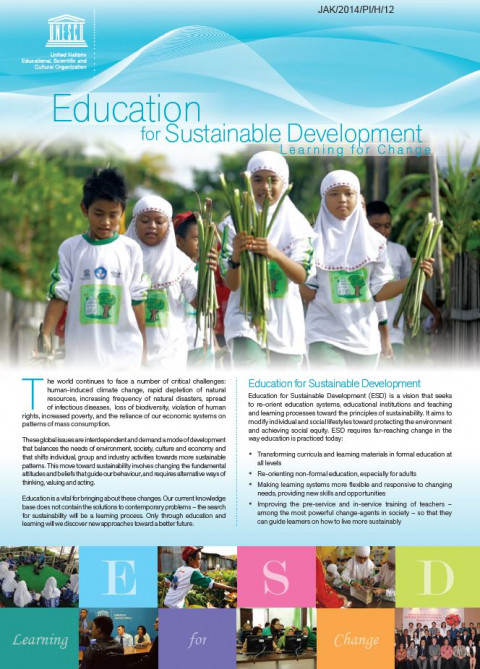 Education for Sustainable Development: Learning for Change 出版年份: 2014 机构作者: UNESCO Jakarta The world continues to face a number of critical challenges: human-induced climate change, rapid depletion of natural resources, increasing frequency of natural disasters, spread of infectious diseases, loss of biodiversity, violation of human rights, increased poverty, and the reliance of our economic systems on patterns of mass consumption. These global issues are interdependent and demand a mode of development that balances the needs of environment, society, culture and economy and that shifts individual, group and industry activities towards more sustainable patterns. This move toward sustainability involves changing the fundamental attitudes and beliefs that guide our behaviour, and requires alternative ways of thinking, valuing and acting. Education is a vital for bringing about these changes. Our current knowledge base does not contain the solutions to contemporary problems – the search for sustainability will be a learning process. Only through education and learning will we discover new approaches toward a better future.
  Developing Holistic Indicators to Promote the Internationalization of Higher Education in the Asia-Pacific 出版年份: 2018 作者: Da Wan Chang 机构作者: UNESCO Bangkok The internationalization of higher education has been emphasized by the global community to improve access and quality in higher education (SDG4.3), as well as to achieve other global goals by promoting cross-cultural understanding and tolerance. Even though the internationalization of higher education has diverse dimensions, ‘student mobility’ has been a predominant indicator and there are conceptual and methodological challenges in the existing sources of data and statistics. In addition to student mobility, this document proposes a holistic set of indicators to capture other important dimensions of the internationalization of higher education, such as alignment with international normative instruments, international networking, governance and management, as well as the mobility of academics and programmes, etc. The suggested indicators are categorized into domains on two levels: system and institutional. It is hoped that this policy brief will help users better understand and adapt the indicators for use in their local contexts, so as to promote the internationalization of higher education.
 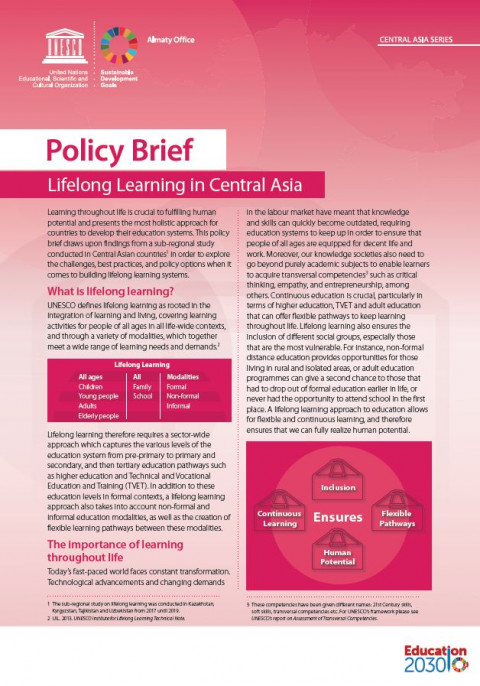 Аналитическая записка: Обучение на протяжении всей жизни в Центральной Азии 出版年份: 2019 机构作者: UNESCO Almaty Обучение на протяжении всей жизни занимает самое центральное место в глобальной повестке дня в области образования и ЦУР4 с обязательным обеспечением "инклюзивного и справедливого качественного образования и возможностей обучения на протяжении всей жизни для всех".Центральноазиатские системы образования добились успеха в обеспечении почти всеобщей грамотности, в том числе среди взрослых, а также во всеобщем предоставлении образования на начальном и среднем уровнях. Однако прежняя система Советского Союза привела к определенной негибкости систем образования в субрегионе, а также их неспособности быстро адаптироваться к разным потребностям учащихся, ставя сложную задачу в обеспечении обучения на протяжении всей жизни. Policy brief: lifelong learning in Central Asia 出版年份: 2019 机构作者: UNESCO Almaty Lifelong learning stands at the very core of the global education agenda and SDG 4, with a commitment to ensure ‘inclusive and equitable quality education and lifelong learning opportunities for all.Central Asian education systems have been successful in ensuring near-universal literacy, including among adults, as well as the universal provision of education at the primary and secondary levels. However, the legacy of the Soviet Union has resulted in a certain inflexibility of education systems in the sub-region, as well as their inability to rapidly adapt to the diverse needs of learners—posing a significant challenge to ensuring lifelong learning.
  Levels of learning are alarmingly low: if younger generations don't learn, how can they contribute to the sustainable development of Africa? 出版年份: 2018 机构作者: UNESCO Dakar | Regional Coordination Group on SDG 4-Education 2030 in West and Central Africa | Teaching and Learning Educators’ Network for Transformation With the adoption of The 2030 Agenda for Sustainable Development, UN member states and partner organizations have agreed to ensure inclusive and equitable quality education and promote lifelong learning opportunities for all by 2030. Building on the unfinished agendas of the Millennium Development Goals and Education for All, quality education and learning are at the very core of both SDG4 and CESA 16-25 (see box 1). Five of the seven SDG4 targets are specifically designed with the intention of addressing the global learning crisis. Moreover, CESA 16-25 specifically calls on African Union member states to address issues of quality and equity in education, particularly at the pre-primary level, a neglected area in terms of investment and policy, and at the primary level where geographical disparities indicate that girls and women, the poorest and those leaving in remote areas are still left behind. The next question is whether these international and regional commitments have been translated into national policies and strategies that can address the alarmingly low levels of learning. Les niveaux d'apprentissage sont alarmants: si les jeunes générations n'apprennent pas, peuvent-elles contribuer au développement durable de l'Afrique? 出版年份: 2018 机构作者: UNESCO Dakar | Regional Coordination Group on SDG 4-Education 2030 in West and Central Africa | Teaching and Learning Educators’ Network for Transformation Avec l’adoption de le Programme pour le développement durable à l’horizon 2030, les États membres de l’ONU et les organisations partenaires ont convenu d’assurer, d’ici 2030, une éducation inclusive et équitable de qualité et de promouvoir des possibilités d’apprentissage tout au long de la vie pour tous. S’appuyant sur les programmes inachevés des Objectifs du Millénaire pour le développement et de l’Éducation pour tous, l’éducation et les apprentissages de qualité sont au cœur même de l’ODD4 et de la CESA 16-25 (voir l’encadré 1 dans la section suivante). En effet, cinq des sept cibles de l’ODD4 sont spécifiquement formulées pour s’attaquer à la crise mondiale de l’apprentissage. En outre, la CESA 16-25 appelle spécifiquement les États membres de l’Union Africaine à aborder les questions de qualité et d’équité dans l’éducation, en particulier au niveau pré-primaire, un domaine négligé en termes d’investissements et de politiques, et au niveau primaire où les disparités géographiques laissent sur le côté les filles et les femmes, les plus pauvres et ceux qui vivent dans les zones reculées. La question est désormais de savoir si ces engagements internationaux et régionaux ont été traduits en politiques et stratégies nationalesqui peuvent s’attaquer aux niveaux alarmants des résultats d’apprentissage.