
相关资源
探索丰富的全球公民教育资源,深化理解,促进研究、倡导、教学与学习。
共找到684条结果
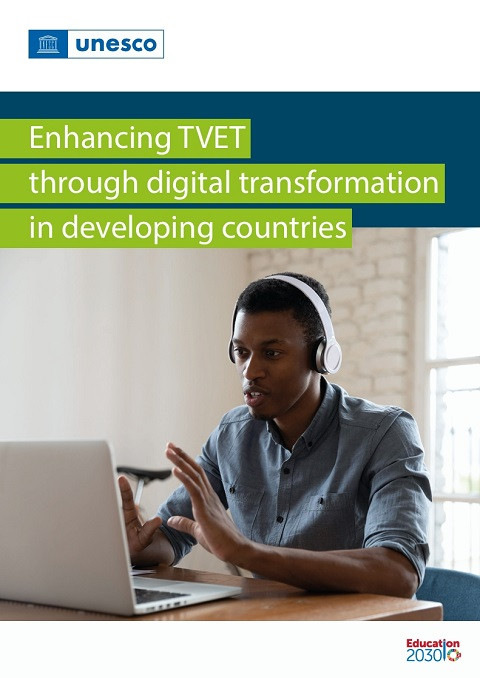 Enhancing TVET through Digital Transformation in Developing Countries 出版年份: 2023 机构作者: UNESCO Technological advancements and digitalization are profoundly reshaping our work and lifestyle, business models and operations, and government policy choices. Digital transformation in technical and vocational education and training (TVET) is the planned and structured introduction of automated and streamlined processes within institutions and national technical and vocational education and training (TVET) systems through digital technology, with the goal of enhancing their scope, scale, efficiency and effectiveness and ultimately, driving their more sustainable development. This document provides overall perspective and five country case studies on digital transformation in TVET. Most countries studied face similar enabling factors: the digital infrastructure available; legal and policy frameworks; focused institutional change to improve the acquisition of digital skills; and the promotion of equality and inclusivity. To understand how digital transformation in TVET is occurring, the report analyses it at four levels: technical and technological development; curriculum and qualifications; teaching and learning using technology; and its contribution to the sustainability and resilience of societies.
 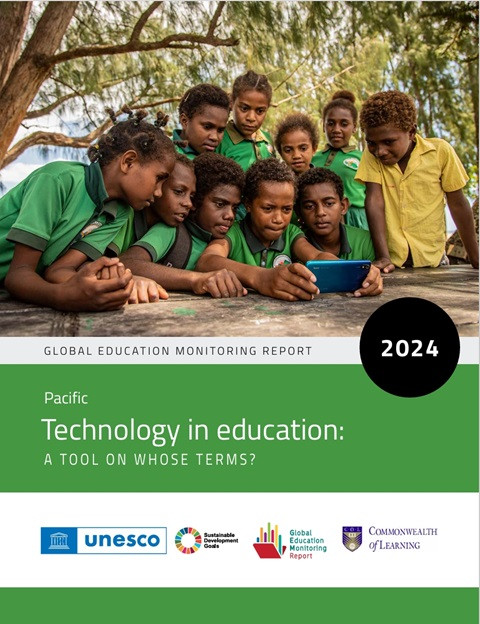 Global Education Monitoring Report 2024, Pacific: Technology in Education; A Tool on Whose Terms? 出版年份: 2024 机构作者: UNESCO | Global Education Monitoring Report Team | Commonwealth of Learning Information transmission and connectivity is crucial in the Pacific, a region characterized by high geographic dispersion. While the application of ICT in education has significant potentials, it is hindered by the region's limited and costly infrastructure. This edition accompanies the 2023 Global Education Monitoring Report, which acknowledges technology as a useful tool but invites the education community to question on whose terms it is deployed. The report considered four key policy areas of the Pacific Regional Education Framework (PacREF) (2018–2030): In terms of quality and relevance, mobile technology has offered an affordable and flexible approach to learning, and social media have improved communication between institutions, parents and learners. Moodle is the most widely used digital platform in the region. Textbooks are being digitalised and digital resources made available. Yet content is not always developed or adapted to local languages and cultural contexts. Open and distance learning has historically expanded learning pathways in the Pacific, specially in higher education and as a response to natural hazards. The University of South Pacific is a leading example of open and distance learning connecting campus across 12 countries. With the aim to enhance student outcomes and well-being, efforts have been made to incorporate digital skills into curricula and initiatives have increased outside formal education. Yet regulations do not adequately address threats from the use of technology to privacy, safety and well-being. With a focus on the teaching profession, countries leverage technology to provide training opportunities and transform the teaching profession. However, ICT training varies greatly across the region and limited digital infrastructure hinders technology integration into classrooms and teacher training. Three conditions need to be met for technology's potential to be fulfilled: equitable access to technology, appropriate governance and regulation, and sufficient teacher capacity. Supporting this publication is seven background thematic studies that provide a comprehensive overview of education technology issues; Commonwealth of Learning’s short case studies on some of its projects; a survey administered to key informed respondents from the region; and a series of country profiles on PEER, a policy dialogue resource describing policies and regulations related to technology in the region’s education systems.
 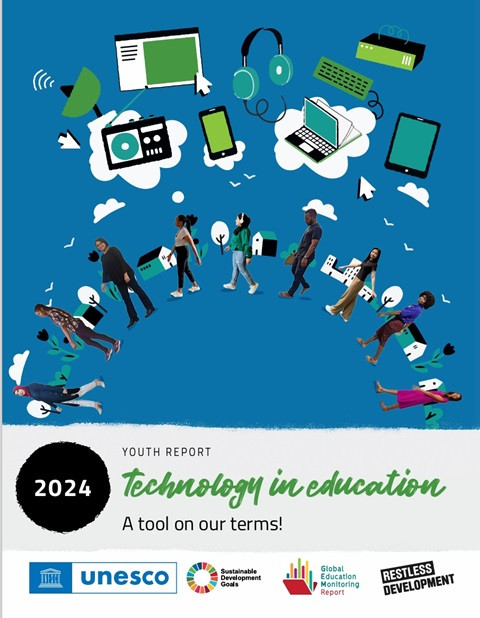 Youth Report 2024: Technology in Education; A Tool on Our Terms! 出版年份: 2024 机构作者: UNESCO | Global Education Monitoring Report Team | Restless Development The 2024 Youth Report on technology in education is the result of an extensive consultation process in partnership with Restless Development involving +1500 youth and students across 8 regions. The consultations invited participants to reflect on the key challenges and opportunities for the use of technology in education in their regions through the lenses of the recommendations in the global 2023 Global Education Monitoring Report on technology in education: Technology on our terms. The discussions centred on the need for the use of technology in education to be appropriate for national and local contexts and to be equitable and leave no one behind. The report calls for decisions about technology in education to keep learners at the centre when deciding whether the use of technology in education would be appropriate, equitable, evidence-based, and sustainable. Through this report, young people have described what technology on their terms would look like. It concludes with a call to action calling which highlights concrete recommendations that governments can follow to ensure that technology in education is on youth terms.
 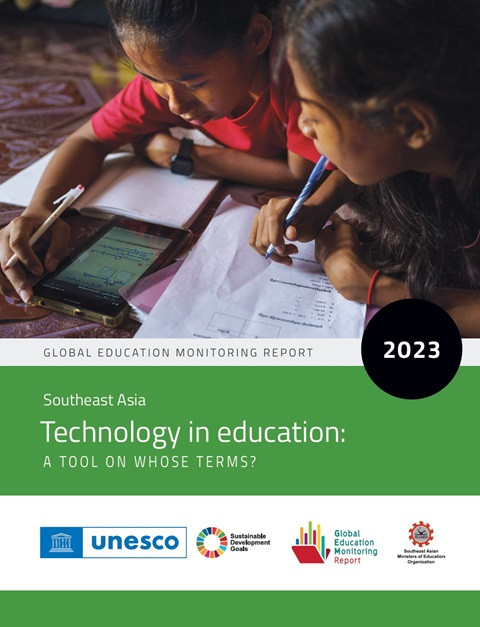 Global Education Monitoring Report 2023, Southeast Asia: Technology in Education; A Tool on Whose Terms? 出版年份: 2023 机构作者: Global Education Monitoring Report Team | Southeast Asian Ministers of Education Organization (SEAMEO) Developed in partnership with the Southeast Asia Ministers of Education Organization (SEAMEO), and with the contribution of EdTech Hub, the fifth regional report focuses on technology in education in Southeast Asia. Characterized by a variety of contexts and resources, Southeast Asia has experienced a rapid growth in digital technology applications. In education, digital technologies have been identified for their potential to transform education and meet the region’s development aspirations. The regional report investigates both challenges and potentials, which technology as a tool and as a process can potentially contribute to, across and within countries, and education levels. The regional report on Southeast Asia covers 11 countries, Brunei Darussalam, Cambodia, Lao PDR, Indonesia, Malaysia, Myanmar, Philippines, Singapore, Thailand, Timor-Leste and Viet Nam. Extensive background research informs the regional analysis: 9 country case-studies compiled by local research teams and independent experts; 5 thematic studies produced by SEAMEO centers on open and distance learning, technology for students with disabilities, integration of technology in teaching practices, key policies issues in ICT in education; technology in technical and vocational education and training, and 3 research inputs on ICT in education practices produced by SEAMEO affiliate members and partners.
  Global Education Monitoring Report 2023: Technology in Education; A Tool on Whose Terms? 出版年份: 2023 机构作者: UNESCO | Global Education Monitoring Report Team This report recommends that technology should be introduced into education on the basis of evidence showing that it would be appropriate, equitable, scalable and sustainable. In other words, its use should be in learners’ best interests and should complement face-to-face interaction with teachers. It should be seen as a tool to be used on these terms. Midway to the deadline, the 2023 Global Education Monitoring Report assesses the distance still to go to reach the 2030 education targets. Education is the key to unlocking the achievement of other development objectives, not least the goal of technological progress.
  Empowering Minds: A Round Table on Generative AI and Education in Asia-Pacific 出版年份: 2023 机构作者: UNESCO Bangkok The emergence of generative AI, a recent groundbreaking artificial intelligence (AI) technology capable of producing sophisticated content from text and images to simulations and audiovisuals, has become a transformative force across multiple sectors. Popular applications like OpenAI’s ChatGPT and Anthropic’s Claude are prime examples of the rapidly expanding range of generative AI tools that are having an impact in education across the Asia-Pacific. These tools offer unprecedented opportunities for enabling personalized learning experiences at scale and expanding access to high-quality learning resources. However, as generative AI increasingly reshapes classrooms, critical questions remain unanswered, such as:- How can generative AI be ethically and responsibly integrated into educational settings?- What policies and safeguards are needed to address issues like misinformation, algorithmic bias and threats to academic integrity?- What challenges do Asia-Pacific countries face in harnessing generative AI in education, given the region’s unique context?- What are the strategies for Asia-Pacific countries to take up opportunities offered by generative AI, while mitigating the risks? In response to these questions and emerging challenges in the region, the UNESCO Regional Office in Bangkok (UNESCO Bangkok), in collaboration with The Southeast Asian Ministers of Education Organization (SEAMEO), organized the regional experts meeting on 7-9 November 2023 in Bangkok, Thailand. This hybrid meeting, titled ‘Empowering Minds: A Round Table on Generative AI and Education in Asia-Pacific’, explored the implications of generative AI for teacher training and development. It served as an important platform to leverage opportunities and mitigate risks of generative AI in education across the Asia-Pacific region.
  Opportunities for Media and Information Literacy in the Middle East and North Africa: Yearbook 2016 出版年份: 2016 作者: Magda Abu-Fadil | Jordi Torrent | Alton Grizzle 机构作者: International Clearinghouse on Children, Youth and Media (Sweden) Opportunities for Media and Information Literacy in the Middle East and North Africa is the seventeenth Yearbook published by the Clearinghouse and fills a gap in the existing body of literature about the progress of media and information literacy work in different parts of the world. This book also helps educators in the Middle East and North Africa region looking for opportunities to bring to their classrooms elements of MIL education.
 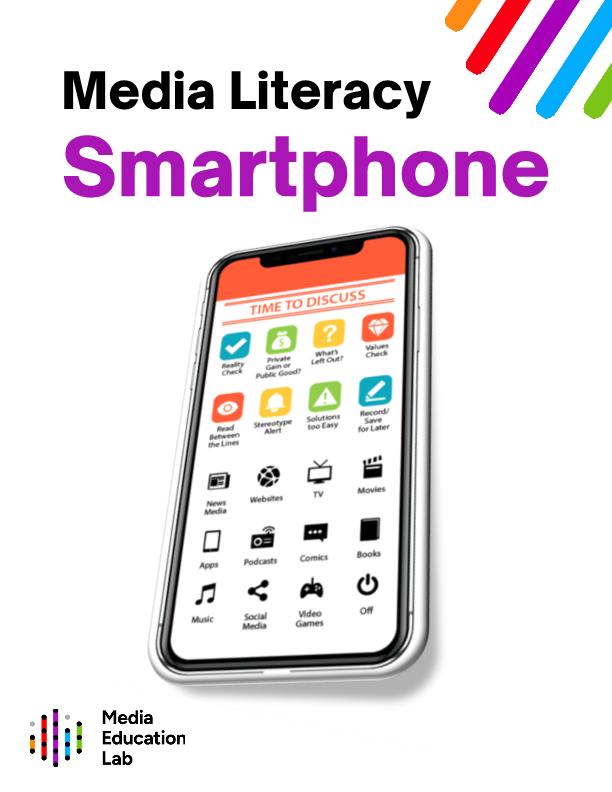 Media Literacy Smartphone 出版年份: 2020 作者: Renee Hobbs | Pam Steager 机构作者: Media Education Lab Learn how to use the Media Literacy Smartphone with learners of all ages! Download the free Learning Guide to bring the power of media literacy analysis to your learners!These easy-to-use cards, shaped exactly in the size of a smartphone, are available to educators for classroom use. You can use these simple paper cards to introduce a structured approach that helps students learn to critically analyze any media text --- web sites, books, advertising, news, TV shows, movies, video games, magazines and music. One side of the smartphone displays the various "apps" for analyzing a media text and the other side displays the "five critical questions" of media literacy developed by Renee Hobbs.Pair the smart phone with the LOVE IT OR HATE IT cards for a dynamic and fun learning experience.
 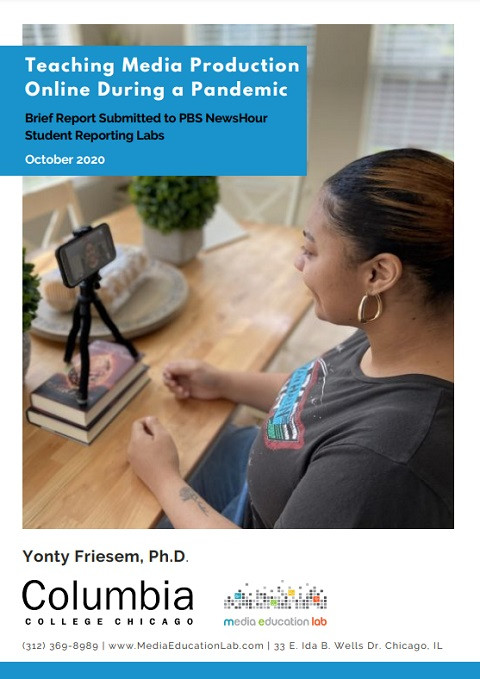 Teaching Media Production Online During a Pandemic: Brief Report Submitted to PBS NewsHour Student Reporting Labs 出版年份: 2020 作者: Yonty Friesem 机构作者: Media Education Lab How are media production teachers coping with remote video production with students?Starting in mid-March, US schools moved to remote instruction due to COVID-19 pandemic. Media production teachers had to shift their teaching to online without the possibility to use their high-end equipment in school. This report showcase the findings from Dr. Yonty Friesem’s research with media teachers who used the curriculum of PBS NewsHour Student Reporting Lab as they adapt to online and remote instruction. Dr. Friesem shared the report with PBS NewsHour Student Reporting Lab and the audience of the webinar.
  How to Understand Misinformation, Disinformation and Malinformation 出版年份: 2020 机构作者: Shout Out UK | U.S. Embassy London | Association for Citizenship Teaching (ACT) We live in a world where information is very easy to fabricate. Now more than ever, media literacy (the ability to critically analyse information) is critical for us as citizens and for our democracy to function. This video explains the difference between Misinformation, Disinformation and Malinformation and presents you with some examples! This video is part of a resource pack created and designed by Shout Out UK, supported by the US Embassy in London and in collaboration with the Association For Citizenship Teaching.For more info: https://www.shoutoutuk.org/media-literacy/