
相关资源
探索丰富的全球公民教育资源,深化理解,促进研究、倡导、教学与学习。
共找到1,443条结果
 التعليم والهوية ومنع التطرف: من منع التطرف العنيف إلى تعزيز السالم والصمود والمساواة في الحقوق والتعددية )PREP) 出版年份: 2017 作者: Sanam Anderlini 机构作者: International Civil Society Action Network فـي تشـرين الثانـي / نوفمبـر 2016 ، خـال منتـدى ايـكان ICAN السـنوي الخامـس للمـرأة والسـام واألمـن ، قــام أعضــاء التحالــف النســائي مــن أجــل القيــادة األمنيــة )وصــل( وغيرهــا مــن المنظمــات التــي تقودهــا النســاء فــي أكثــر مــن 30 دولــة بتحليــل دور التعليــم الرســمي وغيــر الرســمي فــي المســاهمة فــي تمكيــن الظـروف و تخفيـف العنـف المتطرف.كمـا قامـوا بتسـليط الضـوء علـى تجاربهـم العمليـة الخاصـة والـدروس المســتفادة مــن توفيــر التعليــم لمنــع التطــرف العنيــف مــن خــال تعزيــز الســام والصمــود والمســاواة فــي الحقـوق والتعدديـة )PREP )فـي المسـاحات الرسـمية وغيـر الرسـمية، بمـا فـي ذلـك مـن خـال تعاليـم بديلـة إلـى جنـب مع األبحـاث المكتبيـة حـول حالـة السياسـات والممارسـات للروايـات الدينيـة.إن تجاربهـم، جنبـا الحاليــة، وأول اجتماع للمنصــة العالميــة لتبــادل الحلــول )GSX ) حــول العالقــة بيــن التعليــم والجنــدر والتطـرف الـذي عقـد فـي مقـر اليونسـكو فـي باريـس فـي مـارس 2017 ، تقـوم بإبـاغ نتائج هـذا التقريـر .
  To live together: shaping new attitudes to peace through education 出版年份: 1997 作者: Daniel S. Halpérin 机构作者: UNESCO International Bureau of Education (IBE) The ‘To live together’ initiative was born at a meeting in February 1996 with Professor Emeritus Antoine Cuendet, a pediatric surgeon, former Dean of the Faculty of Medicine at Geneva University, and chairman of the Geneva Foundation to Protect Health in War (hereafter the Geneva Foundation). His foundation was in a process of trying to better define its scope of action within the large theme of ‘health and war’, and to identify areas of research that would deserve priority support. We agreed that, at a time when politicians had entered an era of peacemaking in the Middle-East, the situation might be suitable for Palestinians and Israelis to venture into joint research projects. In particular, a potentially fruitful project could be to examine the effects of long term, protracted conflicts-such as the Israeli-Palestinian one-on the mental and social health of children. Little was known about how much of their anxiety, psychosomatic complaints, agressivity, behavioural disorders or school failures may be linked with direct or indirect consequences of the conflict. What were the interventions or instruments that may counterbalance, or even correct such problems? Was there any kind of an educational programme, for instance, that might be demonstrated to be efficacious in counteracting those putative effects of the conflict; and that might prove of value in actually accelerating the healing of the traumatisms, while simultaneously strengthening the construction of peace? Pour vivre ensemble: l'élaboration de nouvelles attitudes à la paix par l'éducation 出版年份: 1997 作者: Daniel S. Halpérin 机构作者: UNESCO International Bureau of Education (IBE) L'initiative «Pour vivre ensemble» est né lors d'une réunion en Février 1996 avec le professeur Emeritus Antoine Cuendet, un chirurgien pédiatrique, ancien doyen de la Faculté de médecine de l'Université de Genève et président de la Fondation de Genève pour la protection de la santé dans la guerre (ci-après Fondation de Genève). Sa fondation était en train d'essayer de mieux définir son champ d'action au sein du grand thème de «la santé et de la guerre», et d'identifier les domaines de recherche qui mériterait un soutien prioritaire. Nous avons convenu que, à un moment où les politiciens étaient entrés dans une ère de rétablissement de la paix au Moyen-Orient, la situation pourrait être appropriée pour les Palestiniens et les Israéliens à se lancer dans des projets de recherche conjoints. En particulier, un projet potentiellement fructueux pourrait consister à examiner les effets de long terme, les conflits prolongés, tels que celui sur la santé israélo-palestinien mental et social des enfants. On ne savait pas combien de leur anxiété, troubles psychosomatiques, agressivité, troubles du comportement ou des échecs scolaires peuvent être liés avec des conséquences directes ou indirectes du conflit. Quelles ont été les interventions ou les instruments qui peuvent contrebalancer, voire corriger ces problèmes? Y avait-il tout type d'un programme d'éducation, par exemple, qui pourrait être démontré pour être efficace dans la lutte contre les effets putatifs du conflit; et qui pourrait se révéler utile pour accélérer effectivement la guérison des traumatismes, tout en renforçant simultanément la construction de la paix?
  The Role of Education in Countering Violent Extremism 出版年份: 2013 机构作者: Center on Global Counterterrorism Cooperation and Hedayah On 18 and 19 September 2013, the Center on Global Counterterrorism Cooperation (CGCC) and Hedayah co-hosted in New York City an expert roundtable on “The Role of Education in Countering Violent Extremism.” The meeting brought together a group of policy-makers, researchers and practitioners to discuss challenges and best practices related to efforts to counter violent extremism through education. The Role of Education in Countering Violent Extremism 出版年份: 2013 机构作者: Center on Global Counterterrorism Cooperation and Hedayah Les 19 et 20 septembre 2013, le Centre de coopération internationale pour la lutte contre le terrorisme (Center on Global Counterterrorism Cooperation, CGCC) et Hedayah ont accueilli une table ronde d'experts, à New York, sur « le rôle de l'éducation pour lutter contre l'extrémisme violent » (The Role of Edcuation in Countering Violent Extremism). Cet événement a réuni des décideurs politiques, des chercheurs et des praticiens afin de discuter des défis et des meilleures pratiques dans les efforts réalisés pour lutter contre l'extrémisme violent par l'éducation. Final report of the roundtable: challenges of education for peace, intercultural and inter-religious dialogue in Georgia, Armenia and Azerbaijan 出版年份: 2007 机构作者: Union Century 21 (Georgia) The Roundtable Meeting was organized in Tbilisi in June, (24 -27) 2007. The meeting gathered participants of the ToT course in all three countries of the Caucasus, which happened to be a sort of “première” given the region’s tensions. It was important to bring together teachers and social workers from 18 regions of Georgia as well as from the neighboring countries like Azerbaijan and Armenia ( a total amount of 40 persons (some travelled at their own expenses). Civil Society was thus well represented and will be involved in project realization with a multiplier effect once they get back to the regions or countries. The tentative programme of the meeting identifies common challenges in this field and setting up of common action plan in addressing them. This was possible with the notable participation of a facilitator and the openness of those who attended this workshop. They were also keen to draw attention to the authorities from their educational systems to implement these grassroots activities so as to attract attention not only on a regional level but on the international level too and inform international organizations about the outcomes as well as the further steps planned. Inter-agency peace education programme: skills for constructive living; overview of the programme 出版年份: 2005 作者: Antonella Verdiani 机构作者: UN. Office of the United Nations High Commissioner for Refugees (UNHCR) | Inter-agency Network for Education in Emergencies (INEE) This manual is one of the components of the “Inter-Agency Peace Education Programme”. The programme is designed for education managers of ministries dealing with both formal and non-formal education and for agencies which implement education activities on behalf of the government. The implementation structure is based on the experience acquired over the eight years the programme has been in use, from 1998 to 2005. The programme has been evaluated by external experts and the new revised materials (2005) incorporate both the suggestions made in the evaluation and the feedback from the specialists who implemented it in the field. Programme Interinstitution d'éducation pour la paix: compétences pour la vie constructive; aperçu du programme 出版年份: 2005 作者: Antonella Verdiani 机构作者: UN. Office of the United Nations High Commissioner for Refugees (UNHCR) | Inter-agency Network for Education in Emergencies (INEE) Ce manuel est l'une des composantes du «Programme Interinstitution d'éducation pour la paix». Le programme est conçu pour les gestionnaires de l'éducation des ministères chargés de l'éducation formelle et non-formelle et pour les organismes qui mettent en œuvre des activités d'éducation au nom du gouvernement. La structure de mise en œuvre est basée sur l'expérience acquise au cours des huit années, le programme a été utilisé, de 1998 à 2005. Le programme a été évalué par des experts externes et les nouveaux matériaux révisés (2005) intègrent à la fois les suggestions formulées dans l'évaluation et les réactions des spécialistes qui œuvre dans le domaine.
 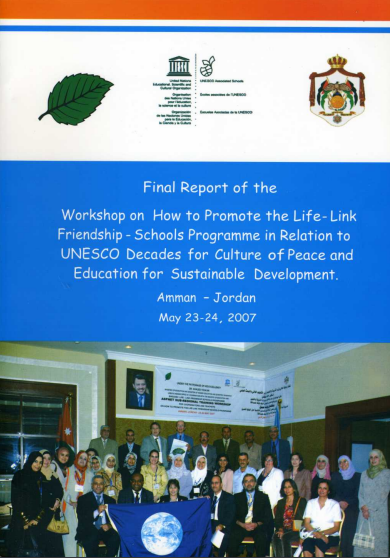 Final report of the workshop on how to promote the life-link friendship-schools programme in relation to UNESCO decades for culture of peace and education for sustainable development, Amman, Jordan, May 23-24, 2007 出版年份: 2007 机构作者: UNESCO Amman This chapter provides a brief summary of the speeches presented at the official opening and closing ceremonies as well as presentations delivered by the experts of Life-Link and UNESCO staff at the two day workshop The sub-regional workshop for ASPnet National Coordinators and Life-Link Friendship Schools Programme, organized in close collaboration with the Ministry of Education, was constructed according to the following format: (i). An organizing Committee was formed comprising of staff from the Ministry of Education and UNESCO Amman Office and Chairperson of Life-Link Programme. The committee oversaw the organization, preparation of documentation, venue, draft agenda, logistic and procedural aspects of the workshop. (ii). The selection of participants for the workshop was done by the National Commissions for UNESCO to Lebanon, Palestine, Iraq, Egypt, Oman and Jordan. The participating Arab Countries were selected by UNESCO Office-Amman and Life-Link. (iii).The selected participants comprised the National Coordinators and teachers for ASPnet in their countries. A member from Life-Link in Jordan was invited as an observer for the workshop. (iv).The resource persons (trainers) for the workshop were carefully selected on the basis of their expertise, experience and relevance to the main subjects of the workshop. The experts came from the Ministry of Education, Life-Link, UNESCO and UNRWA. (v). The format of the workshop was basically structured to firstly provide an overview and background of the Life-Link Friendship Schools Programme and ASPnet, followed by experts' presentations relevant to the main subjects of Life-Link Programme. The workshop also had three sessions of discussion on the different aspects of Life Link Programme. Participants were circulated to these sessions one after another. The workshop also had a session on how to plan for implementing peace actions as Extra Curricula Activities in schools. (vi). The ASPnet national workshop was organized under the patronage of his Excellency Dr. Khaled Toukan, the Minister of Education and the Minister of Higher Education & Scientific Research and Chairman of the Jordan National Commission for UNESCO. Rapport final de l'atelier sur la façon de promouvoir le programme de liaison de vie amitié écoles par rapport aux décennies UNESCO pour la culture de la paix et de l'éducation pour le développement durable, Amman, Jordanie, 23 au 24 mai 2007 出版年份: 2007 机构作者: UNESCO Amman Ce chapitre présente un bref résumé des discours présentés lors de l'ouverture officielle et de clôture ainsi que les présentations faites par les experts de Life-Link et personnel de l'UNESCO à l'atelier de deux jours. L'atelier sous-régional pour réseau des coordonnateurs nationaux et de Life-Link Programme des Écoles Amitié, organisée en étroite collaboration avec le Ministère de l'éducation, a été construit selon le format suivant: (i). Un comité d'organisation a été formé, comprenant des membres du personnel du ministère de l'Education et le Bureau UNESCO à Amman et présidente programme Life-Link. Le comité a supervisé l'organisation, la préparation de la documentation, le lieu, le projet de l'ordre du jour, la logistique et les aspects procéduraux de l'atelier. (Ii). La sélection des participants de l'atelier a été fait par les Commissions nationales pour l'UNESCO au Liban, en Palestine, en Irak, en Egypte, à Oman et en Jordanie. Les pays arabes participants ont été sélectionnés par l'UNESCO Bureau-Amman et Life-Link. (Iii). Les participants sélectionnés comprennent les coordonnateurs nationaux et les enseignants pour Réseau dans leur pays. Un membre de la Life-Link en Jordanie a été invité à titre d'observateur à l'atelier. (Iv). Les personnes ressources (formateurs) pour l'atelier ont été soigneusement sélectionnés sur la base de leur expertise, de l'expérience et de la pertinence des principaux sujets de l'atelier. Les experts provenaient du ministère de l'Education, Life-Link, l'UNESCO et l'UNRWA. (V). Le format de l'atelier a été essentiellement structuré pour fournir d'abord une vue d'ensemble et contexte de Life-Link Programme Amitié Ecoles et Reseau, suivie par les présentations des experts compétents pour les sujets principaux programme Life-Link de. L'atelier a également eu trois séances de discussion sur les différents aspects du Programme Life Link. Les participants ont été distribués à ces sessions un après l'autre. L'atelier a également eu une séance sur la façon de planifier la mise en œuvre des actions de paix en tant Activités extra curricula dans les écoles. (Vi). L'atelier national a été organisé reseau sous le patronage de son excellence Dr. Khaled Toukan, Ministre de l'Éducation et le Ministre de l'Enseignement Supérieur et de la Recherche et Président de la Commission Nationale Jordanienne pour l'UNESCO Scientifique.