
相关资源
探索丰富的全球公民教育资源,深化理解,促进研究、倡导、教学与学习。
共找到875条结果
 Le Prisme de l'éducation pour le développement durable: un outil d'analyse des politiques et des pratiques 出版年份: 2010 机构作者: Organisation des Nations Unies pour l'éducation, la science et la culture (UNESCO) The Education for Sustainable Development (ESD) Lens has been prepared to support UN Member States to respond to these challenges through implementation of the United Nations Decade of Education for Sustainable Development (DESD, 2005- 2014). The ESD Lens supports the goals of the DESD, and encourages policy-makers and practitioners in Member States to initiate the process of re-orienting education, particularly the formal education system, towards sustainable development. The overall goal of the UN Decade of Education for Sustainable Development (DESD) is for countries to integrate the understandings, skills and values inherent in sustainable development into all aspects of national education plans to encourage changes in lifestyles and behaviour that allow for a more sustainable and just society for all. This complements existing Education for All initiatives, and strengthens the objectives of the Millennium Development Goals. Education for Sustainable Development has the potential to improve the quality and relevance of education everywhere. عدسة التعليم من أجل التنمية المستدامة أداة استعراض السياسات والممارسات 出版年份: 2010 机构作者: UNESCO The UN Decade of Education for Sustainable Development (DESD) calls on the Governments to consider the inclusion of measures to implement the Decade in their respective education systems and strategies and, where appropriate, into national development plans’.2 This ESD Lens provides tools to start this process. It can be adapted to different educational contexts, and country specific policy and practice needs. It is not prescriptive, but provides guidelines and starting points for reviewing education policy and practice using an ESD perspective. ESD Lens Review Tools are provided for planning, for building knowledge of ESD, for reviewing national policy and the aims of education, for reviewing quality learning outcomes, and for reviewing more specific and detailed aspects of the education system such as curriculum, learning materials, assessment and teacher education. The tool is flexible and can be used at different levels of the system.Some of the tools are more suited to policy-makers, while others can be used by teachers and principals in schools. Ideally they should all be used to ensure a more systemic re-orientation of the education system in a country, province, region or district.The pilot testing of the ESD Lens showed that it helps to build synergy for understanding and implementing ESD at national level and at sub-regional levels. The key question being addressed by the ESD Lens is:How can education policies, curriculum and other support processes sufficiently integrate the principles of ESD to inform and strengthen the quality of learning experiences for sustainable development? التعليم للجميع في أمريكا اللاتينية والكاريبي، ليما، بيرو، 30-31 تشرين الأول/أكتوبر 2014 : بيان ليما 出版年份: 2014 机构作者: منظمة الأمم المتحدة للتربية والعلم والثقافة (UNESCO) The Ministers of Education of Latin America and the Carribean (LAC), high-level government officials, UN agencies, representatives of civil society organizations and development partners, gathered at th meeting on "Education for All (EFA) in Latin America and the Carribean: Assessment of progress and post-2015 challenges", in Lima, Peru, from 30 to 31 October 2014. Having deliberated on progress towards EFA in the region, the Muscat Agreement adopted at the Global EFA Meeting (GEM) in Muscat, Oman, 12-14 May 2014, and the outcome document of the UN General Assembly Open Working Group for Sustainable Development Goals, and having examined the unfinished EFA tasks in the region, as well as the challenges and priorities that will configure the post-2015 education agenda for the region, the Lima Statement was adopted. Joint E-9 Statement on Education Beyond 2015: Islamabad Statement 出版年份: 2014 机构作者: UNESCO This statement is adopted by the participants of the 10th E-9 Ministerial Review Meeting held in Islamabad, Pakistan, on November 27-28, 2014. They have taken stock of the progress made since 2000 and challenges remaining in the nine countries in achieving the six Education for All (EFA) goals, and reflected on the priorities and prospects for each country to sustain and further advance educational development beyond 2015. Their deliberations were based on a careful examination of the National EFA 2015 Reviews of the countries concerned, the Muscat Agreement adopted at the Global Education for All Meeting (Muscat, Oman, 12-14 May 2014), the Outcome Document of the United Nations General Assembly Open Working Group on Sustainable Development Goals, and took into account the Aichi-Nagoya Declaration on Education for Sustainable Development as well as the changing global environment that shapes the cooperation among the E-9 countries. Joint E-9 Déclaration sur l'éducation Au-delà de 2015: Déclaration Islamabad 出版年份: 2014 机构作者: Organisation des Nations Unies pour l'éducation, la science et la culture (UNESCO) Cette déclaration est adoptée par les participants de la 10e E-9 Réunion Ministérielle tenue à Islamabad, au Pakistan, le 27-28 Novembre 2014. Ils ont fait le point sur les progrès réalisés depuis 2000 et des défis restant dans les neuf pays dans la réalisation des six éducation pour tous (EPT), et réfléchi sur les priorités et les perspectives de chaque pays pour soutenir et faire progresser le développement de l'éducation au-delà de 2015. Leurs délibérations se sont fondées sur un examen attentif des nationaux EPT 2015 Avis sur les pays concernés, le Muscat Accord adopté à l'éducation globale pour tous Réunion (Muscat, Oman, 12-14 mai 2014), le document final du groupe de travail à composition Assemblée Générale des Nations Unies sur les objectifs de développement durable, et a pris en compte la Déclaration d'Aichi-Nagoya sur l'éducation pour développement durable, ainsi que l'évolution du contexte mondial qui façonne la coopération entre les pays E-9.
 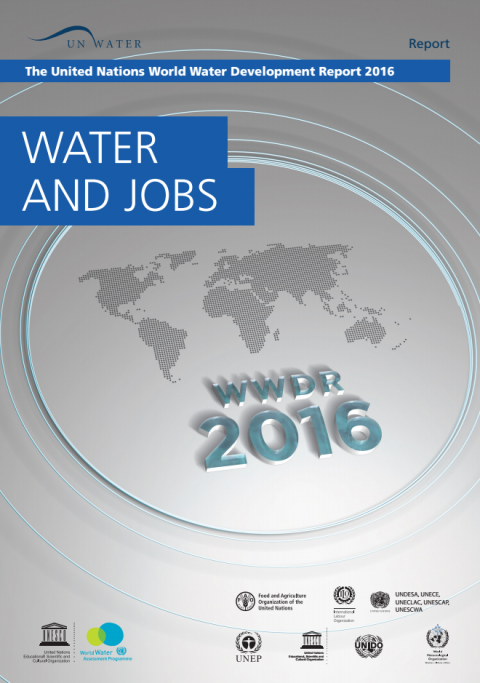 Informe de las Naciones Unidas sobre el desarrollo de los recursos hídricos en el mundo 2016: agua y empleo 出版年份: 2016 机构作者: UNESCO Three out of four jobs worldwide rely on water. As such, water shortages and lack of access may limit economic growth in the years to come, according to the World Water Development Report 2016. From its collection, through various uses, to its ultimate return to the natural environment, water is a key factor in the development of job opportunities either directly related to its management (supply, infrastructure, wastewater treatment, etc.) or in economic sectors that are heavily water-dependent such as agriculture, fishing, power, industry and health. In its analysis of the economic impact of access to water, the report cites numerous studies that show a positive correlation between investments in the water sector and economic growth. It also highlights the key role of water in the transition to a green economy. 九个人口大国关于2015年后教育的联合声明 : 伊斯兰堡声明 出版年份: 2014 机构作者: 联合国教科文组织 (UNESCO) This statement is adopted by the participants of the 10th E-9 Ministerial Review Meeting held in Islamabad, Pakistan, on November 27-28, 2014. They have taken stock of the progress made since 2000 and challenges remaining in the nine countries in achieving the six Education for All (EFA) goals, and reflected on the priorities and prospects for each country to sustain and further advance educational development beyond 2015. Their deliberations were based on a careful examination of the National EFA 2015 Reviews of the countries concerned, the Muscat Agreement adopted at the Global Education for All Meeting (Muscat, Oman, 12-14 May 2014), the Outcome Document of the United Nations General Assembly Open Working Group on Sustainable Development Goals, and took into account the Aichi-Nagoya Declaration on Education for Sustainable Development as well as the changing global environment that shapes the cooperation among the E-9 countries. البيان المشترك للبلدان التسعة ذات الأعداد الضخمة فيما يخص التعليم في مرحلة ما بعد عام 2015 出版年份: 2014 机构作者: منظمة الأمم المتحدة للتربية والعلم والثقافة (UNESCO) This statement is adopted by the participants of the 10th E-9 Ministerial Review Meeting held in Islamabad, Pakistan, on November 27-28, 2014. They have taken stock of the progress made since 2000 and challenges remaining in the nine countries in achieving the six Education for All (EFA) goals, and reflected on the priorities and prospects for each country to sustain and further advance educational development beyond 2015. Their deliberations were based on a careful examination of the National EFA 2015 Reviews of the countries concerned, the Muscat Agreement adopted at the Global Education for All Meeting (Muscat, Oman, 12-14 May 2014), the Outcome Document of the United Nations General Assembly Open Working Group on Sustainable Development Goals, and took into account the Aichi-Nagoya Declaration on Education for Sustainable Development as well as the changing global environment that shapes the cooperation among the E-9 countries. Declaración Conjunta del Grupo E-9 sobre la Educación Después de 2015: Declaración de Islamabad 出版年份: 2014 机构作者: Organización de las Naciones Unidas para la Educación, la Ciencia y la Cultura (UNESCO) This statement is adopted by the participants of the 10th E-9 Ministerial Review Meeting held in Islamabad, Pakistan, on November 27-28, 2014. They have taken stock of the progress made since 2000 and challenges remaining in the nine countries in achieving the six Education for All (EFA) goals, and reflected on the priorities and prospects for each country to sustain and further advance educational development beyond 2015. Their deliberations were based on a careful examination of the National EFA 2015 Reviews of the countries concerned, the Muscat Agreement adopted at the Global Education for All Meeting (Muscat, Oman, 12-14 May 2014), the Outcome Document of the United Nations General Assembly Open Working Group on Sustainable Development Goals, and took into account the Aichi-Nagoya Declaration on Education for Sustainable Development as well as the changing global environment that shapes the cooperation among the E-9 countries. Panorámica regional: América Latina y el Caribe 出版年份: 2011 机构作者: UNESCO The past decade has seen mixed progress towards Education for All (EFA) in Latin America and the Caribbean. More children are participating in pre-school education, many countries have achieved universal primary education and more students are moving from primary to secondary education. Gender parity has been achieved at the primary level in the majority of countries and adult literacy rates are improving. The region invests a relatively high share of national income in education and external aid to basic education has increased in recent years. However, challenges remain. The Caribbean has seen a decline by nearly one-tenth in primary enrolment ratios and 2.9 million children were not enrolled in school in the region as a whole in 2008. Some 36 million adults are still illiterate and levels of learning achievement are low in many countries. The 2011 EFA Global Monitoring Report puts the spotlight on armed conflict and one of its most damaging yet least reported consequences: its impact on education. Conflict-affected states have some of the world’s worst indicators for education. The Report documents the scale of this hidden crisis in education, looks at its underlying causes and explores the links between armed conflict and education. It also presents recommendations to address identified failures that contribute to the hidden crisis. It calls on governments to demonstrate greater resolve in combating the culture of impunity surrounding attacks on schoolchildren and schools, sets out an agenda for fixing the international aid architecture and identifies strategies for strengthening the role of education in peacebuilding.