
相关资源
探索丰富的全球公民教育资源,深化理解,促进研究、倡导、教学与学习。
共找到1,477条结果
 Éducation globalein Lithuania: challenges and opportunities 出版年份: 2014 作者: Indrė Augutienė | Zina Baltrėnienė 机构作者: Lithuanian Development Education and Cooperation Network of Non-governmental Institutions (Association LITDEA) | Lithuanian National Non-Governmental Development Cooperation Organisations‘ Platform (NGDO Platform) La publication a été réalisée la mise en œuvre du projet « Partenariat Qualité pour le projet de développement de l'UE Présidence de la présidence lituanienne de l'UE, 2013 »(no. DCINSA ED / 2013 / 319-124). Aujourd'hui, nous vivons dans un monde en constante évolution qui est lié par l'esprit des relations entre les peuples, les pays et les cultures, et qui présente divers défis et opportunités. Chaque jour, nous devons résoudre de nombreux problèmes économiques, sociaux et environnementaux qui nous relie avec d'autres pays, leurs cultures et leurs citoyens et de fournir une occasion pour nous tous de faire partie d'une société mondiale. Pour acept les possibilités offertes par les processus de mondialisation et faire face aux nouveaux défis, il est nécessaire de créer les conditions pour les gens à acquérir les connaissances sur les réalités mondiales, les problèmes de développement mondiaux émergents et à les relier à leur propre vie. Il est également important de fournir les possibilités pour les personnes à acquérir les compétences et de renforcer les valeurs propres à faciliter la citoyenneté mondiale active et la responsabilité. Les problèmes mondiaux de plus en plus d'impact sur la vie de tout le monde à travers le monde, nous devons donc réaliser que nous faisons partie du monde avec la pauvreté qui prévaut encore, les inégalités sociales, le changement climatique et les problèmes de réchauffement planétaire. Dans la société actuelle, il est particulièrement important de veiller à ce que les différentes formes d'éducation d'améliorer la compréhension des gens sur les défis ci-dessus et de leur impact sur le développement personnel, communautaire, national et mondial. Éducation globaleis dirigée vers la formation et le développement des compétences, les connaissances des personnes et des valeurs qui facilitent la compréhension et la réponse aux défis du 21e siècle. Jusqu'à présent, le concept de l'éducation globalewas pas validée dans les documents nationaux. Aujourd'hui, les organisations non-gouvernementales discutent activement de cette question avec la société académique et avec les Ministères des Affaires Étrangères / et de l'éducation et de la science représentant l'état dans la zone ci-dessus. Par ailleurs, la Lituanie n'a pas encore mis au point une formation globalestrategy uniforme, mais la dimension de l'éducation globaleis inclus dans plusieurs documents spécifiques de la politique nationale. Compte tenu de cela, cet article examine les conditions préalables à l'intégration de l'éducation globaleset énoncées dans les principaux actes juridiques définissant le développement durable, la coopération au développement et de l'éducation de la Lituanie. Ce document fournit un examen de la globaleconcept Éducation, conditions préalables à sa mise en œuvre et la description de la situation actuelle en Lituanie. Il comprend également les propositions pour un développement réussi d’activités mondiales de l'éducation dans notre pays.
  Отчет об общественном мониторинге законодательства и правоприменительной практики местной полицейской службы в сфере предупреждения и профилактики бытового насилия в РК 出版年份: 2017 作者: S.V. Korneytchuk | N.S. Gladyr 机构作者: OSCE. Programme Office in Astana Основной целью настоящего мониторинга является деятельность по оценке и прогнозированию законодательства путем выявления противоречий в законодательстве, устаревших, коррупциогенных и неэффективно реализуемых норм права, а также выработка предложений по совершенствованию законодательства и механизмов его реализации подразделениями местной полицейской службы. Это издание опубликовано при финансовой поддержке Офиса программ ОБСЕ в Астане в рамках проекта «Общественный мониторинг законодательства и правоприменительной практики местной полицейской службы в сфере предупреждения и профилактики бытового насилия в РК».
  Formation pilote sur la paix et la citoyenneté mondiale 出版年份: 2020 机构作者: UNESCO Dakar Du 6 au 8 décembre 2019, une formation sur l'éducation pour la paix et la citoyenneté mondiale des adolescents s’est tenue à Guédiawaye, dans la banlieue de Dakar, à destination des jeunes du Sénégal et de la sous-région.
  Education for Global Citizenship 出版年份: 2012 机构作者: Education Above All (Qatar) This book shows that transformative education for local, national and global citizenship and peace can be implemented even under difficult conditions if there is a policy commitment to do so. Authors have provided examples and lessons learned from their own experiences as eminent practitioners in the field. The book is divided into three parts: Part One provides a brief overview of education for global citizenship; including in chapter 1, the subject matter and sub-themes; in chapter 2 the challenges of teaching for personal values and behavior development; and in chapter 3 the importance of having a clearly defined and holistic policy accepted by key stakeholders, and effective implementation.Part Two comprises chapters contributed by practitioners and specialists. Section A of Part Two presents some reflections on the challenges of teaching for values development and behavior change, and on the use of textbooks in this regard. Section B comprises four case studies that focus on or include education for citizenship and civics. Section C presents three cases focused on education for peace, together with a review of peace education in Muslim societies. Section D introduces human rights education and education designed to explore humanitarian law. Section E reviews problems of and possibilities for teaching about a conflictual past. Section F focuses on the development of national and international policy and planning for education to be supportive of peacebuilding and of respect for human rights.Finally, Part Three offers some recommendations for future action
  Strengthening Health System Responses to Gender-based Violence in Eastern Europe and Central Asia: A Resource Package 出版年份: 2014 机构作者: United Nations Population Fund (UNFPA) | Women Against Violence Europe (WAVE) This collection of materials is the result of a collaboration between UNFPA (United Nations Population Fund), the UNFPA Regional Office for population for the countries of Eastern Europe and Central Asia and the WAVE Network (Women Against Violence in Europe) and is an updated edition of the compilation, revised in 2013-2014. It has been brought in line with new requirements in terms of enhancing the response of the health system to gender inequality; its content has been updated taking into account the latest international developments. Усиление роли системы здравоохранения в реагировании на гендерное насилие в Восточной Европе и Центральной Азии: Сборник материалов. 出版年份: 2014 机构作者: United Nations Population Fund (UNFPA) | Women Against Violence Europe (WAVE) Данный сборник материалов является результатом сотрудничества ЮНФПА (Фонд ООН в области народонаселения), Регионального офиса Фонда ООН в области народонаселения для стран Восточной Европы и Центральной Азии и Сети WAVE («Женщины против насилия в Европе») и является обновленной редакцией сборник, переработанной в 2013-2014 гг. Теперь он в большей степени отвечает современным требованиям с точки зрения усиления реагирования системы здравоохранения на ГН, а его содержание обновлено с учетом новейших международных наработок.
 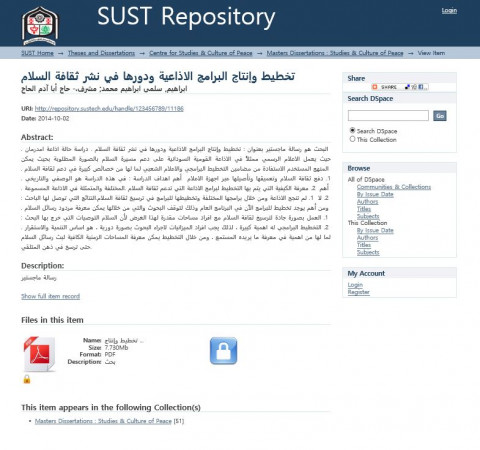 تخطيط وإنتاج البرامج الاذاعية ودورها في نشر ثقافة السلام 出版年份: 2014 作者: Ibrahim, Salma Ibrahim 机构作者: Sudan University of Science and Technology البحث هو رسالة ماجستير بعنوان : تخطيط وإنتاج البرامج الاذاعية ودورها في نشر ثقافة السلام . دراسة حالة اذاعة امدرمان . حيث يعمل الاعلام الرسمي ممثلاً في الاذاعة القومية السودانية على دعم مسيرة السلام بالصورة المطلوبة بحيث يمكن الاستفادة من مضامين التخطيط البرامجي والاعلام الشعبي لما لها من خصائص كبيرة في دعم ثقافة السلام . المنهج المستخدم في هذه الدراسة هو الوصفي والتاريخي . أهم اهداف الدراسة : 1. دفع ثقافة السلام وتعميقها وتأصيلها عبر اجهزة الاعلام المختلفة والمتمثلة في الاذاعة المسموعة . 2. معرفة الكيفية التي يتم بها التخطيط لبرامج الاذاعة التي تدعم ثقافة السلام . أهم النتائج التي توصل لها الباحث : 1. لم تنجح الاذاعة ومن خلال برامجها المختلفة وتخطيطها للبرامج في ترسيخ ثقافة السلام. 2. لا يوجد تخطيط للبرامج الآن في البرنامج العام وذلك لتوقف البحوث والتي من خلالها يمكن معرفة مردود رسائل السلام . ومن أهم التوصيات التي خرج بها البحث : 1. العمل بصورة جادة لترسيخ ثقافة السلام مع افراد مساحات مقدرة لهذا الغرض لأن السلام هو اساس التنمية والاستقرار . 2. التخطيط البرامجي له اهمية كبيرة ، لذلك يجب افراد الميزانيات لاجراء البحوث بصورة دورية ، لما لها من اهمية في معرفة ما يريده المستمع ، ومن خلال التخطيط يمكن معرفة المساحات الزمنية الكافية لبث رسائل السلام حتى ترسخ في ذهن المتلقي. Planning and Producing Radio Programs and Their Role in Spreading a Culture of Peace 出版年份: 2014 作者: Ibrahim, Salma Ibrahim 机构作者: Sudan University of Science and Technology The research is a master thesis entitled: Planning and producing radio programs and its role in spreading a culture of peace. Omdurman radio case study. Where the official media, represented by the Sudanese National Radio, works to support the peace process in the required manner so that the contents of program planning and popular media can be taken advantage of because of its great characteristics in supporting the culture of peace. The method used in this study is descriptive and historical.The most important objectives of the study: Promote, deepen and deepen the culture of peace through the various media outlets represented in the audio station. Know how to plan radio programs that support a culture of peace.The most important results that the researcher reached: The radio, through its various programs and its planning of programs, did not succeed in consolidating the culture of peace. There is no program planning now in the general program in order to stop researches, through which the outcome of peace messages can be known.Among the most important recommendations that came out of the research: Work in earnest to establish a culture of peace with individuals with appreciable spaces for this purpose, because peace is the foundation for development and stability. Program planning is of great importance. Therefore, budgets must be set up to conduct research periodically, because of its importance in knowing what the listener wants, and through planning it is possible to know enough time spaces to broadcast peace messages in order for the recipient to be entrenched in the mind of the recipient.
 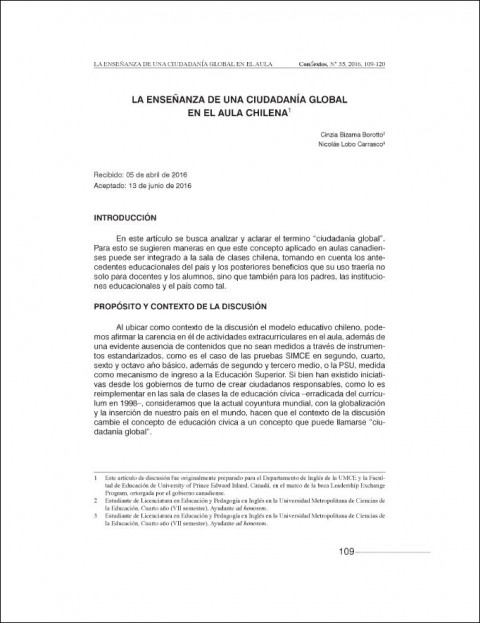 Promoting Global Citizenship in the Chilean Classrooms 出版年份: 2016 作者: Cinzia Bizama Borotto | Nicolás Lobo Carrasco This article focuses on the analysis and clarification of the term "global citizenship". For this, different ways in which this concept is applied in canadian classrooms is analysed while suggesting ways of integrating it in chilean classrooms bearing in mind the educational history of the country and the benefits this would bring not only for teachers and students, but also for families, educational institutions and the country itself. La enseñanza de una ciudadanía global en el aula chilena 出版年份: 2016 作者: Cinzia Bizama Borotto | Nicolás Lobo Carrasco En este artículo se busca analizar y aclarar el termino “ciudadanía global”. Para esto se sugieren maneras en que este concepto aplicado en aulas canadienses puede ser integrado a la sala de clases chilena, tomando en cuenta los antecedentes educacionales del país y los posteriores beneficios que su uso traería no solo para docentes y los alumnos, sino que también para los padres, las instituciones educacionales y el país como tal.