
相关资源
探索丰富的全球公民教育资源,深化理解,促进研究、倡导、教学与学习。
共找到882条结果
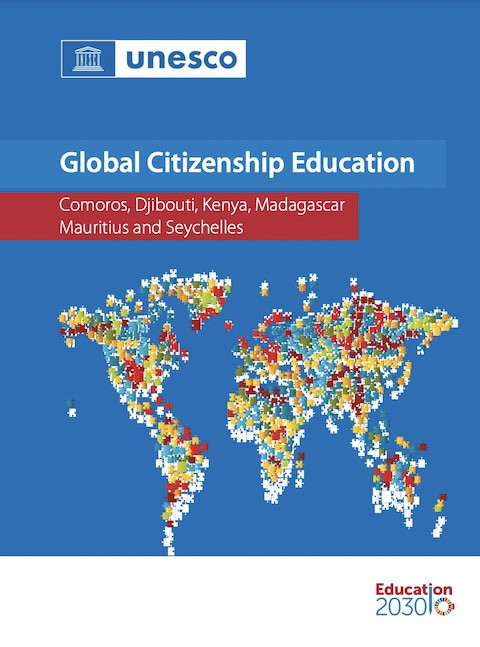 Global Citizenship Education: Comoros, Djibouti, Kenya, Madagascar, Mauritius and Seychelles 出版年份: 2022 机构作者: Organización de las Naciones Unidas para la Educación, la Ciencia y la Cultura (UNESCO) This is a collection of papers of a research project undertaken in six countries of the Eastern Africa region, namely, Comoros, Djibouti, Kenya, Madagascar, Mauritius and Seychelles to assess the Understanding and Implementation of SDG 4.7 on Global Citizenship Education (GCED) in each of the six countries.The research findings were shared by each of the six countries in a Webinar hosted by the UNESCO Nairobi Regional Office for Eastern Africa on September 23, 2021. The Webinar Agenda is contained in this publication along with the Opening and Closing Remarks made by UNESCO and Keynote Address by an affiliate UNESCO Chair in Africa.
 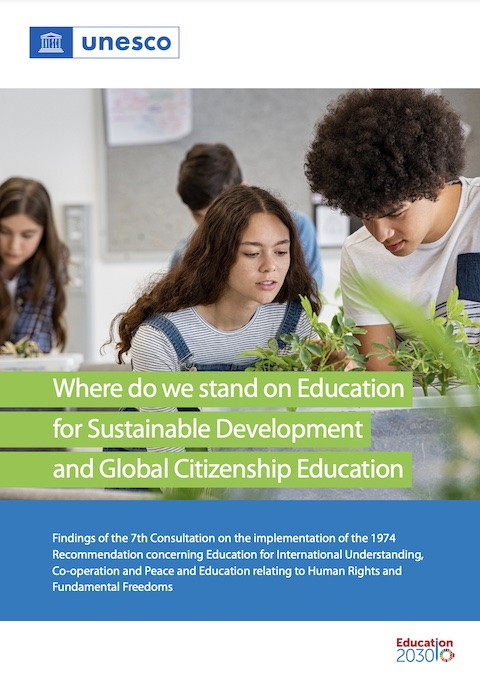 Where Do We Stand on Education for Sustainable Development and Global Citizenship Education: Findings of the 7th Consultation on the Implementation of the 1974 Recommendation Concerning Education for International Understanding, Co-operation and Peace and Education Relating to Human Rights and Fundamental Freedoms 出版年份: 2022 机构作者: UNESCO The Recommendation concerning Education for International Understanding, Co-operation and Peace and Education relating to Human Rights and Fundamental Freedoms was adopted by the 18th session of UNESCO’s General Conference in November 1974. Every four years, Member States are invited to report on the measures they have taken to implement the Recommendation in all levels and types of education from pre-primary to tertiary, formal, non-formal and adult education. This document summarizes the results of the 7th consultation on the implementation of the 1974 Recommendation, covering the period 2017-2020. It also contains, for the first time, data for the global indicator adopted by the UN Statistical Commission and the UN General Assembly for the monitoring of Target 4.7 of Sustainable Development Goal for Education.
  UNESCO Futures of Education Report Explained by Members of the International Commission 出版年份: 2022 机构作者: UNESCO Initiated by UNESCO, the International Commission on the Futures of Education has prepared a new report on how education can best shape the future of humanity and the planet. In this video, members of the Commission and its chair explain the main recommendations and defining features of their report, Reimagining our futures together: A new social contract for education. The report is part of UNESCO’s Futures of Education initiative which aims to rethink education and shape the future. The initiative is catalyzing a global debate on how knowledge, education and learning need to be reimagined in a world of increasing complexity, uncertainty, and precarity.
 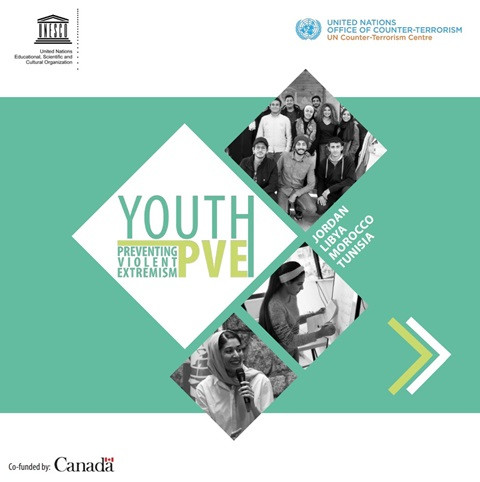 Youth PVE: Preventing Violent Extremism 出版年份: 2020 机构作者: UNESCO | UN. Office of Counter-Terrorism (UNOCT) Violent extremism threatens the security and fundamental rights of citizens all over the world, and undermines the attempts of many countries to achieve sustainable peace. Many violent extremist organizations work by recruiting disenfranchised youth and inciting them to commit acts of violence. This project focuses on meaningful youth engagement because we believe that enhancing the resilience of young people will prevent their involvement in violent extremism and instead transform them into agents of positive change. We provide a framework for action that mobilizes UNESCO at multiple levels to provide young people with opportunities, knowledge and capacities to foster dialogue and cooperation in furtherance of PVE.
  Countering Online Hate Speech 出版年份: 2015 作者: Iginio Gagliardone | Danit Gal | Thiago Alves | Gabriela Martinez 机构作者: UNESCO The present report provides a global overview of the dynamics characterizing hate speech online and some of the measures that have been adopted to counteract and mitigate it, highlighting good practices that have emerged at the local and global levels. While the study offers a comprehensive analysis of the international, regional and national normative frameworks developed to address hate speech online, and their repercussions for freedom of expression, it places particular emphasis on social and non-regulatory mechanisms that can help to counter the production, dissemination and impact of hateful messages online. Combattre les discours de haine sur internet 出版年份: 2015 作者: Iginio Gagliardone | Danit Gal | Thiago Alves | Gabriela Martinez 机构作者: UNESCO Le présent rapport offre un panorama mondial des dynamiques caractéristiques des discours de haine en ligne et des mesures prises pour les combattre et les contenir, en mettant en évidence les bonnes pratiques qui ont émergé au niveau local comme au niveau international. Si l’étude fournit une analyse exhaustive des cadres normatifs internationaux, régionaux et nationaux mis en place pour lutter contre les discours de haine en ligne et de leurs répercussions sur la liberté d’expression, elle met particulièrement l’accent sur les mécanismes sociaux et non réglementaires qui peuvent contribuer à lutter contre la production, la diffusion et l’impact des messages de haine en ligne.
  Youth and Violent Extremism on Social Media: Mapping the Research 出版年份: 2017 作者: Séraphin Alava | Divina Frau-Meigs | Ghayda Hassan 机构作者: UNESCO | Information for All Programme (IFAP) Does social media lead vulnerable individuals to resort to violence? Many people believe it does. And they respond with online censorship, surveillance and counter-speech. But what do we really know about the Internet as a cause, and what do we know about the impact of these reactions? All over the world, governments and Internet companies are making decisions on the basis of assumptions about the causes and remedies to violent attacks.The challenge is to have analysis and responses firmly grounded. The need is for a policy that is constructed on the basis of facts and evidence, and not founded on hunches – or driven by panic and fearmongering.It is in this context that UNESCO has commissioned the study titled Youth and Violent Extremism on Social Media – Mapping the Research. This work provides a global mapping of research (mainly during 2012-16) about the assumed roles played by social media in violent radicalization processes, especially when they affect youth and women. The research responds to the belief that the Internet at large is an active vector for violent radicalization that facilitates the proliferation of violent extremist ideologies.Indeed, much research shows that protagonists are indeed heavily spread throughout the Internet. There is a growing body of knowledge about how terrorists use cyberspace. Less clear, however, is the impact of this use, and even more opaque is the extent to which counter measures are helping to promote peaceful alternatives. While Internet may play a facilitating role, it is not established that there is a causative link between it and radicalization towards extremism, violent radicalization, or the commission of actual acts of extremist violence. Молодежь и насильственный экстремизм в социальных медиа: Сопоставление исследований 出版年份: 2017 作者: Séraphin Alava | Divina Frau-Meigs | Ghayda Hassan 机构作者: UNESCO | Information for All Programme (IFAP) Оказывают ли влияние социальные сети на уязвимые группы молодежи, в последствие которого они прибегают к насилию? Многие считают, что да. И они отвечают онлайн-цензурой, наблюдением и контрречью. Но что действительно мы знаем об Интернете в качестве причины развития насилия, и что мы знаем о влиянии реакций людей? Во всем мире правительства и интернет-компании принимают решения на основе предположений о причинах и средствах защиты от насильственных нападений.Задача состоит в том, чтобы анализ и ответы были прочно обоснованы. Существует необходимость в политике, которая построена на основе фактов и доказательств, а не основана на суждениях или на панике и страхе.Именно в этом контексте ЮНЕСКО поручила провести исследование под названием «Молодежь и насильственный экстремизм в социальных медиа - сопоставление исследований". Эта работа обеспечивает глобальное сопоставление (в основном в течение 2012-16 гг.) о предполагаемых ролях, которые играют социальные медиа в процессе радикализации, особенно когда они затрагивают молодежь и женщин. Исследование реагирует на убеждение, что Интернет в целом является активным вектором насильственной радикализации, что способствует распространению насильственных экстремистских идеологий.Действительно, много исследований показывает, что протагонисты достаточно широко распространены по всему Интернету. Eсть растущий объем знаний о том, как террористы используют киберпространство. Менее ясное, однако,влияние этого использования и еще более непрозрачное - это степень, в которой встречные меры помогают продвигать мирные альтернативы.
  Les femmes prennent la parole (Le Courrier de l’UNESCO no. 2, Juillet-septembre 2020) 出版年份: 2020 机构作者: UNESCO Politologues, journalistes, sociologues, chercheuses, écrivaines ou enseignantes dessinent les contours de l’après-pandémie, qu’il s’agisse de l’avenir des musées, des mutations de l’école, des dérives de l’information ou encore des enjeux de la recherche.Ce numéro trace un portrait en creux de notre époque, souligne les lignes de fracture que la crise sanitaire a mises à nu et montre l’ampleur des défis à relever. Il souligne aussi le potentiel de coopération scientifique, culturelle, éducative que cet événement inédit a révélé. Si les réflexions, le désir de changement et les mouvements d’entraide qui se sont manifestés ne restent pas sans lendemain, le monde pourrait réellement devenir plus solidaire, plus durable et plus égalitaire. A Whole New World, Reimagined by Women (The UNESCO Courier no. 2, July-September 2020) 出版年份: 2020 机构作者: UNESCO In this issue, the UNESCO Courier gives women a voice. Political scientists, journalists, sociologists, researchers, writers, and teachers have drawn the contours of the post-pandemic era – whether it is the future of museums, changes in schools, the rise of disinformation, or the challenges of scientific research.This issue paints a sobering picture of our times – highlights the fault-lines exposed by the health crisis, and shows the magnitude of the challenges ahead. It also underlines the potential for scientific, cultural and educational co-operation that this unprecedented event has revealed. If the reflections, the desire for change, and the movements of mutual aid that have emerged are not short-lived, the world really could become a more united, more sustainable and more egalitarian place.