
相关资源
探索丰富的全球公民教育资源,深化理解,促进研究、倡导、教学与学习。
共找到1,447条结果
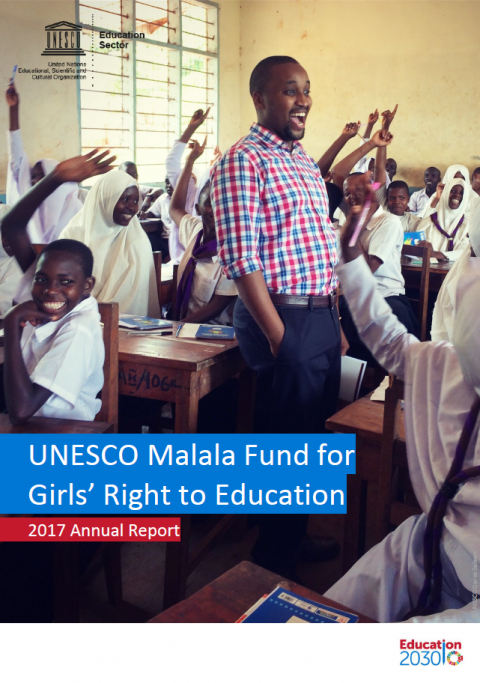 UNESCO Malala Fund for Girls' Right to Education: 2017 annual report 出版年份: 2018 机构作者: UNESCO The brutal assassination attempt made against Pakistani teenager and activist for girls’ education Malala Yousafzai gave birth to the UNESCO Malala Fund for Girls’ Right to Education. Part of the “Better Life, Better Future” Global Partnership for Girls’ and Women’s Education, the fund was established in 2012 to expand girls’ access to quality and gender-responsive education and ensure safe learning environments, especially in countries affected by conflict and disaster. The Islamic Republic of Pakistan initially committed 10 million USD to the Fund, and since 2014 the CJ Group is another major contributor to the Fund, along with other supporters.Fund objectivesThe Fund supports the implementation of holistic programmes which aim to: Expand access to education for girls and women, especially those hardest to reach and affected by conflict and disaster Improve the quality and relevance of education, ensuring that content, teaching practices, learning processes and environments are gender-sensitive Strengthen policy and capacity to ensure safe learning environments
  Education for Sustainable Development: Partners in Action; Global Action Programme (GAP) Key Partners' Report (2015-2018) 出版年份: 2019 机构作者: UNESCO The Global Action Programme (GAP) on Education for Sustainable Development (ESD) was launched by UNESCO as a follow up to the United Nations Decade of ESD in order to accelerate progress on sustainable development and scale up action in all areas of education and learning. Its duration is from 2015 to 2019.To that end, UNESCO works with a network of 97 GAP Key Partners from government, civil society, the private sector and academia active in five Priority Action Areas: advancing policy, transforming learning environments, building the capacity of educators, empowering youth, and accelerating sustainable solutions at the local level. Each GAP Key Partner committed to meet specific targets by 2019. To measure progress in meeting the targets set by the GAP Key Partners, 10 indicators were identified, two in each Priority Action Area. Through surveys sent to them by UNESCO, GAP Key Partners report against these 10 indicators and toward the targets set for each indicator. In the surveys, GAP Key Partners are also invited to rate the benefits of participation in the GAP for their work and provide qualitative data concerning their implementation progress. Three progress reports are scheduled to be produced: The first report, covering progress between 2015 and 2016, was released by UNESCO in 2017 This second report, covering 2015-2018, is to be published in 2019 The third and final report, covering the entire period of the GAP, 2015-2019, will be published in 2020 This second report presents the results of the GAP Key Partners survey carried out at the end of 2018, with a response rate of 78%. The report presents the analysis of the quantitative responses of GAP Key Partners to each of the 10 indicators. Based on the qualitative responses provided by the GAP Key Partners, a short comment on each of the progress status is also provided. Éducation en vue du développement durable: Partenaires dans l’action; Rapport des partenaires clés du Programme d’action global (2015-2019) 出版年份: 2019 机构作者: Organisation des Nations Unies pour l'éducation, la science et la culture (UNESCO) Le Programme d’action global pour l’éducation en vue du développement durable (EDD) a été lancé par l’UNESCO dans le cadre du suivi de la Décennie des Nations Unies pour l’éducation au service du développement durable afin de donner un coup d’accélérateur à la réalisation des objectifs de développement durable et d’intensifier l’action en faveur de l’EDD dans tous les domaines de l’éducation et de l’apprentissage. Le Programme a été mis en œuvre entre 2015 et 2019. L’UNESCO a travaillé avec un réseau constitué des 97 partenaires clés du Programme d’action global. Issus des gouvernements, de la société civile, du secteur privé et de l’université, ces partenaires interviennent dans cinq domaines d’action prioritaires : promouvoir des politiques, transformer les environnements d’apprentissage, renforcer les capacités des éducateurs, autonomiser les jeunes et accélérer la recherche de solutions durables à l’échelle locale. Les partenaires clés du Programme d’action global se sont engagés à atteindre des objectifs précis en 2019. Dix indicateurs, soit deux par domaine d’action prioritaire, ont été définis.Les partenaires clés du Programme d’action global ont rendu compte des progrès accomplis au regard de ces indicateurs à l’aide des trois enquêtes que l’UNESCO leur a envoyées au cours de la mise en œuvre du Programme.Les partenaires clés ont par ailleurs été invités à évaluer en quoi leur participation au Programme d’action global avait été bénéfique à leurs activités et à fournir des données qualitatives sur le déroulement de la mise en œuvre. Trois rapports d’étape ont ainsi été produits : le premier rapport, relatif aux progrès accomplis en 2015 et 2016, a été publié par l’UNESCO en 2017 ; le second, qui concerne la période de 2015 à 2018, est paru en 2019 ; le troisième et dernier rapport (le présent document) couvre l’ensemble de la période de mise en œuvre du Programme d’action global, de 2015 à 2019. Le présent rapport livre une analyse des données quantitatives fournies par les partenaires clés du Programme d’action global pour chacun des dix indicateurs. En s’appuyant sur ces données quantitatives, il indique brièvement quels ont été les progrès réalisés par rapport aux indicateurs. On trouvera en conclusion de ce bref rapport quelques-uns des enseignements tirés du Programme d’action global qui pourront utilement guider la mise en œuvre du nouveau cadre global établi pour la période 2020-2030, L’éducation en vue du développement durable : vers la réalisation des ODD (L’EDD pour 2030).
  Proposal for a Global Action Programme on Education for Sustainable Development as Follow-up to the United Nations Decade of Education for Sustainable Development (DESD) after 2014 出版年份: 2013 机构作者: UNESCO The present document contains the proposal for a Global Action Programme on Education for Sustainable Development (ESD) and the comments and observations of the Executive Board thereon.
  برنامج الملك عبد الله بن عبد العزيز الدولي لثقافة السلام والحوار: أهم منجَزات المرحلة الأولى 出版年份: 2016 机构作者: منظمة الأمم المتحدة للتربية والعلم والثقافة (UNESCO) انبثق برنامج الملك عبد الله بن عبد العزيز الدولي لثقافة السلام والحوار من الإطار المؤسسي لبرنامج اليونسكو لثقافة السلام واللاعنف.إن ثقافة السلام لا تقتصر على كونها مفهوماً بل تتعداه إلى كونها التزاماً بجعل السلام واقعاً ملموساً للجميع. فهي تعبِّ عن “مجموعة من القيم والمواقف والتقاليدوأنماط السلوك وأساليب الحياة تستند إلى [...] احترام الحياة وإنهاء العنف [... و] التمسك بمبادئ الحرية والعدل والديمقراطية والتسامح والتضامنوالتعاون والتعددية والتنوع الثقافي والحوار والتفاهم على مستويات المجتمع كافة وفيما بين الأمم” (المادة 1 من إعلان وبرنامج العمل بشأن ثقافة السلام،اليونسكو، 1999 ). وتثابر اليونسكو على العمل لغرس ثقافة السلام مع مراعاة اعتبارات التنمية، بمضافرة القوى مع أصحاب المصلحة الملتزمين فيمجال التربية والعلوم والثقافة، والاتصال والإعلام.
  Promouvoir l’education a la citoyennete mondiale en afrique de l’ouest : Atelier international de renforcement de capacités des pays de la CEDEAO 07 – 09 Juillet 2015, Dakar, Sénégal 出版年份: 2015 机构作者: Organisation des Nations Unies pour l'éducation, la science et la culture (UNESCO) Ce rapport est le fruitde l’atelier international de renforcement de capacités organisé par l’UNESCO dans l’objectif de renforcer les capacités des pays membres de la Communauté économique des États de l'Afrique de l'Ouest (CEDEAO) pour la promotion de l’Education à la citoyenneté mondiale aux niveaux nationaux et régionaux. Autonomiser des citoyens du mon de actifs et construire un sens d’appartenance à une humanité commune ne font pas uniquement partie du mandat de l’UNESCO mais sont aussi des problèmes prioritaires pour l’Afrique de l’Ouest. Ce rapport d’atelier fournit des ressources, stratégies et feuilles de routes pour l’avancée et une meilleure intégration de l’ECM dans les politiques et les programmes éducatifs en Afrique de l’Ouest. Les feuilles de route ont été proposées par les Etats membres eux-mêmes et leur mise en œuvre dépendra de la disponibilité des ressources et des partenariats potentiels.
 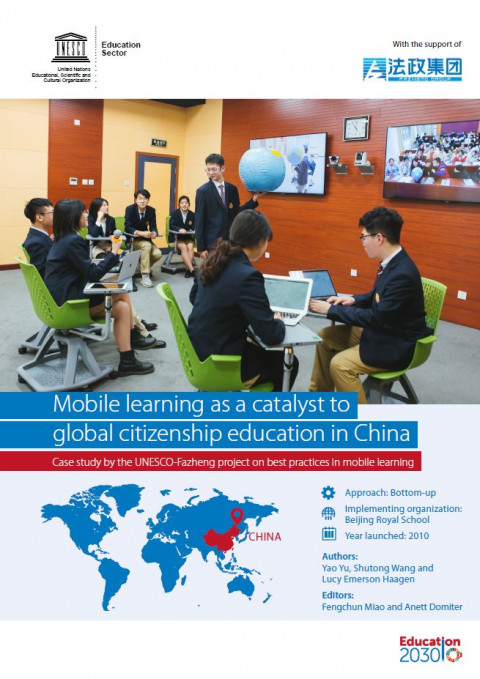 Mobile Learning as a Catalyst to Global Citizenship Education in China: Case Study by the UNESCO-Fazheng Project on Best Practices in Mobile Learning 出版年份: 2019 作者: Yao Yu | Shutong Wang | Lucy Emerson Haagen 机构作者: UNESCO The Beijing Royal School was one of the pioneer schools in China in incorporating mobile learning into pedagogical transformation. Its mobile learning programme started in 2010. Stemming from the school’s orientation towards global citizenship education, the Beijing Royal School recognizes mobile learning as both driver and enabler for supporting the development of students’ cognitive, socio-emotionaland behavioural dimensions, organized around knowledge acquisition, understanding and respect for difference and diversity, and responsible engagement with global issues. It takes advantage of a variety of mobile apps to support students’ multilingual education, and uses open educational resources (OER) to support multicultural education, taking advantage of the up-to-date worldwide data and information available on the web. It also engages with students from other countries in projects and courses that help the students to widen their understanding of diverse cultures and social contexts. Overall, this case study illustrates how to use mobile technologies to support the implementation of a well-defined and clearly structured educational vision by embedding the use of mobile technologies in students’ daily learning lives.
  UNESCO's Contribution to the Prevention of Violant Extremism 出版年份: 2016 机构作者: UNESCO This document provides a summary of recent efforts by UNESCO to step up its action to prevent violent extremism, in the context of the United Nations Secretary-General’s Plan of Action on Violent Extremism, launched in January 2016. Building on its mandate and existing activities, UNESCO has adopted an intersectoral approach, paying particular attention to the needs of young people particularly at risk of radicalization.
 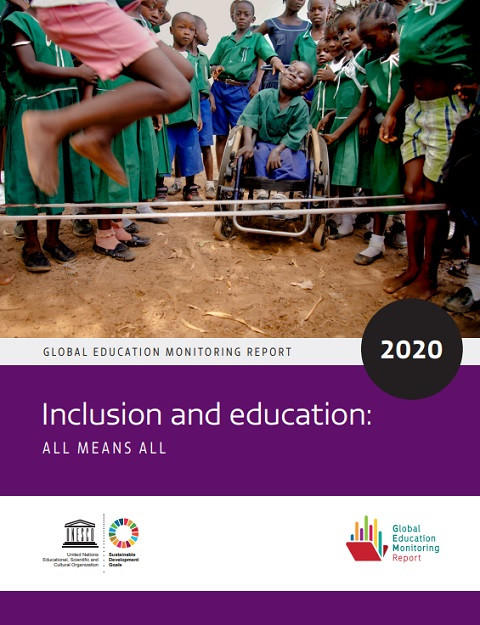 Informe de seguimiento de la educación en el mundo 2020: Inclusión y educación: Todos y todas sin excepción 出版年份: 2020 机构作者: Global Education Monitoring Report Team | Organización de las Naciones Unidas para la Educación, la Ciencia y la Cultura (UNESCO) En el Informe de Seguimiento de la Educación en el Mundo 2020 se examinan los mecanismos sociales, económicos y culturales que discriminan a niños, jóvenes y adultos desprotegidos, manteniéndolos excluidos de la educación o marginados dentro de ella. Estimulados por su compromiso de hacer realidad el derecho a la educación inclusiva, los países están ampliando su visión de la inclusión en la educación y otorgando a la diversidad un lugar central en sus sistemas. Sin embargo, la aplicación de leyes y políticas bienintencionadas suele flaquear. El informe, publicado a principios del decenio de acción que culmina en 2030 y en el contexto de la crisis de Covid-19 que ha exacerbado las desigualdades subyacentes, sostiene que la resistencia a atender las necesidades de todos los educandos es una verdadera amenaza para el logro de los objetivos mundiales de educación.En Inclusión y educación: todos y todas sin excepción se definen prácticas en materia de gobernanza y finanzas; planes de estudios, manuales escolares y evaluaciones; formación de los docentes; infraestructura escolar; y relaciones con los alumnos, los padres y las comunidades que pueden desbloquear el proceso hacia la inclusión. Se formulan recomendaciones de política para que la diversidad de los educandos sea una fuerza que se valora, una fuerza de cohesión social.Dos nuevos sitios web complementan la cuarta edición del Informe de Seguimiento de la Educación en el Mundo. Education Profiles (Perfiles educativos) describe la manera en que los países abordan la inclusión, y constituye un medio útil para el diálogo sobre políticas. Education Progress (El Progreso de la educación) brinda la oportunidad de interactuar con los datos y explorar una serie de indicadores del ODS 4.
  Holocaust Education in a Global Context: Report 出版年份: 2013 机构作者: UNESCO Teaching and learning about the Holocaust, which until this point had largely been a matter of regional interest, for Europeans, as well as North Americans and Israelis, became officially an issue of universal concern. Other countries are now invited to teach about the Holocaust even if they do not have a direct link to the event. This raises many issues concerning the pedagogical implications of this global perspective on Holocaust education. Why and how is the Holocaust taught in countries that have no connections with the genocide and the history of the Jewish people? How does this history connect and resonate with the preoccupations of these countries? Generally speaking, what could be the purposes and the benefits of teaching about the Holocaust globally?In order to address these issues, UNESCO organized an experts-meeting on 27 April 2012, in partnership with the Topography of Terror Foundation (Berlin, Germany). The purpose was specifically to clarify the following questions: What are the current trends of Holocaust education worldwide? How can the Holocaust be studied in a comparative fashion in the classroom? In which ways does Holocaust education contribute to the prevention of genocide? Furthermore, how is it taught in a human rights education perspective? Can the Holocaust provide a suitable framework to address other traumatic events of the past?